What You Need to Check for Mold in Your Home
You don't need a lab or a special license to look for mold in your own house. Minnesota's health department puts it plainly: "The most practical way to find a mold problem is to simply use your eyes and nose to find signs of excess moisture and mold growth."
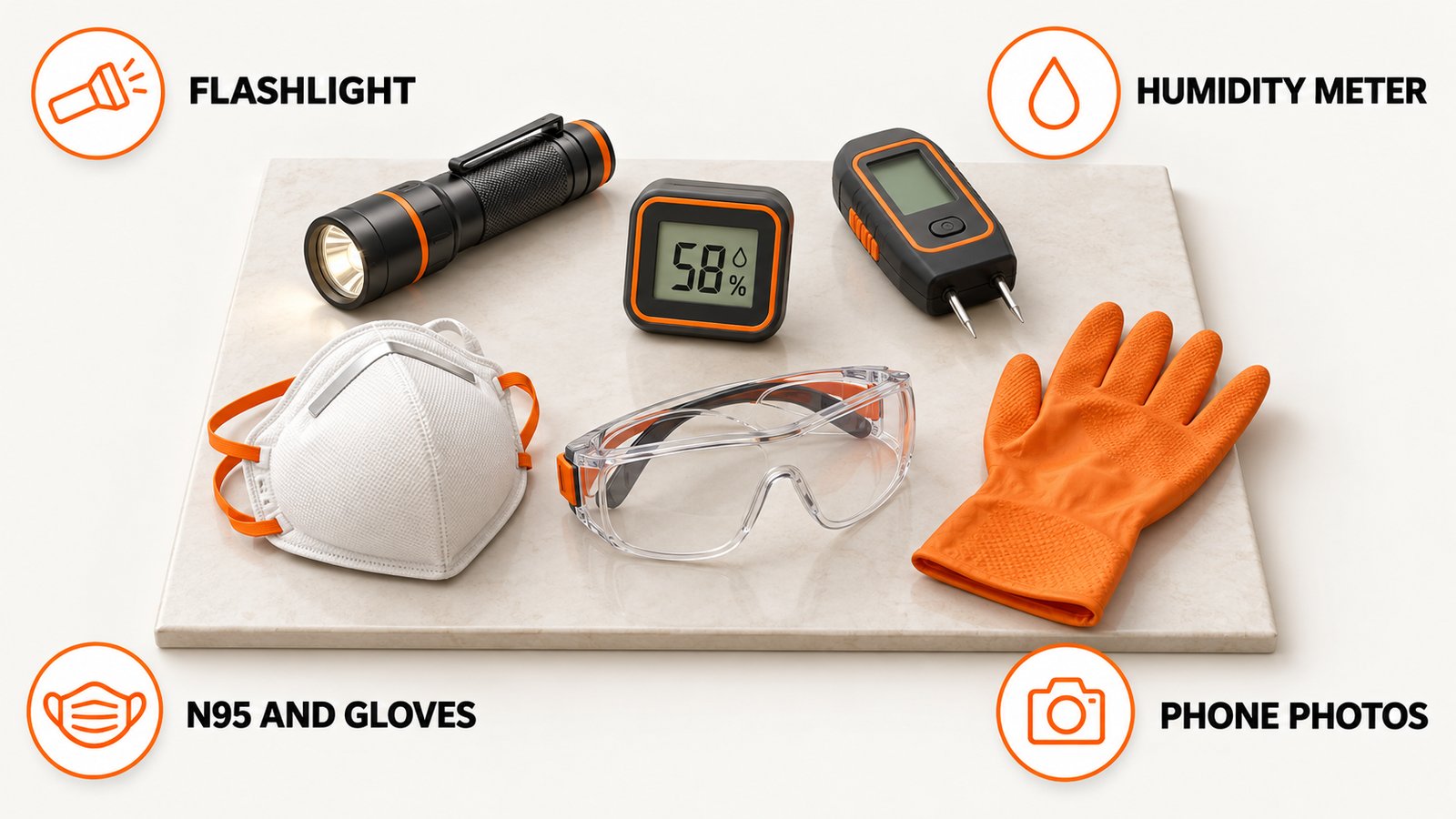
Gather a few things first:
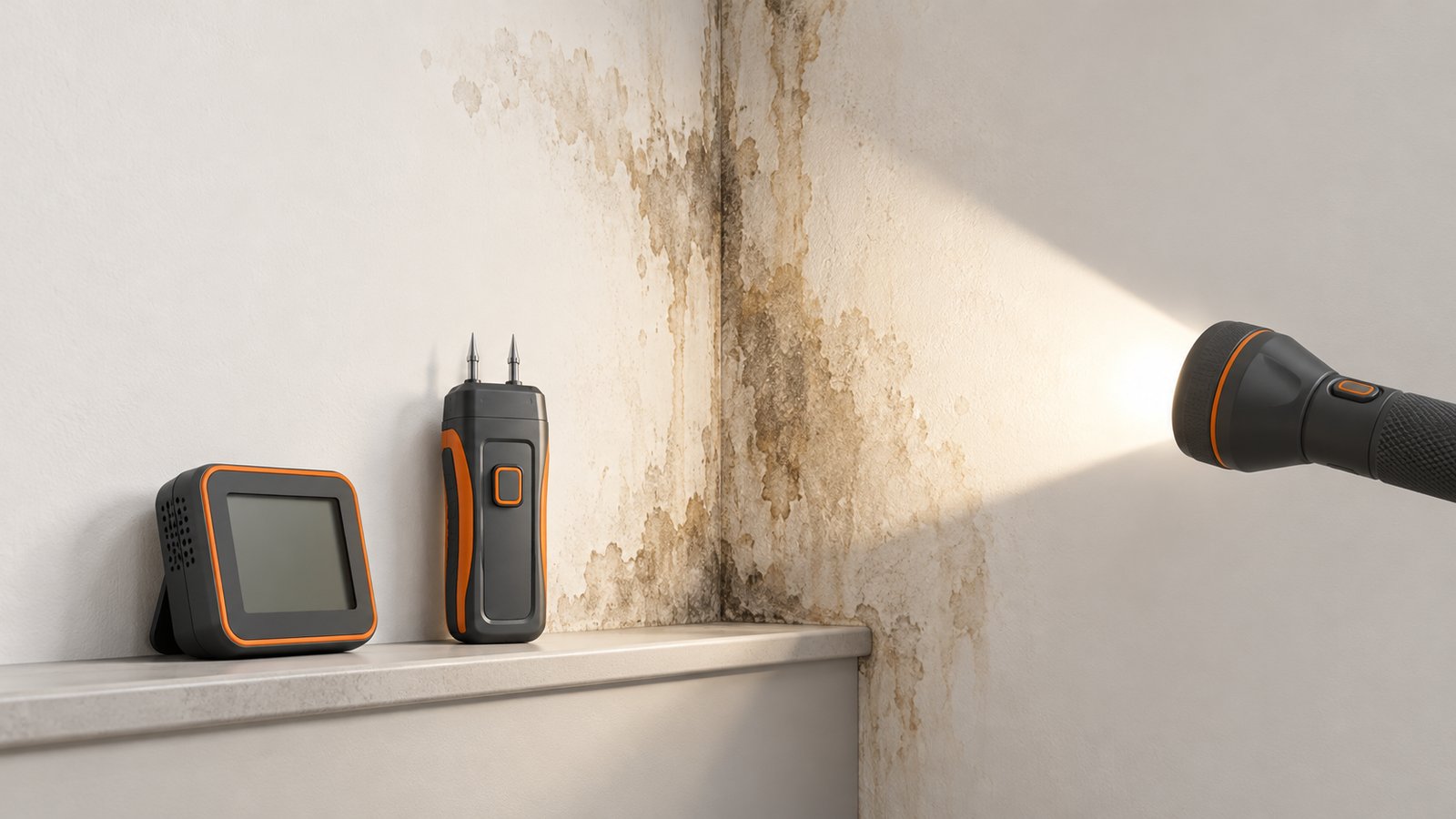
- A bright flashlight. Hold it at a low angle against walls and ceilings. Light that skims the surface shows bumps, stains and fuzzy texture that a flat overhead light hides.
- Your phone. Take a dated photo of every spot, so you can see next week whether it grew.
- A humidity meter. The EPA describes it as "a small, inexpensive ($10-$50) instrument available at many hardware stores." It reads the air, not the wall.
- A moisture meter, if you have one. It reads dampness inside a material. We cover what it can and can't tell you in its own section below, and our moisture meter guide compares models.
- Protective gear. The EPA suggests an N-95 respirator ("They cost about $12 to $25"), long gloves, and goggles without ventilation holes. Wear them if you'll move wet carpet or stored boxes.
One ground rule: look, don't scrub. Cleaning a spot before you've checked it can hide the evidence. After a flood or a burst pipe, start with our post-flood mold risk checklist instead. Otherwise, work in the order below and write down every finding.
How to Check for Mold in the Bathroom and Kitchen

New York State's health department lists the spots that are "always susceptible to mold growth": shower stalls, bathroom tiles and shower curtains, window moldings, the seal on the refrigerator door, and the surfaces on and around air conditioners. Start there.
Bathroom. Shine the flashlight along caulk lines, grout, the bottom edge of the shower curtain and the ceiling above the shower. Look for caulk that stays dark after you wipe it. Check the ceiling near the exhaust fan for stains. Hold a tissue to the fan grille while it runs. If it doesn't pull in, the fan isn't clearing steam. The EPA's advice for a bathroom that keeps growing mold is that "increasing ventilation (running a fan or opening a window) and cleaning more frequently will usually prevent mold from recurring." More in mold in the bathroom.
Under the sink. Open the cabinet, empty it, and look at the back wall and floor with the flashlight. Check the hoses and drain connections for drips or white crusty residue. See mold under the kitchen sink for what to do with what you find.
Kitchen appliances. Pull back the fridge door seal and look in the folds. Check the dishwasher gasket and the floor around it for soft spots. See mold in the fridge and mold in the dishwasher.
Windows and air conditioners. Look at the window sill and the track under each window for dark spots and water pooling. The EPA says "Condensation can be a sign of high humidity." For a window air conditioner, pull the front cover and check the drip pan and coils for dark growth. The EPA's advice is to "keep air conditioning drip pans clean and the drain lines unobstructed and flowing properly." See mold in a window air conditioner.
Signs of Mold in the Basement
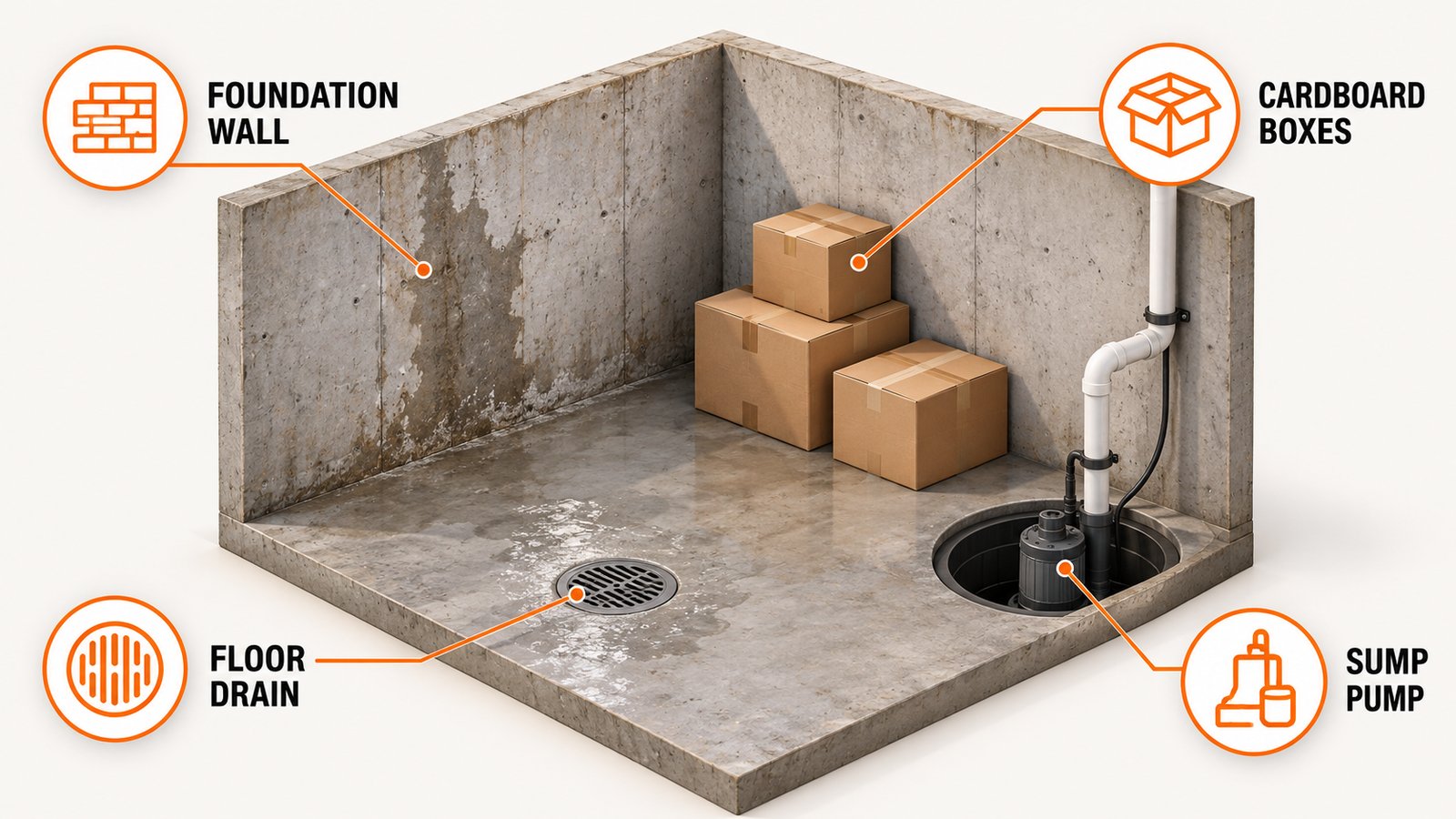
Basements are damp more often than any other part of a house, so give them a slow walk. Minnesota's health department lists "flooding in basement" and "pooling water at foundation" among the common places mold and water show up. Here is what to check.
- The bottom of the foundation walls. Look for white chalky film, dark stains, and paint that bubbles or peels.
- Stored items. The CDC says mold grows on "paper, cardboard, ceiling tiles, and wood." Look inside the bottom row of boxes and behind furniture pushed against an outside wall. The EPA lists "the surface of walls behind furniture (where condensation forms)" as a place hidden mold turns up.
- Floor drains and the sump pit. Look for standing water, a slime ring, and a sewer or musty smell. Make sure the sump pump runs.
- Pipes. Look for drips, wet insulation and rust. The EPA notes that "Rust is an indicator that condensation occurs on this drainpipe."
- Outside, at the foundation. Walk the outside wall after rain and look for puddles. The EPA says the ground should slope away from the building.
Check the humidity while you're down there. The EPA says to keep indoor humidity "below 60 percent (ideally between 30 and 50 percent)," and the CDC says "no higher than 50%." If yours reads higher, see our dehumidifier guide. For more on this space, see mold in the basement and mold in a crawl space.
Signs of Mold on the Ceiling
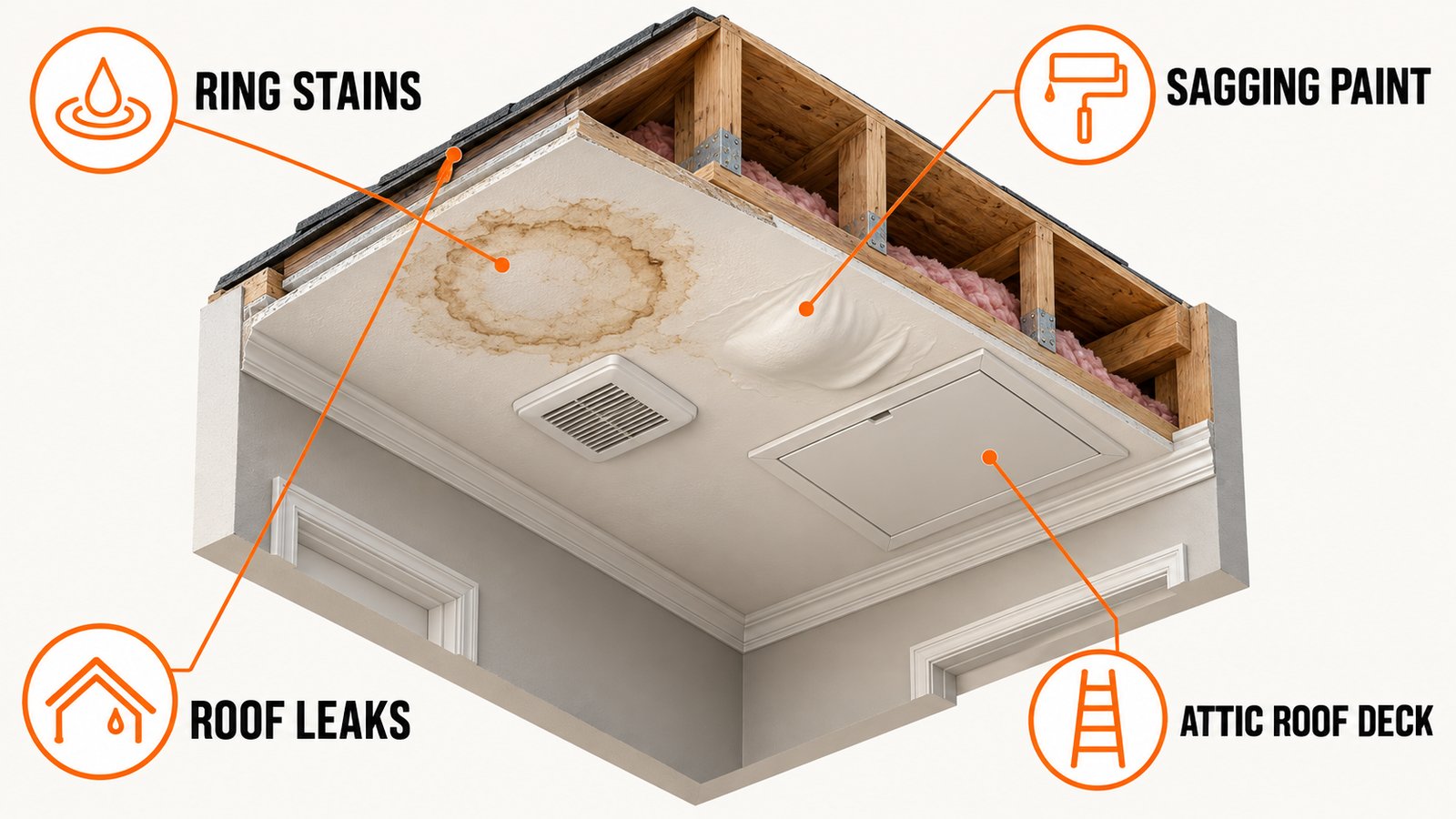
Look up. Walk each room with the flashlight pointed along the ceiling and watch for brown or yellow rings, dark spots, bubbles in the paint and any sag. Minnesota's health department says "Mold damage may look like discoloration or staining on the surface of building materials or furnishings."
Ask where the water could come from. Rooms under the roof, under a bathroom, or under a laundry room are the usual suspects. Minnesota's list of common sources includes "leaking roofs and ice dams" and "leaking pipes."
Then look in the attic if you can reach it safely. Stay on the joists. Use the flashlight to check the underside of the roof deck for dark staining, the insulation for damp or flattened patches, and the area around bathroom fan ducts for wet insulation. The EPA lists "roof materials above ceiling tiles (due to roof leaks or insufficient insulation)" among places hidden mold can sit. See mold in the attic for more.
Don't poke a sagging ceiling or scrape a stain open. If the ceiling is bulging with water, keep clear and get the leak fixed. Our mold on ceiling page and bathroom ceiling mold page cover what to do next.
How to Check for Mold Under Carpet
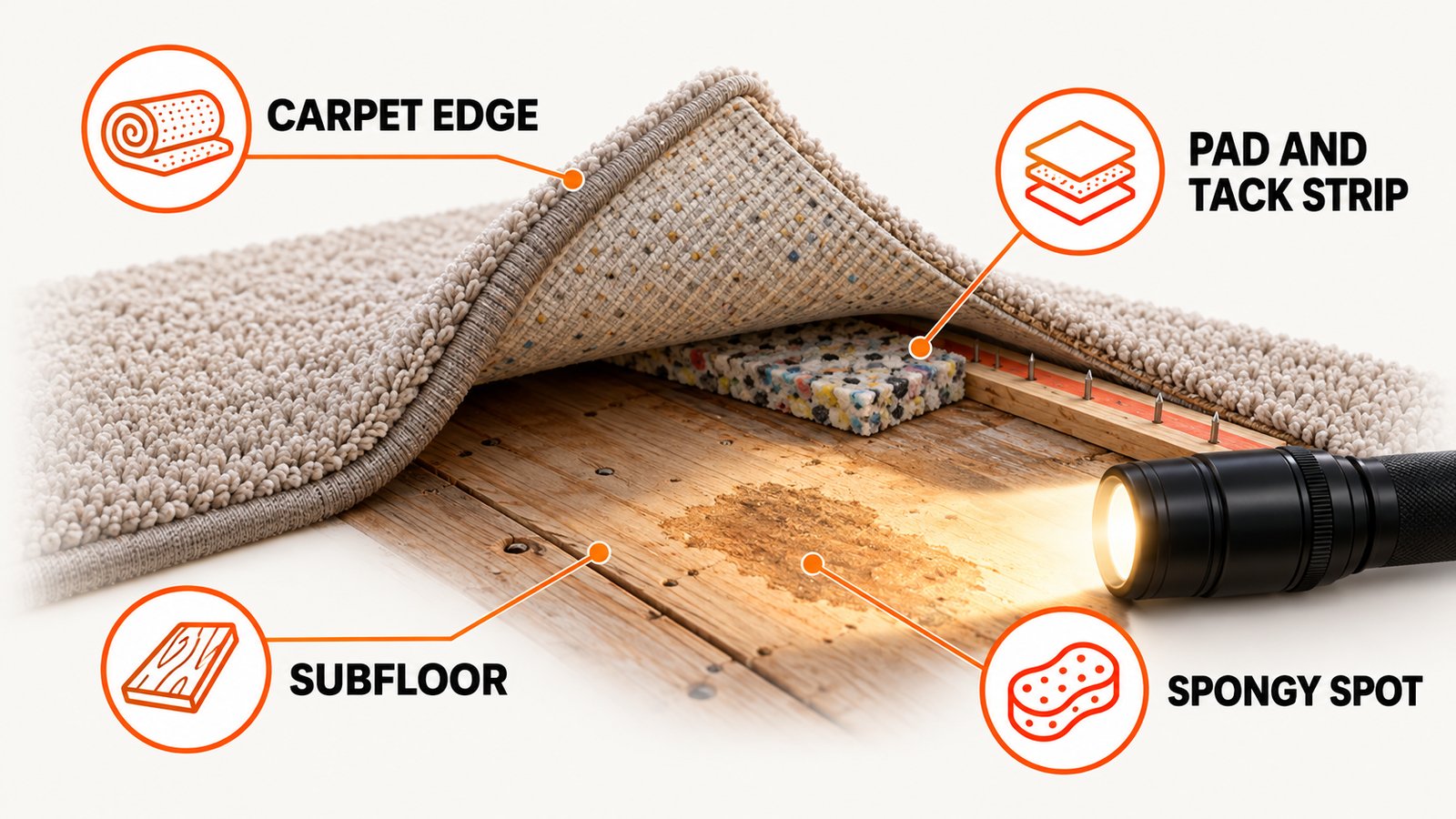
Carpet hides moisture well. Minnesota's health department tells people to search "behind and underneath furnishings, stored items, and building materials (For example, under carpet and pad, wallpaper, vinyl flooring, sink cabinets, or dry wall)." The EPA lists "the underside of carpets and pads" as a hidden-mold location. Here is a careful way to look without tearing up a room.
- Walk the room first. Spongy or damp spots mean something is wrong underneath. Mark them with painter's tape.
- Smell the corners. Kneel and smell where the carpet meets the wall.
- Lift a corner. Put on your N95, gloves and goggles. In a closet or at a doorway, where a loose edge is easy to fold back, peel the carpet from the tack strip just enough to see the pad and the floor. Use a flashlight.
- Look at the underside. Check for dark or fuzzy spots on the backing or pad, water stains on the subfloor, and a pad that feels damp or crumbles.
- Stop if you find growth. Put the corner back, take a photo, and measure the area by eye. A patch bigger than about 10 square feet is a hire-a-pro size.
The EPA says "Absorbent or porous materials, such as ceiling tiles and carpet, may have to be thrown away if they become moldy," because the mold "can grow on or fill in the empty spaces and crevices of porous materials." The EPA's drying window is 24 to 48 hours: "If wet or damp materials or areas are dried 24-48 hours after a leak or spill happens, in most cases mold will not grow."
Our mold in carpet and mold on carpet pages go through cleaning versus replacing.
How to Check for Mold Behind Walls
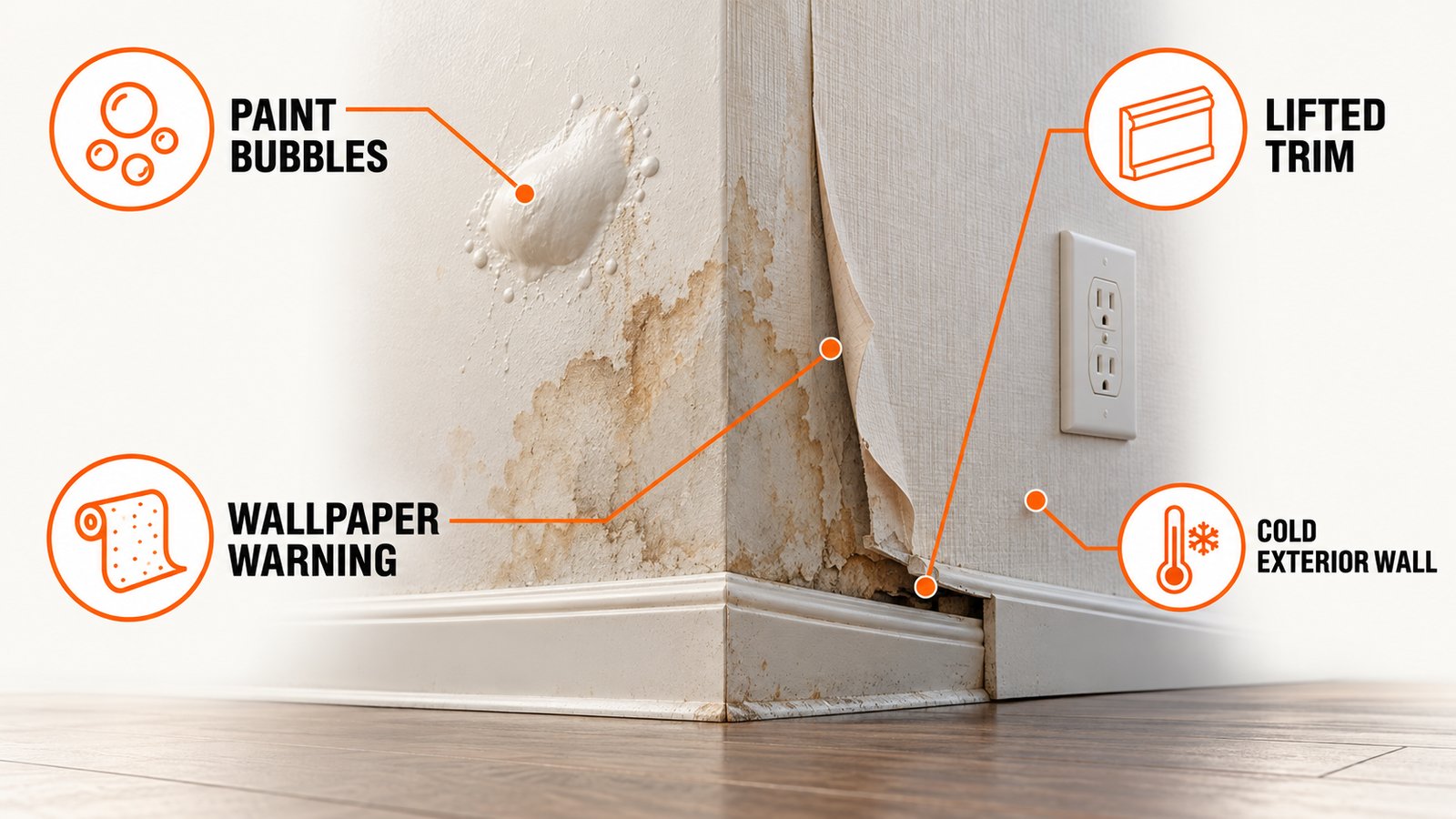
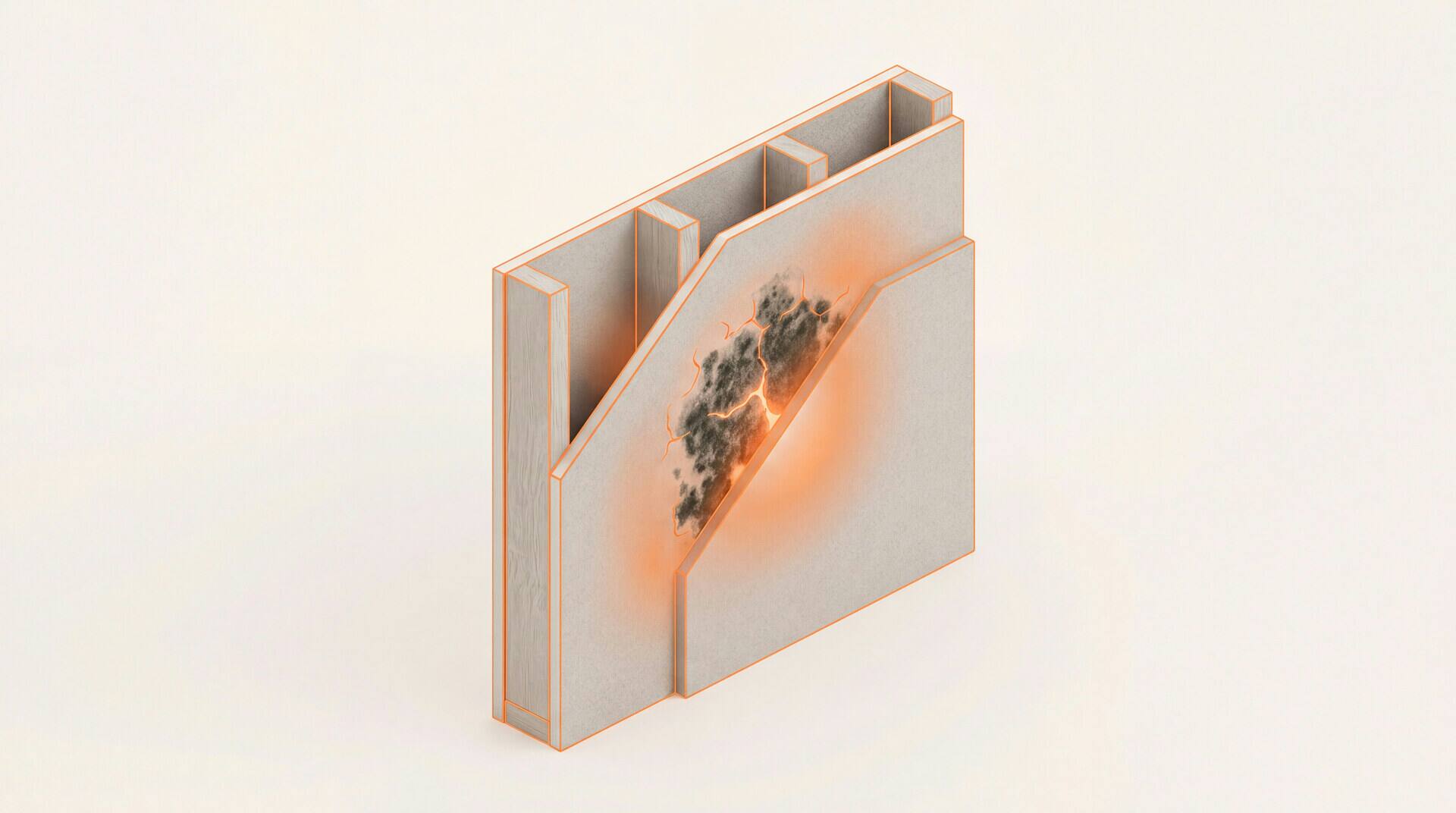
A wall is closed, so the check is indirect. Look for the surface clues that tell you moisture is getting in or building up. The EPA says you may suspect hidden mold "if a building smells moldy, but you cannot see the source, or if you know there has been water damage." It also says that "Mold may be hidden in places such as the back side of dry wall, wallpaper, or paneling, the top side of ceiling tiles, the underside of carpets and pads, etc."
On each wall, check for these:
- Paint that bubbles, flakes or peels in one patch.
- Stains that are brown, yellow or gray, especially with a ring or a drip pattern running down.
- Baseboards or trim that have lifted, swelled or darkened at the bottom.
- Walls that feel soft under your thumb or look wavy under the flashlight.
- Outside walls that feel cold and show condensation in winter. The EPA lists "areas inside walls around pipes (with leaking or condensing pipes)" as a place for hidden mold, and "the surface of walls behind furniture (where condensation forms)."
Check the wall behind a bathroom, kitchen sink or washing machine, where supply and drain lines run, and around windows after heavy rain.
One firm rule: do not cut or drill into a wall to look. Don't tear off wallpaper either. The EPA warns that "removal of wallpaper can lead to a massive release of spores if there is mold growing on the underside of the paper." For a hidden problem, the EPA says to "consider hiring an experienced professional." Our mold behind walls guide covers the clues and the limits in more detail, and mold on drywall covers the surface you can see.
What Does Mold in Your House Smell Like
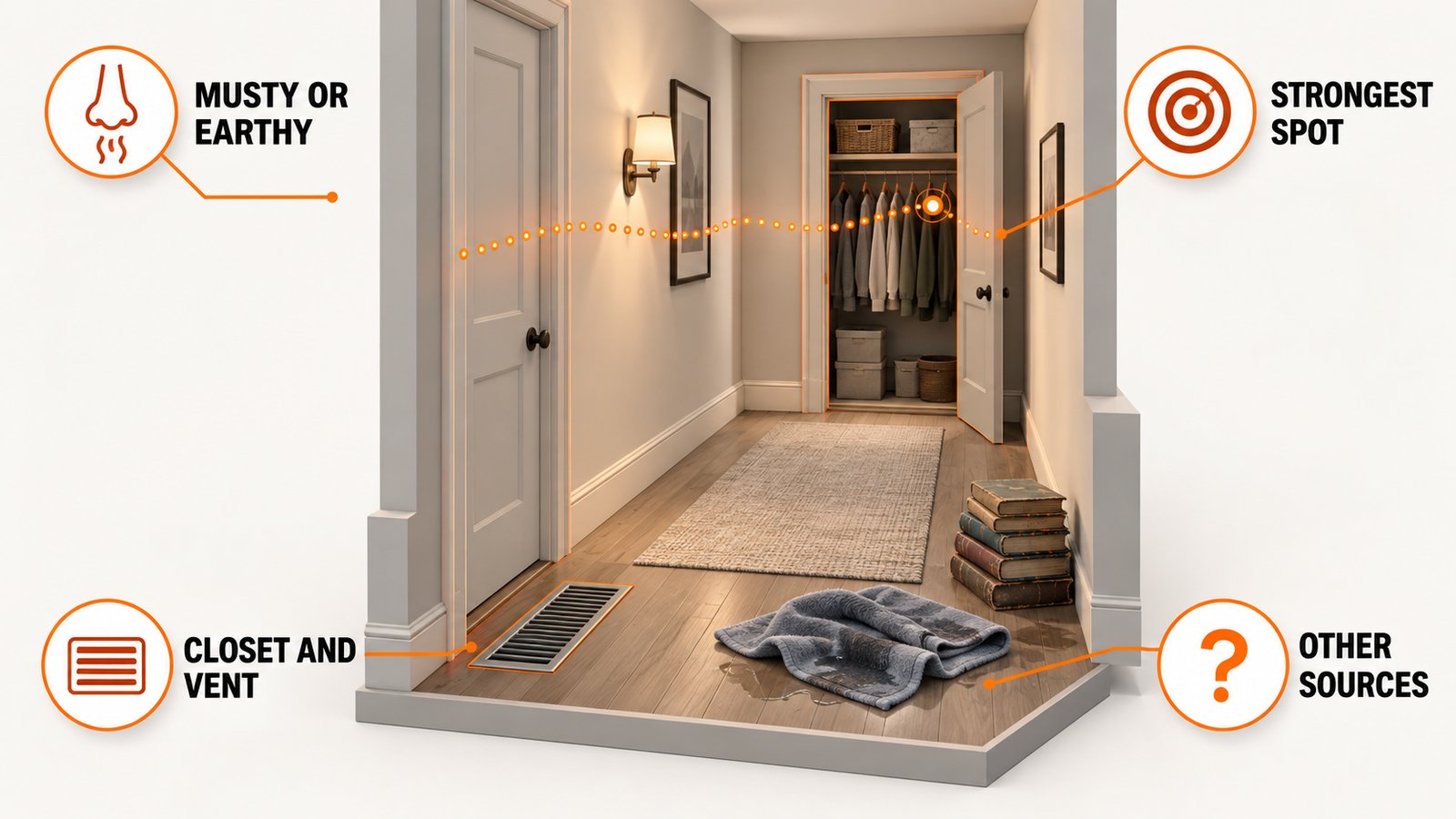
Most people describe it as musty, earthy, like a damp basement or wet cardboard. Minnesota's health department says "Noticeable mold odors are described as musty or earthly," and New York State says "Most molds produce musty odors that are the first indication of a problem."
Use your nose like a tool. Walk through the house and notice where the smell is stronger. Get close: down by the baseboard, inside closets, at the back of cabinets, and near floor vents.
A smell alone doesn't prove mold. Wet towels, a drain, an old cooler, pet bedding, soil from a houseplant and a damp book can all smell musty. Our mold smell in house page covers the other sources. What a smell does is point you to a place to investigate.
If the smell is strongest when the heat or air conditioning runs, the EPA says "Do not run the HVAC system if you know or suspect that it is contaminated with mold - it could spread mold throughout the building." Look at the return vents and the air handler cabinet for dark growth or standing water, and read our mold in air ducts guide.
One more note on the air. People ask whether they should check for mold in the air with a kit. The CDC says "CDC does not recommend mold testing," and our how to test for mold page explains why a visual check comes first.
Moisture Meter to Check for Mold
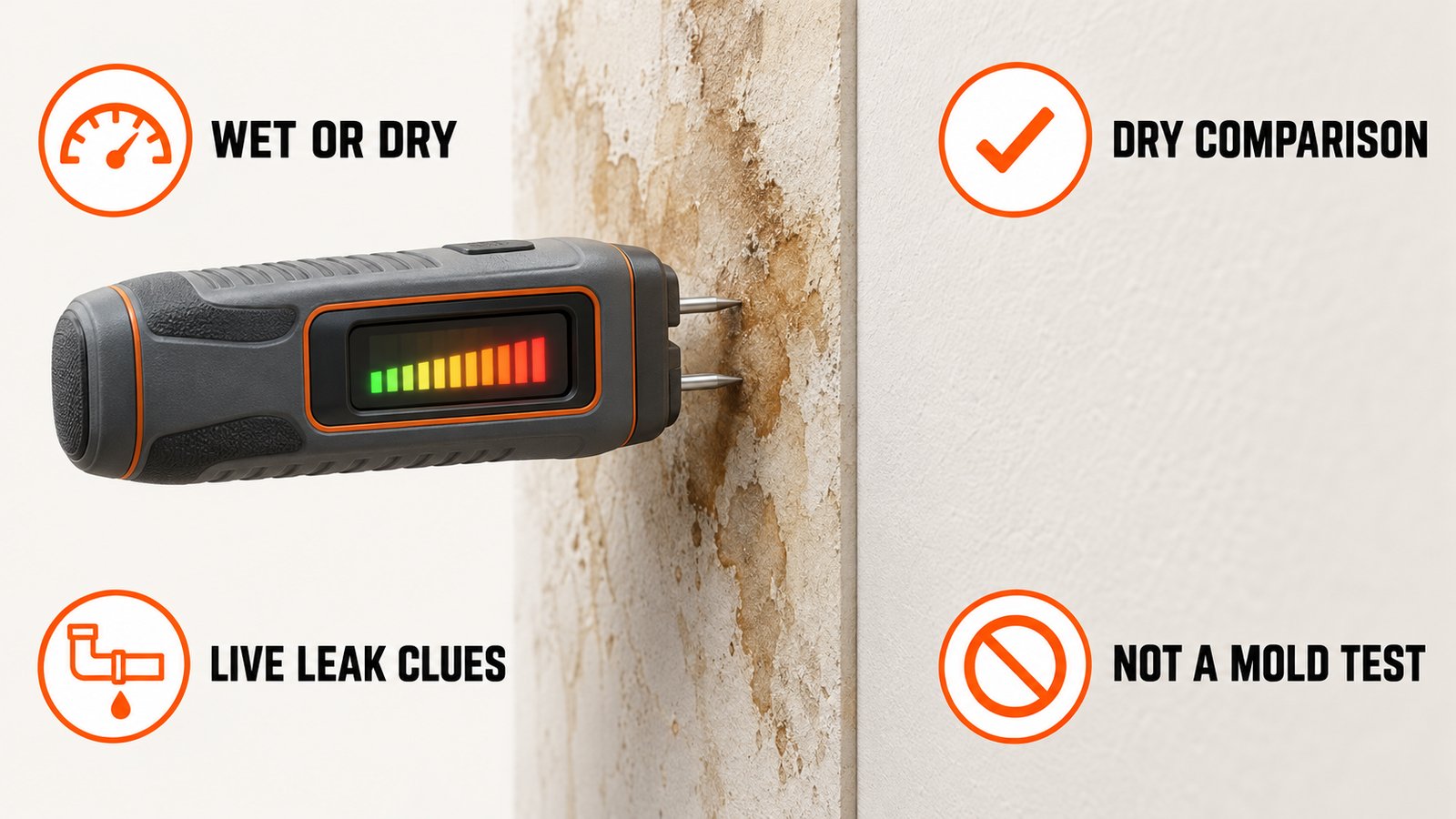
A moisture meter tells you how wet a material is. It doesn't tell you whether mold is growing. Mold needs moisture, and the EPA says "none of them will grow without water or moisture," so finding out where a wall or floor is wet is the right question.
Here is how to use one well:
- Read a dry spot first. Find a part of the same wall or floor, made of the same material, that you know is dry. That number is your comparison. Meter scales differ by model and by material, so follow your meter's manual instead of a number from a website.
- Then read the suspect spot. A reading that is clearly higher than the dry spot points to extra moisture. Read several spots around a stain to see how far it reaches.
- Check again later. A spot that reads high on three different days is probably a live leak or a condensation problem. A spot that reads dry is likely an old stain.
- Write it all down. Photo, date, room, material and reading.
The limits matter. A meter only reads the spot you touch, and different materials read differently. Our mold behind walls page puts it plainly: a moisture meter reading can support a moisture investigation, but it can't confirm mold or locate a hidden source by itself. Minnesota's health department adds that professionals "may have tools such as moisture meters, scoping cameras and infrared cameras that may be useful in an investigation," and that "Testing should never be a substitute for a good visual inspection."
If you want to buy one, our best moisture meter for mold page compares them.
How to Tell if Mold Is Black Mold
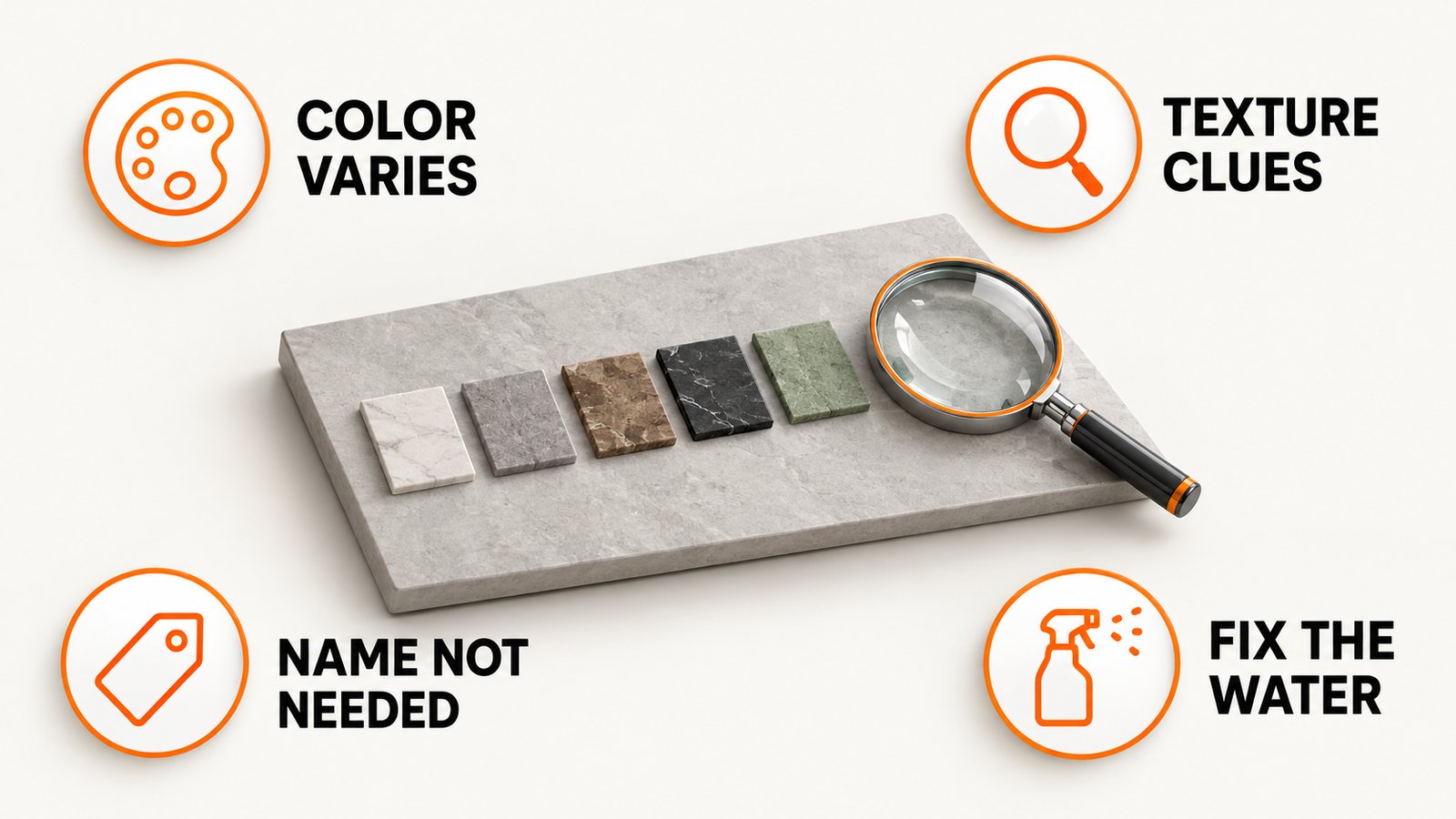
People search this one a lot, so here is the honest answer: you can't tell by looking. Minnesota's health department says the color of mold "can vary from white, gray, brown, black, green or other colors," and that mold "can have a cottony, velvety, granular or leathery texture." The CDC says mold "can look like spots of many different colors." A black patch can be a plain surface mold, and a green or white patch can be just as much of a problem.
Here is the good news: you don't need the name to act. The CDC says "You do not need to know the type of mold." New York State says "Knowing the kinds of mold present does not change this advice." The steps are the same either way: fix the water, remove the growth, and dry the surface.
If you want to compare what you're seeing, our black mold vs regular mold, what does mold look like and is this mold pages go surface by surface. For a photo you can take now, how to tell if it's mold from a photo shows what a photo can and can't show. The Mold Scanner app gives an AI-assisted visual screening of what is visible in a photo, and processing time varies. It can't see inside a wall and it doesn't name a species. For the dark species people worry about, see black mold.
Do I Have Mold in My House
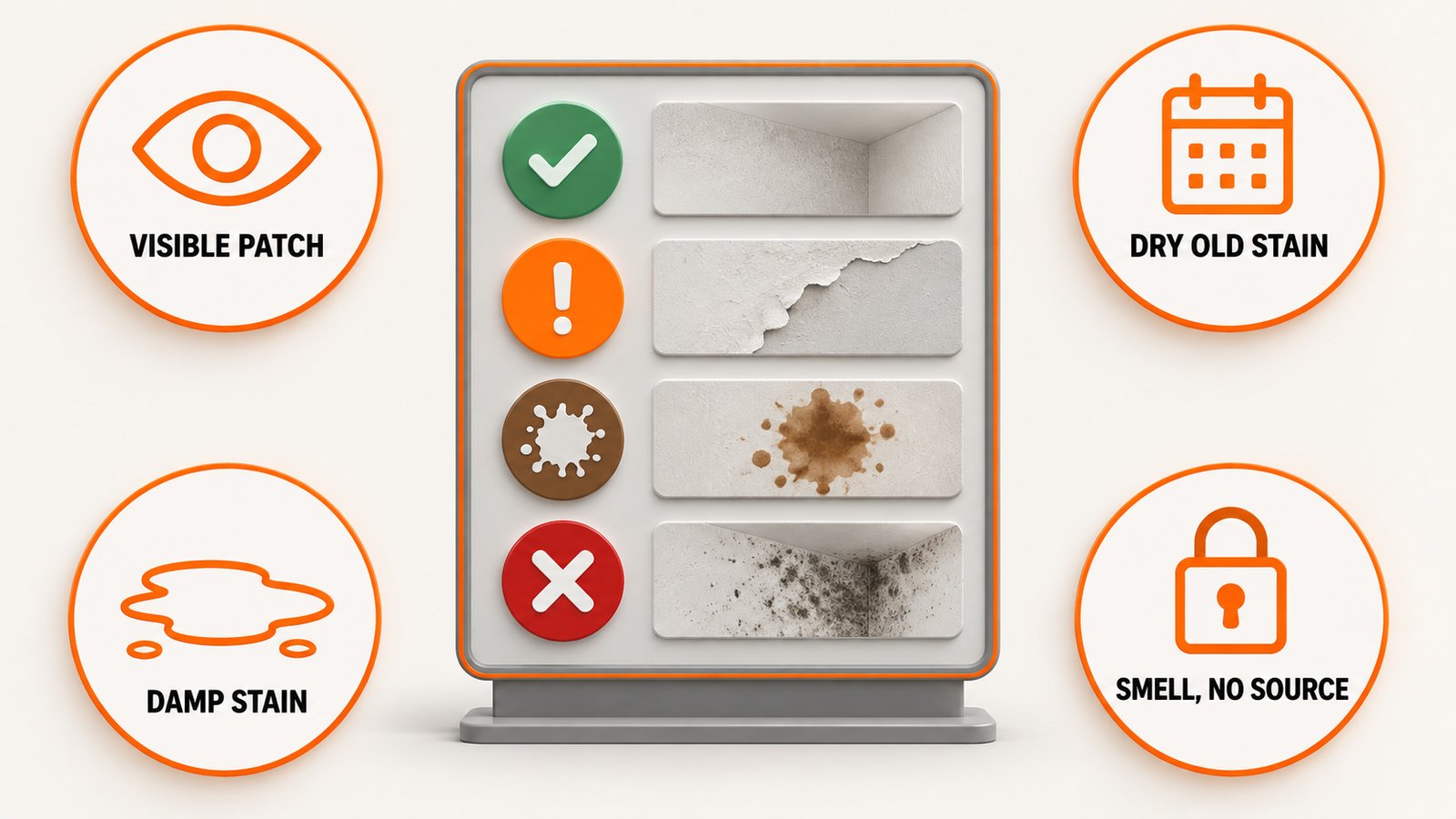
Now you have a list of findings and some photos. Minnesota's health department says "If you see or smell mold, you should assume that a problem exists." Here is how to sort what you found. None of this is a lab result. It's a way to decide what to do next.
| What you found | What it can mean | Your next step |
|---|---|---|
| Fuzzy, slimy or discolored patch on a hard surface, smaller than about 10 square feet | Visible growth on a surface that got damp | Fix the water source. The EPA says to "scrub mold off hard surfaces with detergent and water, and dry completely." |
| Stain with no growth, and the spot is dry | An old leak or past condensation | Photo it, check it again in a week, and confirm the source is fixed |
| Stain, bubbling paint or a soft spot that is damp now | Active moisture in the material | Find and stop the water. Dry it within 24 to 48 hours |
| Musty smell, and you can't see anything | Possible hidden growth or another odor source | Follow the smell, check the hidden-mold places above, and consider a pro |
| Growth bigger than about 10 square feet, sewage water, or a suspect HVAC system | A job beyond a home cleanup | Call a pro (see below) |
The EPA's rule holds for all of them: "If there is mold growth in your home, you must clean up the mold and fix the water problem. If you clean up the mold, but don't fix the water problem, then, most likely, the mold problem will come back." Don't paint over moldy surfaces. The EPA says "Paint applied over moldy surfaces is likely to peel."
Our how to prevent mold page covers the habits that keep a clean house clean, and our signs of mold in house page lists the warning signs in one place. A free 160-point checklist is there if you want a printable version of this walk-through.
This page is about the building. If a symptom worries you, that is a question for a doctor, not for a mold check.
When to Call a Pro
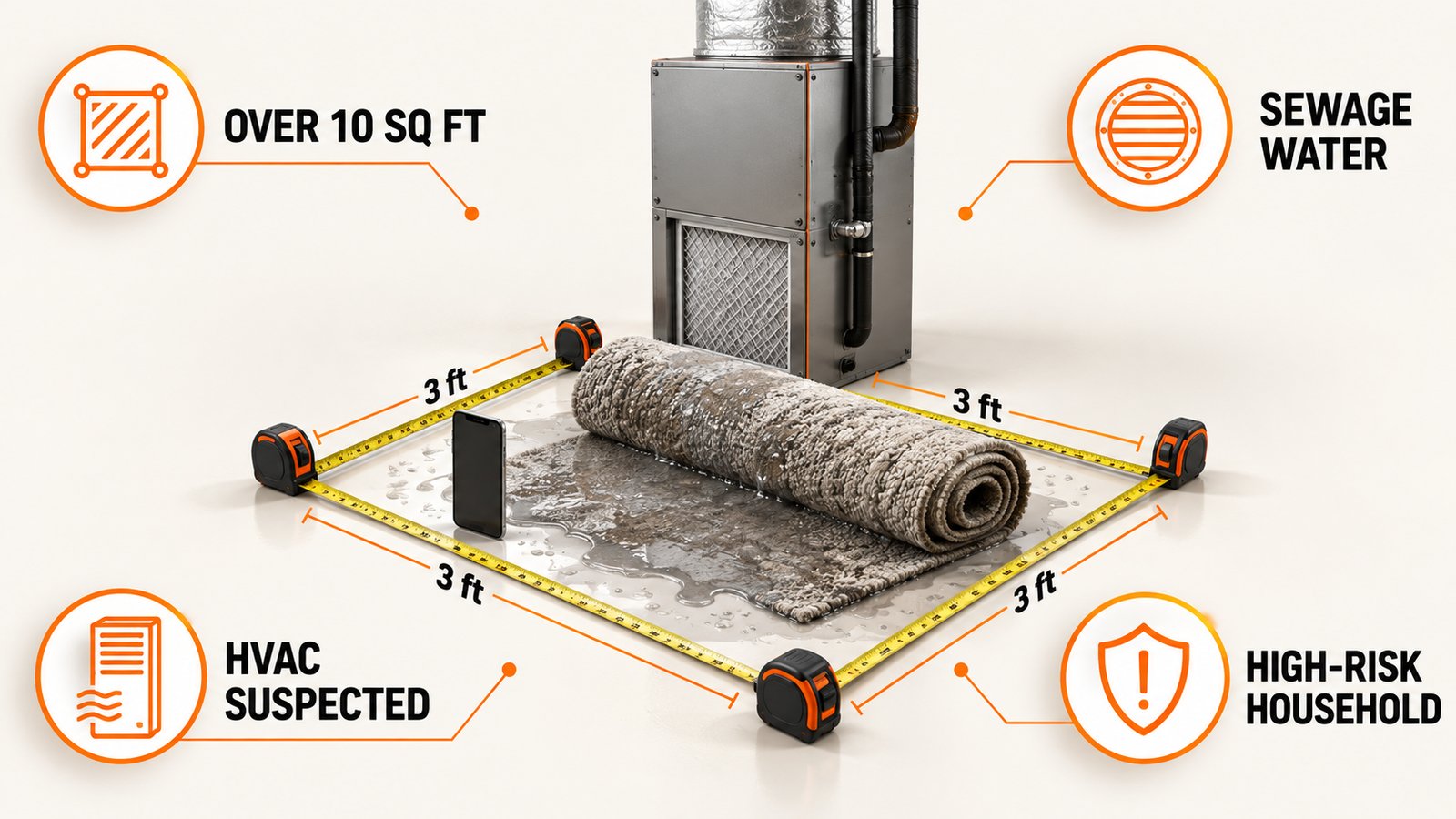
Most small surface problems are a homeowner job. The EPA says "If the moldy area is less than about 10 square feet (less than roughly a 3 ft. by 3 ft. patch), in most cases, you can handle the job yourself." Call a professional when any of these is true:
- The growth is bigger than about 10 square feet. That is the EPA's line, and New York State uses the same 10 square foot figure for hiring a licensed contractor.
- The water was sewage or otherwise contaminated. The EPA says to "call in a professional who has experience cleaning and fixing buildings damaged by contaminated water."
- You suspect the HVAC system. Keep it off, and ask a professional.
- You think the mold is hidden. Smell with no source, or a wet wall you can't reach. The EPA says to consider hiring an experienced professional.
- You're highly sensitive to mold, or someone in the home is. New York State lists "if you are highly sensitive to mold" as a reason for a licensed contractor, and the EPA says "If you have health concerns, consult a health professional before starting cleanup."
Check whether your state licenses mold work. New York State, for example, says to "Check that a company is licensed by the NYS Department of Labor to perform mold remediation." Minnesota's health department notes that "Neither the state of Minnesota nor any federal agency licenses or certifies mold investigators or remediators," so in some states you'll check references and credentials yourself. Our mold inspection and mold inspection cost pages cover what to ask and what it costs. Renters should read mold in apartment rights.
Frequently asked questions
How do you check for mold in a house?
Walk through each room with a flashlight and look for stains, fuzzy or discolored patches, bubbling paint and soft materials. Follow any musty smell to its strongest point. Start with the bathroom, kitchen, basement, ceilings and carpet edges.
How can I tell if there is mold in my house without a test?
You can usually see it or smell it. New York State's health department says mold "can appear as slightly fuzzy, discolored, or slimy patches that increase in size as they grow." The CDC does not recommend mold testing, and Minnesota's health department says testing should never replace a good visual inspection.
Can I check for mold behind walls without opening them?
You can check the surface clues: bubbling paint, stains, lifted trim, soft spots, and cold outside walls with condensation. A moisture meter can show where a wall is wetter than a dry part of the same wall, but it can't show mold. Don't cut or drill into a wall yourself. If you suspect hidden mold, the EPA advises considering an experienced professional.
What tools do I need to check for mold at home?
A bright flashlight, your phone camera, and a humidity meter are enough for a first pass. A moisture meter helps with stains and suspect walls. If you plan to disturb wet materials, the EPA suggests an N-95 respirator, long gloves and goggles without ventilation holes.
What humidity level should I aim for when I check for mold?
The EPA advises keeping indoor humidity below 60 percent, ideally between 30 and 50 percent. The CDC says to keep it no higher than 50 percent. Minnesota's health department suggests 20 to 40 percent in winter and less than 60 percent the rest of the year.
How big can a mold patch be before I should call a pro?
About 10 square feet, roughly a 3 foot by 3 foot patch. Past that size, or with sewage water, a suspect HVAC system or hidden growth, hand it off. Small patches on hard surfaces are usually a do-it-yourself job with soap, water and good drying.
Can I tell black mold from other mold by color?
No. Minnesota's health department says mold color can vary from white and gray to brown, black and green, and the CDC says you do not need to know the type of mold. The response is the same: fix the water, remove the mold and dry the area.
Should I check for mold in the air with a kit?
A kit won't change what you do. The CDC does not recommend mold testing because there are no set standards for what is an acceptable amount in a home. Start with a visual check and a humidity reading.
Sources
Every claim on this page traces to one of these. Links open the primary document.