
Pin Against Pinless: Which One You Need
Every meter in this category is one of two designs, and picking the wrong one wastes the purchase.
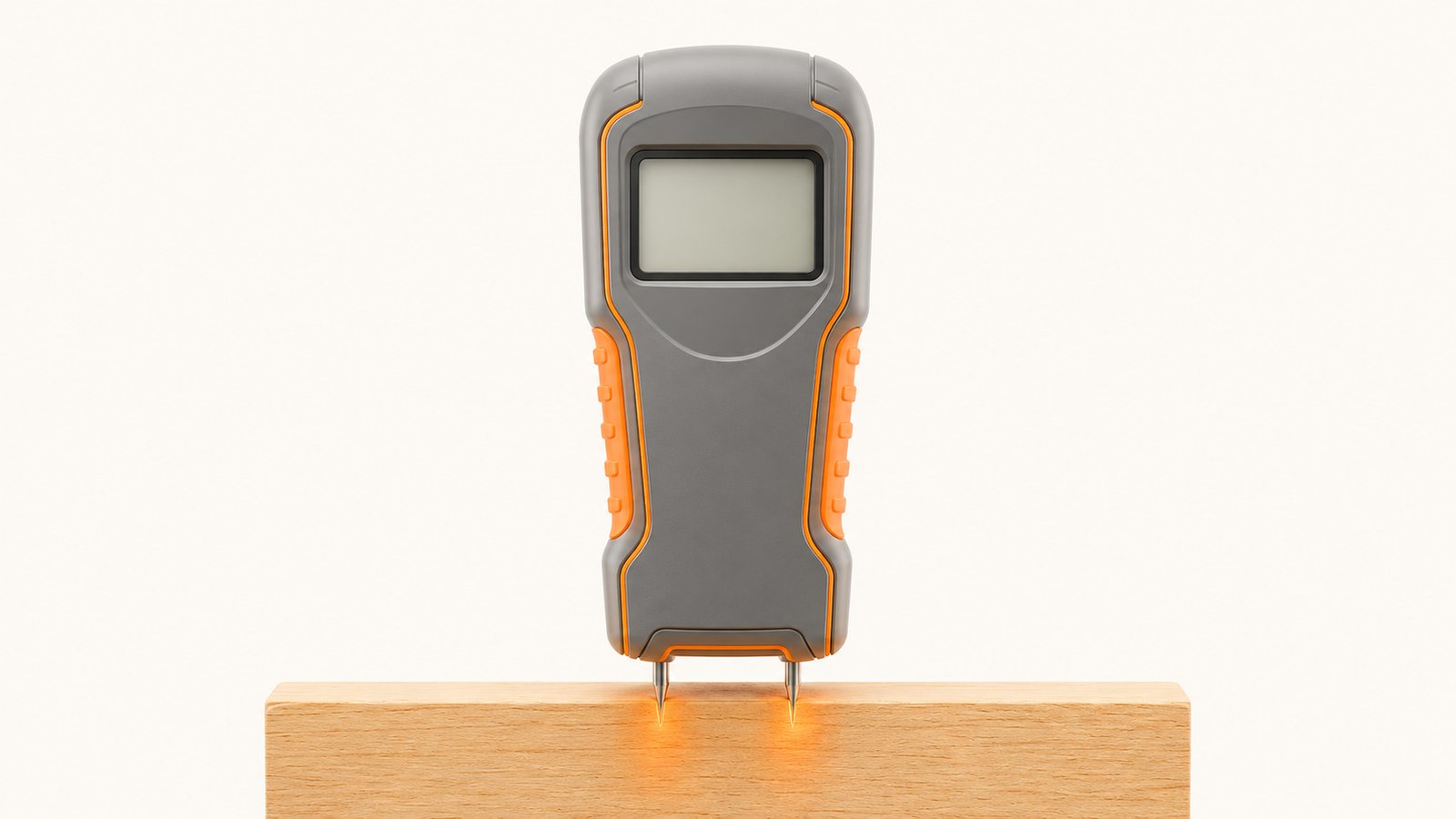
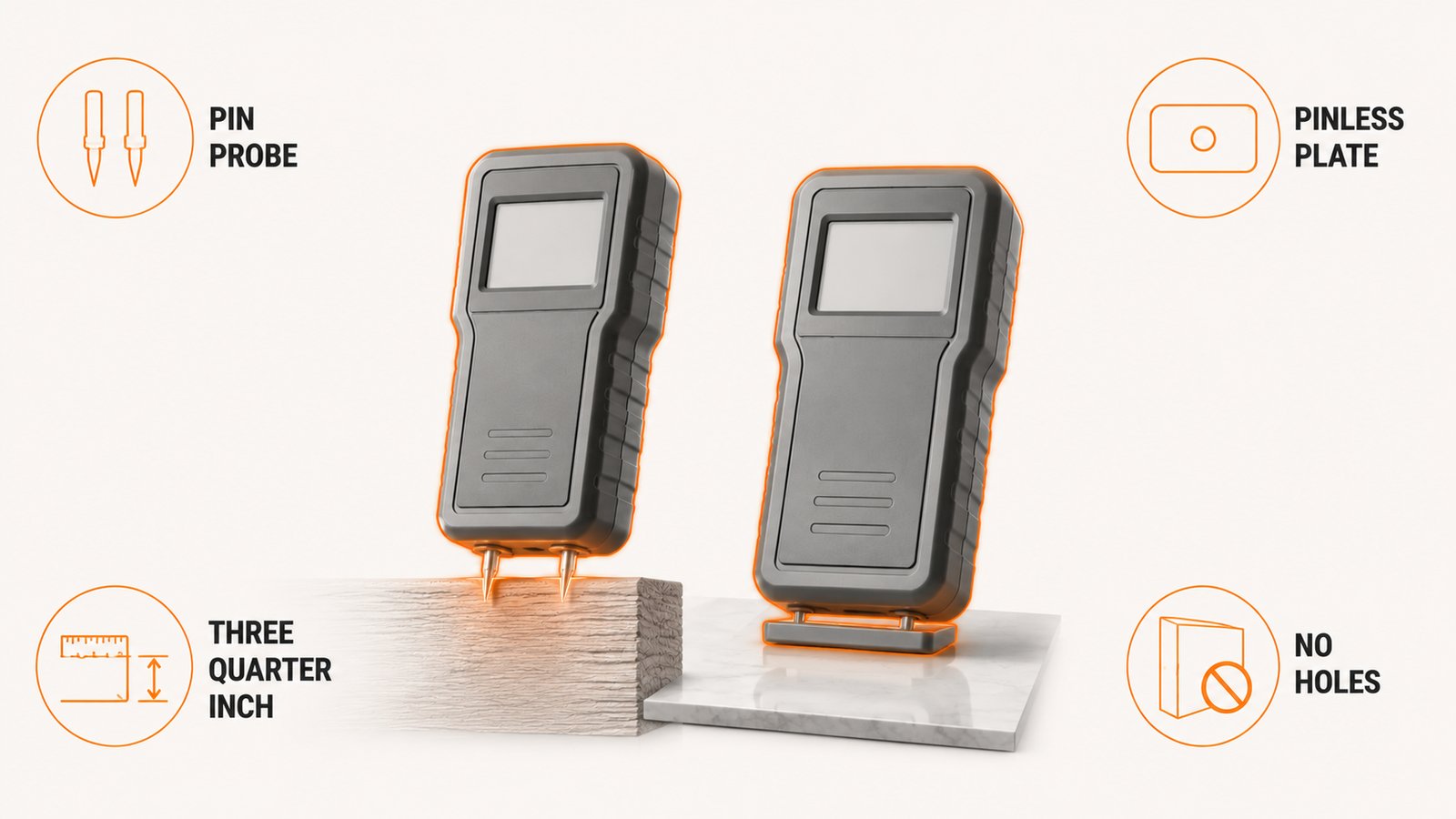
Pin meters push two small metal probes into the material and measure electrical resistance between them. Wet material conducts better than dry material, so the meter converts that resistance into a moisture content percentage. The reading is specific and numeric, and it applies to the exact spot between the two pins. The cost is two pinholes per reading, which is nothing on a baseboard, a subfloor edge, or the back of a cabinet, and unacceptable on a finished surface you care about.
Pinless meters press a flat sensor plate against the surface and read the dielectric response of whatever sits underneath, typically to about three quarters of an inch deep. Nothing punctures. You can sweep a whole wall in a minute, which makes pinless the right tool for finding where the wet zone is. The trade is precision: readings are relative rather than an absolute moisture percentage, and metal studs, foil-faced insulation, or a wire run behind the drywall can lift the number on their own.
Most people who are chasing mold want both behaviors: sweep fast, then confirm. That is why 2-in-1 meters exist, and why the cheapest sensible setup is a pinless sweep tool plus a pin meter for the spots that read high. If you only buy one, buy pinless for walls and ceilings, and pin for wood, subfloor, and anything you are willing to poke.
What a meter never does is identify mold. It reads water. Water is the condition mold needs, which is why the EPA puts moisture control at the center of mold control and tells homeowners to dry water-damaged areas and items within 24 to 48 hours to prevent growth. A meter is how you find out whether that drying actually happened. Our mold detector roundup covers the wider set of tools.
The 5 Best Moisture Meters for Mold, at a Glance
| Meter | Type | Rating | Range | Best for |
|---|---|---|---|---|
| General Tools MMD4E | Pin | 4.5/5 from 15,195 | 5 to 50 percent wood, 1.5 to 33 percent building materials | Best overall, exact readings in wood and drywall |
| Klein Tools ET140 | Pinless | 4.5/5 from 6,206 | Relative, to three quarters of an inch deep | Sweeping walls with no holes |
| RDINSCOS 2-in-1 | Pin and pinless | 4.5/5 from 3,958 | 5 to 52 percent wood, 2 to 30 percent building materials | One tool that does both jobs |
| General Tools MMD7NP | Pinless | 4.3/5 from 4,112 | 0 to 53 percent softwood, 0 to 35 percent hardwood | Pinless with an out-of-range alarm |
| TopTes TS-630 | Pin | 4.5/5 from 1,824 | 0 to 57 percent across 7 calibration scales | Simplest readout, color-coded |
Titles, star ratings, rating counts, ranges, and stock status read off live Amazon product pages on September 2, 2026. We print a price only where we could read it off the buy box that day, because listing prices move constantly.
The 5 Moisture Meters, Ranked
Heads up: the Amazon links below are affiliate links, and buying through them may earn Mold Scanner AI a small commission at no extra cost to you.
Photograph the surface with Mold Scanner AI first
A meter tells you a wall is wet. It cannot tell you the dark patch beside the wet spot is mold rather than soap scum, efflorescence, or old staining. Photograph it, get an AI-assisted visual screening result back, then meter the surface around whatever the photo flags. Free to join, no hardware. It reads visible surfaces only, does not name a species or confirm active growth, makes no health claim, and processing time varies.
General Tools MMD4E Moisture Meter
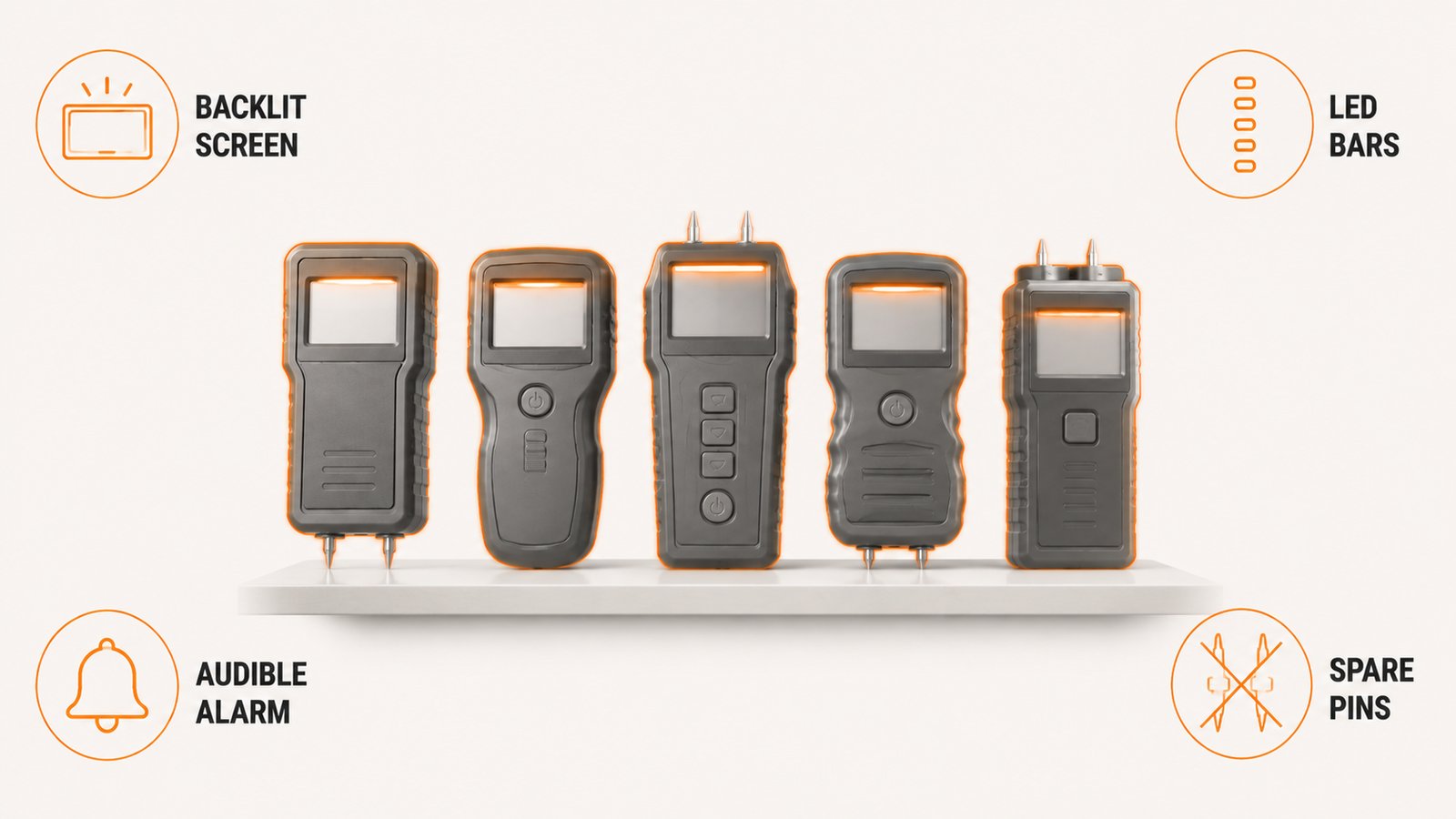
Listed at $37.70 and in stock on Amazon, 4.5 out of 5 stars from 15,195 ratings, the deepest review history in this category by a wide margin. Two stainless steel pins read moisture content directly across 5 to 50 percent on wood and 1.5 to 33 percent on building materials such as concrete and drywall, on a backlit display with digits about three tenths of an inch tall. It ships with spare 8mm stainless pins and a protective cap that doubles as a calibration checker, which is the detail that separates a tool from a toy. The honest caveat: it is a pin meter, so every reading is two small holes, and it reads only the material between the pins.
Klein Tools ET140 Pinless Moisture Meter
Listed at $49.97 and in stock on Amazon, 4.5 out of 5 stars from 6,206 ratings. It reads relative moisture to three quarters of an inch below the surface using an electromagnetic field, with a reverse-contrast display and nine LED bars showing where the reading sits, and the housing is rated for a two meter drop. This is the tool you use to find the wet zone: slide it across a painted wall, watch the bars climb, and mark the peak. The honest caveat: Klein calibrates it for drywall, masonry, hardwood, and softwood only, the scale is relative rather than a true moisture percentage, and metal or foil behind the wall can lift the reading by itself.
RDINSCOS 2-in-1 Pin and Pinless Moisture Meter
In stock on Amazon, 4.5 out of 5 stars from 3,958 ratings. One body, two modes: a non-invasive ball sensor for scanning a wall, and pin probes for a precise percentage once you have found the spot. Pin mode covers 5 to 52 percent on wood and 2 to 30 percent on building materials at a stated accuracy of plus or minus 2.5 percent, with a 2.9 inch backlit screen, a tri-color low, medium and high indicator, an audible alarm above a set point, a rechargeable internal battery, and auto shut-off after 30 minutes. The honest caveat: combo tools compromise on both halves, and this brand has a much shorter track record than General Tools or Klein.
General Tools MMD7NP Pinless Moisture Meter
In stock on Amazon, 4.3 out of 5 stars from 4,112 ratings. Same depth as the Klein at three quarters of an inch, or 19mm, with auto-calibration, a two inch diagonal backlit screen, a three-color LED bar graph, a hold button, an out-of-range alarm, and a low battery alert. Its range runs 0 to 53 percent on softwood and 0 to 35 percent on hardwood, with relative readings for wallboard, drywall, and masonry. The honest caveat: 4.3 is the lowest rating of the five here, and the audible alarm is the main thing it adds over the Klein, so buy on price.
TopTes TS-630 Wood Moisture Meter
In stock on Amazon, 4.5 out of 5 stars from 1,824 ratings. A pin meter built around a 2.25 inch screen with a tri-color backlight, green for dry, orange for middling, red for wet, so you get the answer without interpreting a number. Seven built-in calibration scales cover wood and building material from 0 to 57 percent, and it ships with three AAA batteries, a carry pouch, a spare pair of test pins, and a mini wrench. The honest caveat: the color bands are a convenience, not a standard, so you still want your own dry baseline reading before you trust the red light.
Affiliate disclosure: the Amazon links above are affiliate links. If you buy through them, Mold Scanner AI may earn a small commission at no extra cost to you. Titles, ratings, rating counts, measurement ranges, and stock status were read off the live Amazon product page for every pick on September 2, 2026.
What the Numbers Mean and How to Read Them
The single biggest mistake is treating one reading as a verdict. A moisture meter produces a comparison, not a diagnosis, and the comparison only works if you make it yourself.
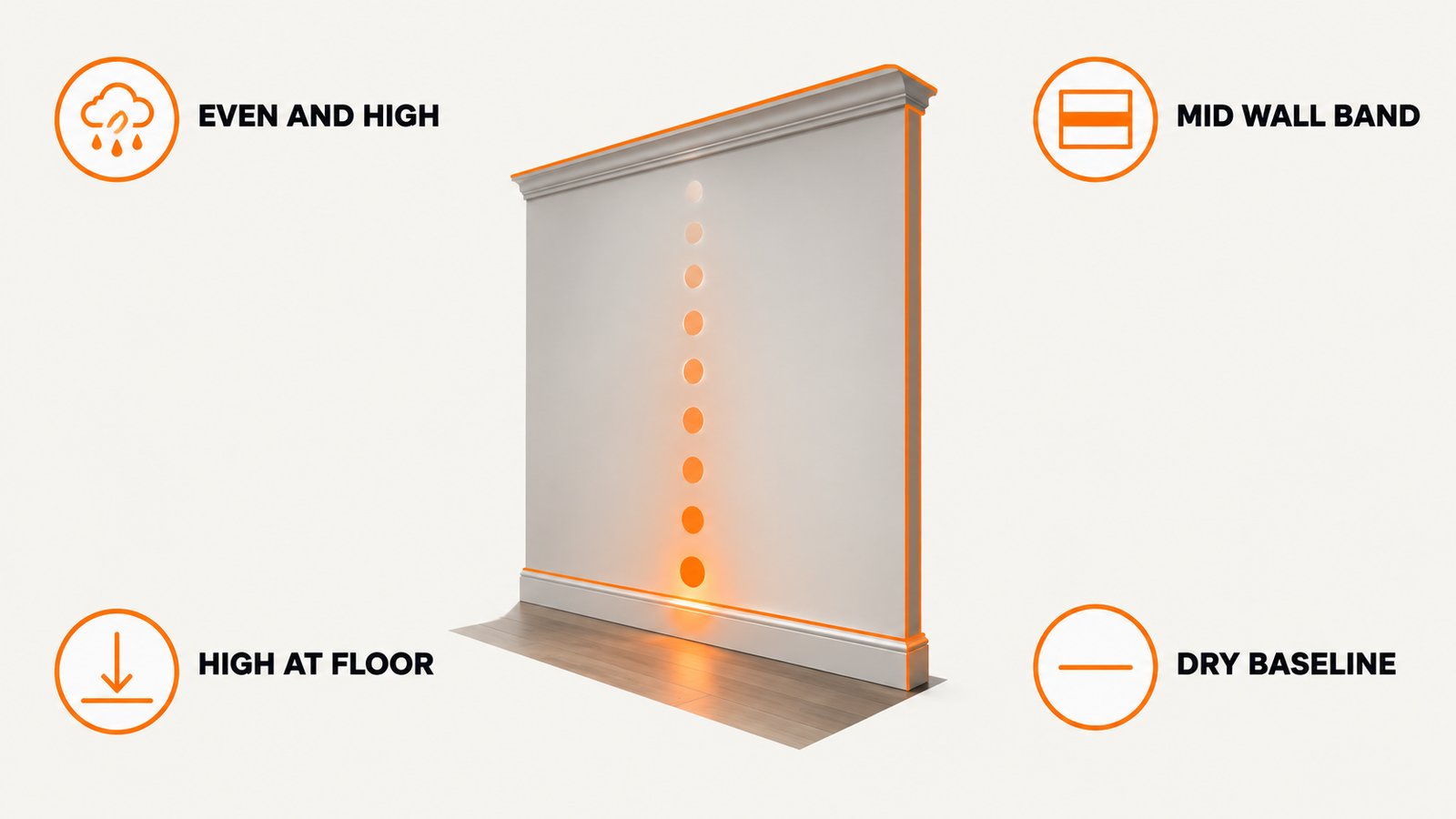
- Establish a dry baseline. Read the same material somewhere it cannot be wet, on the far side of the house, away from plumbing and exterior walls. That number is your zero for the day.
- Grid the suspect area. Read every 12 inches across and up. Water spreads down and sideways, so the wet zone is usually widest at the floor line.
- Follow the rising numbers. Keep going until the readings stop climbing. The peak sits near the source, which is rarely the middle of the visible stain.
- Read the same points three days later. Falling means it is drying. Flat or rising means an active source, and that is what justifies opening a wall.
On wood, professionals generally treat readings in the high teens and above as high enough to support growth, but species, temperature, and meter calibration all move that line, which is why the gap from your own baseline is more useful than any number quoted online. On drywall and masonry, most consumer meters give a relative scale rather than a real percentage, so the only meaningful question is whether this spot reads higher than a spot you know is dry.
Three readings that mean something specific:
- High at the floor line, dropping as you go up. Water is coming from below or has run down inside the cavity. Check the baseboard, the sill plate, and the subfloor. Our page on mold under flooring covers what happens next.
- High in a band across the middle of a wall. A pipe run or a window leak, not rising damp.
- High everywhere, evenly. Usually humidity rather than a leak, especially in a basement. A dehumidifier holding the room under 60 percent fixes that class of problem where a repair cannot.
If the wall reads wet and nothing is visible on the face, the growth may be on the cavity side. Mold behind walls covers the signs, and how fast mold grows explains why the 24 to 48 hour drying window matters so much.
When a Wet Reading Means Call a Pro
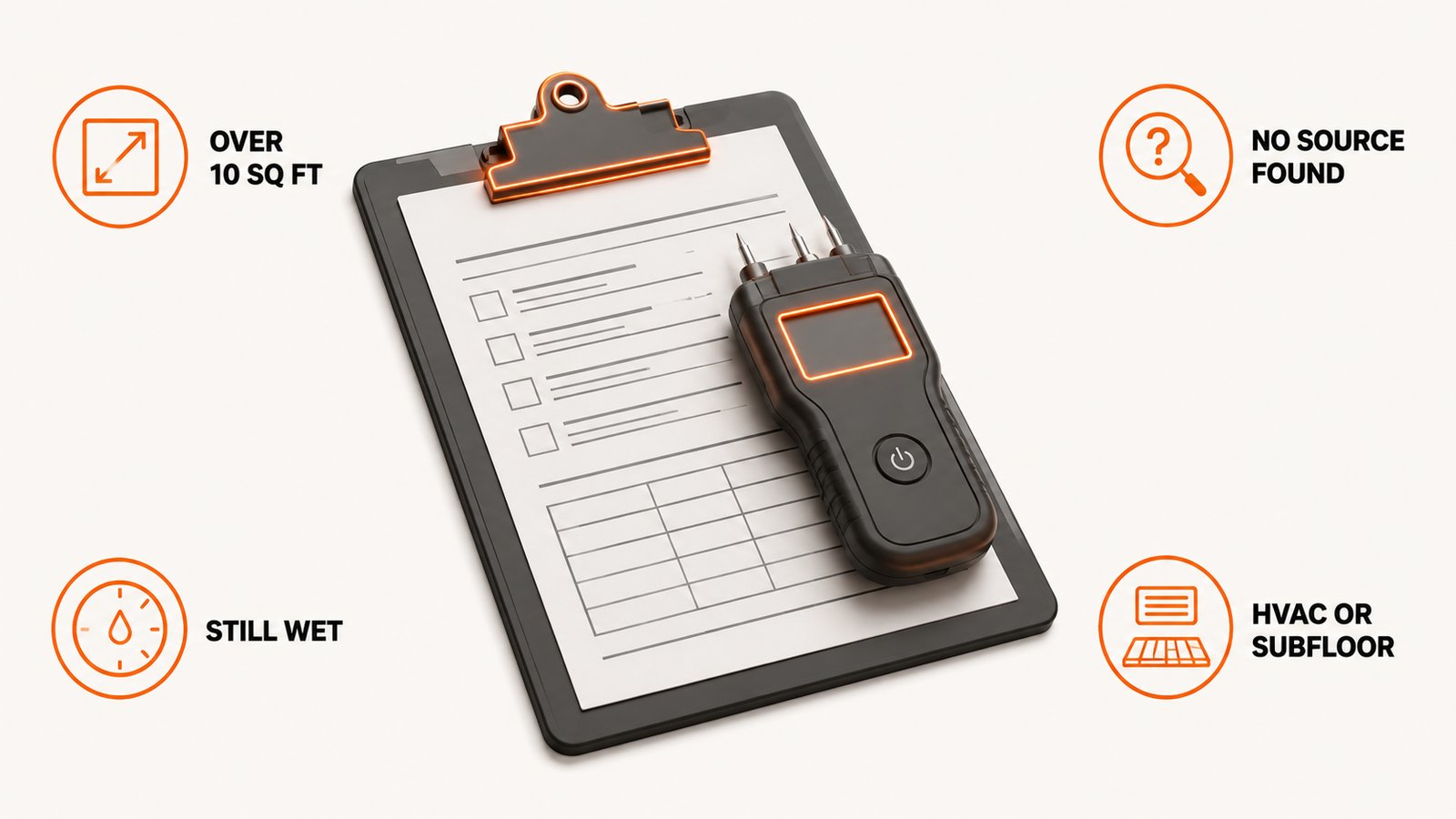
A meter is a scoping tool, not a permission slip. Stop and bring in a professional when any of these is true.
- The visible growth is larger than about 10 square feet, roughly a 3 foot by 3 foot patch, which is the EPA's own dividing line for handling cleanup yourself.
- The readings are high and the source is not obvious. Water tracks along framing and pipe runs, so a wet bedroom wall can start at a roof valley two rooms away.
- The water came from sewage or floodwater. Contamination is the deciding factor, and no reading changes it.
- Readings stay flat after several days of drying. That means something is still feeding water into the assembly.
- The wet area is inside the heating and cooling system or under a finished floor you cannot open without damage.
- Anyone in the home is immune-compromised or has chronic lung disease. The CDC notes people in those groups may get lung infections from mold, which makes it a question for a physician and a professional.
Keep the testing and the cleanup in separate hands where you can. A firm that both inspects and sells remediation has an obvious reason to find a problem. Mold inspection covers what an independent visit includes, and mold remediation covers the cleanup standard. While you wait, ventilate, keep humidity down, and wear an N95 respirator, gloves, and eye protection near disturbed growth. This page provides cleaning and protective-equipment guidance only, not medical advice.
Frequently asked questions
What is the best moisture meter for finding mold?
For most homeowners the General Tools MMD4E is the best single buy, at $37.70 with 4.5 out of 5 stars from 15,195 ratings, because a pin meter gives you an actual moisture content number you can compare against a dry baseline. If you are checking painted walls and ceilings you do not want to puncture, the Klein Tools ET140 at $49.97 is the better tool, and a lot of people end up owning one of each.
Should I buy a pin or a pinless moisture meter?
Pinless for walls and ceilings, pin for wood, subfloor, and anywhere a couple of small holes do not matter. Pinless meters read to about three quarters of an inch deep without marking the surface, which makes them fast for sweeping. Pin meters give a specific moisture percentage for the exact spot between the probes. A 2-in-1 covers both at the cost of being slightly worse at each.
What moisture reading is high enough for mold to grow?
There is no single number, which is why the comparison matters more than the reading. On wood, professionals generally treat the high teens and above as wet enough to support growth, but species and calibration shift that line, and on drywall most consumer meters report a relative scale rather than a true percentage. Take a dry baseline elsewhere in the house and judge the gap.
Can a moisture meter detect mold inside a wall?
It detects the water, not the mold. A pinless meter reads to roughly three quarters of an inch, which covers drywall and a little behind it, and no consumer meter reads a full stud cavity. A high reading with nothing visible on the surface is the practical signal that something is wrong inside the wall, and confirming it means an inspection camera or a small hole.
Do cheap moisture meters actually work?
The inexpensive pin meters in this roundup work well enough for the job a homeowner needs, which is comparing one spot against another. Where cheap tools fall down is absolute accuracy and calibration drift, and that matters far less when you are hunting for the wettest point rather than certifying a number. Buy on review depth and on whether it ships with spare pins.
How often should I re-check a wet spot?
Read the same marked points again after about three days, and again a week later. The EPA advises drying water-damaged areas and items within 24 to 48 hours to prevent mold growth, so a reading that is still high a week after a leak tells you the drying failed and the assembly needs to be opened or actively dried.
Will a moisture meter tell me if my basement needs a dehumidifier?
Indirectly. If readings run high evenly across many surfaces rather than concentrated in one zone, the problem is usually room humidity rather than a leak, and a hygrometer is the better instrument for confirming it. The EPA advises keeping indoor relative humidity below 60 percent and ideally between 30 and 50 percent.
Sources
Every claim on this page traces to one of these. Links open the primary document.