Why mold grows in a fridge at all
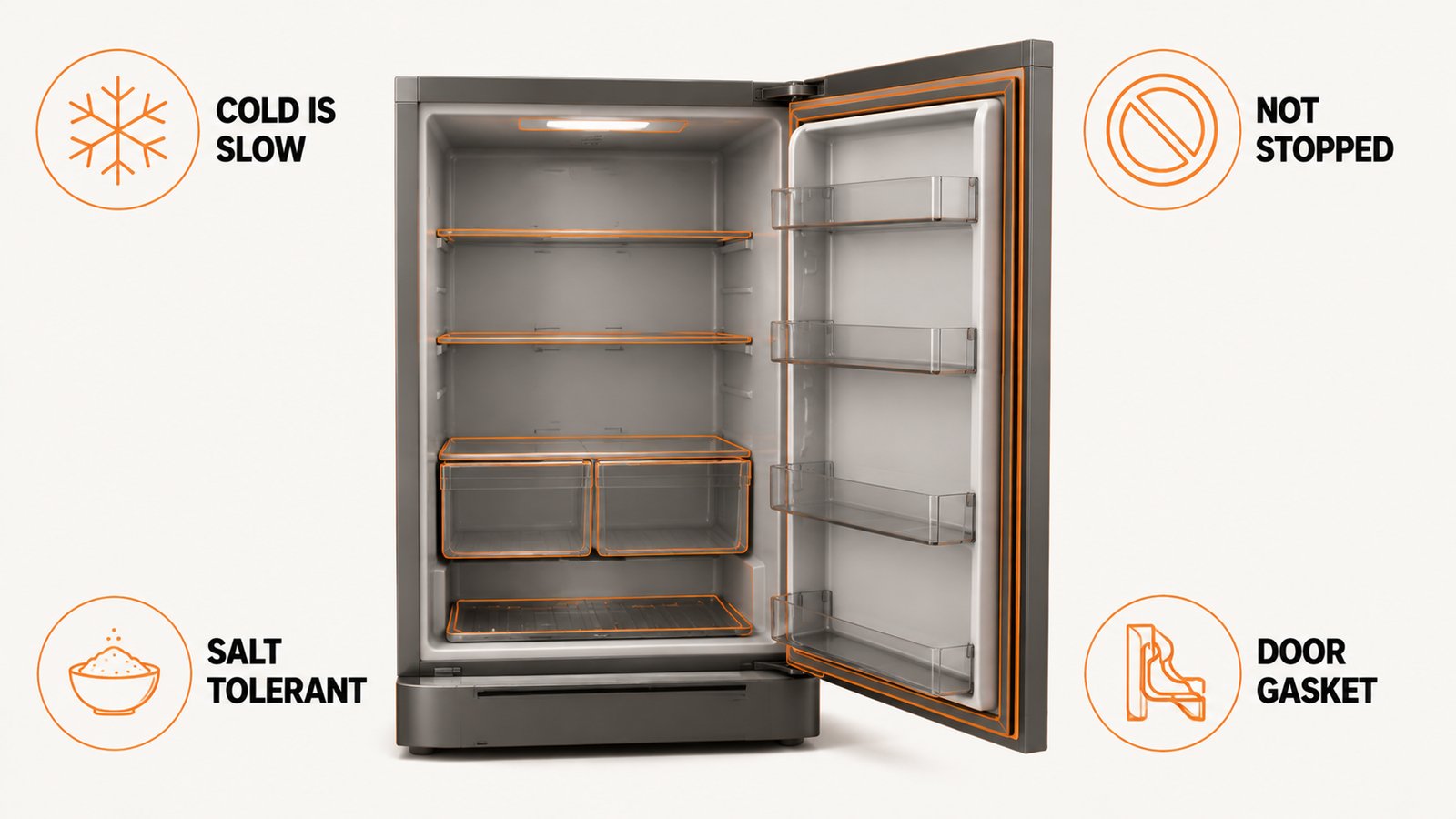
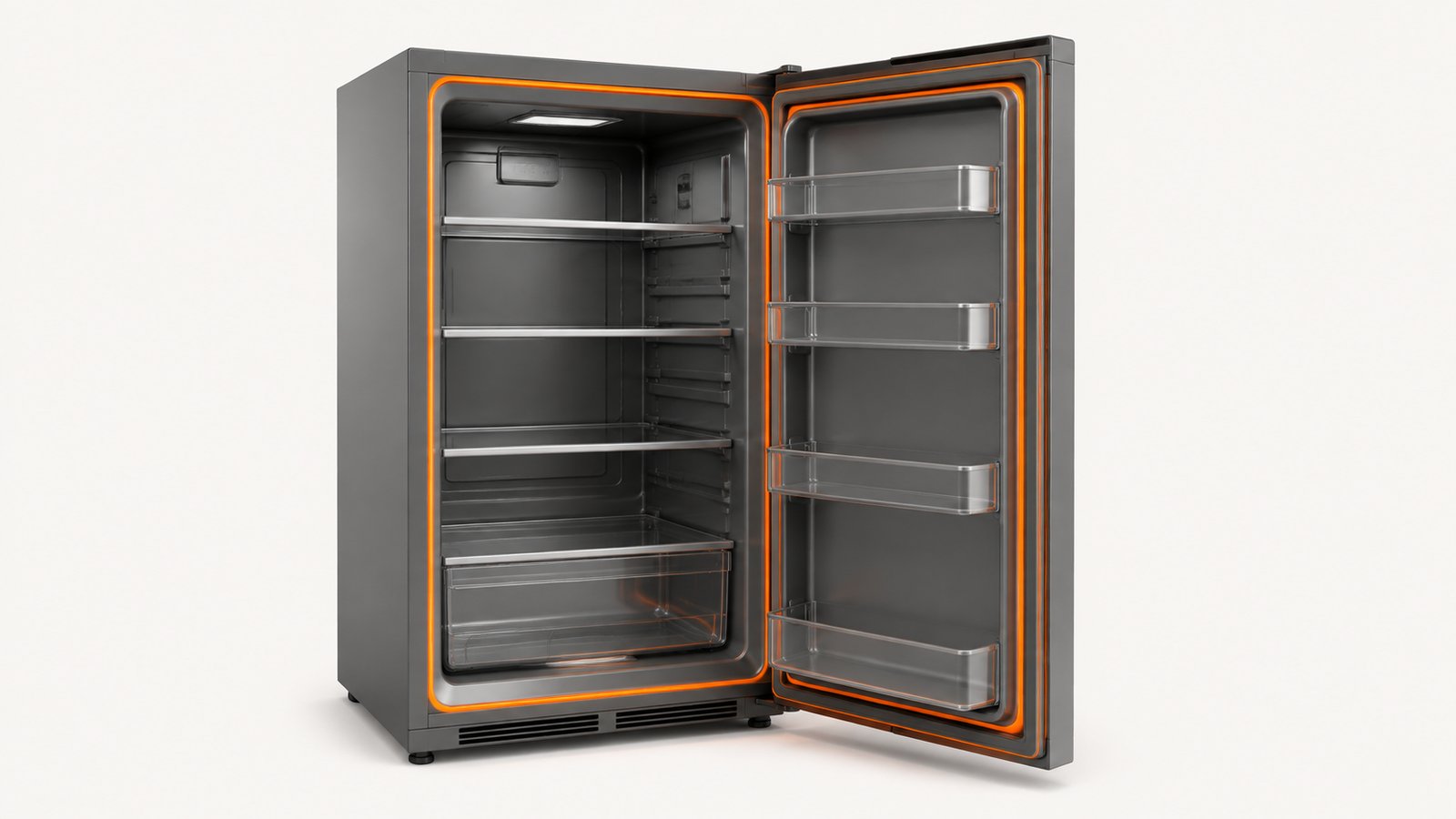
The refrigerator is not a sterile box, it is a slow one. USDA's Food Safety and Inspection Service puts it plainly: most molds prefer warmer temperatures, but they can grow at refrigerator temperatures too, and molds tolerate salt and sugar better than most other food invaders. That is why growth turns up in refrigerated jam and jelly and on cured salty meats such as ham, bacon, salami and bologna.
Three places in a fridge stay wet long enough for growth to take hold.
The door gasket. The rubber seal traps condensation in its folds, and FSIS singles it out, describing visible mold on rubber casings as usually black and calling for a bleach solution to scrub it. It is the most commonly missed surface in the whole appliance.
The crisper drawers and the channel beneath them. Produce releases moisture, the drawer holds it, and a forgotten cucumber does the rest. FSIS notes that mold spreads quickly in fruits and vegetables, so a single soft item takes its neighbors with it.
The drip tray and drain channel at the back. Defrost water collects there by design. When the channel clogs, water pools on the floor of the compartment.
The temperature itself matters too. FoodSafety.gov sets the refrigerator at 40 degrees Fahrenheit or below and the freezer at 0 degrees Fahrenheit or below. A fridge running warm because the door seal has failed is running two problems at once, and the gasket is the common cause of both.
What to throw out and what you can save
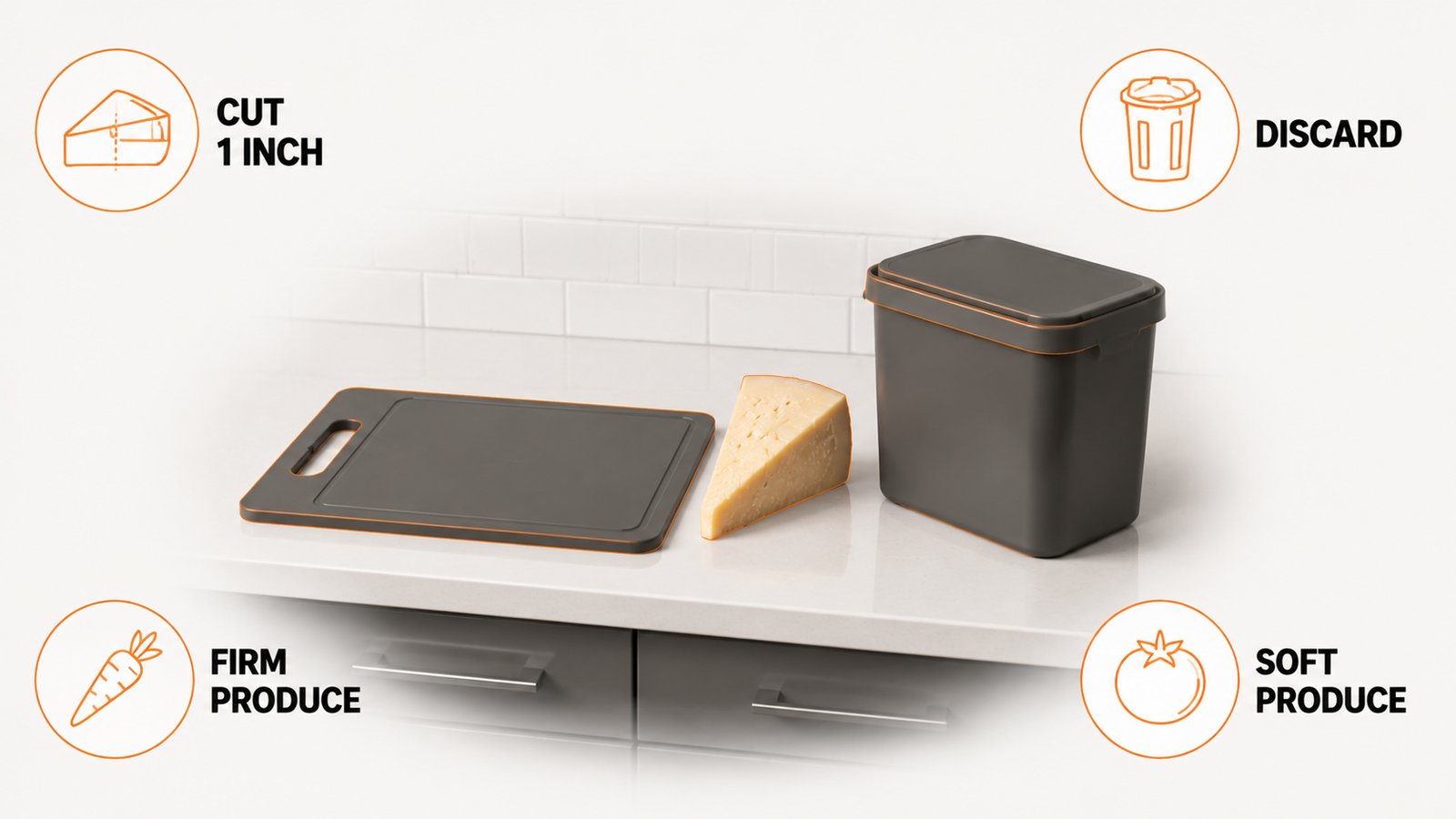
USDA publishes the answer as a table, and it is more permissive than the internet assumes in a couple of places and much stricter in others. The controlling idea is moisture: mold cannot get far into dense, dry food, and it can get all the way through anything wet or porous.
| Food | USDA verdict | Why |
|---|---|---|
| Luncheon meats, bacon, hot dogs | Discard | High moisture content can be contaminated below the surface, and bacteria may be growing with the mold |
| Hard salami and dry-cured country ham | Use, scrub the mold off the surface | Surface mold is normal on these shelf-stable products |
| Cooked leftover meat and poultry | Discard | High moisture content, contamination below the surface |
| Cooked casseroles, cooked grain and pasta | Discard | High moisture content, contamination below the surface |
| Hard cheese, where mold is not part of the process | Use, cut off at least 1 inch around and below the spot | Mold generally cannot penetrate deep into the product |
| Soft cheese, plus all crumbled, shredded and sliced cheese | Discard | High moisture, and the cutting instrument can spread contamination through the package |
| Cheese made with mold such as blue or Gorgonzola | Cut 1 inch around a surface spot on the hard ones, discard soft ones such as Brie and Camembert | Molds that are not part of the manufacturing process can be dangerous |
| Yogurt and sour cream | Discard | High moisture content, contamination below the surface |
| Jams and jellies | Discard | The mold could be producing a mycotoxin, and microbiologists recommend against scooping it out |
| Firm fruits and vegetables such as cabbage, bell peppers, carrots | Use, cut off at least 1 inch around and below the spot | It is difficult for mold to penetrate dense, low-moisture foods |
| Soft fruits and vegetables such as cucumbers, peaches, tomatoes | Discard | High moisture content can be contaminated below the surface |
| Bread and baked goods | Discard | Porous foods can be contaminated below the surface |
| Peanut butter, legumes and nuts | Discard | Foods processed without preservatives are at high risk for mold |
Verbatim from the USDA Food Safety and Inspection Service page Molds on Food: Are They Dangerous. Keep the knife out of the mold itself when you trim, so it does not carry contamination into the rest of the food.
Three handling rules travel with that table, all from the same USDA page. Do not sniff the moldy item, because FSIS says it can cause respiratory trouble. Bag it before it goes in the bin: put it in a small paper bag or wrap it in plastic and dispose of it in a covered trash can that children and animals cannot get into. And clean the spot where it was stored, then check nearby items it might have touched.
Cheese gets its own detailed treatment on mold on cheese, and soft fruit on mold on strawberries. Both follow the same firm-versus-soft logic.
How to clean mold in a fridge, step by step
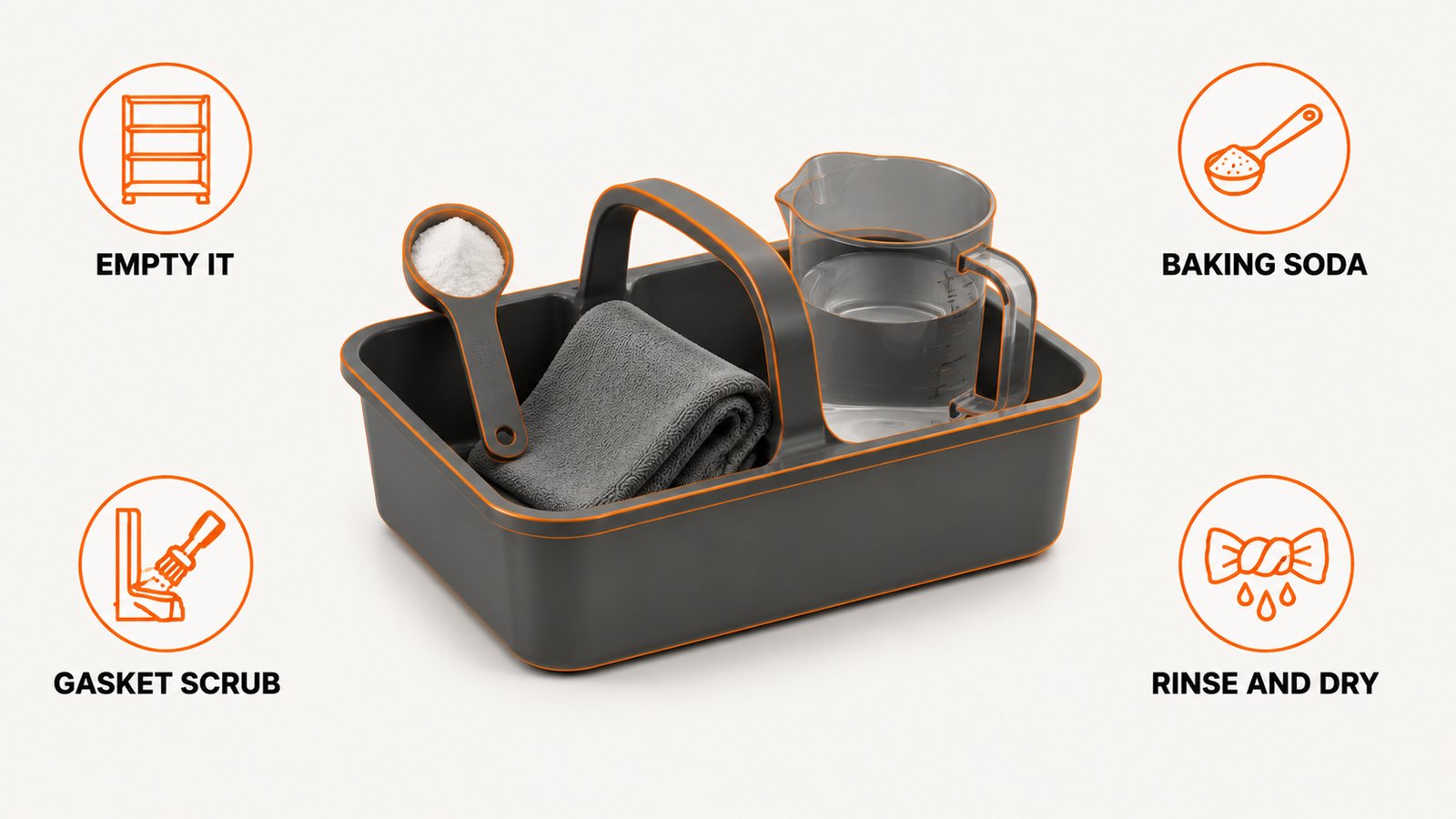
USDA gives two different solutions for two different surfaces inside the same appliance. Use the right one on the right part.
1. Empty it and triage as you go. Work through the table above rather than by smell. Bag anything that goes, and keep the bag closed.
2. Wash the interior with the baking soda solution. FSIS recommends cleaning the inside of the refrigerator every few months with 1 tablespoon of baking soda dissolved in a quart of water, then rinsing with clear water and drying. That is a mild alkaline wash rather than a disinfectant, and it is also what handles odor. We cover what bicarbonate does and does not do on baking soda for mold removal.
3. Scrub the rubber gasket with the bleach solution. For visible mold on rubber casings, usually black, FSIS calls for 3 teaspoons of bleach in a quart of water. Get into the folds of the seal with a soft brush or an old toothbrush, then rinse and dry. Never mix that with any other cleaner, and never with ammonia.
4. Pull the drawers and wash them separately. Wash the channel they sit in, not just the drawer. Dry both completely before they go back.
5. Clean the cloths you just used. FSIS is specific that mold spores from affected food build up in the refrigerator, in dishcloths and in other cleaning utensils, and that a musty smell means they are spreading mold around. Launder them hot or throw them out.
6. Check the temperature before you reload. A thermometer on the middle shelf should read 40 degrees Fahrenheit or below.
Mold in the freezer and the ice maker
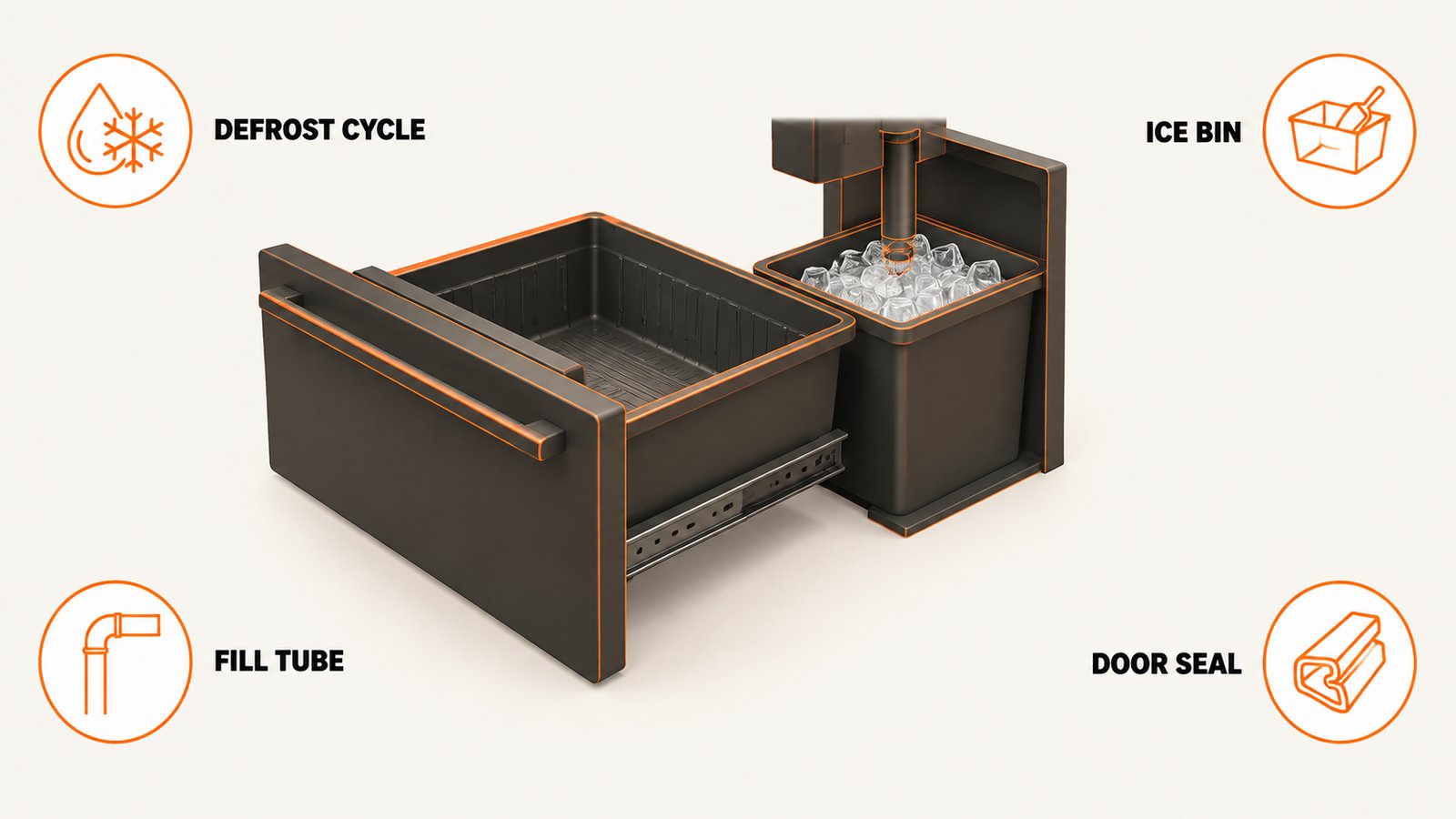
The freezer. At 0 degrees Fahrenheit or below, active growth is not the normal state of a working freezer. When people find growth in one, the usual explanation is that the compartment was warm for a while: a door left ajar, a failed seal, a power outage, or a defrost cycle draining into a blocked channel. Clean it with the same baking soda solution, treat the gasket like the fridge gasket, and then work out why it warmed up. Anything that thawed and refroze is a food-safety question separate from the mold.
The ice maker. This is not a cold-storage problem, it is a wet-parts problem. The reservoir, the fill tube, the chute and the ice bin all stay damp, and the bin is often the one part nobody has ever taken out. Empty the bin, wash it in the sink, dry it fully, and follow your manufacturer's manual for the reservoir and any filter, because the disassembly differs by model and forcing it is how the fill tube gets broken.
Two things not to do. Do not put a bleach solution anywhere ice or drinking water will contact unless the manufacturer's manual specifically says to. And do not eat or use ice from a bin with visible growth, on the same reasoning USDA applies to high-moisture food: what you can see is not the extent of it.
If the smell survives a full clean of all of it, the source is probably not in the appliance. Our page on what mold smells like and where it hides covers tracking that down, and mold in the kitchen covers the cabinet and under-sink cases that sit next to the fridge.
Why it comes back, and how to stop it
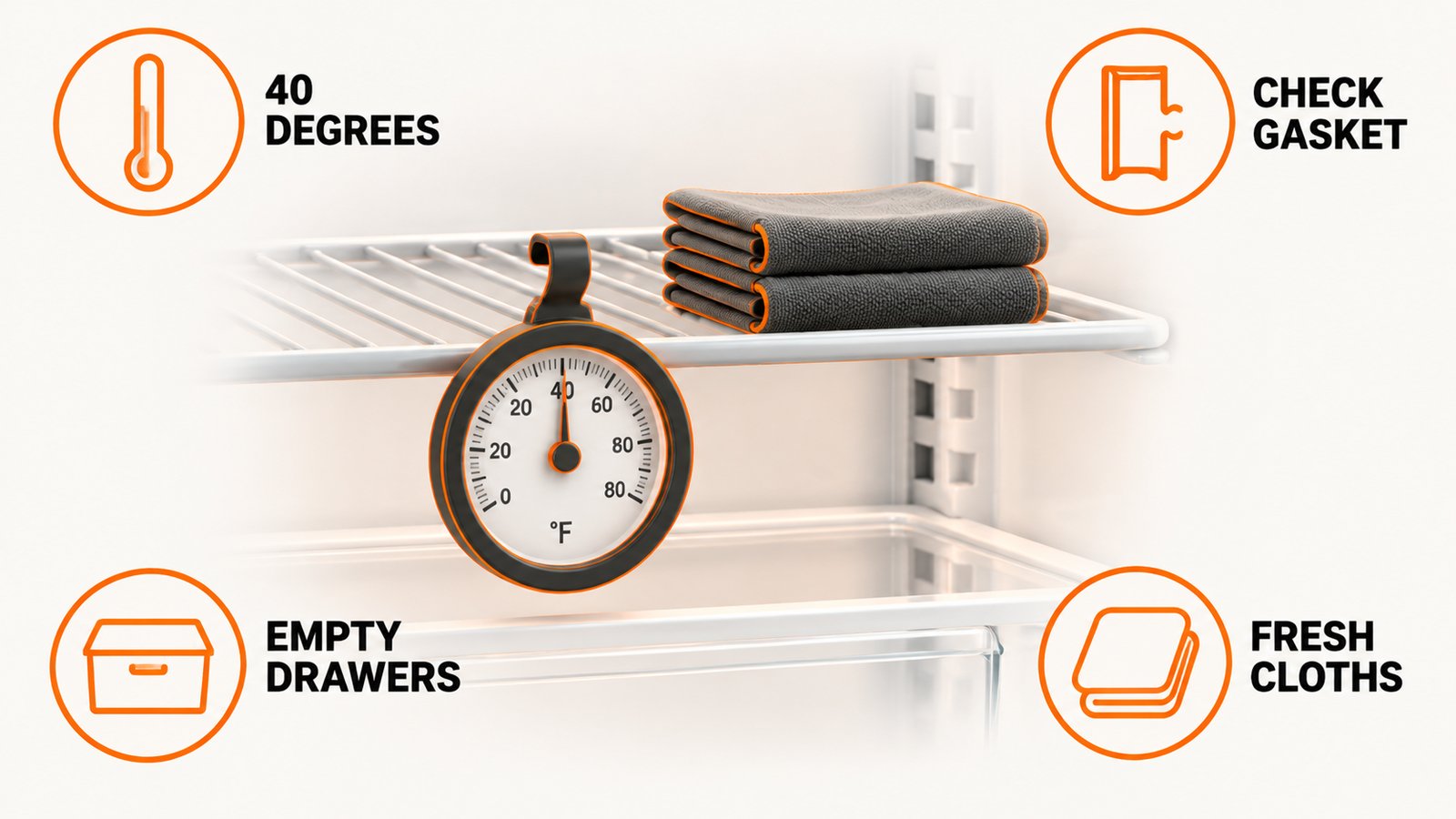
Regrowth in an appliance is almost always one of four things, and none of them is the cleaner you chose.
The seal is not sealing. Close the door on a slip of paper and pull. If it comes out with no drag, the gasket is not compressing, warm humid air is getting in continuously, and the fridge is probably running above 40 degrees Fahrenheit as well.
Spores are riding back in on the cloth. FSIS is explicit that spores build up in dishcloths and cleaning utensils and that a musty cloth spreads mold around. Discard items you cannot clean or launder.
The room is too humid. FSIS advises keeping the humidity level in the house below 40 percent as part of minimizing mold growth. EPA's general indoor guidance is a wider band, 30 to 60 percent. The two agencies are answering slightly different questions, and the honest reading is that lower is better and anything sitting at the top of EPA's range is not helping you. Our page on how to prevent mold covers getting there.
Food is going in already contaminated. FSIS advises examining food before you buy it, checking glass jars and the stem areas on fresh produce, and avoiding bruised produce. Buying smaller amounts and using them faster is the other half of that.
One useful exception worth knowing so you do not throw away good food: some salamis of the San Francisco, Italian and Eastern European types carry a characteristic thin white mold coating that FSIS says is safe to consume, though they should show no other mold, and dry-cured country hams normally have surface mold that gets scrubbed off before cooking. If you are unsure whether what you are looking at is even mold, mold vs mildew and what dark growth can and cannot tell you are the places to start.
When to call a pro
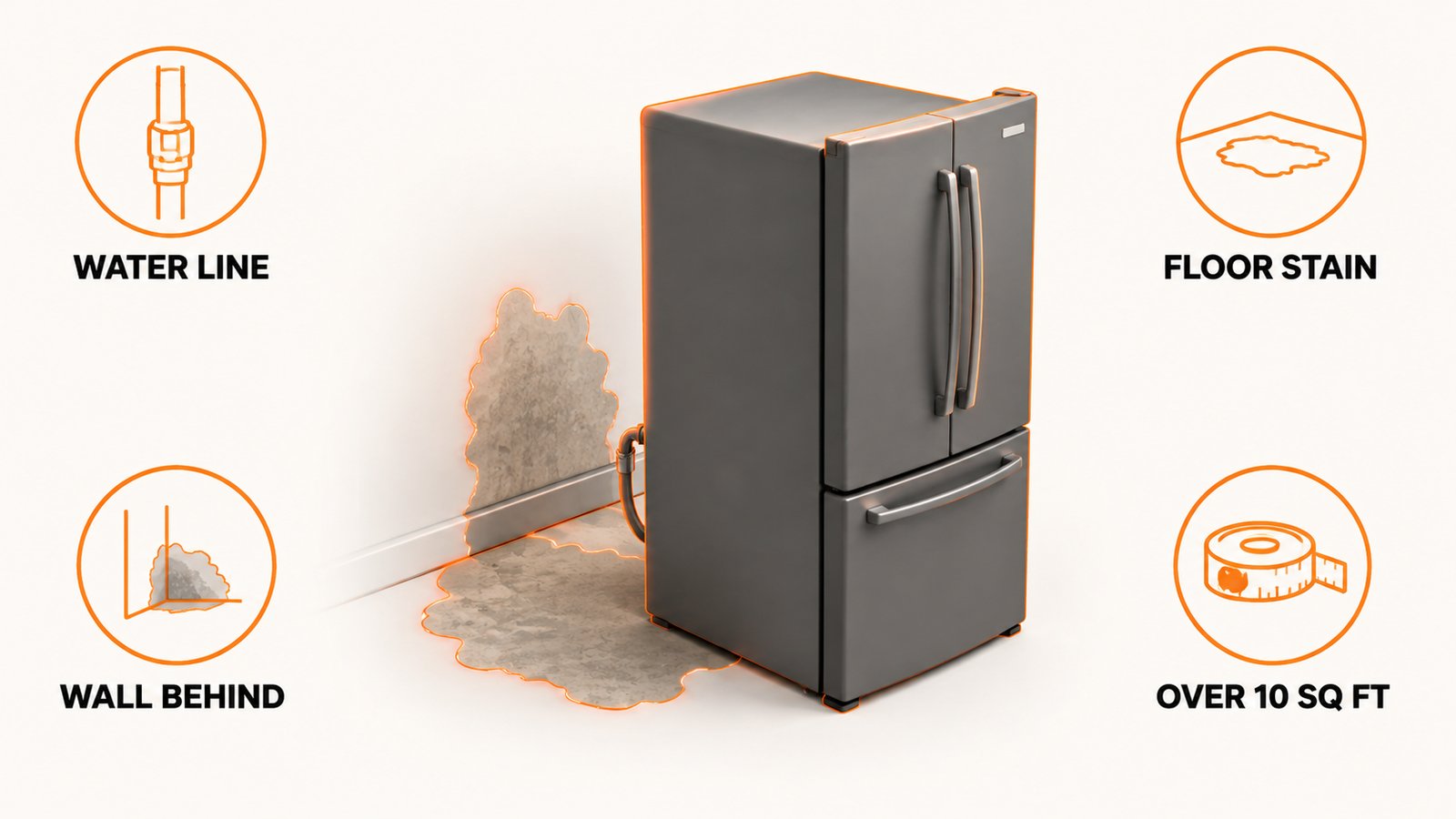
A refrigerator interior is a cleaning job. Four situations are not.
Growth on the wall or floor behind the fridge. Ice maker supply lines fail slowly, and a pinhole leak behind an appliance nobody moves can run for months. That is a building problem, and by the time it is visible the affected area is usually larger than what you can see.
The affected area outside the appliance is larger than about 10 square feet. EPA's line for consumer cleanup, above which it points readers to its professional remediation guide.
The floor is soft, or the cabinet next to the fridge is stained. Water has been moving through the structure, and cleaning the surface treats a symptom. See mold in the kitchen for the cabinet and under-sink cases.
Someone in the home reacts to it. CDC says exposure to damp and moldy environments may cause a variety of health effects or none at all, that people with asthma or a mold allergy may have severe reactions, and that immune-compromised people and people with chronic lung disease may get lung infections from mold. Health questions go to a licensed clinician.
If it turns out to be a repair rather than a wipe-down, the 2026 price tables are on mold removal cost. If the appliance nearby is the washer rather than the fridge, mold in a washing machine covers that gasket, and mold in a dishwasher covers the other wet appliance in the same room.
Frequently asked questions
Is mold in the fridge dangerous?
USDA treats it as a food-handling problem with clear rules rather than a single yes or no. Discard high-moisture and porous foods, trim 1 inch around and below a spot on hard cheese and firm produce, do not sniff the moldy item because FSIS says it can cause respiratory trouble, and clean the spot where it was stored. Health questions belong to a licensed clinician.
How do I clean mold out of a refrigerator?
USDA gives two solutions for two surfaces. Clean the inside every few months with 1 tablespoon of baking soda dissolved in a quart of water, rinse with clear water and dry. For visible mold on the rubber casings, usually black, scrub with 3 teaspoons of bleach in a quart of water. Never mix bleach with another cleaner, and launder or discard the cloths afterward.
Can mold grow in a fridge if it is cold enough?
Yes. FSIS states that while most molds prefer warmer temperatures, they can grow at refrigerator temperatures too, and that molds tolerate salt and sugar better than most other food invaders. That is why it turns up in refrigerated jams and jellies and on cured salty meats. Keeping the fridge at 40 degrees Fahrenheit or below slows it, it does not prevent it.
Do I have to throw out everything in the fridge?
No. USDA's table saves several categories. Hard cheese where mold is not part of the process, firm low-moisture produce such as cabbage, bell peppers and carrots, and hard salami and dry-cured country ham can all be used after trimming or scrubbing. Everything wet or porous goes, including soft cheese, all shredded and sliced cheese, yogurt, jams, bread and soft produce.
Why does the mold keep coming back in the same spot?
Usually the door gasket. If a slip of paper pulls out of the closed door with no drag, the seal is not compressing, warm humid air is getting in continuously, and the compartment is probably running warm too. The other repeat causes are a musty cleaning cloth carrying spores back in and a blocked defrost drain channel.
What about mold in the ice maker?
Treat it as a wet-parts problem, not a cold-storage one. Empty and wash the ice bin in the sink, dry it fully, and follow the manufacturer's manual for the reservoir, fill tube and filter, because disassembly differs by model. Do not put a bleach solution anywhere ice or drinking water contacts unless the manual specifically says to, and do not use ice from a bin with visible growth.
Can I just scoop the mold off the jam?
USDA says no. Its guidance for jams and jellies is discard, on the reasoning that the mold could be producing a mycotoxin and that microbiologists recommend against scooping out the mold and using the remaining condiment. The same logic covers yogurt, sour cream and every soft cheese.
How can I stop my fridge from smelling musty?
Wash the interior with the baking soda solution, clean the drawers and the channel underneath them separately, scrub the gasket folds, and launder or replace the cloths you used. FSIS notes that a musty smell on a dishcloth means it is spreading mold around. If the smell survives all of that, the source is probably outside the appliance.
Sources
Every claim on this page traces to one of these. Links open the primary document.