Do You Actually Need a Mold Test?
Often, no. CDC does not recommend routine home mold testing, and EPA says visible mold generally does not need sampling before cleanup.
Investigate inaccessible moisture carefully. Odor, staining, or a meter reading can justify a building investigation but cannot confirm hidden growth or severity.
Do not use building tests to diagnose symptoms. A sample cannot confirm or rule out the cause of a person's symptoms. A licensed clinician handles health questions.
Define documentation needs before sampling. A landlord, insurer, attorney, buyer, or remediation contract may require a particular method. No generic kit automatically creates legal or insurance evidence.
Define verification before remediation. An independent qualified professional can help set completion criteria. No single sample or score proves a building is safe for every occupant.
DIY Mold Testing Methods
If you are comparing consumer options, our mold testing kit guide breaks down what each format can and cannot tell you.
Surface sample
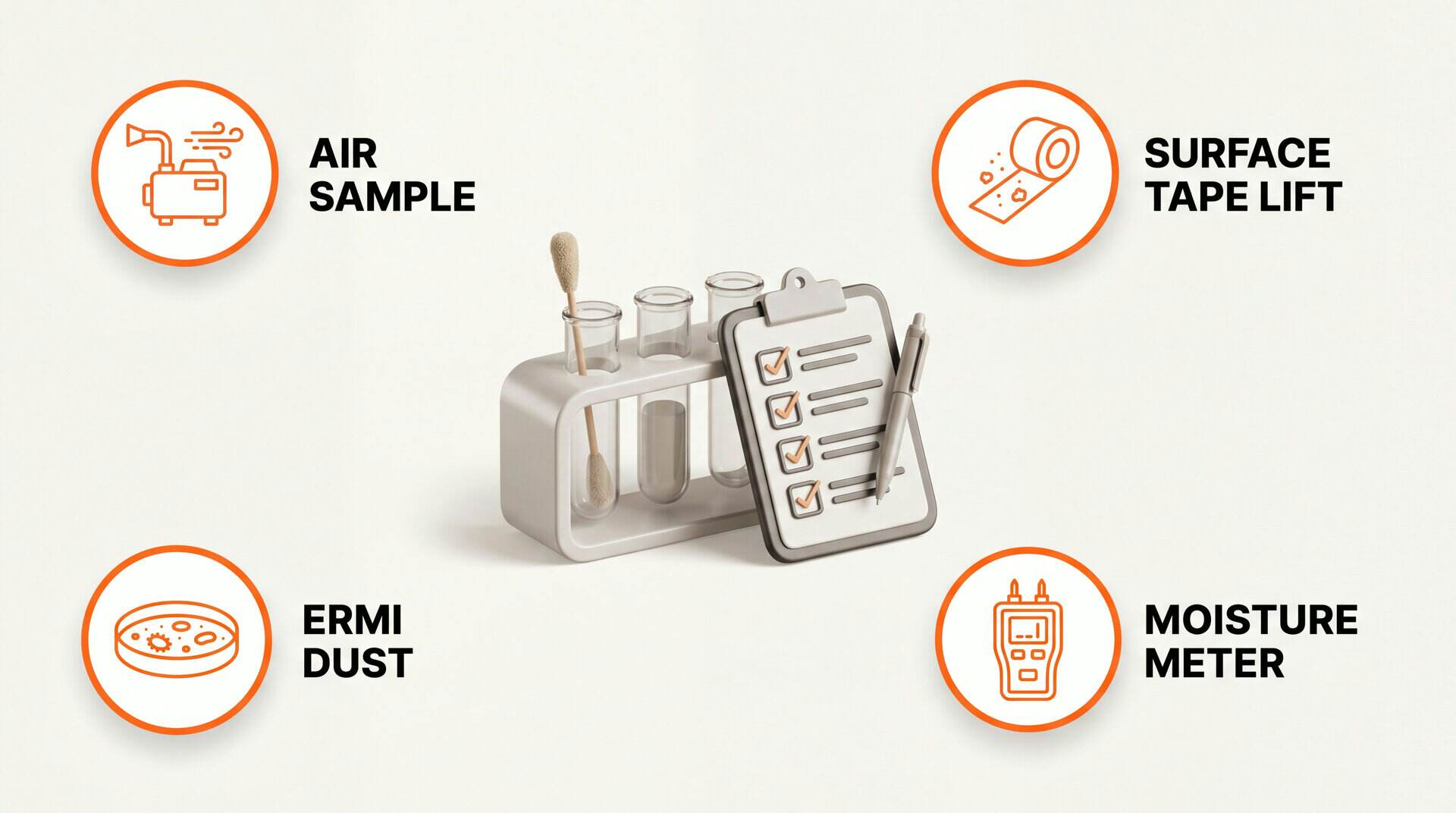
A laboratory may identify organisms in the material placed on a tape lift or swab. The result describes that submitted spot only. It does not rank health risk, establish whole-room severity, or show what is behind a surface.
Settle Plate Test (Petri Dish)
A consumer petri dish shows what grew under that kit's collection and culture conditions. It does not establish whether a home is safe, whether hidden growth is absent, or what exposure means for a person.
DIY Air Sampling Cassette
Air results depend on the collection method, location, timing, outdoor conditions, ventilation, and laboratory interpretation. One consumer air-sampling kit is examined in our Got Mold? test kit review. CDC notes that there are no health-based indoor mold standards and does not recommend routine air sampling for building evaluations.
ERMI dust analysis
ERMI analyzes mold DNA in a dust sample. EPA describes ERMI as a research tool and does not recommend it for routine public use in homes, schools, or other buildings. If a qualified professional has asked for this method, our guide to the best ERMI test kits compares the consumer options. An ERMI value is not a clearance or health-safety threshold.
Professional Mold Testing Methods
A qualified professional should begin with the question being investigated, then choose inspection and sampling methods that can address that question. Our guide to professional mold testing explains the boundaries.
Air sampling: Results are a time-limited snapshot and require a documented protocol and careful interpretation. They do not establish a universal safe level.
Moisture assessment: Meters and thermal cameras can support investigation, but readings depend on materials and conditions. They do not see mold or prove a source.
Invasive inspection: Wall cavities can contain electrical, plumbing, structural, or hazardous-material risks. Drilling or cutting requires an appropriate safety and containment plan.
Material samples: A laboratory can describe the submitted material. The result does not establish the condition of unsampled areas.
Separate Medical Questions From Building Tests
A building sample cannot diagnose a person, and a medical test cannot locate a building defect. Symptoms are nonspecific and require evaluation by a licensed clinician who knows the person's history.
This site does not recommend urine mycotoxin panels, genetic susceptibility tests, VCS screens, biomarker panels, medications, supplements, or treatment protocols. Do not use a consumer test or online score to self-diagnose mold illness.
Plan Scope and Cost
Prices change by location and scope. Before paying, get a written proposal that states:
- Purpose: the exact question the inspection or sample is meant to address.
- Scope: accessible areas, instruments, sample types, count, and locations.
- Laboratory: method, accreditation or qualifications, fees, and reporting limits.
- Interpretation: who explains results and which conclusions the method cannot support.
- Deliverables: photographs, moisture observations, laboratory reports, and any verification criteria.
Mold Scanner can organize guided photos and provide AI-assisted visual screening of submitted visible surfaces. It cannot select a sampling plan, flag hidden growth, interpret laboratory results, or generate remediation scope.
If a Laboratory Requests a Surface Sample

Do not improvise a universal collection method. Ask the laboratory or qualified professional for written instructions that match the analytical method and decision being made.
Check safety first. Do not disturb extensive growth, unstable material, HVAC equipment, electrical areas, or suspected hazardous building materials.
Follow the supplied procedure exactly. Use only the collection material, location, handling, labeling, and shipping process specified for that method.
Record limitations. The result applies to the submitted sample and cannot establish the condition of unsampled surfaces or a person's health risk.
Frequently asked questions
Can I test for mold myself?
Consumer kits can describe only the submitted sample under their stated method. They cannot establish the condition of an entire room or home, diagnose health effects, locate hidden growth, or prove safety. CDC does not recommend routine home mold testing.
What is the most accurate mold test for homes?
There is no single best whole-home test. Results depend on the question, sampling plan, timing, method, laboratory, and interpretation. EPA describes ERMI as a research tool and does not recommend it for routine public use.
Do home mold test kits work?
A kit may report what was present in a submitted surface, dust, or air sample, but it cannot determine whole-building severity or health risk. A negative sample cannot rule out growth elsewhere, and a positive culture is not a safety threshold.
When should I test for mold instead of just addressing it?
When mold is visible, federal guidance generally emphasizes correcting moisture and removing the mold rather than identifying its type. Sampling may be useful when a qualified professional defines a specific investigation or verification question before collection.
How much does mold testing cost?
Cost varies by location, scope, number and type of samples, laboratory fees, and interpretation. Get a written quote that states the purpose, method, sample count, limits, and deliverables before paying.
Sources
Every claim on this page traces to one of these. Links open the primary document.