What kills mold, product by product
The word "kills" is a label claim, so it only means something when you know whose label you are reading. In the United States, a product sold to destroy or suppress harmful microorganisms on surfaces is an antimicrobial pesticide, and EPA says more than 4,000 antimicrobial products are registered and sold. A box of baking soda or a jug of vinegar is not in that group. Nobody reviewed a mold claim for them.
The table sticks to what each maker, regulator or lab study says.
| Option | What its label or EPA record says | Surfaces | Cautions | Our page |
|---|---|---|---|---|
| Chlorine bleach | EPA says a biocide that kills organisms such as mold, chlorine bleach for example, is not recommended as a routine practice during mold cleanup. CDC lists no more than 1 cup of household laundry bleach in 1 gallon of water for hard surfaces. | Hard, non-porous surfaces such as tile, glass and tubs | Never mix with ammonia or acids. Ventilate and exhaust air outdoors. | Does bleach kill mold |
| White vinegar | Lab testing of vinegar at 4.0 to 4.2 percent acetic acid inhibited the growth of one of two common indoor fungi and not the other. A grocery vinegar bottle is not sold with a mold claim. | Small hard-surface spots | Never mix with bleach. Acid can harm natural stone and some metals. | Does vinegar kill mold |
| Hydrogen peroxide, 3 percent | The drugstore label we read lists first aid antiseptic use and makes no mold claim. | Hard surfaces and grout, after a spot test | Can lighten fabric and some finishes. | Hydrogen peroxide for mold |
| Baking soda | Lab work found bicarbonate and carbonate salts fungistatic on citrus green mold, which means they slow growth. It is sold as food with no mold claim. | Light film on hard surfaces, as a scrub | Not a kill. Never mix with vinegar in one container. | Baking soda for mold |
| Borax | The National Pesticide Information Center says boric acid can stop the growth of fungi such as mold. Laundry products that contain it fall under non-pesticide products. | Hard surfaces that dry fully | Inhibits growth. No label directions for mold. | Borax for mold |
| Tea tree oil | One lab comparison found it the most effective of five agents tested. Published numbers come from culture plates, not walls. | Small hard surface, as a finishing wipe | Not a registered mold product. Keep it away from pets. | Tea tree oil for mold |
| Concrobium Mold Control | The maker's product page says it effectively eliminates existing mold and prevents regrowth. The page we read shows no EPA registration number. | The maker lists drywall, wood, concrete, tile and many more | Our review notes it cannot reach growth rooted inside porous material. | Does Concrobium kill mold |
| KILZ Mold & Mildew Primer | The data sheet says an EPA registered ingredient creates a film that protects the primer film from mold and mildew growth. It also says the surface must be free of mold first. | Clean, dry walls and ceilings in damp-prone rooms | A primer, not a cleaner. | Does KILZ kill mold |
| RMR-86 stain remover | The maker's product page answers the question directly: it does not kill mold, it only removes the stains caused by mold and mildew. | Stained hard surfaces | Not a mold killer. Treat like bleach. | Does RMR-86 kill mold |
| UV light | EPA training material says mold does not need light to grow and can grow in dark, hidden places. A lamp only reaches what it lights. | Visible surfaces only | Never aim UV-C at skin or eyes. | UV light for mold |
| Ozone generator | EPA says at levels within public health standards, ozone does not effectively remove mold, and no federal agency has approved these devices for occupied spaces. | None recommended | Ozone is a lung irritant. | Ozone generator for mold |
For ranked picks of purpose-built products, see our roundups of mold cleaning products and best mold removal products.
What kills mold on porous surfaces
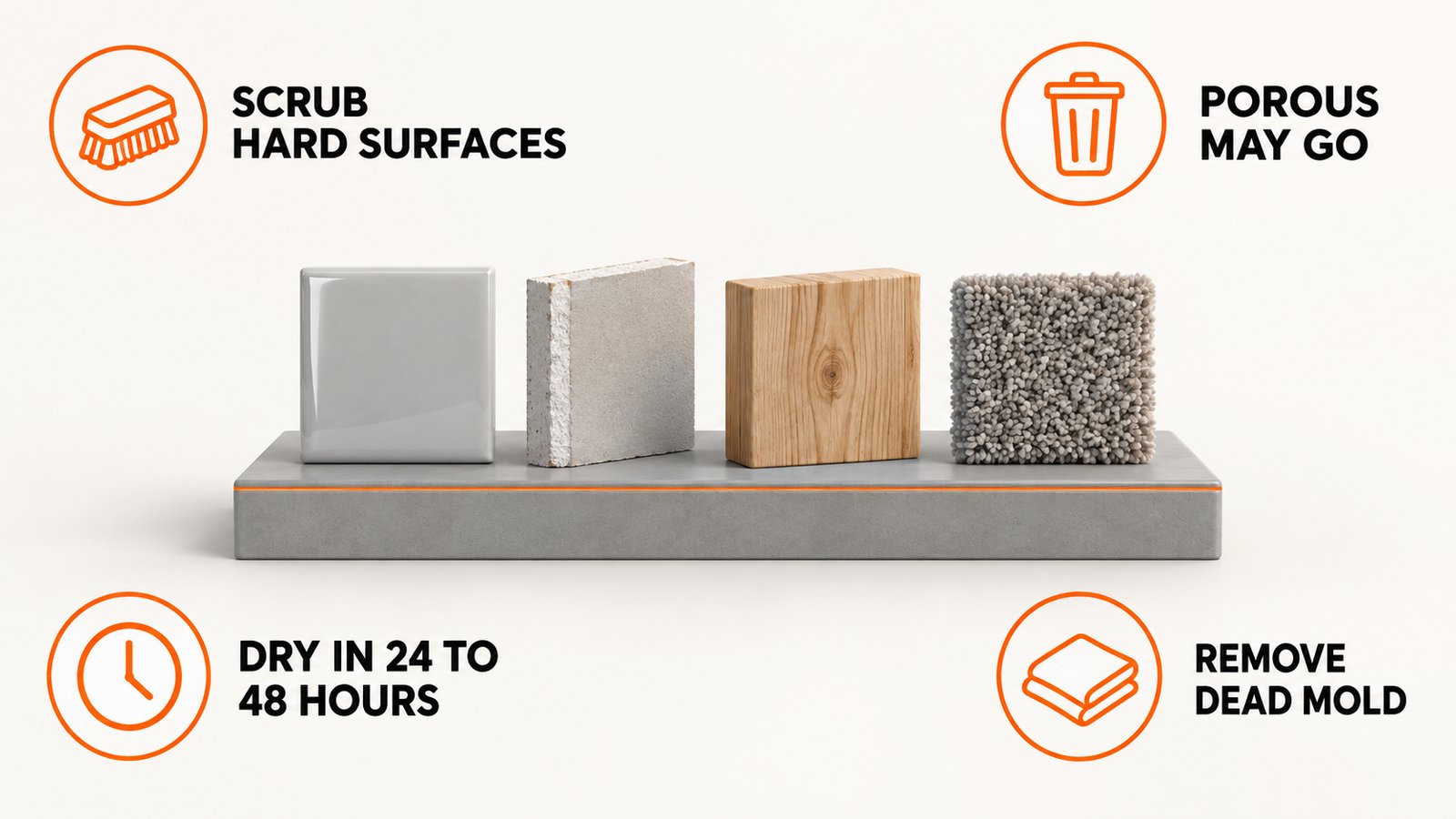
Short answer: usually nothing you can pour on it. EPA says absorbent or porous materials, such as ceiling tiles and carpet, may have to be thrown away if they become moldy, because mold can grow on or fill in the empty spaces and crevices of porous materials and may be difficult or impossible to remove completely.
That is why the surface matters more than the bottle. Here is how the usual materials sort out:
- Non-porous: tile, glass, metal, sealed counters and tubs. EPA's method is to scrub mold off hard surfaces with detergent and water and dry completely.
- Semi-porous: painted drywall, sealed wood and grout. Light surface growth on a sound surface may clean. Soft, swollen or stained-through material does not. Our guides to mold on drywall, mold on wood and mold on grout show how to tell.
- Porous: carpet, ceiling tile, insulation and padding. Plan to replace them if they get moldy.
Pouring a liquid onto drywall also adds water to a water problem. EPA's prevention advice is to dry wet or damp materials within 24 to 48 hours, because mold growth is then unlikely in most cases. If you are choosing between bottles on one of these materials, our bleach vs vinegar page walks through that fight, and best mold killer for wood and drywall covers product picks for those two materials.
EPA also notes that dead mold may still cause allergic reactions in some people, so it must be removed, not only killed.
What percent hydrogen peroxide kills mold
This question gets searched in a dozen forms, and it deserves a straight answer: no label we found names a percentage that kills mold on a wall.
The bottle most people own is 3 percent. We read the Drug Facts label on a store-brand 3 percent bottle. It lists the active ingredient as hydrogen peroxide 3 percent and the purpose as a first aid antiseptic. It says nothing about mold. That does not mean peroxide does nothing on a bathroom tile. It means the household bottle is not sold or reviewed for mold work, so there is no label rate, no label contact time and no label surface list to follow.
Our hydrogen peroxide for mold guide covers the 3 percent strength that homeowners use, the steps, the dwell time and the finishes it can lighten.
If you want a product with a mold claim and directions behind it, look for one that states the claim on its own label, then follow its dwell time and surface list instead of guessing a percentage. A spot test on a hidden corner is still smart, because peroxide can lighten colored grout, fabric and some paints.
What spray kills mold
Only a spray whose own label says it kills mold, for the surface you are spraying, earns that name. That sounds obvious, and it filters out a lot of the shelf.
Here is what the labels and makers we read actually claim:
- A bleach-based stain remover can be honest about being a stain remover. RMR Brands answers the question on its RMR-86 page: "this product does not kill mold, it only removes the stains caused by mold and mildew." See does RMR-86 kill mold.
- The Concrobium Mold Control product page says it effectively eliminates existing mold and prevents mold re-growth. We could not find an EPA registration number on that page, so the claim comes from the maker. Our Concrobium page covers how it dries and where it falls short, and the full Concrobium Mold Control review has the rest.
Read four things before you buy: the claim wording, the surface list, the directions and the dwell time. Then check the part people skip, which is the line about what to do first. KILZ, for example, tells you to wash mold off the surface before priming.
No spray fixes the water that feeds the colony. EPA says moisture control is the key to mold control.
What paint kills mold
Paint cannot kill a mold colony that is already on the wall. Some paints and primers protect the dried coat from new growth, and that is a different job.
EPA is direct about the order: do not paint or caulk moldy surfaces. Clean up the mold and dry the surfaces before painting, because paint applied over moldy surfaces is likely to peel.
The KILZ Mold & Mildew Primer data sheet fits that rule: it says the EPA registered active ingredient creates a mold and mildew-resistant film that protects the primer film from mold and mildew growth, and its surface preparation section says the surface must be free of mold and mildew. So the can protects the paint, not the wall under it. We go through the label line by line in does KILZ kill mold.
Other primer labels word this differently, and the wording is what counts. Our can you paint over mold page covers the question for each case, and best mold resistant paints compares paints made for damp rooms.
What does not kill mold
Several popular answers fall short when you read the sources.
UV light. EPA's mold course says mold does not need light to grow and can grow in dark areas and on hidden surfaces such as the backside of drywall, wallpaper, paneling and the top side of ceiling tiles. A lamp reaches only what it lights. EPA lists eyes, nose and a flashlight as the most important equipment for investigating, with borescopes and moisture meters for hidden areas. See UV light for mold.
Ozone generators. EPA says that if used at concentrations that do not exceed public health standards, ozone applied to indoor air does not effectively remove viruses, bacteria, mold or other biological pollutants. It adds that even at high concentrations, ozone may have no effect on contaminants embedded in porous material, and that no agency of the federal government has approved these devices for use in occupied spaces. Details are on ozone generator for mold.
Baking soda. In the lab it slowed growth of green mold on oranges. All the carbonate and bicarbonate salts tested were fungistatic. That is a long way from a kill. Use it as a mild scrub, as covered in baking soda for mold.
Borax. The National Pesticide Information Center says boric acid can stop the growth of fungi such as mold and prevents them from reproducing. Stopping reproduction is not the same as a fast kill. See borax for mold.
Vinegar and tea tree oil. In one published comparison of five agents against two common indoor fungi, tea tree oil showed the greatest inhibitory effect, vinegar inhibited Penicillium chrysogenum but not Aspergillus fumigatus, and 70 percent ethanol inhibited neither. You cannot tell which fungus is on your wall by looking. Our pages on vinegar and tea tree oil give the methods and the limits.
Never mix cleaners to kill mold faster
Stacking products feels thorough. It is the fastest way to hurt yourself.
Bleach and ammonia. EPA says to never mix chlorine bleach solution with other cleaning solutions or detergents that contain ammonia, because toxic fumes could be produced. CDC gives the same warning: never combine bleach with ammonia or other cleaners.
Bleach and vinegar. Health Canada's advisory says bleach will react with any cleaning product containing ammonia or an acid, including vinegar, and names glass cleaners as one source of the problem. It also says breathing the gases can be deadly. If you switch products, rinse the surface well with water and ventilate before the second one comes out.
Ventilate. If you choose a disinfectant or biocide, EPA says to always ventilate the area and exhaust the air to the outdoors.
Protect yourself. CDC says to wear rubber boots, rubber gloves and goggles during cleanup. Our how to get rid of mold guide lists the full sequence, and a HEPA vacuum helps with debris.
If someone breathes fumes after mixing products, get them to fresh air and call Poison Control at 1-800-222-1222 in the United States. Poison Control says mixing bleach with an acid forms chlorine gas and that anyone who inhales it should leave the area immediately and breathe fresh air.
What professionals use to kill mold
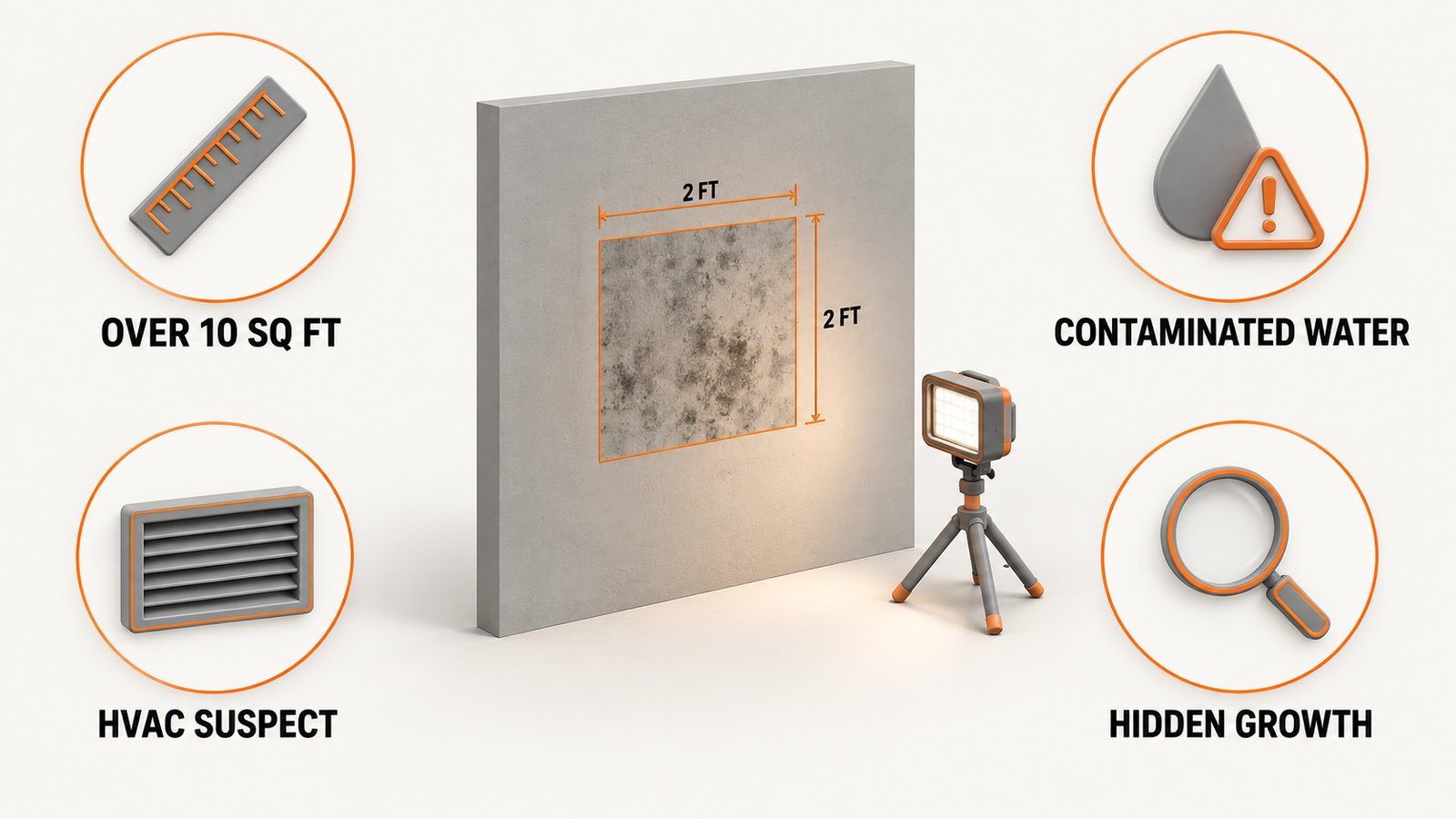
Professionals work to written guidance rather than a favorite bottle. EPA says that if the moldy area is less than about 10 square feet (less than roughly a 3 foot by 3 foot patch), in most cases you can handle the job yourself. If there has been a lot of water damage, or mold growth covers more than 10 square feet, it points to its guide for mold remediation in schools and commercial buildings, which it says applies to other building types too. It also notes that a contractor can follow the ACGIH guidelines or the ANSI/IICRC S520 standard.
Other cases that call for experience:
- Sewage or contaminated water. EPA says to call in a professional who has experience cleaning and fixing buildings damaged by contaminated water.
- An HVAC system. If you know or suspect it is contaminated with mold, EPA says not to run it, because it could spread mold throughout the building.
- Hidden growth. A moldy smell with no visible source calls for careful investigation, and EPA warns that disturbing moldy areas may spread mold.
Educational note: this page covers cleaning products and protective equipment. EPA advises consulting a health professional before starting cleanup if you have health concerns.
Once the cleanup is done, drying keeps it done. EPA says to keep indoor humidity below 60 percent, ideally between 30 and 50 percent, and a dehumidifier helps in damp rooms. Orange or fuzzy growth outside a bathroom is a good reason to read about orange mold before you spray anything.
Frequently asked questions
What kills mold the best?
No single product wins on every surface. EPA's recommended method for hard surfaces is to scrub mold off with detergent and water and dry completely, and it does not recommend a biocide such as chlorine bleach as a routine practice. Products with a mold claim on their own label can be used on the surfaces that label names. Porous material that is moldy may have to be thrown away.
What kills mold on porous surfaces?
Usually nothing that you pour on it. EPA states that absorbent or porous materials, such as ceiling tiles and carpet, may have to be thrown away if they become moldy, because mold may be difficult or impossible to remove completely. Light surface growth on a sound painted wall may clean with detergent and water, and soft or swollen material comes out.
What percent hydrogen peroxide kills mold?
We found no label that names a percentage for mold on a wall. The 3 percent drugstore label we read lists first aid antiseptic use and makes no mold claim. Our hydrogen peroxide page covers how homeowners use the 3 percent strength and where it falls short. For a product with a mold claim, follow the strength and dwell time on that product's own label.
Does EPA recommend bleach for mold?
No, not as a routine practice. EPA says the use of a chemical or biocide that kills organisms such as mold, chlorine bleach for example, is not recommended as a routine practice during mold cleanup, though professional judgment may indicate its use in specific cases, such as when immune-compromised individuals are present. CDC lists a hard-surface solution of no more than 1 cup of bleach in 1 gallon of water.
What paint kills mold?
No paint kills mold already growing on a wall. EPA says not to paint or caulk moldy surfaces and to clean up the mold and dry the surfaces first, because paint applied over mold is likely to peel. The KILZ data sheet describes an EPA registered ingredient that protects the primer film from mold and mildew growth, and it requires a surface free of mold.
Can I mix cleaners to kill mold faster?
No. EPA says never to mix chlorine bleach with products that contain ammonia, because toxic fumes could be produced. Health Canada says bleach reacts with any cleaning product containing ammonia or an acid, including vinegar. Use one product at a time, rinse the surface with water, and ventilate the area.
What do professionals use to kill mold?
They work to written guidance. EPA points to its remediation guide, the ACGIH guidelines and the ANSI/IICRC S520 standard, and it says growth over about 10 square feet, sewage-contaminated water and suspected HVAC contamination call for experienced help. EPA also says dead mold must be removed, not only killed.
Sources
Every claim on this page traces to one of these. Links open the primary document.