What the EPA Actually Found
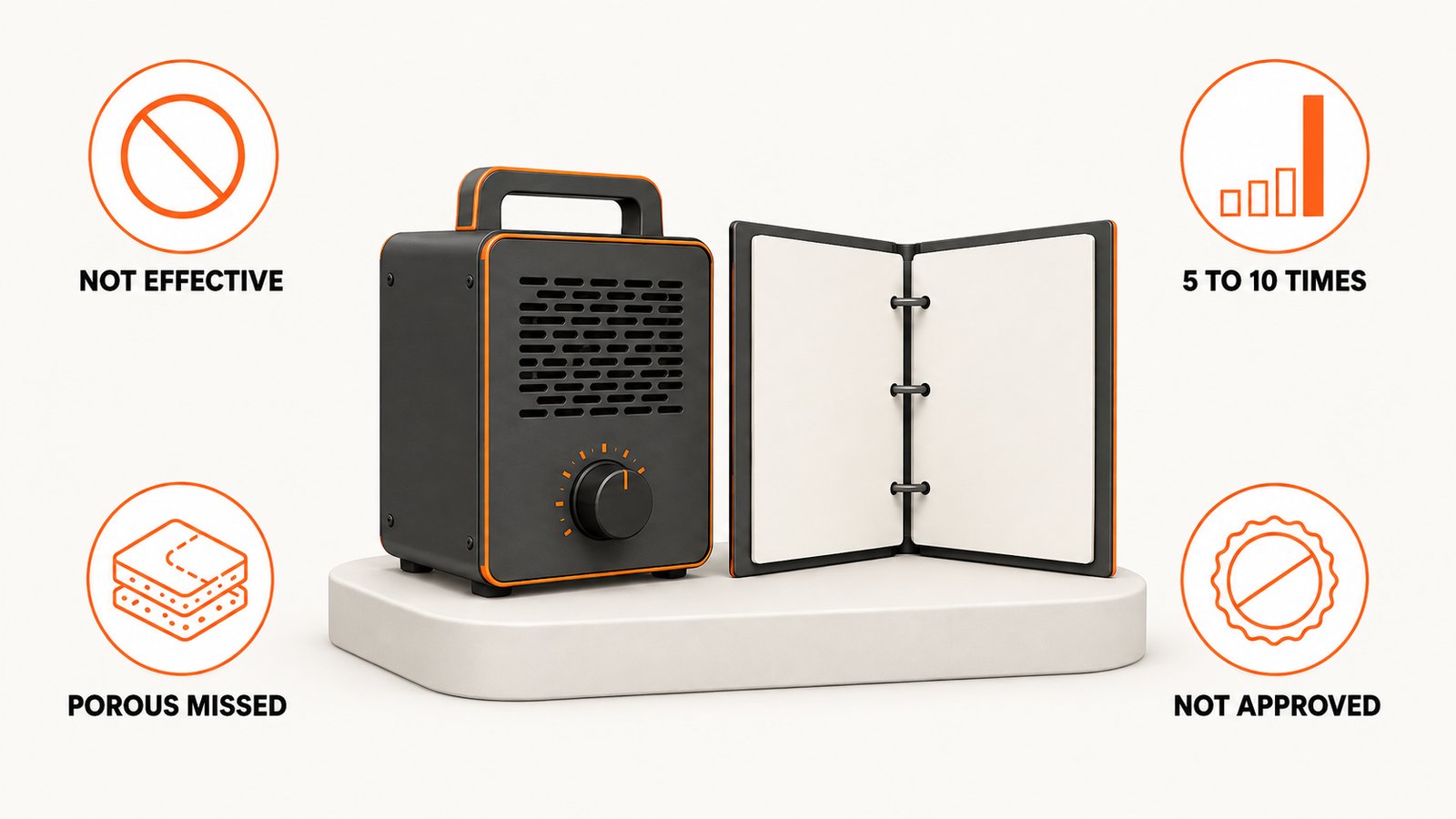
The EPA published a document specifically about these devices, Ozone Generators that are Sold as Air Cleaners, and it says it relied only on peer reviewed, scientifically supported findings. Three sentences from it settle the question.
On effectiveness against mold. If used at concentrations that do not exceed public health standards, ozone applied to indoor air does not effectively remove viruses, bacteria, mold, or other biological pollutants. The agency adds that ozone concentrations would have to be 5 to 10 times higher than public health standards allow before the ozone could decontaminate the air sufficiently to prevent survival and regeneration of the organisms once the ozone is removed.
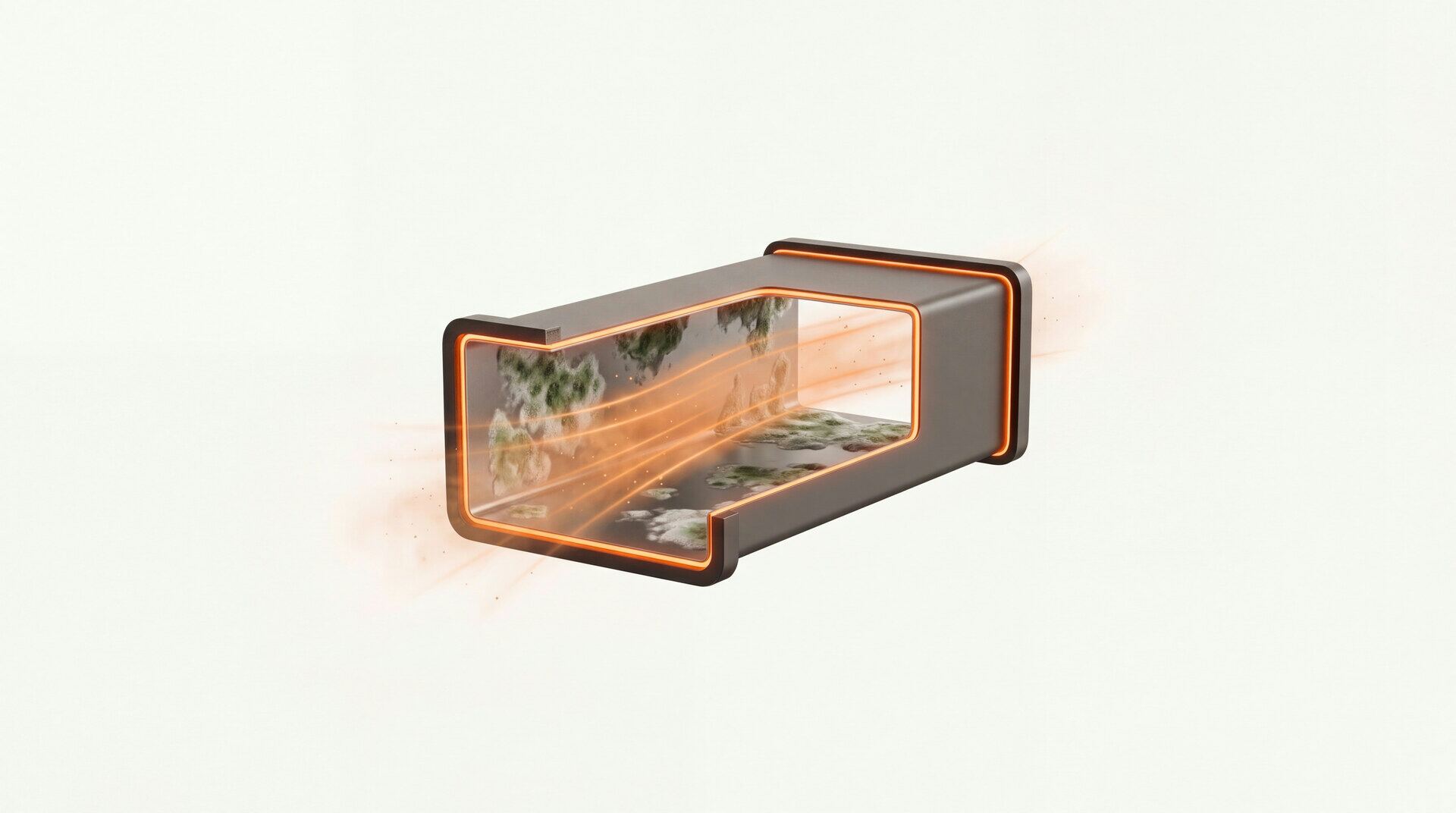
On porous material. Even at high concentrations, ozone may have no effect on biological contaminants embedded in porous material such as duct lining or ceiling tiles. This is the part that matters most for mold, because mold in a house is usually in drywall, wood, carpet backing and insulation rather than floating in the air. The EPA makes the same point about porous material in its household guidance, noting that mold can grow into the empty spaces and crevices of porous materials so it may be difficult or impossible to remove completely.
On federal approval. Some vendors suggest that these devices have been approved by the federal government for use in occupied spaces. To the contrary, no agency of the federal government has approved these devices for use in occupied spaces. The EPA also notes that an EPA establishment number on the packaging identifies the facility that produces the product, and that the display of this number does not imply EPA endorsement or suggest in any way that EPA has found the product to be either safe or effective.
The agency's own summary is that available scientific evidence shows that, at concentrations that do not exceed public health standards, ozone is generally ineffective in controlling indoor air pollution, and that the concentration of ozone would have to greatly exceed health standards to be effective in removing most indoor air contaminants.
The Numbers: Exposure Limits and Real Readings
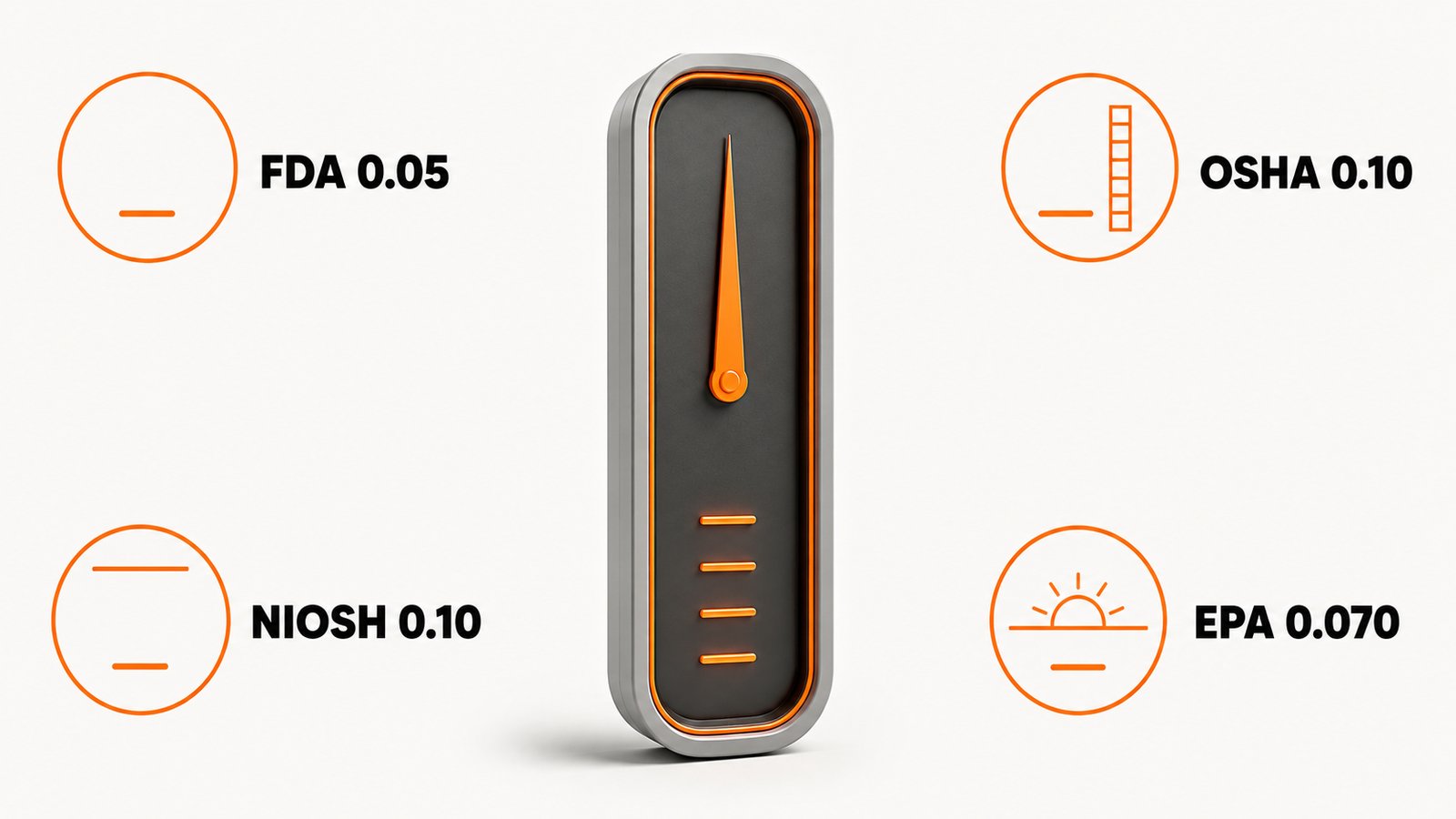
Ozone has published exposure limits, which is unusual in this subject and useful here. The EPA's document lists four.
| Body | Limit | Basis |
|---|---|---|
| FDA | 0.05 ppm | Maximum ozone output required of indoor medical devices |
| OSHA | 0.10 ppm | Workers must not be exposed to an average concentration above this for 8 hours |
| NIOSH | 0.10 ppm | Recommended upper limit, not to be exceeded at any time |
| EPA | 0.070 ppm | Current National Ambient Air Quality Standard, 8-hour outdoor concentration, set in the rule signed October 1, 2015 |
Now the measured readings. In a study the EPA cites, a large ozone generator recommended by the manufacturer for spaces up to 3,000 square feet was placed in a 350 square foot room and run at a high setting. The ozone in the room quickly reached 0.50 to 0.80 ppm, which the EPA describes as 5 to 10 times higher than public health limits.
In an EPA study of several devices placed around a home, some generators run at a high setting with interior doors closed frequently produced concentrations of 0.20 to 0.30 ppm. A powerful unit set on high with interior doors open reached 0.12 to 0.20 ppm in adjacent rooms.
The EPA's conclusion from those studies is the sentence that should end most purchases: results of some controlled studies show that concentrations of ozone considerably higher than these standards are possible even when a user follows the manufacturer's operating instructions.
Two more findings worth knowing. Control settings are not proportional, and in experiments to date the high setting in some devices generated 10 times the level obtained at the medium setting. And you cannot use your nose as a safety gauge, because the ability to detect ozone by smell varies considerably from person to person and one's ability to smell ozone rapidly deteriorates in the presence of ozone. As the EPA puts it, while the smell of ozone may indicate that the concentration is too high, lack of odor does not guarantee that levels are safe.
What Ozone Does to the House
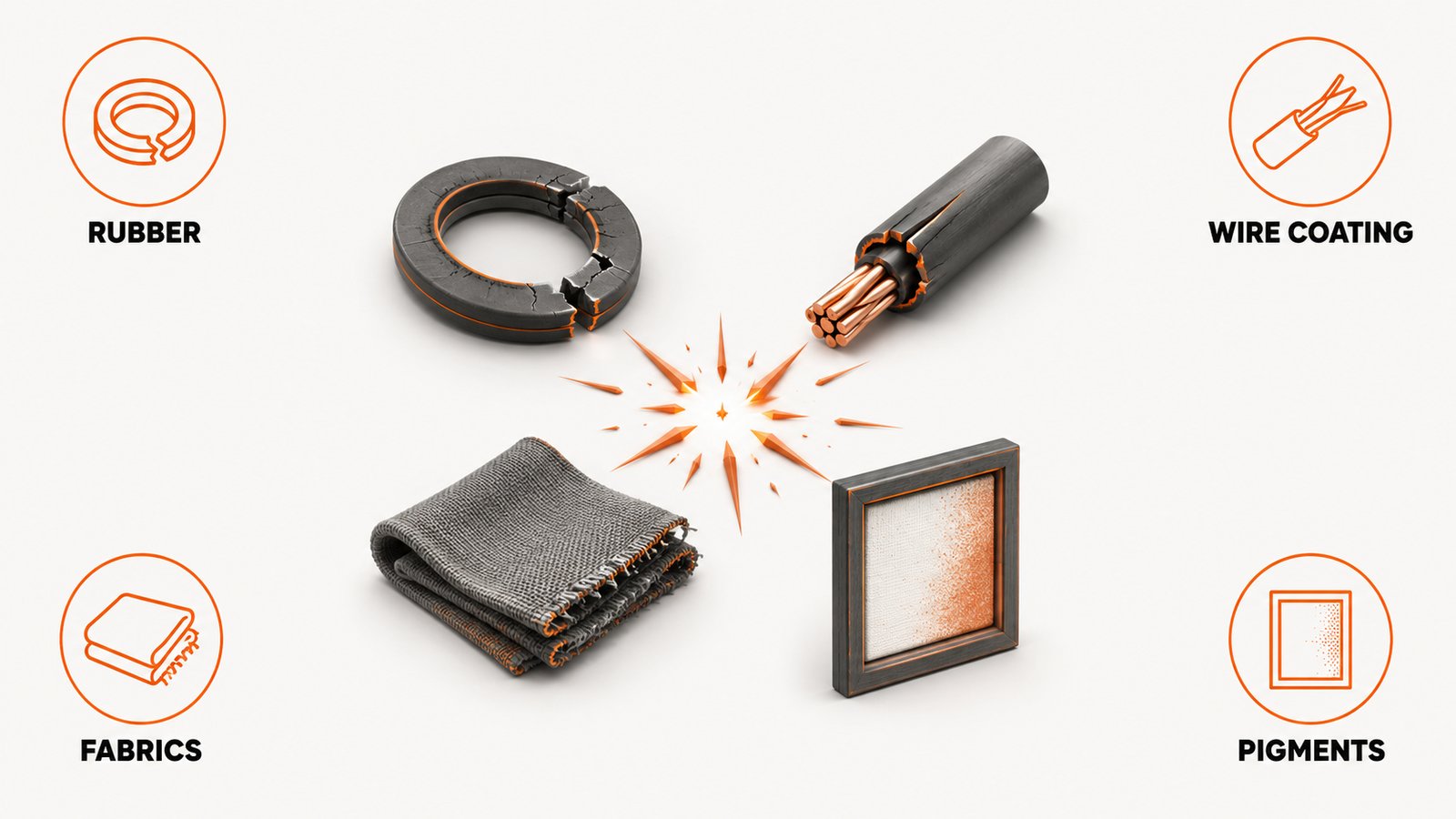
Even setting aside effectiveness, ozone is not inert in a building. The EPA states that ozone can adversely affect indoor plants, and damage materials such as rubber, electrical wire coatings and fabrics and art work containing susceptible dyes and pigments.
It also changes the air chemistry, and not for the better. For many of the chemicals with which ozone does readily react, the EPA states, the reaction can form a variety of harmful or irritating by-products. It gives a specific laboratory example: mixing ozone with chemicals from new carpet reduced many of those chemicals, but produced a variety of aldehydes, and the total concentration of organic chemicals in the air increased rather than decreased after the introduction of ozone. Ozone may also increase indoor concentrations of formic acid, and both aldehydes and formic acid can irritate the lungs if produced in sufficient amounts.
On the specific claims vendors make, the EPA is equally direct. Ozone generators are not effective in removing carbon monoxide or formaldehyde. Ozone does not remove particles such as dust and pollen from the air, including the particles that cause most allergies. In an experiment designed to produce formaldehyde concentrations representative of an embalming studio, ozone showed no effect in reducing formaldehyde concentration. And on odor, other experiments suggest that body odor may be masked by the smell of ozone but is not removed by ozone, with ozone not considered useful for odor removal in building ventilation systems.
The last point is the one that keeps this product category alive in the mold market. A house treated with ozone smells different afterward, and people read that as proof it worked. It is not. The mold is still in the drywall, and now the wiring insulation has had a bad week.
The One Narrow Case: Unoccupied Spaces
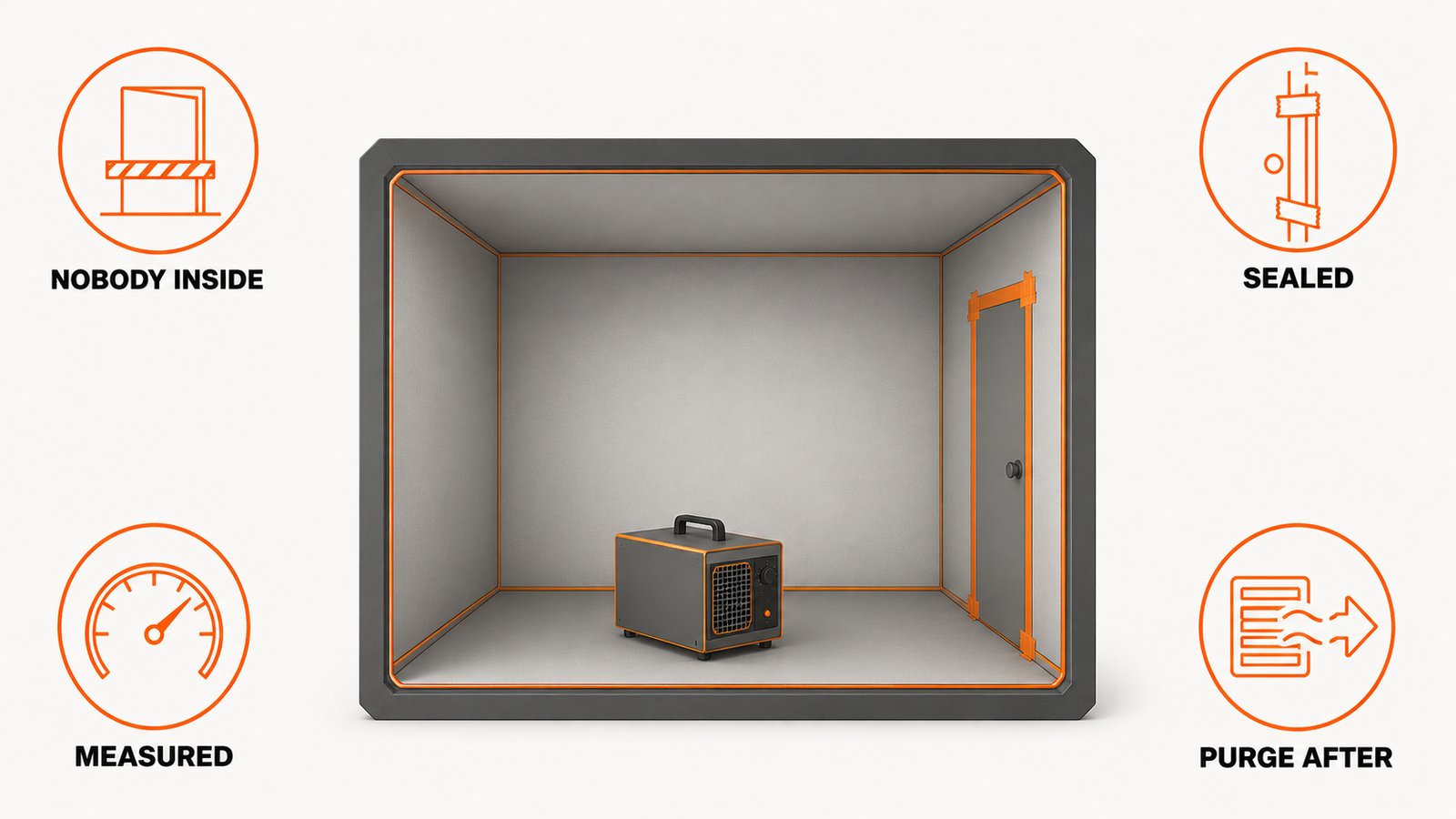
The EPA does describe one context where high-concentration ozone gets used, and it is worth quoting precisely because it is so heavily qualified.
High concentrations of ozone in air, when people are not present, are sometimes used to help decontaminate an unoccupied space from certain chemical or biological contaminants or odors, for example in fire restoration. The agency immediately adds two caveats. Little is known about the chemical by-products left behind by these processes. And while high concentrations of ozone in air may sometimes be appropriate in these circumstances, conditions should be sufficiently controlled to insure that no person or pet becomes exposed.
Read that as a description of a professional procedure in an empty structure with controlled access, not as permission to run a machine in your basement while you sleep upstairs. Three things separate the two:
- Nobody in the building, at all. No people, no pets, no plants. The EPA's phrasing covers all three.
- Controlled conditions and controlled access. That means someone measuring, sealing and preventing entry, not a closed door.
- A purge and a wait before reoccupancy. The EPA notes that little is known about the chemical by-products, which is precisely why this is not a homeowner procedure.
And none of that changes the effectiveness finding. Even where ozone is used this way, the EPA states that ozone produced by ozone generators may inhibit the growth of some biological agents while it is present, but it is unlikely to fully decontaminate the air unless concentrations are high enough to be a health concern if people are present, and that even with high levels of ozone, contaminants embedded in porous material may not be affected at all.
For mold in a house, that means the growth in the wall cavity survives the treatment. Which brings us to what does work.
What Actually Works Instead
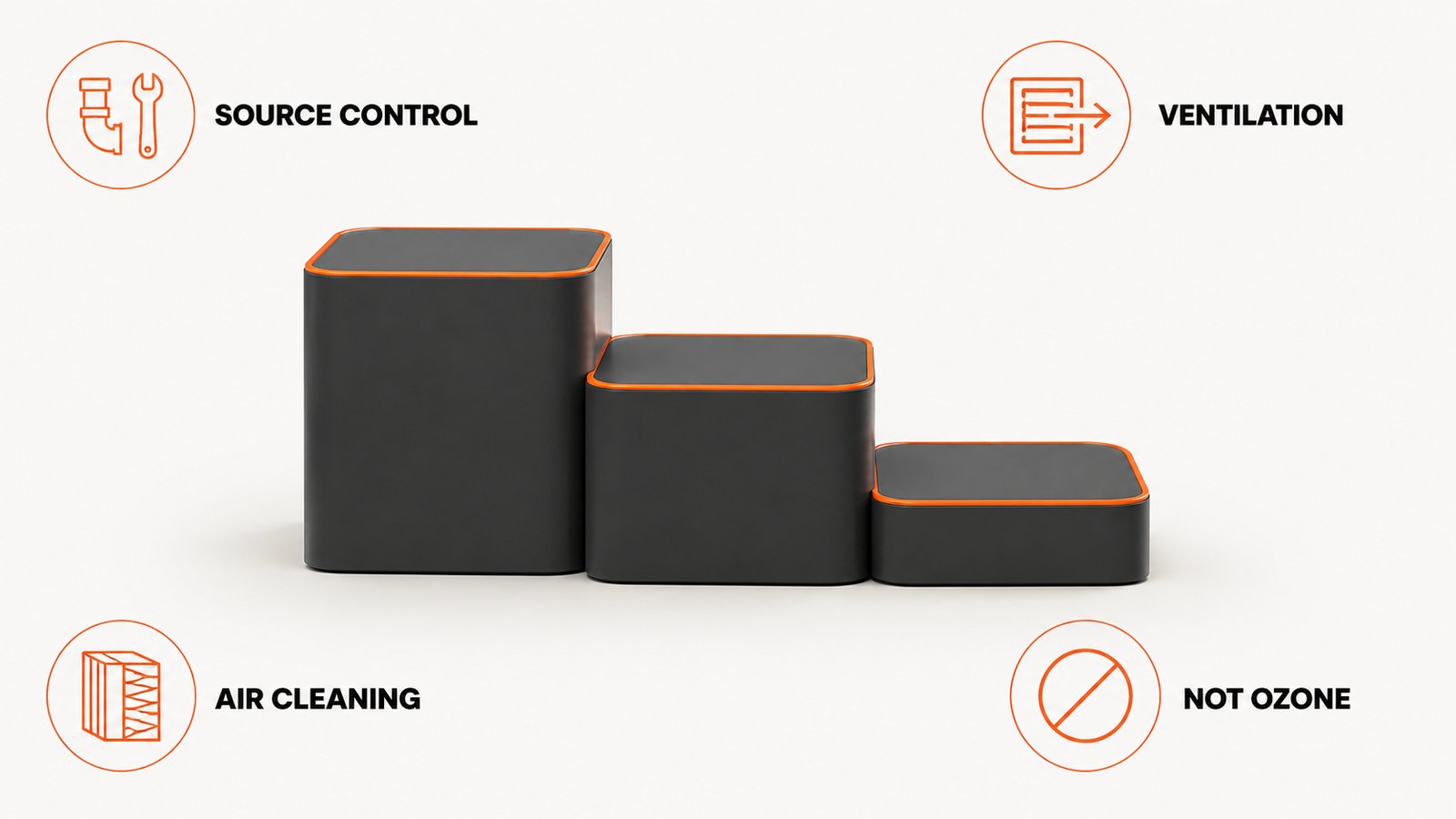
The EPA closes its ozone document with a recommendation and a ranked list, and the ranking is the useful part. It names the three most common approaches to reducing indoor air pollution, in order of effectiveness: source control, meaning eliminate or control the sources of pollution; ventilation, meaning dilute and exhaust pollutants through outdoor air ventilation; and air cleaning, meaning remove pollutants through proven air cleaning methods. It states that of the three, source control is the most effective, and that air cleaning is not generally regarded as sufficient in itself.
Source control, for mold, means moisture control and physical removal. The EPA's household guidance is that the key to mold control is moisture control, that you must clean up the mold and fix the water problem, and that if you clean up the mold but do not fix the water problem the mold problem will most likely come back. Keep indoor relative humidity below 60 percent, ideally between 30 and 50 percent, and dry wet materials within 24 to 48 hours after a leak or spill, because in most cases mold will not grow if you do. It also notes that dead mold may still cause allergic reactions in some people, so it is not enough to simply kill the mold, it must also be removed. No machine of any kind substitutes for that.
Ventilation means moving the moisture out. Bathroom and kitchen exhaust that actually terminates outside, dryers vented outdoors, and windows when the weather allows.
Air cleaning means particle filtration, not gas generation. HEPA filtration captures particles. Ozone, by the EPA's own finding, does not remove particles from the air at all.
One honest note before the picks. The EPA states that it does not certify air cleaning devices and does not recommend air cleaning devices or manufacturers, and points to the Association of Home Appliance Manufacturers, which runs a certification program for room air cleaners known as AC-1 that rates effectiveness by clean air delivery rate for tobacco smoke, dust and pollen. So the products below are our selection, not an agency endorsement, and CADR is the number worth comparing.
The Equipment Worth Buying
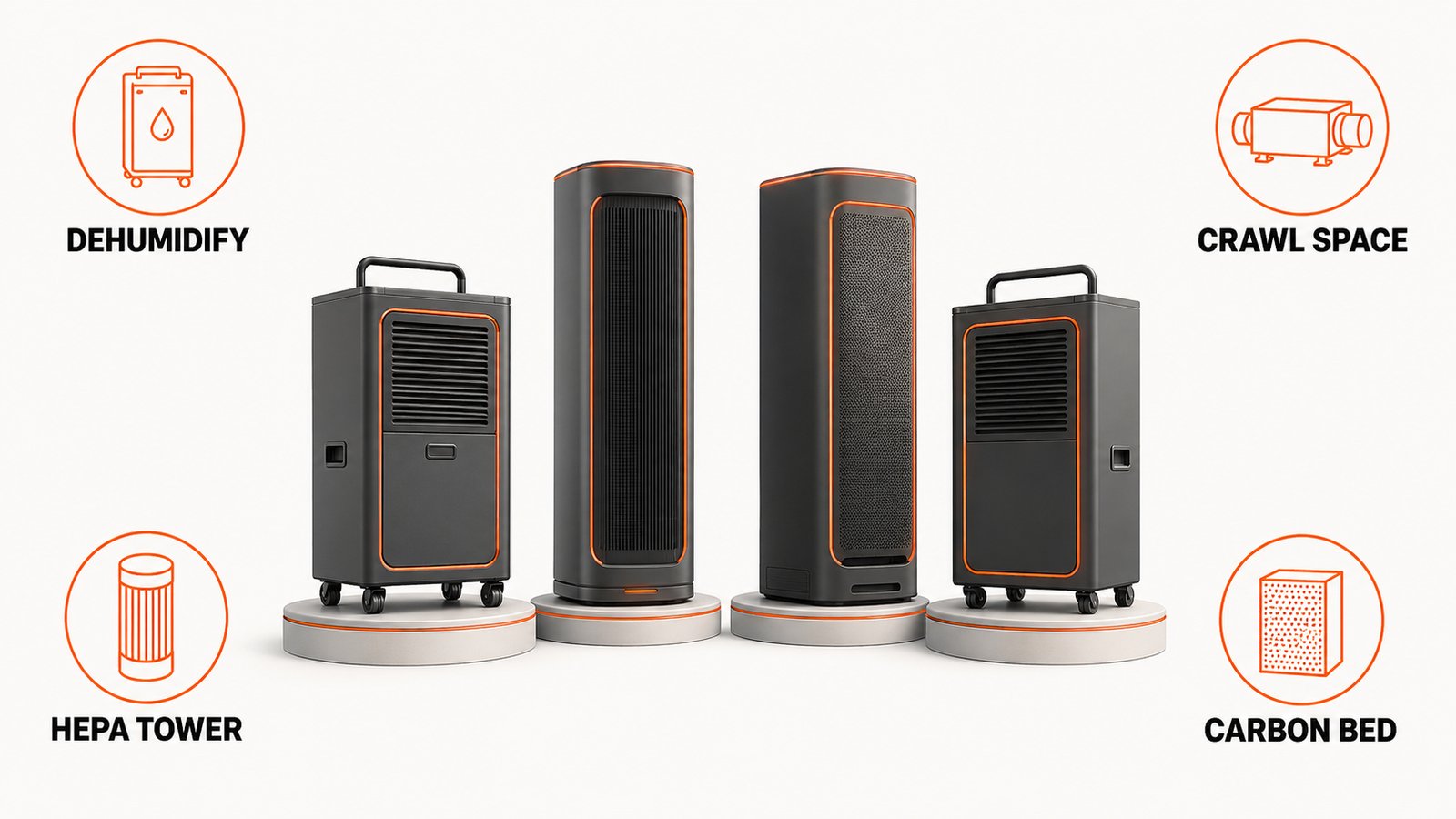
Heads up: the Amazon links below are affiliate links, and buying through them may earn Mold Scanner AI a small commission at no extra cost to you. We checked that every listing below resolves and matches the product named, on September 2, 2026. We are not listing prices or rating counts here, because we could not verify them to our own standard on the day of writing. Check them yourself before you order.
Midea Cube 50 Pint Dehumidifier
Listed for coverage up to 4,500 square feet with smart control and an ENERGY STAR rating, and it ships with a drain hose. This is source control in a box: hold the room under the EPA's 60 percent ceiling and ideally in the 30 to 50 percent band, and the conditions that let growth start stop existing. The Cube's stackable tank design is genuinely useful in a basement where you cannot run continuous drainage to a floor drain. Read our full Midea Cube review for the honest cons.
AlorAir Sentinel HD55 Crawlspace Dehumidifier
A 113-pint commercial-class unit with auto defrost, built for crawl spaces and sealed basements rather than living areas. Crawl spaces are where consumer dehumidifiers fail, because they ice up at low temperatures and stop removing water exactly when the space needs it. Auto defrost is the feature that matters, not the pint rating.
Levoit Core 600S-P Smart Air Purifier
Listed for large rooms up to 2,933 square feet, with HEPA filtration, a sleep mode and remote control. Air cleaning is third on the EPA's ranked list for a reason, so treat this as support during and after a cleanup rather than as the fix. It captures particles, which is exactly what the EPA says ozone does not do. Read our full Levoit Core 600S review for the honest cons.
IQAir HealthPro Plus XE
HyperHEPA filtration with WiFi, listed for large rooms up to 1,125 square feet. The reason to pay this much is the sealed housing: a filter only performs as well as the enclosure around it, and cheap units let air bypass the media entirely. Smaller rated coverage than the Levoit, and a much longer filter life. Read our full IQAir HealthPro Plus review for the honest cons.
Austin Air HealthMate Plus HM450
A steel-cased unit combining HEPA media with a large activated carbon and zeolite bed. The carbon bed is the point here. The EPA notes that ozone is not considered useful for odor removal in building ventilation systems and that body odor may be masked rather than removed, whereas adsorption media physically hold odor compounds. Heavy, and it looks industrial. Read our full Austin Air HealthMate Plus review for the honest cons.
Honeywell HPA300 True HEPA Air Purifier
A no-app, no-subscription HEPA unit for extra large rooms, sold as an allergen and dust reducer. Three filter positions and a simple control panel. If you want particle filtration without a companion application or a proprietary filter ecosystem, this is the least complicated way to get it. Read our full Honeywell HPA300 review for the honest cons.
Affiliate disclosure: the Amazon links above are affiliate links. If you buy through them, Mold Scanner AI may earn a small commission at no extra cost to you. Our selection is our own and is not endorsed by any agency; the EPA states that it does not certify air cleaning devices and does not recommend air cleaning devices or manufacturers. Specifications quoted above come from the live Amazon product listings as they appeared on September 2, 2026, and listings change.
The Picks Compared
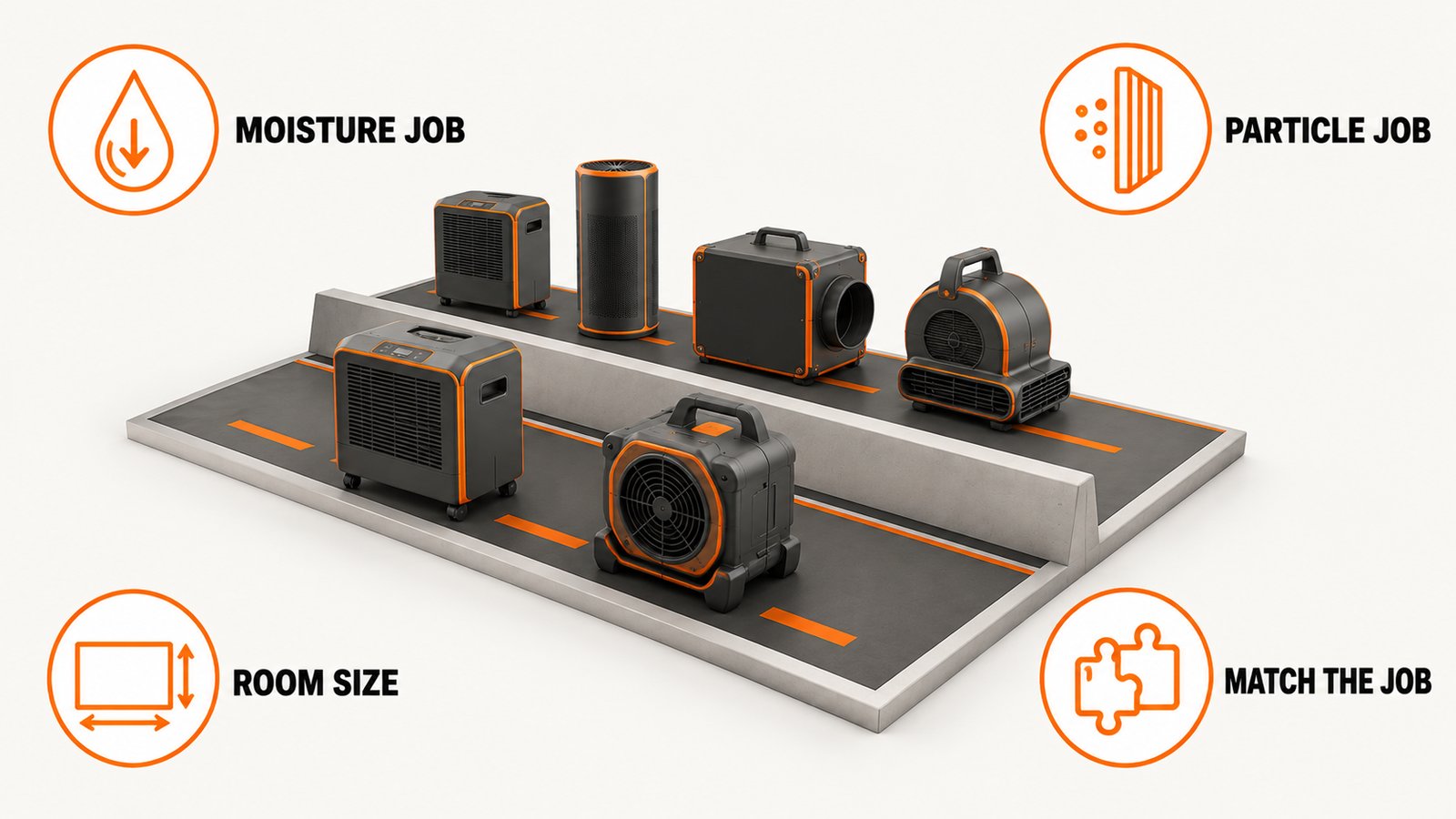
Two of these do source control and four do air cleaning. Those are different jobs, and buying the wrong category is the most common mistake in this aisle.
| Product | Job | Listed coverage | Where it belongs |
|---|---|---|---|
| Midea Cube 50 Pint | Source control, moisture removal | Up to 4,500 sq ft, ENERGY STAR | Basements and whole floors that will not hold a humidity setpoint |
| AlorAir Sentinel HD55 | Source control, moisture removal | 113 pints, auto defrost | Crawl spaces and sealed unconditioned areas |
| Levoit Core 600S-P | Air cleaning, particle capture | Up to 2,933 sq ft | Living areas during and after a cleanup |
| IQAir HealthPro Plus XE | Air cleaning, sealed filtration | Up to 1,125 sq ft | A single room where filtration quality matters most |
| Austin Air HealthMate Plus HM450 | Air cleaning plus odor adsorption | Steel cabinet, large carbon and zeolite bed | Rooms with a persistent musty odor after remediation |
| Honeywell HPA300 | Air cleaning, particle capture | Extra large rooms | A simple, app-free unit for a bedroom or den |
None of these six is an ozone generator, and that is deliberate. We are not recommending an ozone generator for mold, because the EPA's own review found that at concentrations that do not exceed public health standards, ozone does not effectively remove mold, and that concentrations would have to run 5 to 10 times above those limits to decontaminate air.
Deeper comparisons live on our air purifier roundup and our dehumidifier guide, and the sizing calculator matches capacity to your actual space.
Which One to Buy
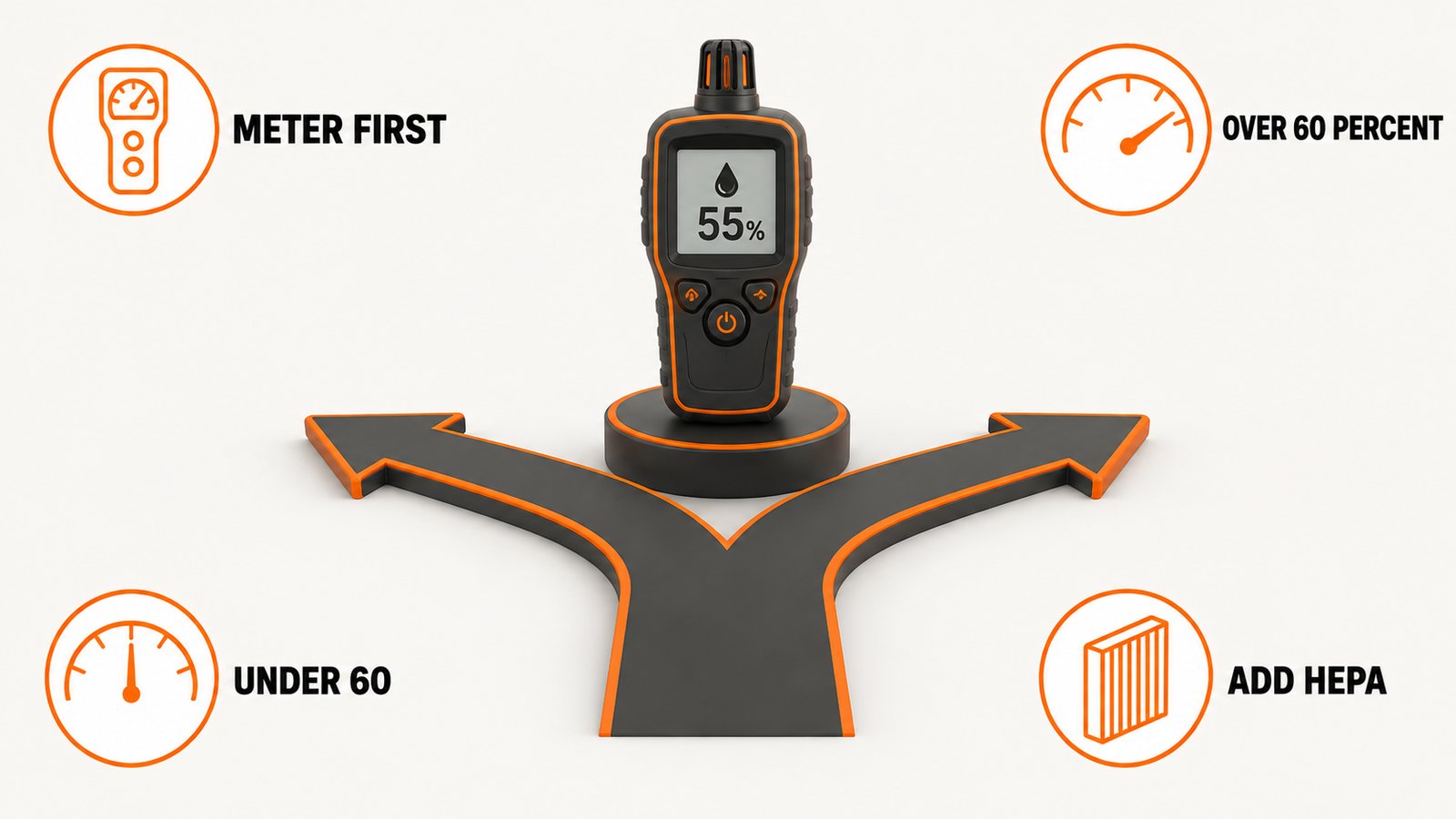
Buy a humidity meter before any of them. The EPA prices a moisture or humidity meter at $10 to $50 at many hardware stores. Take a reading in the room you are worried about, in the evening, for a week. If it is running above 60 percent you have your answer, and it is a dehumidifier.
If the reading is high, buy the dehumidifier. The Midea Cube for a basement or a whole floor, the AlorAir Sentinel HD55 for a crawl space where a consumer unit would ice up. This is source control, which the EPA ranks as the most effective of the three approaches.
If the reading is fine and the problem is a specific patch, buy neither yet. Clean it, dry it, and find the water. The EPA's threshold for handling a cleanup yourself is about 10 square feet, roughly a 3-foot by 3-foot patch. Our removal guide covers the method.
Add a HEPA purifier when you are disturbing material. Cleanup is when particle counts spike, and the EPA warns that removing wallpaper can lead to a massive release of spores if mold is growing on the underside. Run the purifier in the room during the work and for a day or two after. The Levoit Core 600S-P covers the largest listed area of the four; the IQAir HealthPro Plus XE is the pick when filtration quality matters more than square footage.
Add the Austin Air only for a persistent odor. Carbon adsorption is the honest answer to smell. Ozone is the dishonest one, since the EPA notes body odor may be masked by the smell of ozone but is not removed by it.
One thing no machine on this page does: find the leak. That is a flashlight, a meter, and an afternoon, and it is the step that decides whether you are buying equipment or buying a delay.
When to Call a Pro
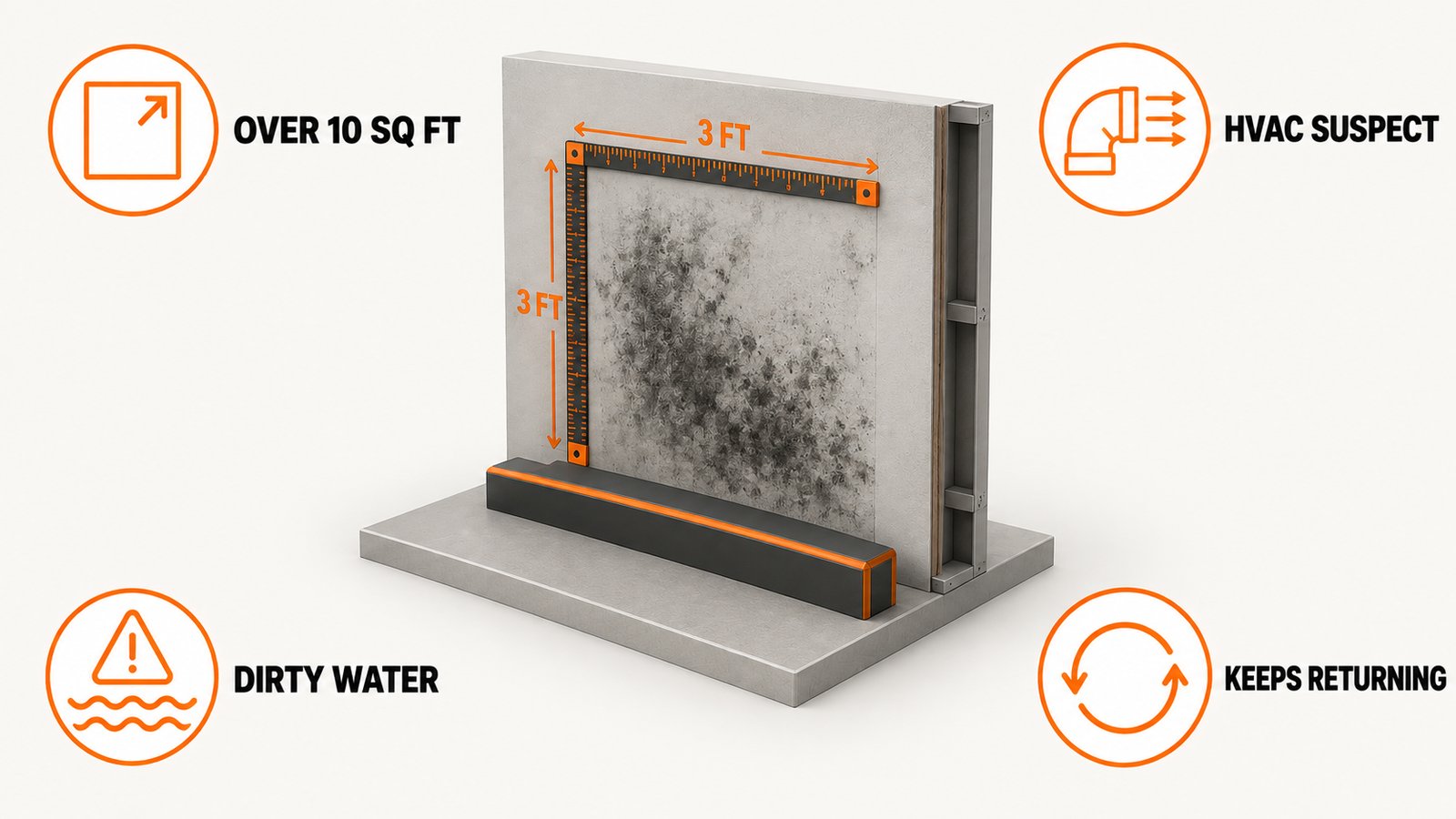
Equipment is for maintaining conditions. It is not remediation. Hire when any of these are true:
- Growth covers more than about 10 square feet, roughly a 3-foot by 3-foot patch. The EPA's threshold for handing off a cleanup, and the same figure New York State uses for calling a licensed contractor.
- You suspect the HVAC system. The EPA advises consulting its guidance on duct cleaning before taking further action, and warns not to run the HVAC system if you know or suspect it is contaminated with mold because it could spread mold throughout the building. Running an ozone generator into ducts is worse still, since the EPA notes ozone may have no effect on contaminants embedded in porous material such as duct lining. Our air ducts guide covers it.
- Sewage or other contaminated water was involved. The EPA says to call in a professional who has experience cleaning and fixing buildings damaged by contaminated water.
- Anyone in the home is at higher risk. The CDC notes that people with asthma or who are allergic to mold may have severe reactions, and that immune-compromised people and people with chronic lung disease may get infections in their lungs from mold. Ozone is a poor fit here for a second reason: the EPA states that ozone may worsen chronic respiratory diseases such as asthma and compromise the ability of the body to fight respiratory infections.
- The growth keeps returning. That is a moisture source you have not found, not a filtration problem.
Hire against the ANSI/IICRC S520 standard for professional mold remediation and check whether your state licenses the work. Our mold remediation certification page maps who is licensed where, and remediation cost covers what moves a quote.
Frequently asked questions
Does an ozone generator kill mold?
Not at concentrations that are safe to be around. The EPA states that if used at concentrations that do not exceed public health standards, ozone applied to indoor air does not effectively remove viruses, bacteria, mold, or other biological pollutants, and that concentrations would have to be 5 to 10 times higher than public health standards allow before ozone could decontaminate the air sufficiently to prevent survival and regeneration of the organisms once the ozone is removed.
Will ozone reach mold inside a wall or a duct?
The EPA says it may not reach it anywhere. Even at high concentrations, ozone may have no effect on biological contaminants embedded in porous material such as duct lining or ceiling tiles. Household mold is usually in drywall, wood, carpet backing and insulation, which is exactly the category the finding covers.
Is an ozone generator approved by the federal government?
No. The EPA states that some vendors suggest these devices have been approved by the federal government for use in occupied spaces, and that to the contrary, no agency of the federal government has approved these devices for use in occupied spaces. An EPA establishment number on the packaging identifies the producing facility and does not imply endorsement or a finding that the product is safe or effective.
What are the safe ozone limits?
The EPA's document lists four. The FDA requires ozone output of indoor medical devices to be no more than 0.05 ppm. OSHA requires that workers not be exposed to an average concentration of more than 0.10 ppm for 8 hours. NIOSH recommends an upper limit of 0.10 ppm not to be exceeded at any time. The EPA's National Ambient Air Quality Standard for ozone is an 8-hour concentration of 0.070 ppm, set in the rule signed October 1, 2015.
Can I run an ozone generator if I follow the instructions?
The EPA's finding is that following the instructions is not sufficient. Results of some controlled studies show that concentrations of ozone considerably higher than the health standards are possible even when a user follows the manufacturer's operating instructions. In one cited study, a generator rated for spaces up to 3,000 square feet, placed in a 350 square foot room on a high setting, reached 0.50 to 0.80 ppm.
Can I tell by smell whether ozone levels are safe?
No. The EPA states that the ability to detect ozone by smell varies considerably from person to person, and that one's ability to smell ozone rapidly deteriorates in the presence of ozone. While the smell of ozone may indicate that the concentration is too high, lack of odor does not guarantee that levels are safe.
Does ozone damage anything in the house?
Yes. The EPA states that ozone can adversely affect indoor plants and damage materials such as rubber, electrical wire coatings, fabrics, and artwork containing susceptible dyes and pigments. It also notes that reactions between ozone and indoor chemicals can form harmful or irritating by-products, including aldehydes and formic acid, both of which can irritate the lungs in sufficient amounts.
What should I buy instead of an ozone generator?
Follow the EPA's ranked order: source control first, then ventilation, then air cleaning. For mold that means a humidity meter and a dehumidifier to hold the space under 60 percent and ideally between 30 and 50 percent, exhaust ventilation that actually terminates outside, and HEPA filtration to capture particles during and after a cleanup. The EPA notes that it does not certify air cleaning devices or recommend manufacturers, so compare clean air delivery rate under the AHAM AC-1 program.
Sources
Every claim on this page traces to one of these. Links open the primary document.