
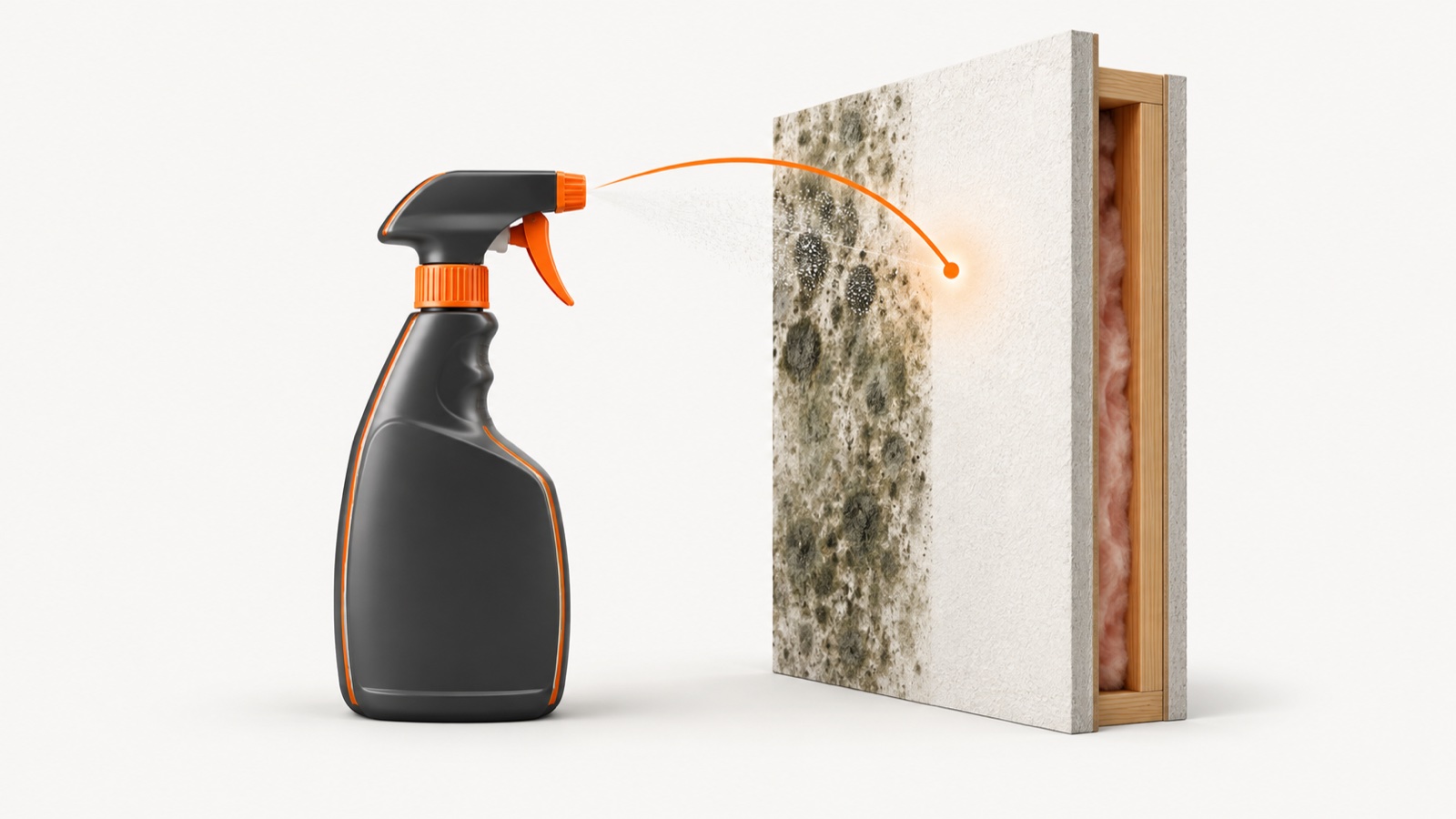
How Concrobium kills mold
Bleach tries to poison mold with chemistry. Concrobium does something different. It is a water-based solution of inorganic salts. You spray it on, and as it dries it forms a thin alkaline film. That film tightens as it hardens, and the tightening crushes the mold structure mechanically. Picture concrete setting around the colony.
This is why it works where bleach struggles. Bleach needs wet contact to kill, and it adds moisture that can feed regrowth. Concrobium does its work in the transition from liquid to solid. Once dry, the film stays put as a residual barrier, so new spores that land there have a harder time taking hold. For the full breakdown of how it stacks up against bleach, EC3, and hydrogen peroxide, read our complete Concrobium Mold Control review.
Where it kills mold, and where it does not
It kills mold on: sealed concrete, tile and grout, finished or bare wood, brick and stone, attic sheathing, and HVAC duct interiors with the fogger attachment. These are surfaces the film can fully coat.
It will not save: drywall where mold has pushed through the paper backing. No spray reaches mold living inside porous material. If the paper feels soft or you see growth on both faces, cut out the section plus 12 inches past the visible edge and replace it. Concrobium also is not a fix for the water itself. If a leak keeps feeding the spot, the mold comes back. Stop the moisture first, then clean, then keep humidity under 50% with a dehumidifier.
Not sure whether you are looking at surface growth or something rooted deeper? Our guide to black mold walks through the look-alikes, and our free water-damage documentation helper records accessible water-event conditions without a risk score.
The step most people get wrong
The kill happens as it dries, not while you scrub. Spray a thin, even coat, then wait. Drying runs 4 to 24 hours depending on humidity and temperature, and the exact timing matters enough that we gave it its own page: how long Concrobium takes to dry. Scrub only after it is fully dry, then lay down a second thin coat and leave it. That second coat is the barrier. For jobs larger than about 10 square feet, or porous structural mold, bring in a remediation pro who follows the IICRC S520 standard.
How long does Concrobium take to dry
Concrobium takes 4 to 24 hours to dry, depending on humidity and temperature. People also ask "how long does Concrobium Mold Control take to dry," and it is the same range on most surfaces. The room matters more than the bottle.
Dry air and mild temperatures put you near the 4 hour end. A cool, damp space like a basement or a bathroom with no ventilation pushes you toward 24. If you searched "how long for Concrobium to dry" hoping for one number, plan around the long end and check the spot before you touch it.
Don't rush it. The drying stage is when the film tightens and does the work, so a surface that still feels damp or looks glossy isn't done. Wait until it is fully dry, then scrub off the dead mold and apply the second thin coat.
- Lower humidity dries it faster. A dehumidifier that holds the room under 50% helps.
- Cold, wet rooms dry slowly. Give them the full 24 hours.
- Don't scrub, wipe, or spray a second coat while any part is still wet.
We wrote a separate page on the timing, with more detail on what changes it: how long Concrobium takes to dry.
How long does it take for Concrobium to kill mold
Concrobium kills mold as it dries, so the kill time is the drying time: about 4 to 24 hours, depending on humidity and temperature. It isn't a spray you watch work in a few minutes.
People search "how long does it take Concrobium to kill mold" expecting a number of minutes, the way you'd time bleach. Concrobium works differently. It forms a thin film, and the film crushes the mold structure as it hardens. There is no fixed minute count on a wet surface, because nothing is finished until the film has dried.
That also means the spot won't look different right away. Dead mold and any staining stay put until you scrub, and you scrub only after the surface is fully dry. Then you apply a second thin coat and leave it as the barrier.
What to do while you wait
- Leave the area alone. No scrubbing or wiping while it's wet.
- Keep the space dry and stop any leak feeding the spot.
- Check the surface after the full 24 hours if the room is cool or damp.
If the mold is on porous drywall and has pushed through the paper backing, waiting won't help. No spray reaches it there, and that section needs to be cut out and replaced.
How to use Concrobium Mold Control
To use Concrobium Mold Control, fix the moisture source, spray a thin even coat, let it dry fully, scrub off the dead mold, then apply a second thin coat and leave it.
Here is how to use Concrobium Mold Control on a surface it can fully coat, like sealed concrete, tile, or finished wood:
- Stop the water first. If a leak keeps feeding the spot, the mold comes back no matter what you spray.
- Spray a thin, even coat over the mold. Thin is the point. You're laying down a film, not soaking the surface.
- Wait until it is completely dry. That takes 4 to 24 hours. The kill happens during this stage.
- Scrub the dead mold off once it's dry. Never scrub while it's wet.
- Apply a second thin coat and leave it. That coat is the barrier against regrowth.
Concrobium is not the right tool for everything. Mold that has rooted inside porous paper-backed drywall can't be reached by a spray, so if the paper feels soft or you see growth on both faces, cut the section out plus 12 inches past the visible edge and replace it. For jobs larger than about 10 square feet, bring in a remediation pro who follows the IICRC S520 standard.
Frequently asked questions
Can you use Concrobium on drywall?
Only if the mold hasn't gone through the paper backing. Concrobium can't reach mold rooted inside porous, paper-backed drywall. If the paper feels soft or you see growth on both faces, cut out the section plus 12 inches past the visible edge and replace it.
How long does Concrobium take to dry?
Concrobium takes 4 to 24 hours to dry, depending on humidity and temperature. Warm, dry rooms are quicker, and cool, damp rooms take longer. Wait until it is fully dry before you scrub or apply the second thin coat.
How long does Concrobium Mold Control last?
There is no fixed number on this page, and we won't invent one. Once it's dry, the film stays in place as a barrier, but it only helps while the surface stays dry. If a leak or high humidity keeps feeding the spot, mold can return.
Does Concrobium kill mold?
Yes. It dries into a thin alkaline film that tightens and crushes mold at the root, then leaves a residual barrier that helps block regrowth. No bleach, no harsh chemicals. It works on surfaces it can fully coat, not on mold rooted deep inside porous drywall.
Does Concrobium kill black mold?
On hard, non-porous surfaces, yes. The deciding factor is the surface, not the species. On glazed tile, sealed concrete, or finished wood it can crush the growth as it dries. If it has rooted through paper-backed drywall, no spray reaches it, so cut out and replace the affected section.
Does Concrobium kill mold roots?
On surfaces it can fully coat, yes. The drying film crushes the structure rather than only bleaching the surface stain. That mechanical action is the difference from bleach, which leaves roots alive in porous material.
Does Concrobium work without scrubbing?
The killing happens during drying, not scrubbing. You still scrub once it is fully dry to remove dead mold, then apply a second thin coat and leave it as the barrier. Never scrub while it is wet.
Sources
Every claim on this page traces to one of these. Links open the primary document.