Do you need a HEPA vacuum for mold removal?
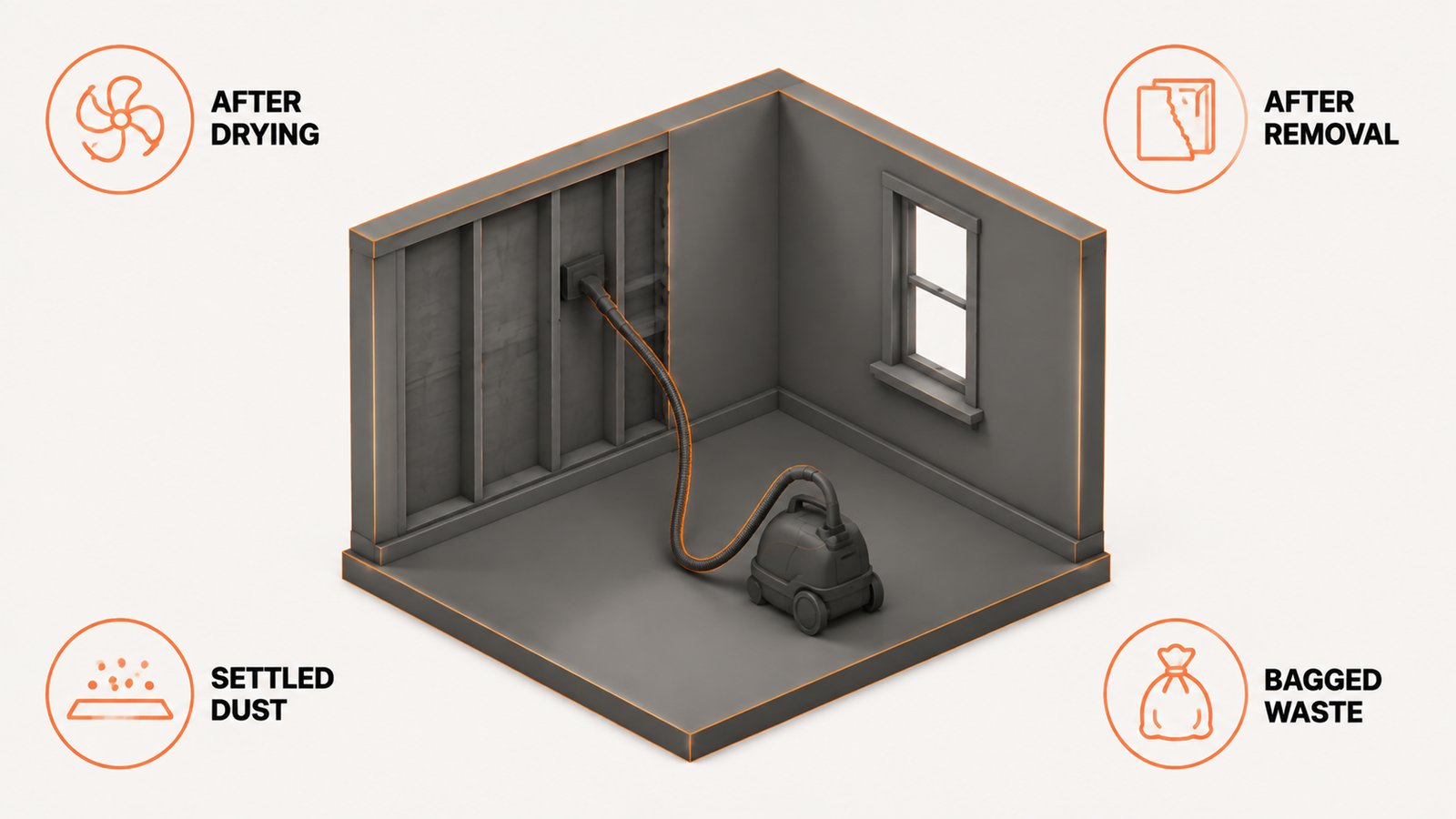
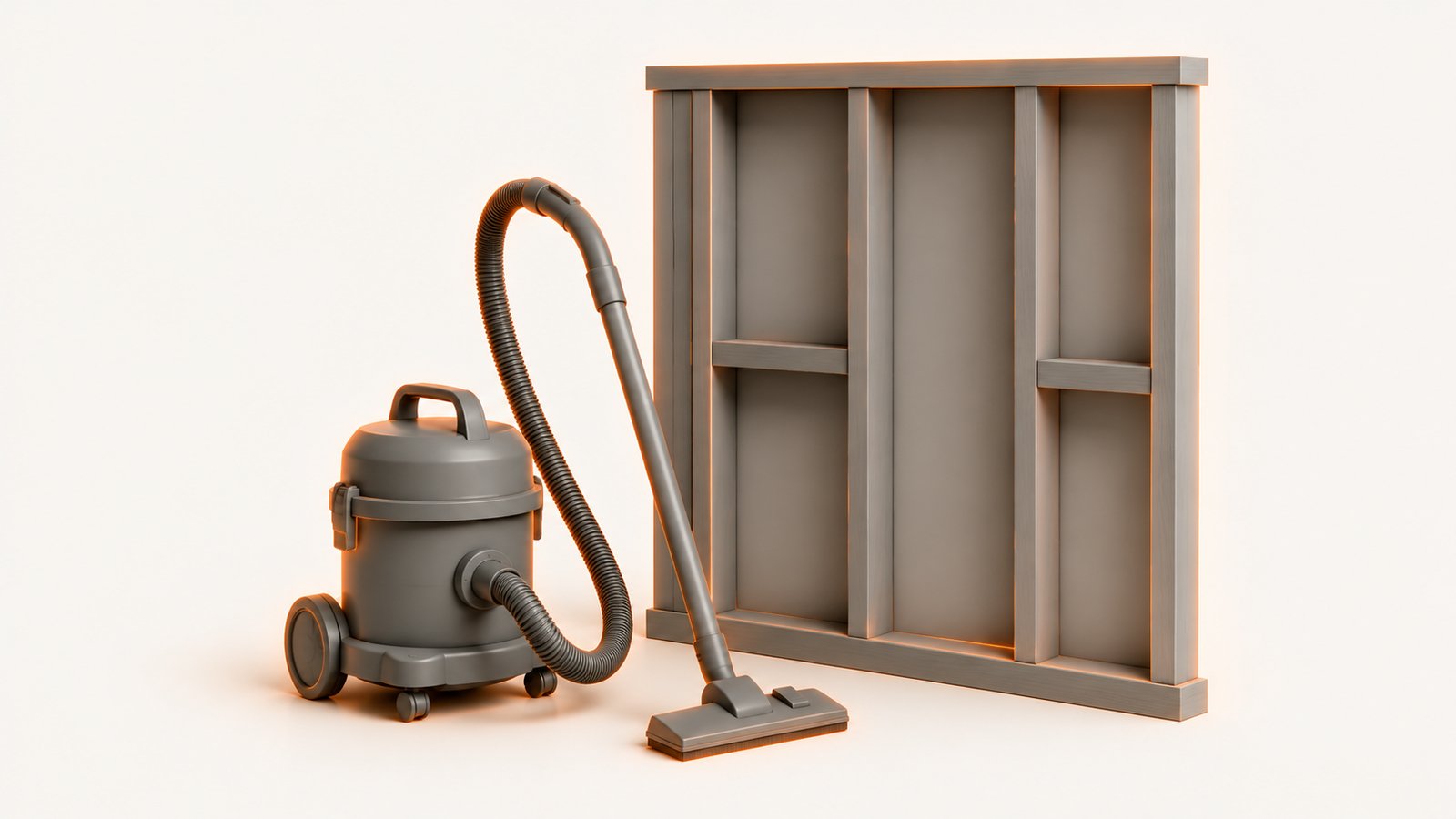
Not for every job, and not at the point most people think. EPA's remediation guide lists HEPA vacuuming as Method 3 of four cleanup methods and is specific about timing: HEPA vacuums are recommended for final cleanup of remediation areas after materials have been thoroughly dried and contaminated materials removed.
That rearranges the shopping decision. The vacuum is the last tool, not the first. Wet vacuuming is Method 1, damp wiping is Method 2, discarding water-damaged material is Method 4. The HEPA vacuum comes after the drying and the demolition.
It has a second job: EPA also recommends HEPA vacuums for dust that may have settled on surfaces outside the remediation area. Cutting out a section of wall throws fine material well past the work zone, and the shelf across the room is part of the job.
So you need one if you are opening up material or removing a section of moldy drywall. You do not need one to wipe growth off bathroom tile, which EPA handles with detergent and water. The full order of operations is on how to get rid of mold and mold remediation.
What legally counts as a HEPA vacuum
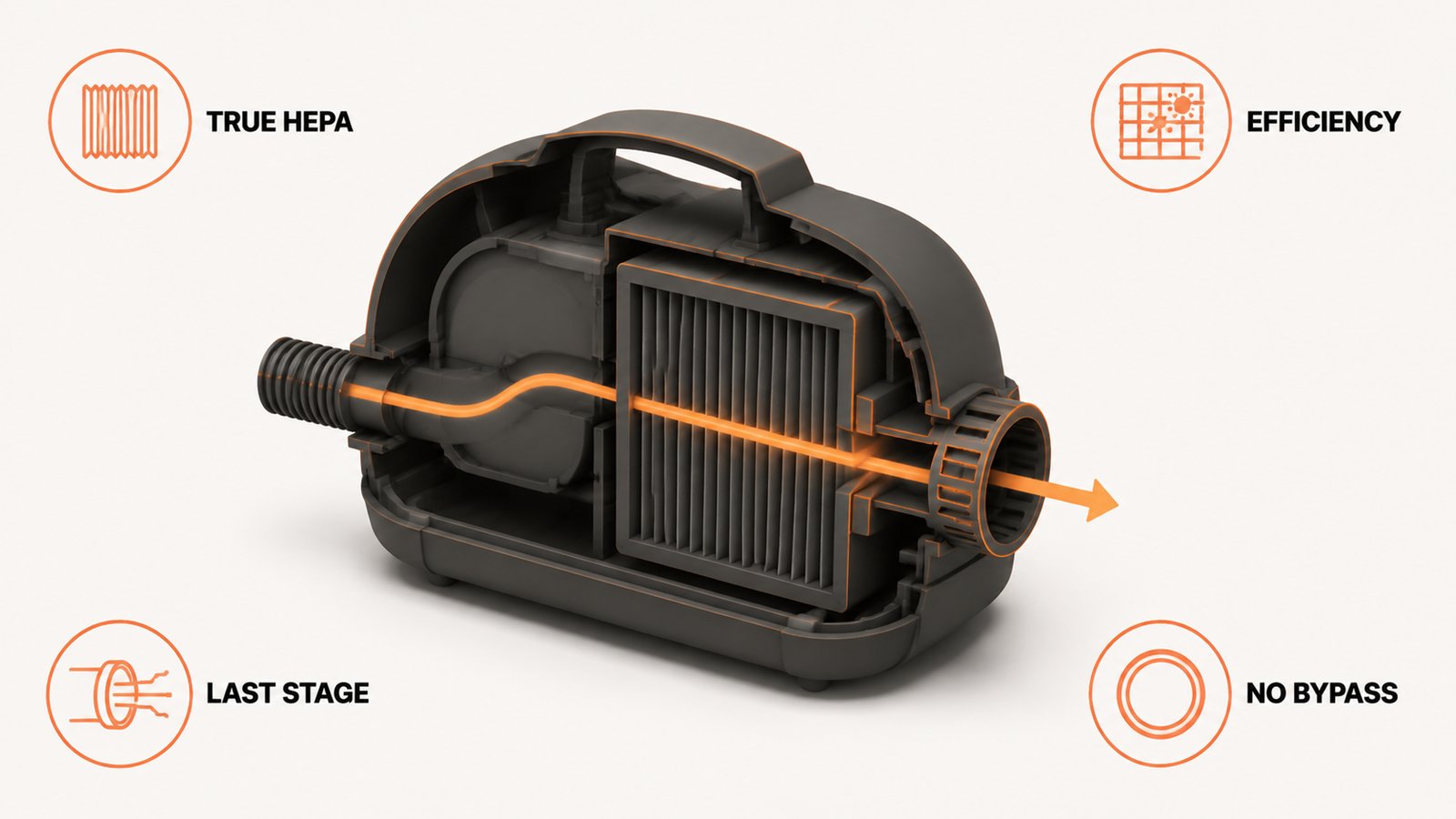
The marketing on this category is loose, and there is an actual legal definition to measure it against. Federal regulation defines the term at 40 CFR 745.83, in the lead renovation rules. A HEPA vacuum means a vacuum cleaner which has been designed with a high-efficiency particulate air filter as the last filtration stage. A HEPA filter is a filter that is capable of capturing particulates of 0.3 microns with 99.97 percent efficiency. The vacuum cleaner must be designed so that all the air drawn into the machine is expelled through the HEPA filter with none of the air leaking past it. And HEPA vacuums must be operated and maintained in accordance with the manufacturer's instructions.
Four conditions, and the third is where most consumer machines fail. A cheap vacuum can hold a genuine HEPA filter and still leak unfiltered air around the cartridge and out through the housing seams.
On the filter itself, EPA notes that 0.3 microns is the worst case, the most penetrating particle size, and that particles larger and smaller are trapped with greater efficiency.
Three phrases to distrust on a box: HEPA-type, HEPA-like, and high-efficiency filtration. None is the defined term. EPA notes MERV ratings describe capture between 0.3 and 10 microns, a lower bar. A vacuum advertising capture down to one micron is not a HEPA vacuum, however well it performs.
The best HEPA vacuums for mold removal, at a glance
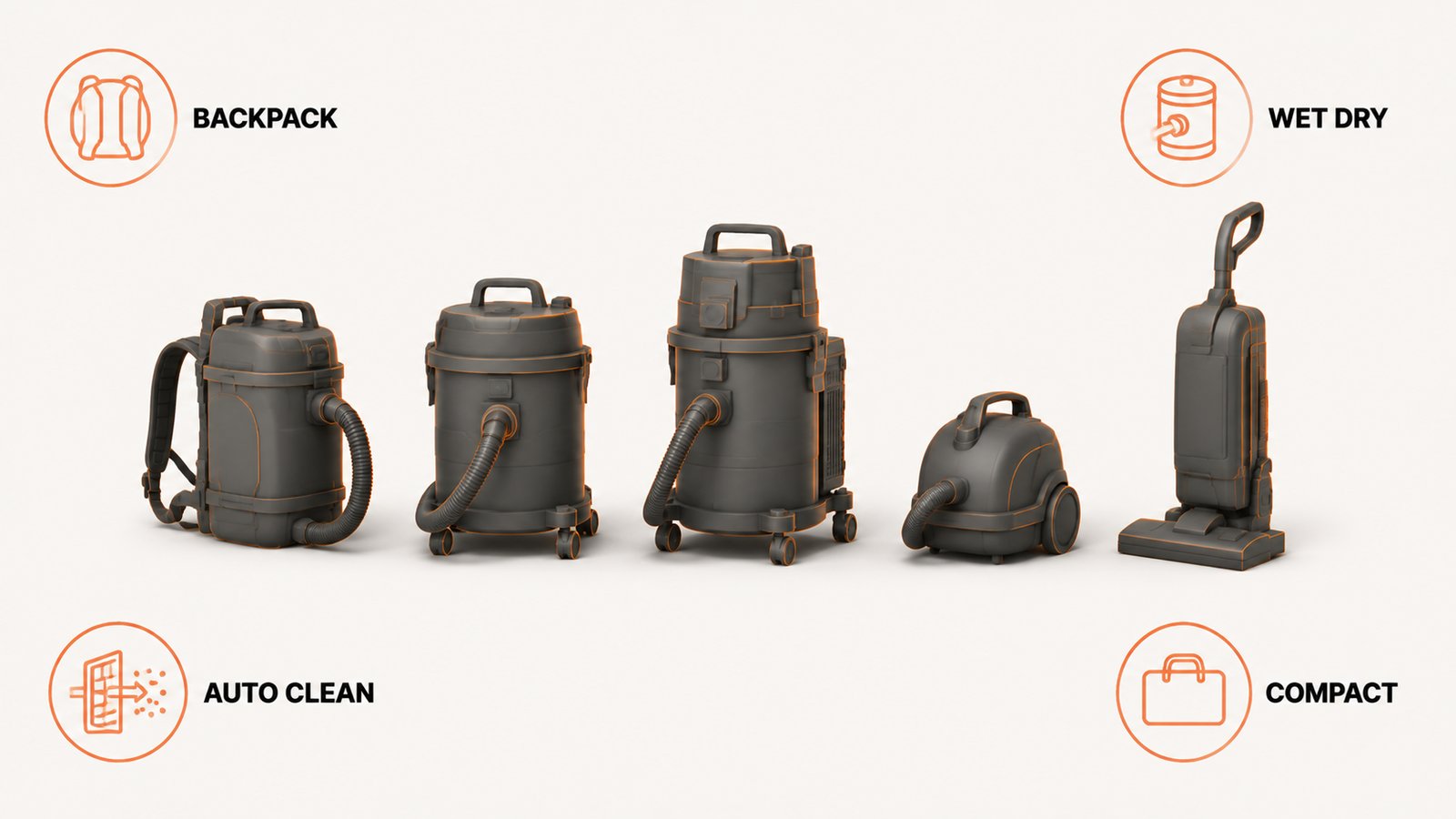
| Vacuum | Format | Price | Rating | Best for |
|---|---|---|---|---|
| ProTeam GoFit 6 HEPA | Commercial backpack, 6 qt | $753.60 | 4.1/5 from 35 ratings | The only listing that states the federal definition |
| Bosch VAC090AH | Wet and dry extractor, 9 gal | $632.87 | 4.6/5 from 455 ratings | Best rated, and it covers the wet step too |
| DEWALT DWV010 | Dust extractor, 8 gal | $484.30 | 4.4/5 from 451 ratings | Long demolition sessions, with a filter caveat |
| Atrix Omega Supreme HEPA | Compact canister | $334.00 | 4.4/5 from 15 ratings | Tight spaces and settled dust, thin review history |
| Simplicity S20EZM | Bagged household upright | $279.99 | 4.2/5 from 714 ratings | Household dust control after the job |
Every price, rating, review count and stock status above was read off the live Amazon product page the week of publication, and all five showed an active add-to-cart button. These numbers move, so confirm before you order.
The 5 picks, ranked
Heads up: the Amazon links below are affiliate links, and buying through them may earn Mold Scanner AI a small commission at no extra cost to you.
ProTeam GoFit 6 HEPA Commercial Backpack Vacuum
Listed at $753.60, 4.1 out of 5 stars from 35 ratings, in stock with an active buy box. The only product here whose own listing states the federal definition rather than gesturing at it: capture of 99.97 percent of airborne particulates as small as 0.3 microns, and it meets the EPA definition of a HEPA vacuum under the Lead Safety Renovation, Repair and Painting Rule. It ships with a remediation tool kit. The backpack format keeps the machine off a floor you have just cleaned and lets you work a ceiling or a stud bay without dragging a drum. Honest caveats: most expensive pick, thin review history at 35 ratings, and a 6-quart bag fills fast on a demolition job.
Bosch VAC090AH 9 Gallon Dust Extractor
Listed at $632.87, 4.6 out of 5 stars from 455 ratings, the strongest rating and review combination here, in stock with an active buy box. The listing describes a HEPA filter system, OSHA compliance, and a maximum airflow of 150 cubic feet per minute. It is a wet and dry machine, so it covers EPA's Method 1 wet vacuum step as well as the Method 3 HEPA step and one tool spans the sequence. Power-tool activation switches it on with the saw. Caveats: heavy, loud, and replacement filters are not cheap.
DEWALT DWV010 HEPA Dust Extractor, 8-Gallon
Listed at $484.30, 4.4 out of 5 stars from 451 ratings, in stock with an active buy box. Its automatic filter-cleaning system pulses the filter clear during operation, which keeps suction up through a long session instead of fading as the filter loads. A 15-amp motor delivers 150 cubic feet per minute. Read the caveat, which is on the listing itself: it meets the EPA lead renovation rule for HEPA vacuums only when the specific filters DEWALT names are fitted. Without those filters you have a dust extractor, not a HEPA vacuum by the federal definition.
Atrix Omega Supreme HEPA Vacuum
Listed at $334.00, 4.4 out of 5 stars from 15 ratings, in stock with an active buy box. A small portable fine-particle machine built for electronics service work, with a grounded static-safe design and an electronic line filter. For mold work the appeal is size: it reaches a cabinet base, a closet floor, or a crawl-space hatch a drum extractor cannot, and it is light enough to carry up a ladder. Honest caveats: at 15 ratings the thinnest review history here, and small capacity means frequent emptying.
Simplicity S20EZM Allergy Bagged Upright Vacuum
Listed at $279.99, 4.2 out of 5 stars from 714 ratings, in stock with an active buy box. A household upright rather than a jobsite machine, with a certified HEPA filter, a 12-amp motor and a sealed bagged system. Wrong tool for demolition cleanup, right tool for the year afterward, because a bagged HEPA upright stops settled dust being redistributed every time you clean the room. Caveats: it cannot do a stud bay, it is not a wet vacuum, and bags are a running cost.
Affiliate disclosure: the Amazon links above are affiliate links. If you buy through them, Mold Scanner AI may earn a small commission at no extra cost to you. We verified the title, price, star rating, review count and stock status on each live Amazon product page the week of publication. These change, so confirm before you order.
How to use a HEPA vacuum on a mold job
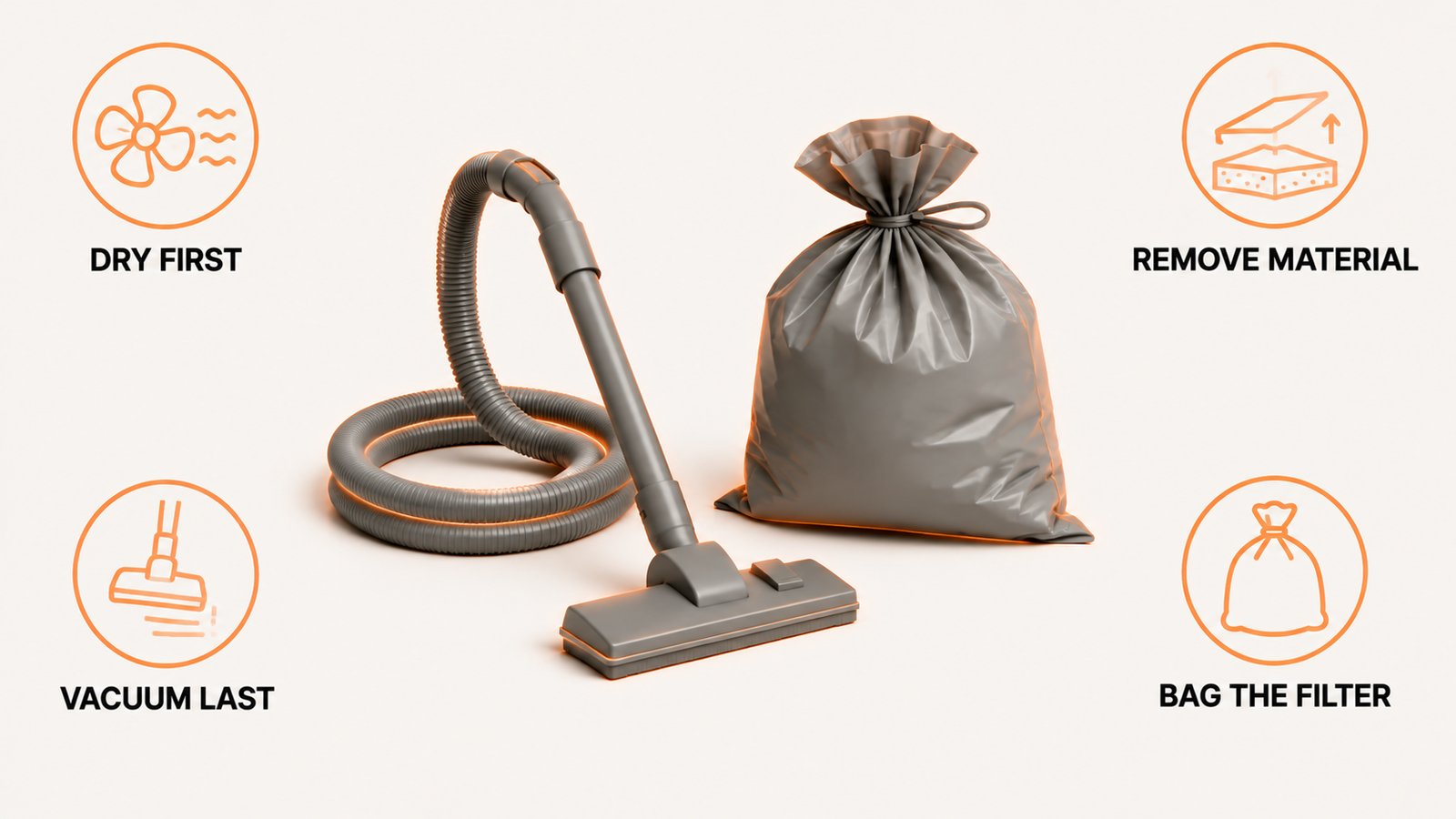
The machine is only as good as the sequence it sits in.
1. Fix the water and dry the material first. Method 3 is HEPA vacuuming after the material has been thoroughly dried. Vacuuming damp material clogs the filter and achieves nothing.
2. Remove what has to go first. The HEPA step is final cleanup after contaminated materials have been removed, not a substitute for removing them.
3. Check the filter is seated. EPA warns that care must be taken to ensure the filter is properly seated so all the air must pass through it. Check the gasket every time you reassemble.
4. Vacuum beyond the work area. EPA recommends HEPA vacuuming for dust that may have settled on surfaces outside the remediation area. Include horizontal surfaces at head height and above.
5. Wear PPE, especially at the filter change. EPA's minimum tier is gloves, an N-95 respirator, and goggles, and its guide says that when changing the vacuum filter, remediators should wear PPE to prevent exposure to the mold that has been captured.
6. Bag the filter and the contents. EPA's instruction is to dispose of the contents of the HEPA vacuum in well-sealed plastic bags, and the filter goes the same way. Change filters outdoors where you can.
7. It is not a killing step. EPA states that it is necessary to clean up mold contamination, not just to kill the mold, and that dead mold is still allergenic. Removal is the point, which is why bleach is the wrong headline tool.
What a HEPA vacuum will not do

Four honest limits, because this category is oversold.
It does not dry anything. Every gain is undone if the moisture source is still there. EPA's position is that the way to control indoor mold growth is to control moisture, and that damp material should be dried within 24 to 48 hours. A dehumidifier and a repair do that job.
It does not kill anything, and that is fine. Removal is the goal, not disinfection.
It does not reach inside material. EPA notes mold fills the empty spaces and crevices of porous material, and that absorbent materials may have to be thrown away. A surface pass over an affected board does not restore it. See mold in carpet.
It does not find anything. If you suspect growth behind a finish, that is an inspection question, covered on mold behind walls and how to test for mold.
One more thing it is not: an air purifier. A HEPA vacuum cleans surfaces. A portable air cleaner filters room air continuously, a different purchase for a different purpose, compared on best air purifiers for mold. Cleaners and sprays are a third category again, on best mold removal products.
When to call a professional
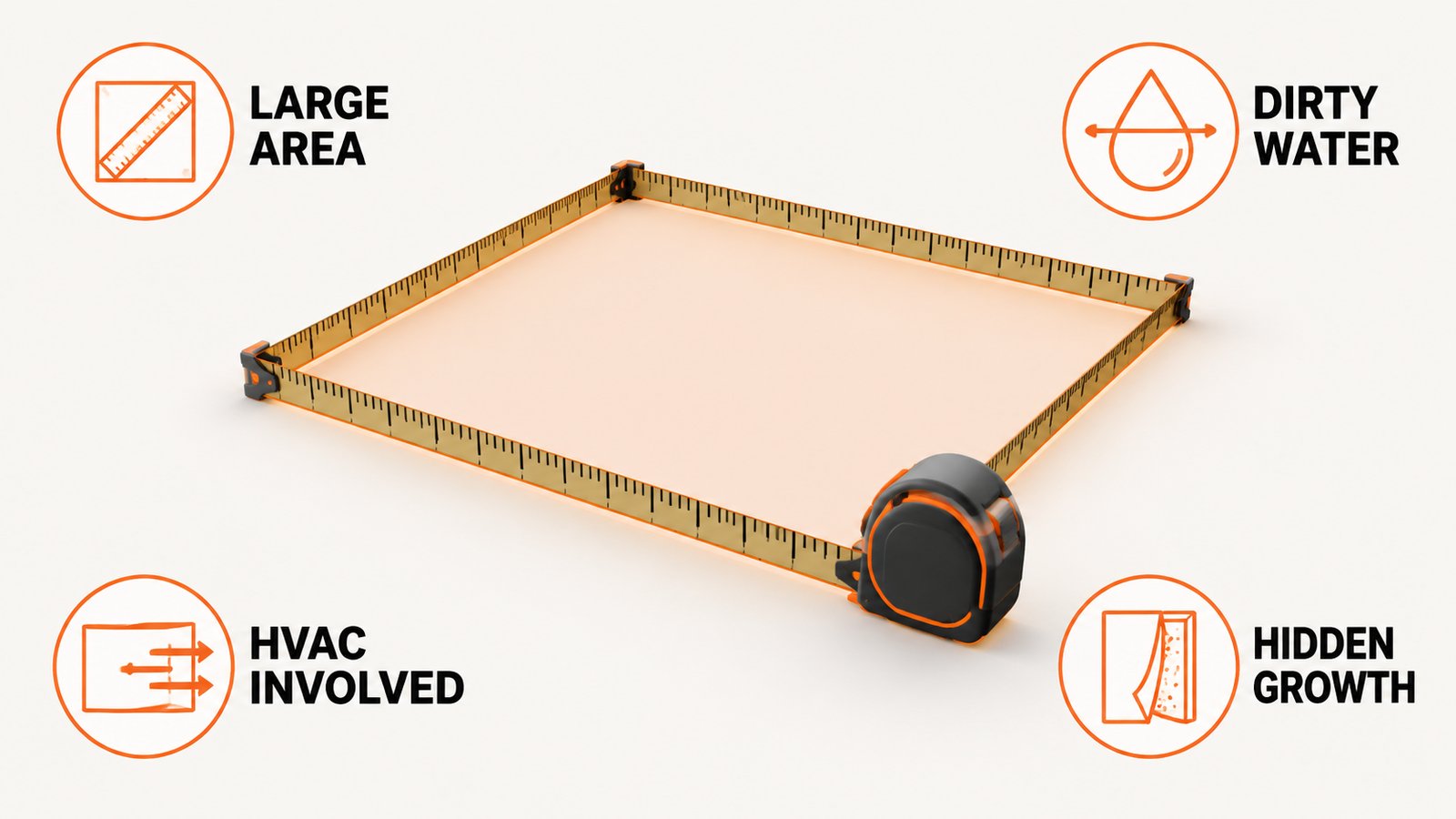
EPA scales the response by area: a small tier under 10 square feet, a medium tier between 10 and 100 square feet, and a large tier above that, with heavier PPE and containment at each step. Its homeowner guidance puts it simply: under about 10 square feet, in most cases you can handle the job yourself.
The PPE tiers show where the line really sits. Minimum is gloves, an N-95 respirator and goggles. Limited adds a half-face respirator with a HEPA filter and disposable overalls. Full is a full-face respirator with a HEPA filter and disposable full body clothing. A job needing the second or third tier needs a contractor, not a weekend.
Call a qualified professional when:
- The affected area is larger than about 10 square feet, or it keeps growing once you open up.
- The water was contaminated by sewage or floodwater, a separate category of job.
- An air-handling system is involved. Do not open ducts or disturb duct lining yourself. See mold in air ducts.
- Containment is needed. EPA's medium and large tiers call for polyethylene sheeting and negative pressure with a HEPA-filtered fan unit, which is training as much as equipment.
- Someone in the home is in a higher-susceptibility group and cannot be kept out of the work area. What agencies report is on mold exposure symptoms.
Look for firms that follow the ANSI and IICRC S520 standard, and get a written scope covering containment, removal, drying, and verification before anyone starts. Pricing is on mold remediation cost.
Frequently asked questions
Do you need a HEPA vacuum to clean up mold?
Only for some jobs, and only at the end of them. EPA recommends HEPA vacuums for final cleanup after materials have been thoroughly dried and contaminated materials removed, and for dust that may have settled on surfaces outside the remediation area. Wiping growth off a hard surface with detergent and water needs no vacuum at all.
What officially counts as a HEPA vacuum?
Federal regulation at 40 CFR 745.83 defines it as a vacuum cleaner designed with a high-efficiency particulate air filter as the last filtration stage, where the filter captures particulates of 0.3 microns with 99.97 percent efficiency, and the machine is designed so that all air drawn in is expelled through that filter with none leaking past it. It also has to be operated and maintained per the manufacturer's instructions.
Is a HEPA-type filter the same thing?
No. HEPA-type, HEPA-like, and high-efficiency filtration are marketing terms, not the defined standard. EPA also notes that MERV ratings describe capture of particles between 0.3 and 10 microns, which is a lower bar. A vacuum advertising capture down to one micron is not a HEPA vacuum under the federal definition however well it performs in practice.
Can you use a regular shop vac for mold?
For the wet vacuuming step, EPA's Method 1 uses a wet vacuum, so a shop vac has a legitimate place early in the sequence. For final cleanup it does not, because without a sealed HEPA path the machine collects fine material at the nozzle and returns much of it to the room through the exhaust.
Should you vacuum mold before or after cleaning?
After. EPA's Method 3 is HEPA vacuuming after the material has been thoroughly dried, for final cleanup once contaminated materials have been removed. Vacuuming damp material clogs the filter, and vacuuming instead of removing affected porous material leaves the problem in place.
How do you empty a HEPA vacuum safely?
EPA's guidance is to dispose of the contents of the HEPA vacuum in well-sealed plastic bags, and that the filter and contents must both be bagged that way. Its guide also says that when changing the vacuum filter, remediators should wear PPE to prevent exposure to the mold that has been captured. Do the filter change outdoors where you can, in gloves, goggles, and at minimum an N-95 respirator.
Is a HEPA vacuum the same as an air purifier?
No. A HEPA vacuum removes settled material from surfaces during and after a cleanup. A portable air cleaner filters room air on an ongoing basis. Neither dries a wet material or repairs a leak, and EPA's position is that the way to control indoor mold growth is to control moisture.
Sources
Every claim on this page traces to one of these. Links open the primary document.