What Identification Can and Cannot Tell You
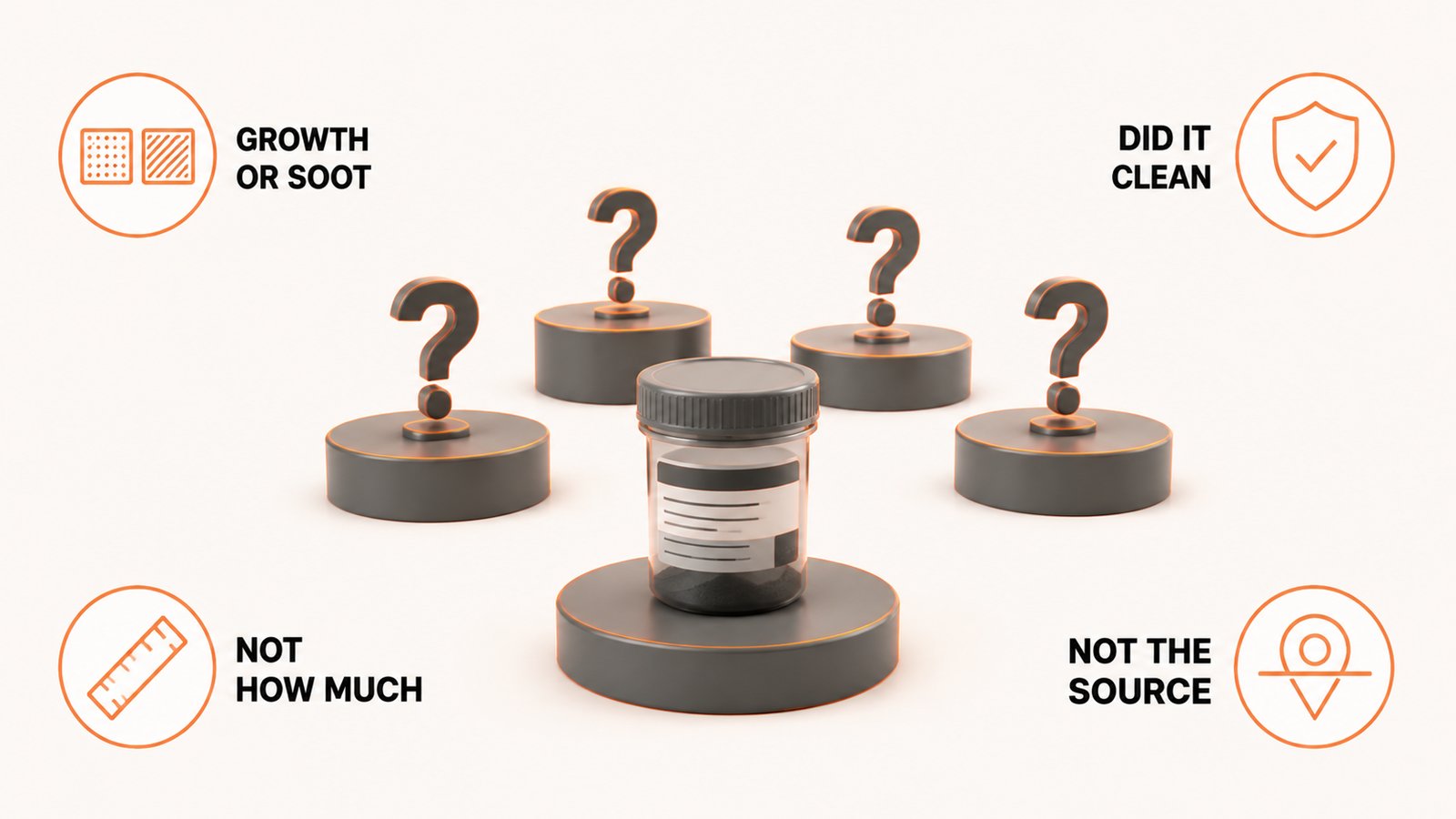
Start with the uncomfortable part, because it saves people a great deal of money. The CDC states that you do not need to know the type of mold. New York State's health department is blunter: mold testing is not recommended, nor is it required by any regulatory agency, and knowing the kinds of mold present does not change this advice. Texas's licensing agency says the same thing in its consumer guidance, noting that generally it is not necessary to identify the species of mold growing in a residence and that testing to determine what kind of mold is present is not required prior to remediation or cleaning.
Three agencies, no coordination, one conclusion. The reason is that the response to visible growth does not branch on species. Fix the moisture, clean or discard the material, dry the area. That is the plan for every genus.
So what is identification actually good for? A short and honest list:
- Telling growth apart from something that is not growth. The EPA notes that sampling may help differentiate between mold and soot or dirt. That distinction genuinely changes what you hire.
- Checking whether a cleanup worked. The EPA states that surface sampling may be useful in determining if an area has been adequately cleaned or remediated.
- Documenting a dispute. Where litigation is involved, the EPA lists sampling among the circumstances worth considering.
- Satisfying curiosity. Legitimate, and worth being honest that it is what you are paying for.
What identification does not tell you is how much there is, where the water came from, whether the material is salvageable, or whether the space is safe. Those are moisture and building questions. Our comparison of every home mold testing method covers which instrument answers which question.
The Mold Color Chart and Its Limits
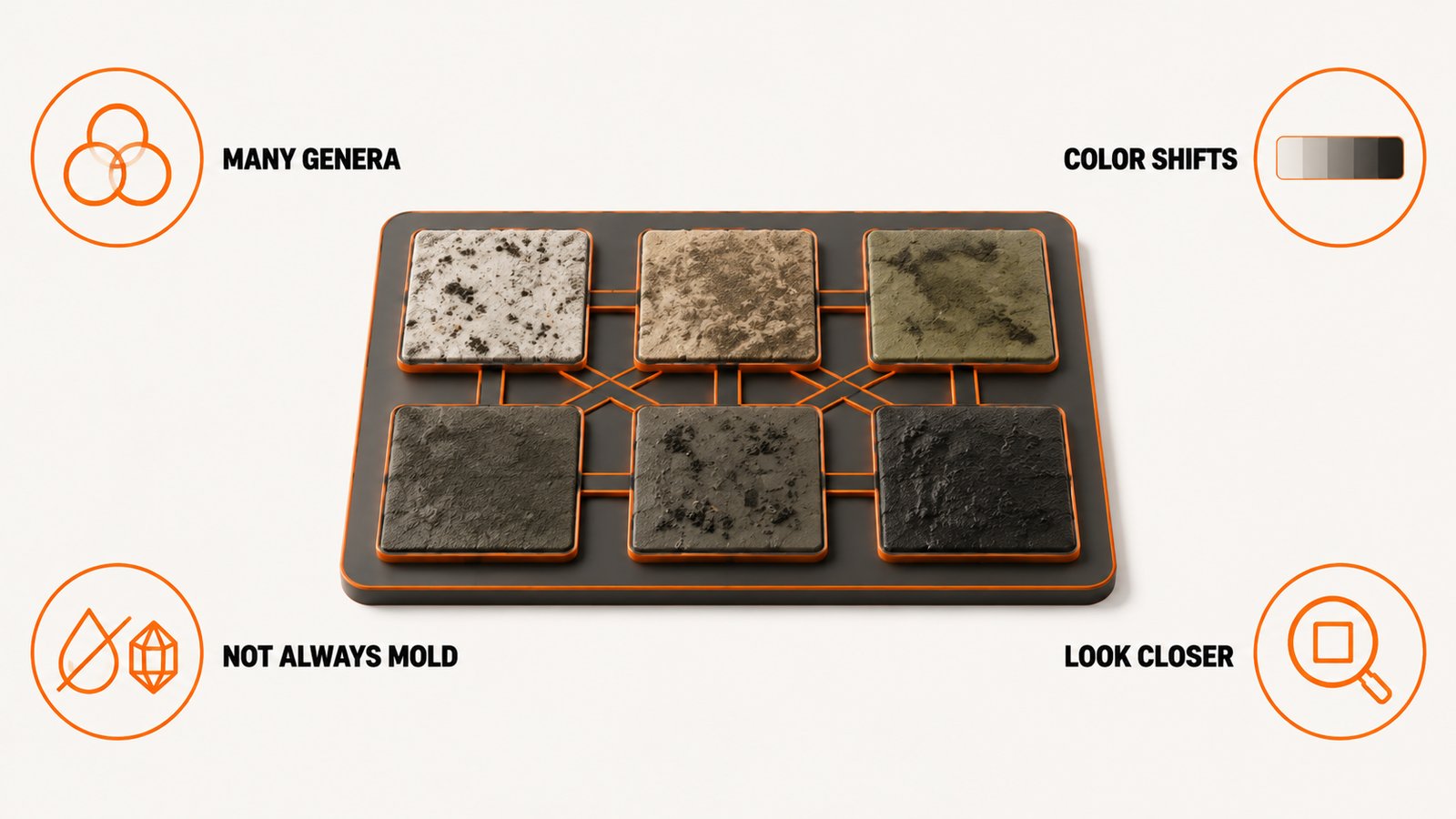
Mold color charts are the most-shared artifact in this whole subject and the least reliable. The problem is structural rather than a matter of chart quality: colors are not exclusive to genera, and many genera change color with age, substrate, and moisture. A colony that is white this week can darken as it matures.
Here is an honest version of the chart, with a column most published ones leave out.
| What you see | What it might be | What the color does not tell you |
|---|---|---|
| Black or very dark green | Several genera, plus soot, mildew, and ordinary dirt | Nothing about the genus, and nothing about risk. Dark color is the single most over-read cue there is. |
| Green | Very common indoors across multiple genera, and common on food | Whether it is one colony or several, or how deep it goes into the material |
| White or pale gray | Early-stage growth of many genera, and also efflorescence, which is mineral salt and not biological at all | Whether it will darken with age. White growth is often just young growth. |
| Yellow or orange | Several genera, plus slime molds on soil and mulch | Whether it is fungal at all. Some orange films are bacterial. |
| Pink or salmon | Frequently attributed to bacteria rather than fungus, most often Serratia marcescens | That it is mold. Pink film in a bathroom usually is not. |
| Brown or tan | Multiple genera, and also water staining, which is not growth | Whether there is anything alive there at all |
Notice how often the right-hand column says the same thing. Color tells you what to look at more closely. It does not tell you what you are looking at. Our individual pages on black mold, white mold, green mold, yellow mold, orange mold, pink mold, blue mold, gray mold and brown mold each cover what that color usually means on a household surface, and each one carries the same caveat.
What You Can Actually Read Off a Surface
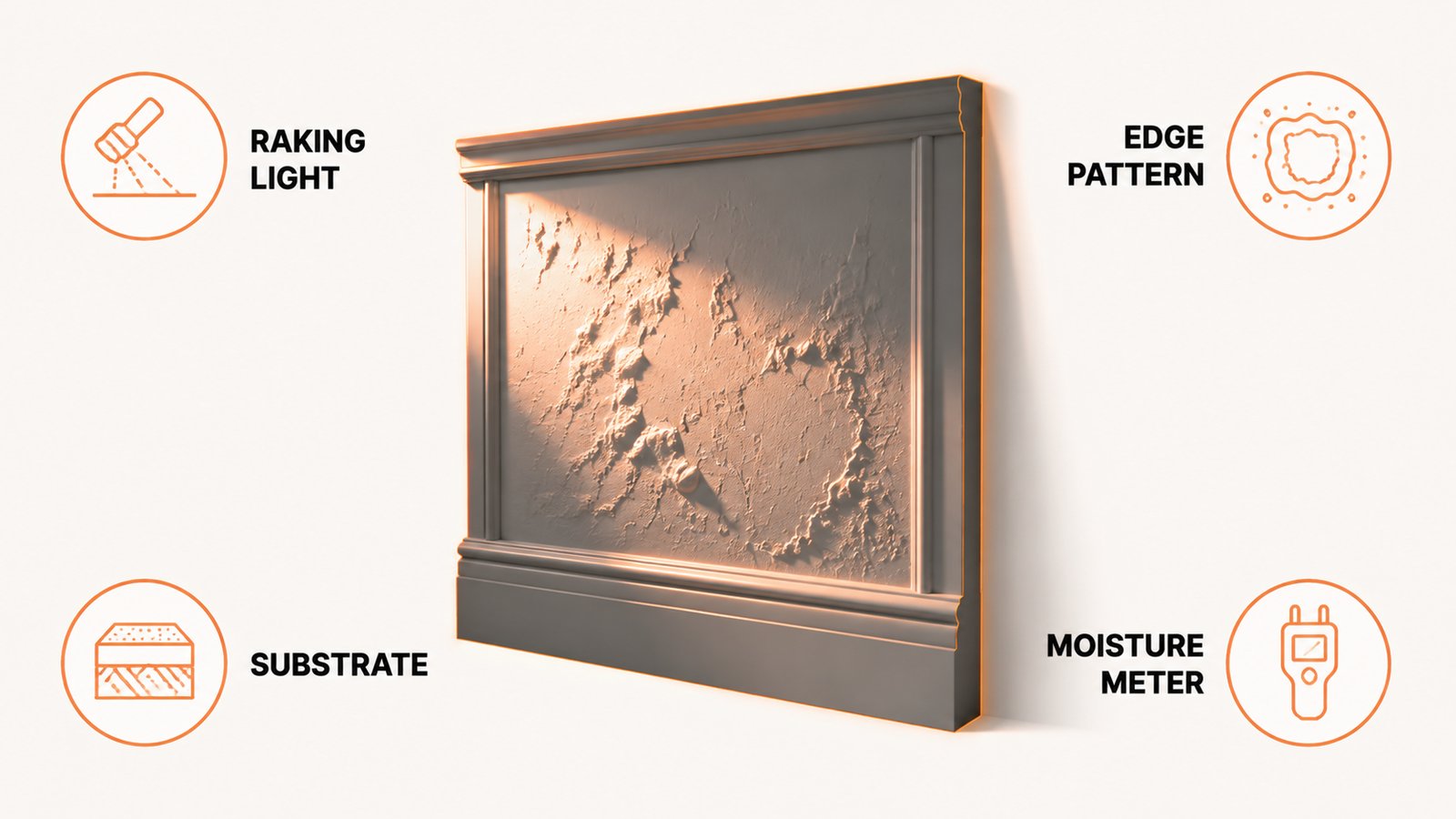
Put the color chart down and look at four other things instead. Each of these changes your decision, which is more than color does.
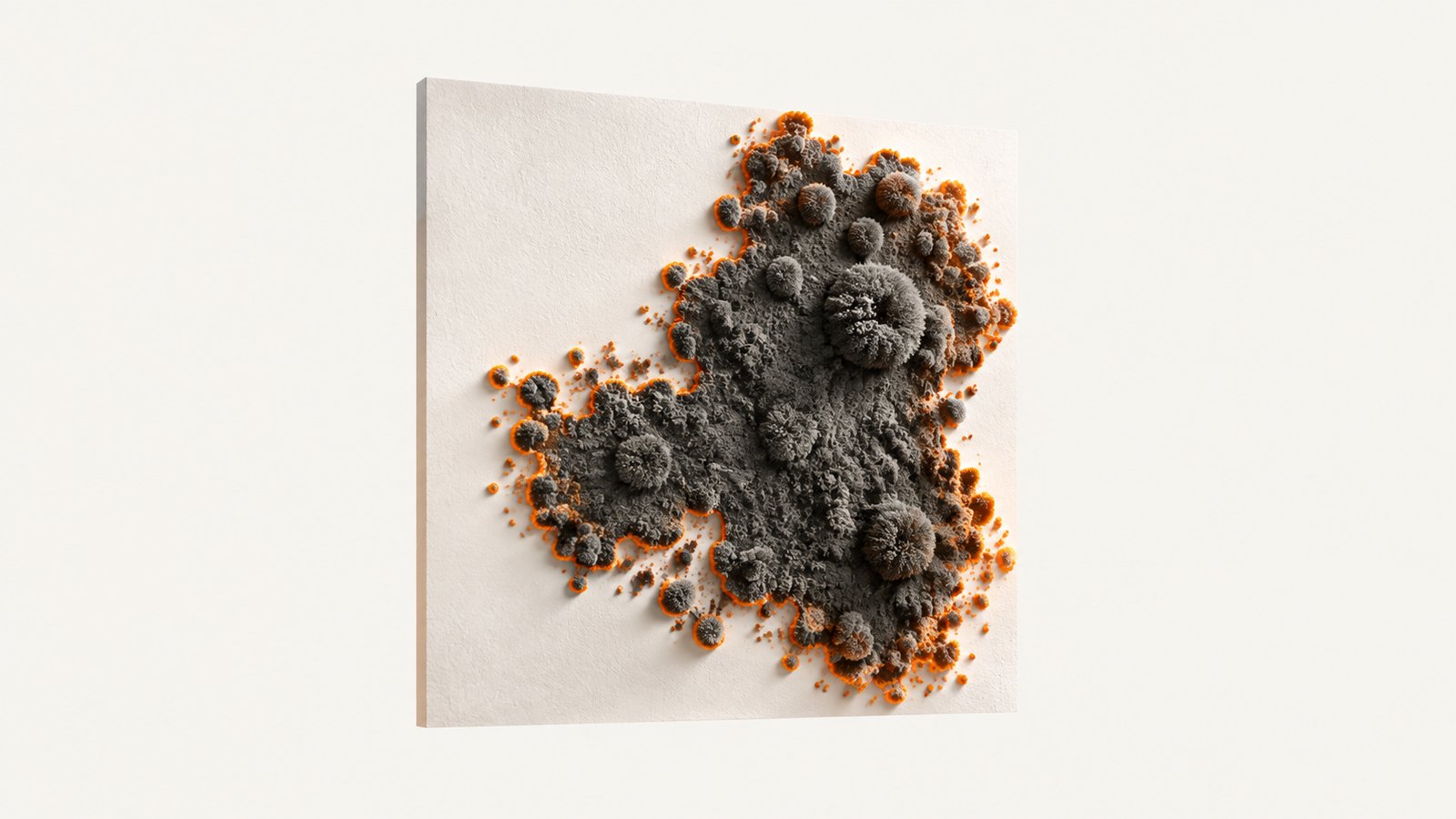
Texture, in raking light. Growth sits proud of the surface and catches light from the side. Staining is flat and level with the material. Hold a flashlight nearly parallel to the wall and look across it rather than at it. New York State describes mold as appearing in slightly fuzzy, discolored, or slimy patches that increase in size as they grow, and that increase over time is a cue in itself. Photograph the spot and check it in a week.
Edge pattern. Biological growth tends to spread with irregular, roughly circular fronts and satellite spots at the margin. Water staining has a hard tide line where the water stopped. Soot follows air movement, so it concentrates around registers, gaps and electrical boxes.
Substrate. What is it growing on, and is that material porous? The EPA advises that absorbent or porous materials such as ceiling tiles and carpet may have to be thrown away if they become moldy, because mold can grow on or fill in the empty spaces and crevices of porous materials and may be difficult or impossible to remove completely. That decision does not depend on genus at all.
Moisture, measured. This is the cue that actually solves the problem. The EPA prices a moisture or humidity meter at $10 to $50 at many hardware stores and advises keeping indoor relative humidity below 60 percent, ideally between 30 and 50 percent. A wet reading behind a stain tells you more than a lab report on the stain itself, because the EPA's whole framework is that the key to mold control is moisture control.
Smell is worth noting but worth being careful with. New York State says most molds produce musty odors that are the first indication of a problem, and that following your nose to the source is a reasonable way to search. Treat an odor as a prompt to inspect and to measure moisture, not as a conclusion about what is behind the wall. Our musty smell guide covers the usual hiding spots.
Photograph what you find before you clean it. One wide frame that shows where it is on the wall, one close frame with light raking across the texture. Photograph it and get an AI-assisted visual screening of what is visible in the frame, and keep the originals with their timestamps in case you need them later.
The Common Indoor Genera
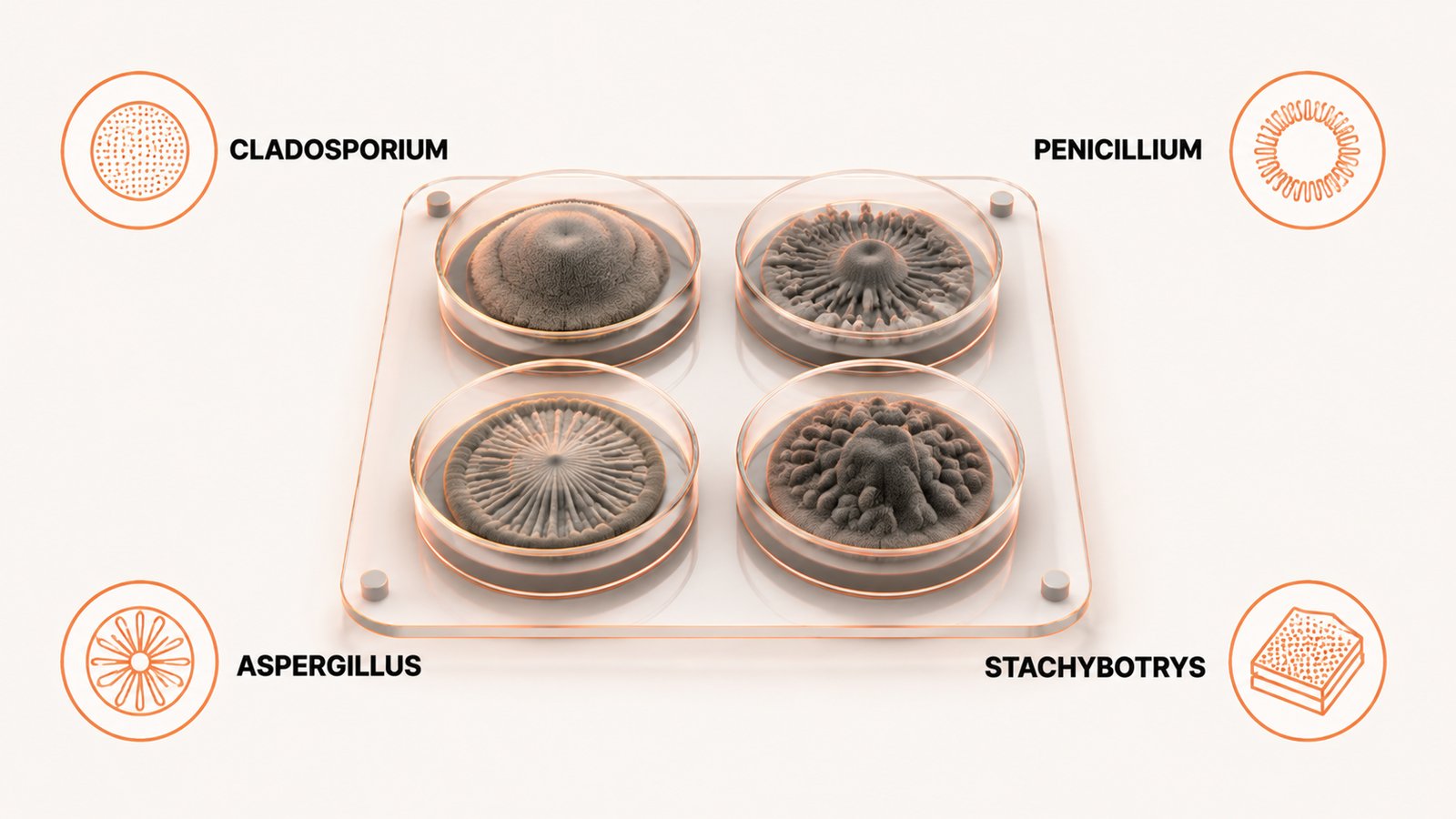
A handful of genera account for most indoor growth. Knowing the names is useful for reading a lab report, not for deciding what to do with a wall.
Cladosporium. One of the most common indoor and outdoor genera anywhere, which is exactly why it shows up on air sampling reports constantly. Its presence indoors at levels similar to outdoors is unremarkable. Our Cladosporium page covers it.
Penicillium. Frequently found on damp building materials and on food. Often blue or green in appearance. See Penicillium.
Aspergillus. A large genus with many species, common in indoor dust and on damp material. The CDC notes that immune-compromised people and people with chronic lung disease may get infections in their lungs from mold, and this genus is the one most often discussed in that context. Our Aspergillus page goes into it.
Stachybotrys chartarum. The one everyone means when they say black mold. It is associated with material that has stayed wet for a long time, typically cellulose-based building material such as paper-faced drywall. It is also far less common than the internet implies, and other genera are dark too. Our page on Stachybotrys chartarum and our guide to identifying black mold cover the honest version, including why appearance alone does not settle it.
An important framing point. The EPA states that molds produce allergens, irritants, and in some cases potentially toxic substances, and that inhaling or touching mold or mold spores may cause allergic reactions in sensitive individuals. It also says that symptoms other than the allergic and irritant types are not commonly reported as a result of inhaling mold, and that research on mold and health effects is ongoing. Any health question belongs with a licensed physician, and New York State's guidance says to always discuss health concerns with your doctor because symptoms could be caused by other exposures and illnesses.
The full set, including the less common ones, is on our types of mold page.
Mildew, Soot and the Other Lookalikes
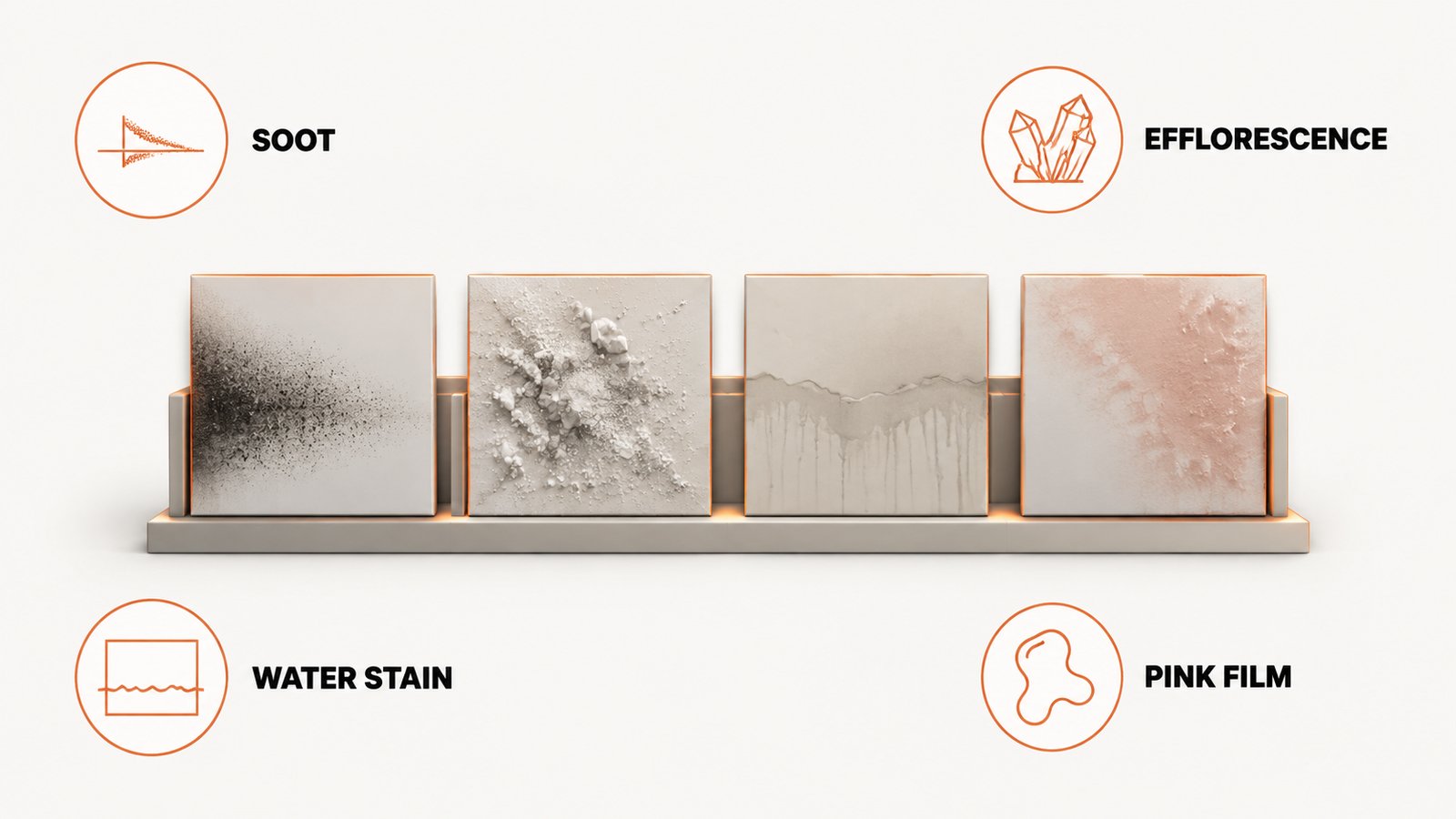
A large share of what gets photographed and labeled mold is something else. Four in particular.
Soot and carbon deposits. Common near candles, fireplaces, gas appliances and above electrical outlets, and it tracks with air movement rather than with moisture. It smears when wiped rather than lifting in patches. The EPA specifically lists differentiating between mold and soot or dirt as one of the things sampling can help with, which tells you how often the two get confused.
Efflorescence. The white crystalline bloom on basement walls, concrete and brick. It is mineral salt carried out of the masonry by water, not a living thing. It brushes off as powder and dissolves in water. It is still a real finding, because it proves water is moving through the wall, which is the condition that lets actual growth start. Our mold on concrete page covers telling them apart.
Water staining. Flat, in the material rather than on it, with a hard tide line. Cosmetic damage from a past event. The EPA notes that mold may cause staining and cosmetic damage and that it may not be possible to clean an item so its original appearance is restored, so a stain can also be the residue of growth that has already been dealt with.
Pink or orange bathroom film. Generally attributed to bacteria rather than fungus, most often Serratia marcescens. Slimy rather than fuzzy, and it wipes away easily. Covered on pink mold in the shower.
Mildew is the other word that causes trouble, because in common use it means surface growth on a damp bathroom or fabric surface rather than a specific organism. Our mold vs mildew and black mold vs mildew pages cover how the terms get used and, more usefully, why the cleanup is largely the same either way.
How a Laboratory Actually Identifies Mold

If you do want a name, this is what actually produces one, and none of it happens by eye.
Direct microscopy. A tape lift or swab is examined under a microscope and structures are identified morphologically. Fast and cheap. It often resolves to genus or to a group of genera that look alike, rather than to species. This is what most consumer mail-in kits buy you.
Culture. The sample is grown on a medium and identified from the resulting colony. It can reach species level for some organisms, and it has a known bias: only what will grow on that medium under those conditions gets counted, so the result reflects the medium as well as the sample.
DNA analysis. Used in dust-based indexes. The Environmental Relative Moldiness Index is the well-known example, and the EPA, which developed it, describes it as a research tool for estimating mold contamination and states that it has been peer reviewed for research purposes but has not been validated for non-research purposes. Our ERMI explainer covers what a score does and does not settle.
Whichever method is used, the EPA advises that samples should be analyzed according to the analytical methods recommended by the American Industrial Hygiene Association, the American Conference of Governmental Industrial Hygienists, or other professional guidelines, and that sampling should be conducted by professionals with specific experience in designing sampling protocols, sampling methods and interpreting the results. Ask any lab which method it uses and what level of resolution it reports to, before you pay.
One thing no laboratory can hand you is a pass mark. The EPA states that standards or Threshold Limit Values for airborne concentrations of mold, or mold spores, have not been set, and that there are no EPA regulations or standards for airborne mold contaminants. A name on a report is a name, not a verdict.
When Identification Changes What You Do
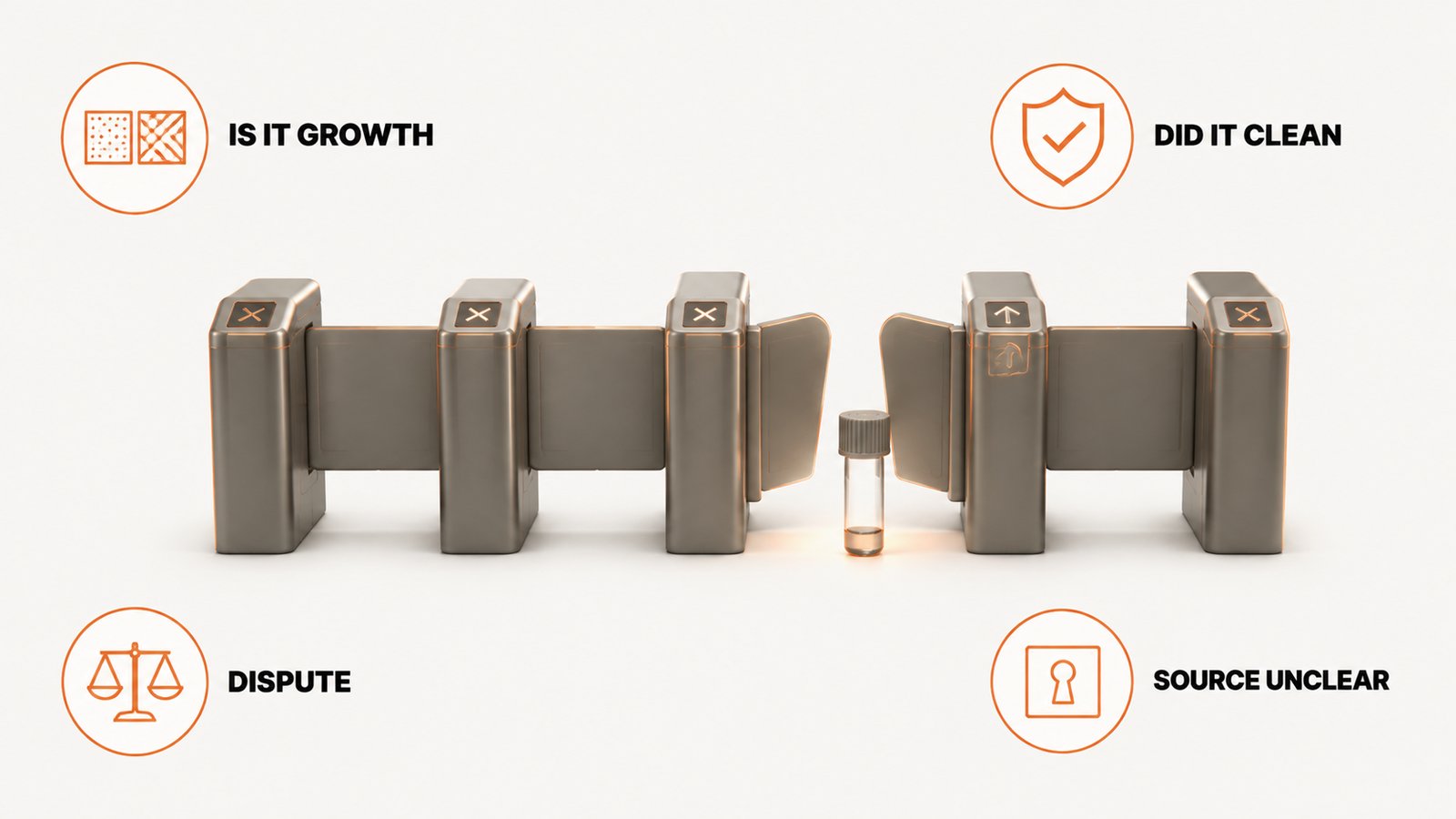
The EPA gives the cleanest decision rule in this entire subject: unless the results would or could make a change in your plans, you do not need to sample. Run every identification question through it.
The cases that pass:
- You are not sure it is growth at all. Soot, efflorescence and staining call for different work. The EPA lists differentiating mold from soot or dirt among the things sampling helps with.
- You need to know whether a cleanup worked. The EPA endorses surface sampling for determining whether an area has been adequately cleaned or remediated. New York State requires a post-remediation assessment on licensed work.
- There is a dispute. The EPA lists litigation among the circumstances where sampling may be worth considering. Have the sample taken by a party independent of whoever will do the remediation.
- The source is unclear. Also on the EPA's list. Pair sampling with a moisture survey rather than running it alone.
Everything else is curiosity, and curiosity is a perfectly good reason to spend money as long as you know that is what you are buying. What it should not do is delay the work. Texas's guidance is direct about the order: testing to determine what kind of mold is present is not required prior to remediation or cleaning.
A last note on cost. New York State points out that mold sampling and testing can be more expensive than simply cleaning and repairing the water problems that allow mold to grow. If the budget is finite, spend it on the repair. A named genus in a dry house is trivia; an unnamed genus in a wet wall is a problem that keeps growing.
When to Call a Pro

Stop identifying and start hiring when any of these are true:
- Growth covers more than about 10 square feet, roughly a 3-foot by 3-foot patch. That is the EPA's threshold for handing off a cleanup, and New York State uses the same figure for calling in a licensed contractor.
- You think it is inside the wall or the floor. The EPA notes that investigating hidden mold can be difficult and may require a professional with experience investigating water-damaged and mold-damaged buildings, using equipment such as borescopes and moisture meters, and warns that disturbing moldy areas may spread mold throughout the building. Our page on mold behind walls covers the signs.
- Sewage or other contaminated water was involved. The EPA says to call a professional who has experience cleaning and fixing buildings damaged by contaminated water.
- You suspect the HVAC system. The EPA advises consulting its duct guidance and warns not to run a system you know or suspect is contaminated because it could spread mold throughout the building.
- Someone in the home is at higher risk. The CDC notes that people with asthma or who are allergic to mold may have severe reactions, and that immune-compromised people and people with chronic lung disease may get infections in their lungs from mold. The EPA advises consulting a health professional before starting cleanup if you have health concerns.
Hire against the ANSI/IICRC S520 standard for professional mold remediation and check whether your state licenses the work. Our mold remediation certification page maps who is licensed where, and how to get rid of mold covers everything below that threshold that you can safely handle yourself.
Frequently asked questions
Can you identify mold from a photo?
Not to a genus or a species. Genus-level identification requires a laboratory looking at a sample under a microscope, and even then many results resolve to a group of similar-looking genera rather than to one name. What a photo can carry is the information that actually drives a decision: texture, edge pattern, substrate, and how far it has spread.
Is a mold color chart accurate?
Not as an identification tool. A single genus can appear in several colors depending on age, substrate and moisture, and several genera share one color. Color also fails to distinguish growth from things that are not growth at all, including soot, efflorescence and water staining. Use color to decide what to look at more closely, not to decide what it is.
Do I need to know the type of mold before cleaning it?
No. The CDC states that you do not need to know the type of mold. New York State's health department adds that knowing the kinds of mold present does not change the advice, and Texas's licensing agency states that testing to determine what kind of mold is present is not required prior to remediation or cleaning. The response is the same in every case: fix the moisture, clean or discard the material, dry the area.
How do I tell mold from soot or dirt?
Look at texture and pattern rather than color. Growth sits proud of the surface and catches raking light; soot is flat and smears when wiped. Soot follows air movement, so it concentrates near registers, gaps and outlets, while growth follows moisture. The EPA lists differentiating between mold and soot or dirt among the specific things laboratory sampling can help with, which tells you how often the two get confused.
What is the white powder on my basement wall?
Often efflorescence, which is mineral salt carried out of masonry by water rather than a living organism. It brushes off as powder and dissolves in water. It is still worth acting on, because it proves water is moving through the wall, and the EPA's framework is that the key to mold control is moisture control. White growth is also common, so check whether the deposit is powdery or fuzzy.
How does a laboratory identify mold?
Three main methods. Direct microscopy examines a tape lift or swab and identifies structures morphologically, usually to genus or to a group of similar genera. Culture grows the sample on a medium, which can reach species level but only reports what will grow on that medium. DNA analysis is used in dust-based indexes such as ERMI, which the EPA states has not been validated for non-research purposes.
Is dark growth always the dangerous kind?
Color does not rank risk. Several genera appear dark, and so do soot and ordinary dirt. The EPA describes molds generally as producing allergens, irritants and in some cases potentially toxic substances, and notes that inhaling or touching mold or mold spores may cause allergic reactions in sensitive individuals. Any health question belongs with a licensed physician rather than with a color.
When is identification actually worth paying for?
When the result would change your plan, which is the EPA's own test. That means when you are unsure it is growth at all, when you need to check whether a cleanup worked, when there is a dispute or litigation, or when the source is unclear. Outside those cases, New York State's point applies: sampling can cost more than simply cleaning and repairing the water problem.
Sources
Every claim on this page traces to one of these. Links open the primary document.