
Why Mold Type Matters
A genus or species name can be useful when a qualified professional has a defined laboratory or building question. It does not replace an assessment of the moisture source, affected material, extent, and access conditions.
Visual labels are limited. Dark, green, white, yellow, and pink growth can each have multiple biological or nonbiological explanations.
Building decisions rely on context. Persistent moisture, major water damage, recurring growth, concealed areas, and damaged porous materials can matter more than color.
Health questions stay separate. A species name or environmental sample cannot determine whether symptoms were caused by mold. Consult a licensed physician for symptoms.
Public cleanup guidance generally focuses on moisture control, affected area, material, and safe handling rather than a color-based health hierarchy. For small, hard-surface areas, our guide to the best mold removal products covers the no-bleach cleaners that fit that guidance.
Black Molds

Stachybotrys chartarum
Appearance: Descriptions often include dark green or black growth on wet cellulose materials. Other organisms and stains can look similar.
Where it may occur: Persistently water-damaged drywall, ceiling tile, cardboard, or wood. A photograph cannot confirm the organism or inspect behind a surface.
Health limit: The name or color does not establish personal exposure or explain symptoms.
Action: Avoid disturbing large, concealed, or heavily water-damaged areas. Ask a qualified professional to define the building scope when safe handling is uncertain.
Cladosporium
Appearance: Dark green to black, suede-like or powdery texture. Forms in circular patches.
Where it grows: Window sills, bathrooms, textiles, carpets, under sinks. One of the most common indoor molds. Also extremely common outdoors.
Identification limit: A dark appearance does not confirm Cladosporium or establish that an area is low risk.
Action: Correct the moisture source and follow current public-health guidance. On small, non-porous areas, a no-bleach product like the one in our Concrobium Mold Control review is a common choice once the moisture is fixed. Use a qualified professional for large, recurring, concealed, or unsafe areas.
Aspergillus niger
Appearance: Black with a white or yellow border. Powdery texture. Grows in dense circular colonies.
Where it grows: Damp walls, decaying vegetation, HVAC systems, and stored food. Very common in homes with humidity issues.
Identification limit: Appearance alone cannot distinguish Aspergillus niger from other dark growth or predict a person's health response.
Green Molds
Penicillium
Appearance: Blue-green to teal, velvety or powdery. Spreads rapidly in concentric rings.
Where it grows: Water-damaged wallpaper, carpet, insulation, mattresses, upholstered furniture, and stored food. One of the fastest-spreading indoor molds.
Identification limit: Blue-green growth is not enough to confirm Penicillium or determine health risk.
Aspergillus (green species)
Appearance: Green, yellow-green, or gray-green. Powdery. Over 180 species exist, and several are green.
Where it grows: Nearly anywhere with moisture: walls, ceilings, HVAC systems, food, soil, and insulation. The most common mold genus found in indoor environments.
Identification limit: Aspergillus is a broad genus. Color and a photograph cannot determine the species, compounds present, or health significance.
Trichoderma
Appearance: White to bright green, cottony or woolly texture.
Where it grows: Damp drywall, wallpaper, wet carpet, and HVAC filters. Grows rapidly on cellulose in high humidity.
Building context: Growth on damp cellulose indicates a moisture condition that should be corrected. Appearance does not establish health effects.
White Molds
White growth is often confused with efflorescence, a mineral deposit associated with moisture moving through masonry. A simple visual or wipe test is not enough to identify unknown material safely.
Early-stage Penicillium and Aspergillus
Some molds may appear white during parts of their growth, but white fuzzy material can also be another fungus, mineral residue, fibers, or debris. Appearance alone cannot confirm an early-stage mold.
Sclerotinia
Appearance: White, cottony. Often found on stored food and in crawl spaces.
Where it grows: Organic materials in damp, cool environments. Common in crawl spaces, basements, and on stored produce.
Building context: A white cottony appearance does not confirm Sclerotinia. Investigate moisture and use qualified identification only when a defined decision requires it.
Pink, Orange, and Yellow Molds
Serratia marcescens (Pink "Mold")
Appearance: Pink to reddish-orange, slimy film. Not actually a mold. Serratia is a bacterium.
Where it grows: Shower tiles, toilet bowls, sinks, pet water bowls. Anywhere with standing water and soap residue.
Identification limit: Pink residue in a wet area is not a medical finding. Follow product-label and public-health cleaning guidance, and correct standing water or persistent moisture.
Aureobasidium (Pink-Black Mold)
Appearance: Starts pink, turns dark brown to black as it ages. Slimy.
Where it grows: Window frames, caulk, wooden surfaces, painted walls. Common in bathrooms and kitchens.
Identification limit: Pink-to-dark growth cannot be confirmed as Aureobasidium from color alone. Use appropriate precautions for unknown biological material.
Fuligo septica (Yellow "Dog Vomit" Mold)
Appearance: Bright yellow, spongy, looks like scrambled eggs. Actually a slime mold, not a true mold.
Where it grows: Mulch, lawns, garden beds. Occasionally found on basement walls near garden entrances.
Identification limit: A photograph may suggest a slime mold, but it cannot confirm the organism or establish health significance.
Why Visual Identification Falls Short
You cannot reliably identify mold species by looking at it. Many organisms, stains, and mineral deposits overlap in appearance.
Visual clues: Color, texture, location, and growth pattern can describe what is visible but are not definitive. Mold Scanner AI provides AI-assisted visual screening of submitted visible surfaces and common lookalikes. It does not identify species.
Surface sample: A properly collected sample may help a laboratory characterize material from one spot. Precision and turnaround depend on the method, sample quality, and laboratory.
Settled-dust analysis: ERMI is a research index based on selected mold DNA in dust. It does not identify every organism in a home and is not a universal safety or health test.
Professional assessment: A qualified professional can combine building history, accessible observations, moisture evaluation, and selected sampling. Building data cannot quantify personal exposure or attribute symptoms.
Browse Mold by Color
Color is a description, not an identification or diagnosis. Each guide below covers visible cues, common building locations, lookalikes, and cleanup limits. Qualified laboratory analysis may characterize a properly collected sample when a defined building decision requires it.
Black mold Green mold Is green mold dangerous? Hairy black mold White mold Pink mold Orange mold Yellow mold Brown mold Blue mold Gray moldWhat are the different kinds of mold?
There are many different kinds of mold, but only a handful show up again and again in homes. This guide groups them by the color people notice first, which is how most searches for types of molds begin.
So what types of mold are there in a typical home? These six examples of mold come up most often in household guides:
- Cladosporium: dark green to black, often on window sills, in bathrooms, and on textiles.
- Penicillium: blue-green and velvety, often on water-damaged wallpaper, carpet, and insulation.
- Aspergillus: a broad genus that can look green, yellow-green, gray-green, or black (Aspergillus niger), on walls, ceilings, and in HVAC systems.
- Stachybotrys chartarum: dark green or black, described on persistently wet drywall, ceiling tile, and cardboard.
- Trichoderma: white to bright green and cottony, on damp drywall and wet carpet.
- Aureobasidium: starts pink and turns dark brown to black, on window frames, caulk, and painted walls.
Not everything on a list of kinds of mold is a true mold. Pink slime in a shower is usually Serratia marcescens, which is a bacterium, and the bright yellow growth in mulch is a slime mold.
Different mold types can look alike, and one kind can change color as it ages. That is why this page describes what each one looks like and where it grows, but does not rank them by health risk. Any unwanted indoor growth points to a moisture problem that needs fixing, whatever it is called.
What colors are mold?
Mold can be black, green, white, pink, orange, yellow, brown, blue, or gray. Mold colors depend on the kind of mold, how long it has been growing, the material under it, and even the lighting, so color describes what you see but does not name the mold.
People often ask what colors are mold, and the honest answer is nearly any of them. Here are the colors of mold people report most, with the guide for each:
- Black or dark green: see black mold and hairy black mold. Dark growth on this page includes Stachybotrys, Cladosporium, and Aspergillus niger.
- Green or blue-green: see green mold and blue mold. Penicillium and the green Aspergillus species are the usual names.
- White: see white mold. White fuzz can also be efflorescence, a mineral deposit, or plain debris.
- Pink, orange, or yellow: see pink mold, orange mold, and yellow mold. Pink film in a wet area is often a bacterium, and spongy yellow growth in mulch is a slime mold.
- Brown or gray: see brown mold and gray mold.
Two things trip people up. Different mold colors can appear side by side on the same wall, and one color can be several different organisms. Dark discoloration can also have nonbiological causes. Treat color as a starting point, then look at the material, the location, and the moisture source.
Mold identification chart
A mold identification chart matches what you see, such as color, texture, and location, to the mold names often linked to it, but a chart can only narrow the options and cannot confirm one.
Use this chart to describe growth, not to name it:
- Dark green to black, suede-like or powdery, on sills and in bathrooms: often described as Cladosporium. Other organisms and stains can look similar.
- Black with a white or yellow border, powdery, in dense circles: often described as Aspergillus niger.
- Dark green or black on persistently wet drywall or cardboard: the setting usually described for Stachybotrys chartarum.
- Blue-green, velvety, spreading in rings: often described as Penicillium.
- Green, yellow-green, or gray-green and powdery: often described as a green Aspergillus species.
- White to bright green, cottony or woolly: often described as Trichoderma.
- White and cottony in crawl spaces or on stored food: often described as Sclerotinia. Efflorescence, fibers, and debris look similar.
- Pink, slimy film on shower tile or in sinks: usually Serratia marcescens, a bacterium.
- Pink that darkens to brown or black, slimy, on caulk and frames: often described as Aureobasidium.
- Bright yellow and spongy in mulch or garden beds: Fuligo septica, a slime mold.
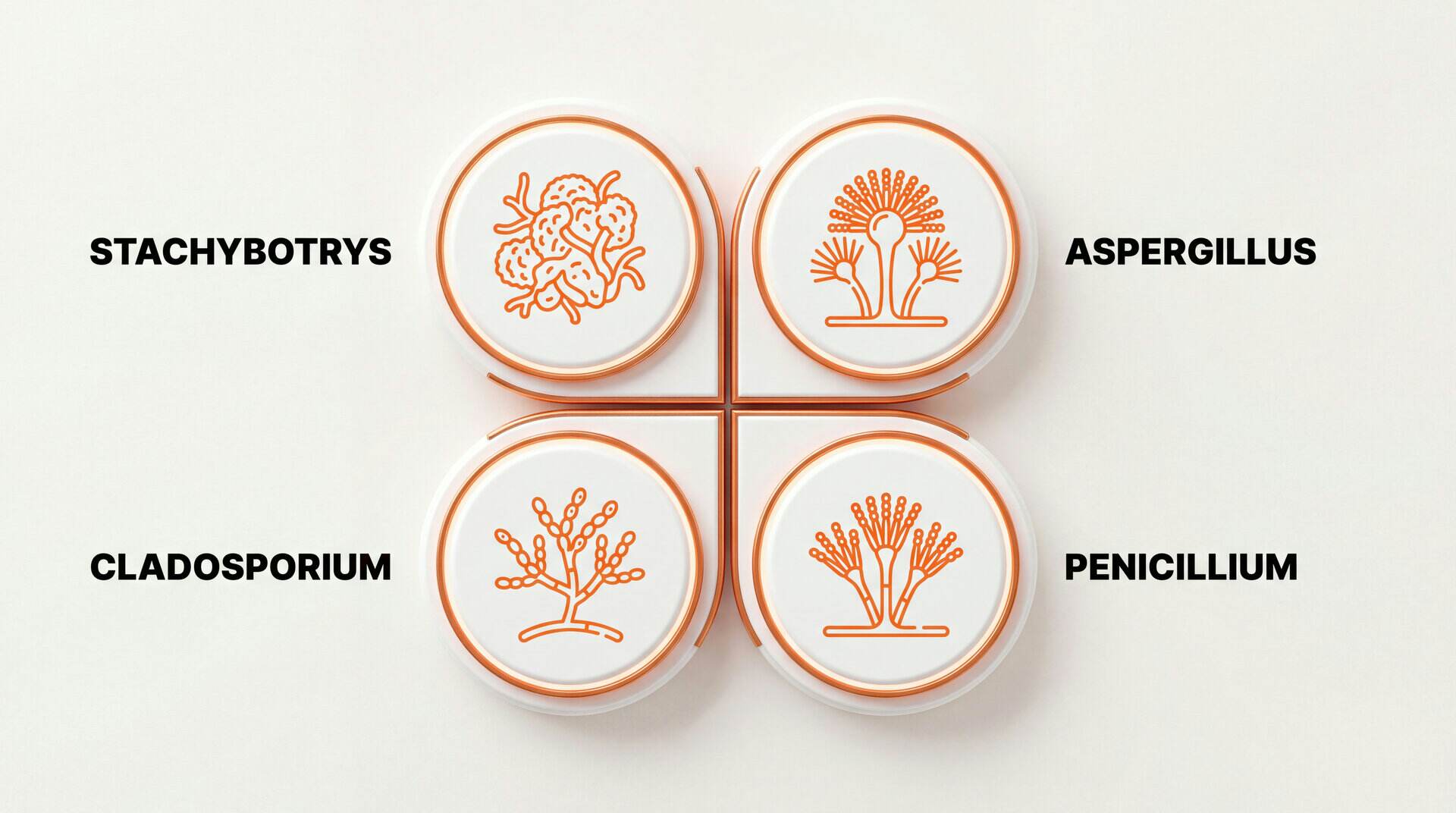
Mold identification photos and mold identification pictures help you compare shapes and colors, but a photograph cannot confirm the organism or look behind a surface. If you searched for types of mold pictures or types of mold in homes, the figures near the top of this page show the four most common species and the four most common hiding spots.
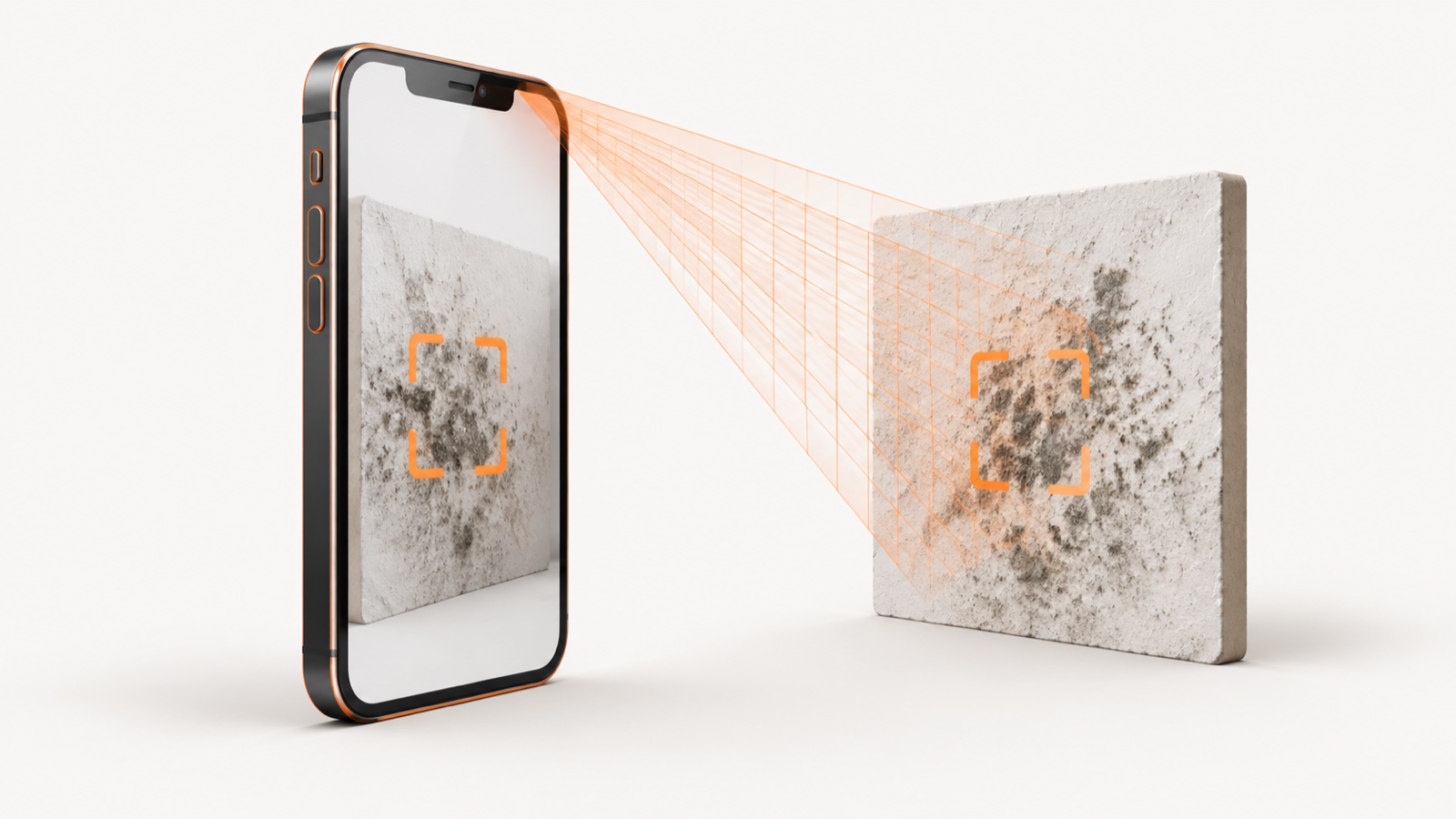
To check your own spot, upload a photo to Mold Scanner. It checks a photo for signs of mold growth and lists next steps.
Identifying mold types at home
Identifying mold types by sight only goes so far: you can describe color, texture, and location, but only a laboratory working from a properly collected sample can characterize what is growing.
Here is a practical order to work through:
- Describe it. Note the color, and whether it looks fuzzy, powdery, slimy, or cottony.
- Note where it is. A window sill, shower, basement wall, HVAC vent, and wet carpet each point to different setups.
- Find the moisture. Look for leaks, condensation, and persistent humidity. Growth needs moisture, and fixing it matters more than the name.
- Take a clear photo. Use good light and include some of the surrounding surface. You can scan it with Mold Scanner for a photo assessment.
- Know when to stop. Large, concealed, recurring, or heavily water-damaged areas call for a qualified professional. Sampling makes sense only when the result will answer a specific building question.
Identifying molds by name rarely changes the first steps. Public cleanup guidance focuses on moisture control, the affected area, and the material, not on a color-based ranking. For health questions, a licensed physician is the right person to ask, and a species name cannot answer them.
Frequently asked questions
What types of mold are there?
There are many kinds. Common indoor names include Cladosporium, Penicillium, Aspergillus, Stachybotrys, Trichoderma, and Aureobasidium. Some things people call mold are not true molds: pink slime in a shower is usually a bacterium, and yellow growth in mulch is a slime mold. Color alone cannot confirm which kind you have.
What are some examples of mold?
Examples of mold found in homes include Cladosporium on window sills, Penicillium on water-damaged wallpaper, Aspergillus on walls and in HVAC systems, and Stachybotrys on persistently wet drywall. Each is described by its usual look and location, but a photo cannot confirm any of them.
Does each color of mold mean a different type of mold?
No. One color can be several different organisms, and one kind of mold can change color as it ages. Black, green, white, and pink growth can each have more than one explanation, including nonbiological ones like stains and mineral deposits. Color is a clue for describing growth, not a way to name it.
What is a mold identification chart?
A mold identification chart pairs color, texture, and location with the mold names often linked to them. It can narrow the options for what you are seeing, but it cannot confirm a genus or species. Only a laboratory looking at a properly collected sample can characterize what is growing.
What are the most dangerous types of mold?
There is no reliable household health-risk ranking based on color, appearance, or a photograph. Any unwanted indoor growth signals a moisture issue that should be assessed based on extent, material, access, and building conditions. Do not use a species name to diagnose exposure or symptoms.
How can I tell what type of mold I have?
Color, texture, and location provide descriptive clues but cannot confirm a substance, genus, or species. A qualified laboratory may characterize a properly collected sample, with precision depending on the method and sample quality. Test only when the result will answer a defined building question.
Is all black mold toxic?
No. Dark discoloration can have many biological and nonbiological causes, and color does not identify Stachybotrys or establish toxicity. Evaluate the moisture source, affected material, and extent. Use qualified sampling only when a specific decision requires it.
Can different types of mold grow together?
Multiple molds and other microorganisms can occur on the same water-damaged material. A sample describes only what was collected with that method; it does not identify every organism in a room or building.
Which molds cause allergies vs which cause toxicity?
A species name, color, photograph, or home test cannot predict an individual's reaction or determine the cause of symptoms. Damp or moldy environments may affect people differently. Consult a licensed physician for symptoms and assess the building separately with a qualified professional.
Sources
Every claim on this page traces to one of these. Links open the primary document.