
The Indiana humidity profile
Indiana's four NOAA stations report 70 to 72 percent annual mean relative humidity with morning means of 81 to 83 percent, and the morning figure climbs to 87 percent in August and September. The calculated annual mean dew point spreads from 40 F at South Bend to 48 F at Evansville, an eight-point gap that follows the state's north-to-south run and is the single most useful line on this table.
The monthly shape is the humid continental signature. Relative humidity peaks in December at 77 percent and January at 76, in the sealed heating months, because cold air reads high while carrying little water. Indoors that means winter moisture is generated inside: showers, cooking, laundry, condensing on cold glass and inside cold wall cavities. Then the pattern flips in late summer, when 87 percent morning air meets basement floors that are still holding spring's cold. Indiana has two different mold seasons with two different fixes, and applying the summer fix in winter makes things worse.
The bulk-water half runs north to south. Northern Indiana takes lake-effect moisture off Lake Michigan and a long heating season. Southern Indiana sits on the Ohio River, and Evansville's 47.9 inches of rain and 48 F dew point are Kentucky numbers rather than Great Lakes ones. Between them the state is full of sump pumps, which is the clearest possible signal about what the housing stock is fighting. EPA guidance treats porous materials wet longer than 24 to 48 hours as at risk of mold growth, and a basement that takes water in a June storm clears that bar before the weekend is over.
Indiana against the national picture
| Metric | Indiana | What it means indoors | Source |
|---|---|---|---|
| Annual mean relative humidity | 70 to 72% | Consistently high, with no dry month anywhere in the state | NOAA NCEI Comparative Climatic Data |
| Morning mean relative humidity | 81 to 83% | Reaches 87 percent in August and September, the basement window | NOAA NCEI Comparative Climatic Data |
| Calculated annual mean dew point | 40 to 48 F | Spreads eight points from South Bend to Evansville, north to south | Calculated from NOAA 1991 to 2020 normals |
| Annual normal precipitation | 39.2 to 47.9 in | Nearly nine inches more in the south than in the north | NOAA NCEI 1991 to 2020 normals |
Relative humidity figures are the mean of the morning and afternoon observations NOAA publishes for each first-order station, rounded to whole percent. Dew point is calculated from the NOAA normal mean temperature and that mean relative humidity using the Magnus formula, so treat it as a derived figure rather than a published one.
How much water the sky delivers, station by station
Evansville takes 47.9 inches a year against 39.2 at South Bend. Bulk water is the mechanism behind most basement and crawl space mold, so the wettest station is the one to plan around.
View the data
| Station | Annual normal |
|---|---|
| Fort Wayne | 39.5 in |
| Indianapolis | 43.6 in |
| South Bend | 39.2 in |
| Evansville | 47.9 in |

Indiana stations ranked by measured humidity
Methodology. Ranked by annual mean relative humidity, the one input that traces to a station record rather than an opinion. Relative humidity is the mean of NOAA's published morning and afternoon values. Mean dew point is calculated from the NOAA 1991 to 2020 normal mean temperature and that mean relative humidity. The humidity band names what the column measures and nothing more. Humidity is not the whole story: a burst supply line in the driest metro on this table soaks the same drywall as a humid August, and EPA guidance treats wet porous material as at risk of mold growth after 24 to 48 hours either way.
Every place on file, ranked by mean RH
Fort Wayne reads 72% against 70% at Evansville. The target for a basement is 50 percent, so every row on this chart sits above it.
View the data
| # | Place | Mean RH | Morning RH | Annual precip |
|---|---|---|---|---|
| 1 | Fort Wayne | 72% | 82% | 39.5 in |
| 2 | Indianapolis | 71% | 82% | 43.6 in |
| 3 | South Bend | 71% | 81% | 39.2 in |
| 4 | Evansville | 70% | 83% | 47.9 in |
| # | Station | Mean RH | Morning RH | Mean dew pt | Annual precip | Humidity band | Notes |
|---|---|---|---|---|---|---|---|
| 1 | Fort Wayne | 72% | 82% | 42 F | 39.5 in | Humid | The state's highest annual mean at 72 percent. Interior northeast, long heating season, sump-pump country. |
| 2 | Indianapolis | 71% | 82% | 44 F | 43.6 in | Humid | Central Indiana. A large housing stock with finished lower levels, which is what turns a basement event into a remediation job. |
| 3 | South Bend | 71% | 81% | 40 F | 39.2 in | Humid | The state's lowest dew point at 40 F but heavy lake-effect snow, so the water arrives as melt rather than as humidity. |
| 4 | Evansville | 70% | 83% | 48 F | 47.9 in | Humid | The state's highest dew point at 48 F and highest rainfall at 47.9 inches. An Ohio River profile, closer to Kentucky than to South Bend. |
Fort Wayne
The state's highest annual mean at 72 percent. Interior northeast, long heating season, sump-pump country.
Indianapolis
Central Indiana. A large housing stock with finished lower levels, which is what turns a basement event into a remediation job.
South Bend
The state's lowest dew point at 40 F but heavy lake-effect snow, so the water arrives as melt rather than as humidity.
Evansville
The state's highest dew point at 48 F and highest rainfall at 47.9 inches. An Ohio River profile, closer to Kentucky than to South Bend.
The eight-point dew point spread is the real story on this table. South Bend at 40 F and Evansville at 48 F are not the same climate, and dew point is the honest measure because it does not move with temperature the way relative humidity does. Evansville's air carries substantially more water year-round, which is why southern Indiana basements need mechanical dehumidification for more months than northern ones do, and why the same construction detail performs differently at the two ends of the state.
What all four share is the morning. Every station reports a morning mean in the low 80s, and the statewide morning figure reaches 87 percent in August and September. That is the number that decides whether a cool basement wall picks up condensation overnight, and it is high everywhere in Indiana. Neighboring reports for Illinois, Ohio, Michigan and Kentucky cover the states this one sits between.
Common mold species in Indiana homes
EPA and CDC name the same core genera for humid continental climates. In Indiana housing they concentrate in basements and lower levels through late summer, and at cold winter surfaces the rest of the year.
Cladosporium
Cladosporium spp.The most commonly found indoor mold nationwide and the standard Indiana basement and window-sill find. Olive-green to black. In a finished lower level it appears first on the cold side of an exterior wall behind stored furniture. EPA lists it among the common allergenic indoor molds.
Penicillium
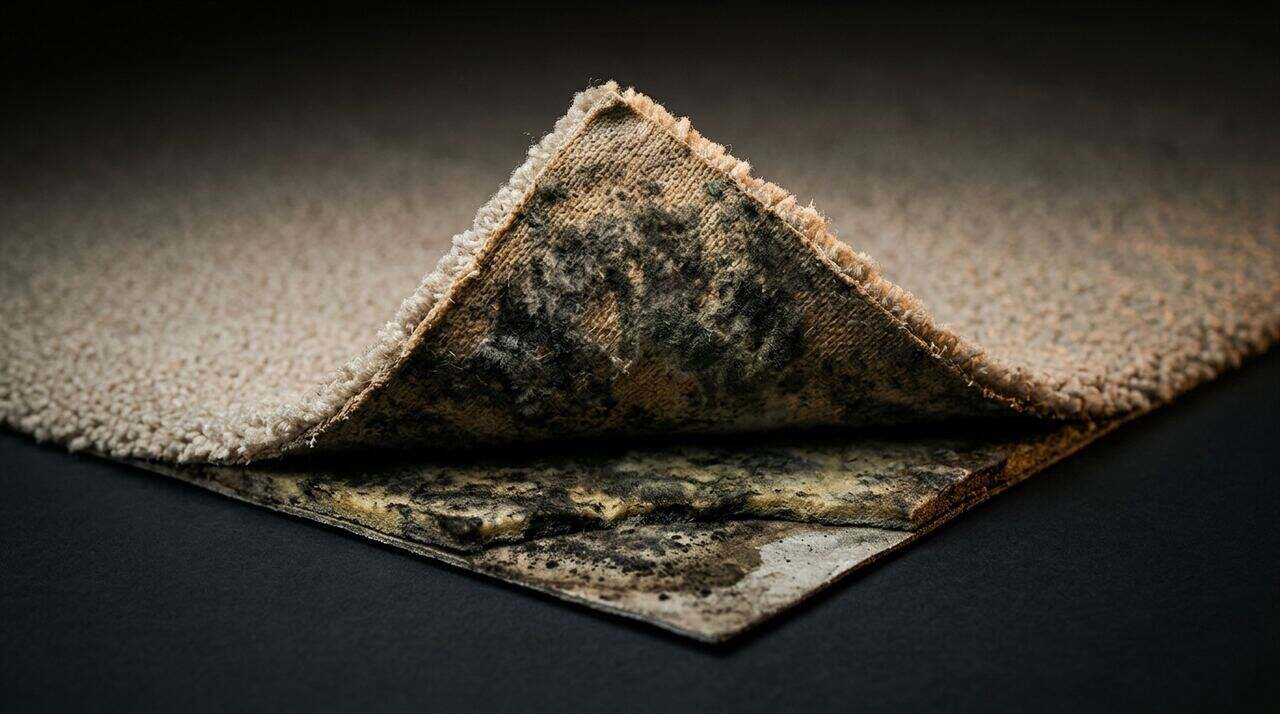
Penicillium spp.Blue-green and powdery, on cardboard, paper, carpet padding and stored fabric. August and September, at an 87 percent morning mean, are its window. EPA lists Penicillium among the most frequently recovered genera in indoor air samples.
Aspergillus
Aspergillus spp.Black, green or brown depending on species. It wants steady moisture and organic dust: bathroom grout in a house with a weak exhaust fan, the back of a closet on an exterior wall, a humidifier reservoir. EPA and CDC flag Aspergillus species as allergens and, in rare cases, as a cause of aspergillosis in people who are immunocompromised.
Stachybotrys chartarum
Stachybotrys chartarumThe species commonly called toxic black mold. It needs sustained wet cellulose, which in Indiana means drywall in a finished basement that stood in water after a sump failure or an Ohio River event. Visible black slimy growth on water-stained drywall is the signature. Do not disturb it. Cut it out.
Alternaria
Alternaria alternataDark green to black, on window tracks, shower stalls and condensation-prone surfaces. It is a common allergen panel entry and is often correlated with asthma flare-ups in sensitive individuals per EPA remediation guidance.
Chaetomium
Chaetomium spp.Olive to grey and cotton-textured. It requires chronic moisture, so finding it in a basement means the condition has been there for seasons rather than since the last storm. Treat it as a dating tool for the problem.
Species information is general and informational. Health responses vary. See a licensed physician for symptom evaluation. Species sources: EPA Mold Remediation in Schools and Commercial Buildings, EPA A Brief Guide to Mold Moisture and Your Home, CDC National Center for Environmental Health guidance.
What mold remediation costs in Indiana
No Indiana agency publishes a mold remediation price schedule. The Indiana Department of Health's Indoor Air Quality program states the reason plainly: apart from 410 IAC 33, which covers indoor air quality in schools and state agencies, there are no enforceable indoor air quality laws in Indiana, and the program relies on federal and published guidelines to make recommendations. There is no state standard to price against.
The Indiana cost driver is the finished lower level. Indiana builds them, and a finished basement that takes water is a demolition and rebuild rather than a cleanup: drywall out, studs exposed, carpet and pad gone, cabinetry out. The mold line on that invoice is small and the reconstruction line is large. An unfinished basement with the same water event is a pump, a dehumidifier and time.
The second driver is the sump system, because in Indiana it is usually the thing that failed. If the water came in because the sump quit during a storm or lost power, the honest scope includes a replacement pump, a battery or water-powered backup, and a check of the discharge line, before anyone talks about drywall. Remediating a basement and leaving the same single unbacked pump in place is buying the next event.
The third is that Indiana has no state credential to check at all, so bids differ in scope as much as in price. Get an itemized written scope from each. Indiana law does require home improvement contracts over $150 to be in writing, which the Attorney General's storm-chaser guidance confirms, so insist on the written contract as a matter of law rather than preference. Our national mold remediation cost guide covers what moves a quote in any market, and the cost estimator lets you scope your own job first.
On insurance: sump pump failure and sewer backup are usually separate endorsements rather than standard coverage, and in a sump-pump state that gap is the one that hurts. Surface-water flooding is excluded from a standard homeowners policy entirely. Check both endorsements before storm season and read our guide to homeowners insurance and mold.
Mold remediation licensing in Indiana: who can legally do the work
Indiana does not license or certify mold assessors or mold remediators, and it goes further than most states: it does not license general contractors or home improvement contractors at state level either.
Indiana does not license or certify mold assessors or mold remediators, and it goes further than most states: it does not license general contractors or home improvement contractors at state level either. The Indiana Professional Licensing Agency publishes the complete list of the 41 professions it regulates, and mold appears nowhere on it. Contractor licensing in Indiana is a city and county matter, so the answer to whether your contractor is licensed depends entirely on which municipality your house sits in.
The Indiana Department of Health confirms the gap from the health side. Its Indoor Air Quality program states that apart from 410 IAC 33, which covers indoor air quality in schools and state agencies, there are no enforceable indoor air quality laws or regulations in Indiana, and that federal and other published guidelines are used to make recommendations instead. Its mold section carries no state-authored guidance and links out to EPA and CDC.
That leaves two real protections. The first is the written contract requirement: Indiana law requires home improvement contracts over $150 to be in writing, which the Attorney General's storm-chaser guidance sets out. Use it. A written contract that itemizes scope is the document that makes a later complaint actionable. The second is the Attorney General's Consumer Protection Division, which handles contractor fraud and publishes specific post-storm guidance, because storm-chasing crews are a recurring Indiana problem.
For the mold work itself the whole credential check is yours. Call your city or county to find out what local contractor registration applies and confirm the company holds it. Then ask for IICRC certification, ask whether the work will follow ANSI/IICRC S520, ask whether the same firm is doing the assessment and the remediation, and ask for daily moisture readings by material. Verify insurance directly with the carrier rather than accepting a certificate the contractor hands you.
Indiana mold laws and tenant rights
Indiana has no mold-specific statute. A mold complaint runs through Indiana Code 32-31-8-5, which requires a landlord to deliver the rental premises in a safe, clean and habitable condition, to comply with all applicable health and housing codes, to keep common areas clean and proper, and to provide and maintain plumbing sufficient for hot and cold running water, sanitary systems, and heating, ventilating and air conditioning systems in good and safe working condition. Mold is not named, so a tenant argues it as a habitability breach or, usually more effectively, as a failure of the plumbing or HVAC system that produced the moisture.
The enforcement path is Indiana Code 32-31-8-6, and it is strictly conditional. A tenant cannot sue unless four things are true: the tenant first gave the landlord notice of the noncompliance, the tenant gave the landlord a reasonable amount of time to make the repair, the tenant did not block access for that repair, and the landlord then failed or refused to fix it. Miss any one of those and the claim does not get off the ground.
What makes it worth doing properly is the remedy. A prevailing tenant can recover actual and consequential damages, attorney's fees and court costs, injunctive relief, or any other appropriate remedy. Attorney's fees change the economics of a modest claim entirely, because a case that would cost more to bring than it recovers becomes worth bringing.
One timing detail matters. The landlord's liability for damages begins when the landlord has notice or actual knowledge and has either refused to remedy or failed to remedy within a reasonable time, whichever comes first. So the date of your notice is the date the meter starts. Send it in writing even though the statute does not say the notice must be written, date it, describe the condition and the water source specifically, and keep proof of delivery. Our landlord letter generator produces that notice, and our guide to mold and apartment rights covers the general playbook.
General information, not legal advice. For your situation, talk to a Indiana attorney, a legal aid office, or your local tenant council.
Indiana-specific actions
A sump-pump state with two mold seasons and no state credential. Three moves cover most of it.
A. Treat the sump system as the most important appliance in the house
In Indiana, the basement failure that produces a remediation job usually starts with a pump that quit at the wrong moment. Test the pump by pouring water into the pit, not by looking at it. Add a battery or water-powered backup, because storms take the power and the pump at the same time. Check the discharge line runs well away from the foundation and does not freeze shut in January. Confirm the check valve works. That package costs a fraction of one remediation and prevents the event rather than cleaning up after it.
B. Own the basement in August and September
The morning mean reaches 87 percent while basement floors are still holding spring's cold, which is the widest gap of the year between air moisture and surface temperature. Opening a basement window on a humid August morning makes the walls wetter, not drier. Run a dehumidifier with a condensate pump and hold the space below 50 percent. Outside, direct downspouts at least six feet from the foundation and grade soil to slope away. Our indoor humidity calculator shows measured relative humidity plus calculated dew point.
C. Flip the strategy in winter
Indiana's relative humidity peaks in December and January, but the mechanism is the opposite one. The air outside carries little water at a 40 to 48 F dew point, and the moisture that matters is what you generate inside a sealed house. Target roughly 30 to 35 percent indoor relative humidity in the cold months rather than 50, run bath and kitchen exhaust fans on a timer, confirm the dryer vents outdoors, and turn a furnace humidifier down in January. Running a dehumidifier against outdoor air in a January basement accomplishes nothing; ventilating and lowering interior moisture does.
Seasonal risk profile for Indiana
Monthly mean relative humidity across Indiana's four NOAA stations. The daily mean peaks in December and the morning mean peaks in August and September, which is why the state effectively has two mold seasons with opposite fixes.
Indiana relative humidity peaks in December
The monthly mean runs from 66 percent in April to 77 percent in December, a 11 point swing across the year.
View the data
| Month | Jan | Feb | Mar | Apr | May | Jun | Jul | Aug | Sep | Oct | Nov | Dec |
|---|---|---|---|---|---|---|---|---|---|---|---|---|
| Mean RH | 76% | 74% | 70% | 66% | 67% | 67% | 70% | 72% | 71% | 70% | 73% | 77% |
August and September are the basement window. The morning mean reaches 87 percent while below-grade surfaces are still cool. This is when Penicillium takes hold on stored cardboard and carpet padding, and when a finished lower level first smells musty. Run the dehumidifier through this stretch even when the upstairs feels comfortable.
June is the storm and sump window. Heavy summer rain on saturated ground is what overwhelms a sump system, and southern Indiana adds Ohio River exposure on top. Test the pump before June, not after the first storm.
December and January are the indoor-moisture window. The daily mean sits at 76 to 77 percent while the air outside carries little water. In a sealed, heated house every cold surface becomes a condensation target, and window sills and exterior-wall closet corners go first. The fix here is ventilation and a lower indoor target, not a dehumidifier. The mold risk by ZIP tool gives you the local read.
Where to get help in Indiana
Indiana runs indoor air quality as a schools-and-state-agencies program with public education attached, and routes contractor problems to the Attorney General. These are the starting points.
Questions on file
Does Indiana require a license for mold remediation?
No, and Indiana does not license general contractors or home improvement contractors at state level either. The Indiana Professional Licensing Agency publishes the complete list of the 41 professions it regulates and mold is not on it; contractor licensing here is a city and county matter. The Indiana Department of Health confirms the gap from the other side, stating that apart from 410 IAC 33 covering schools and state agencies, there are no enforceable indoor air quality laws in Indiana. Call your city or county to find out what local registration applies, then verify it.
Source 3, Indiana Professional Licensing AgencyHow does an Indiana tenant enforce a mold complaint?
Through Indiana Code 32-31-8-6, and the conditions are strict. A tenant cannot sue unless the tenant first gave the landlord notice of the noncompliance, gave a reasonable amount of time to repair, did not block access for that repair, and the landlord then failed or refused to fix it. Miss any one and the claim fails. What makes it worth doing properly is the remedy: a prevailing tenant can recover actual and consequential damages, attorney's fees and court costs, injunctive relief, or any other appropriate remedy. Attorney's fees make a modest claim worth bringing.
When does an Indiana landlord become liable for mold damage?
When the landlord has notice or actual knowledge and has either refused to remedy or failed to remedy within a reasonable time, whichever comes first. That makes the date of your notice the date the clock starts, which is why you send it in writing and keep proof of delivery even though the statute does not require the notice to be written. Describe the condition and the water source specifically rather than writing that there is mold, because the underlying failure of plumbing or HVAC under IC 32-31-8-5 is usually the stronger argument.
Why does mold appear in Indiana basements in late summer?
Because the morning humidity reaches 87 percent in August and September while the basement floor is still holding spring's cold. That is the widest gap of the year between the moisture in the air and the temperature of the surfaces it touches, so the walls and floor condense. It is a dew point problem rather than a leak, and it produces the same wet material a leak does. Run a dehumidifier through this stretch, and do not open basement windows on a humid morning, which pushes wet air onto cool masonry.
Is northern Indiana the same as southern Indiana for mold?
No. The calculated mean dew point runs 40 F at South Bend and 48 F at Evansville, an eight-point spread, and Evansville takes nearly nine more inches of rain a year. Southern Indiana is an Ohio River climate closer to Kentucky's than to the Great Lakes, so it needs mechanical dehumidification for more months of the year. Northern Indiana's water arrives more often as lake-effect snowmelt and a long sealed heating season. Both ends run morning humidity in the low 80s, so the basement rule applies statewide.
Does homeowners insurance cover a sump pump failure in Indiana?
Usually only if you bought the endorsement. Sump pump failure and sewer backup are typically separate add-ons rather than standard coverage, and in a state where sump pumps are the default basement defense, that gap is the one that catches people. Surface-water flooding is excluded from a standard homeowners policy entirely and requires National Flood Insurance Program coverage, which carries a 30-day waiting period. Check both endorsements before storm season and take coverage questions to the Indiana Department of Insurance.
Source register
Every source chip on this page points here. Agency and statute pages first, then the federal technical references.
Find the mold in your Indiana home
The scanner is open. Get a detailed photo report, next steps, testing options and estimated cleanup costs.
Scan My Photo Get the free mold checklistRelated guides on Mold Scanner AI

All 51 State Reports
Humidity, licensing and tenant law for every state.

Mold in the Basement
The Indiana failure mode, start to finish.
Mold in Carpet
Why padding comes out and carpet sometimes does not.
How to Prevent Mold
Moisture control that actually holds up.
Picking a Dehumidifier
Sizing, drain options, and the spec that matters.

Mold in Your Apartment
Renter rights, notice letters, and landlord duties.