
The Illinois humidity profile
Illinois's five NOAA stations report 70 to 72 percent annual mean relative humidity with morning means of 80 to 83 percent, and the statewide morning mean climbs to 89 percent in August and 87 percent in September, the highest pair in this report outside the Gulf and Appalachia. The calculated annual mean dew point runs 41 F at Rockford to 45 F at Springfield, a four-point north-to-south spread.
The daily mean peaks in December at 76 percent in the sealed heating months, which is the usual cold-climate artifact, and that means Illinois has two mold seasons with opposite fixes: an August basement problem and a January condensation problem. Applying the summer fix in winter makes the winter problem worse.
Illinois has the highest disaster load of any state in this part of the report by a wide margin, and the mechanism is severe convective storms and flooding into basements. NOAA counted 128 billion-dollar disasters affecting Illinois from 1980 to 2024, including 92 severe storm events and 8 flooding events, and the 2020 to 2024 annual average has run at 7.8 events against a 1980 to 2024 average of 2.8. NOAA's state climate summary reports that spring and summer precipitation has generally been above average since the mid-1990s against a long-term annual average of 38.1 inches, and that future increases in the frequency and intensity of extreme precipitation may increase the frequency and intensity of floods. The state's interior position, with no mountains north or south, exposes it to warm humid Gulf air masses in summer, which is what loads basement and crawl space humidity between the storms.
Illinois against the national picture
| Metric | Illinois | What it means indoors | Source |
|---|---|---|---|
| Annual mean relative humidity | 70 to 72% | Consistently high, with no dry month anywhere in the state | NOAA NCEI Comparative Climatic Data |
| Morning mean relative humidity | 80 to 83% | Reaches 89 percent in August, among the highest in this report | NOAA NCEI Comparative Climatic Data |
| Calculated annual mean dew point | 41 to 45 F | A four-point north-to-south spread, Rockford to Springfield | Calculated from NOAA 1991 to 2020 normals |
| Annual normal precipitation | 37.2 to 38.3 in | Remarkably even statewide, and arriving in more extreme events than it used to | NOAA NCEI 1991 to 2020 normals |
Relative humidity figures are the mean of the morning and afternoon observations NOAA publishes for each first-order station, rounded to whole percent. Dew point is calculated from the NOAA normal mean temperature and that mean relative humidity using the Magnus formula, so treat it as a derived figure rather than a published one.
How much water the sky delivers, station by station
Moline (Quad Cities) takes 38.3 inches a year against 37.2 at Rockford. Bulk water is the mechanism behind most basement and crawl space mold, so the wettest station is the one to plan around.
View the data
| Station | Annual normal |
|---|---|
| Springfield | 38 in |
| Peoria | 37.5 in |
| Rockford | 37.2 in |
| Chicago | 37.9 in |
| Moline (Quad Cities) | 38.3 in |

Illinois stations ranked by measured humidity
Methodology. Ranked by annual mean relative humidity, the one input that traces to a station record rather than an opinion. Relative humidity is the mean of NOAA's published morning and afternoon values. Mean dew point is calculated from the NOAA 1991 to 2020 normal mean temperature and that mean relative humidity. The humidity band names what the column measures and nothing more. Humidity is not the whole story: a burst supply line in the driest metro on this table soaks the same drywall as a humid August, and EPA guidance treats wet porous material as at risk of mold growth after 24 to 48 hours either way.
Every place on file, ranked by mean RH
Springfield reads 72% against 70% at Chicago. The target for a basement is 50 percent, so every row on this chart sits above it.
View the data
| # | Place | Mean RH | Morning RH | Annual precip |
|---|---|---|---|---|
| 1 | Springfield | 72% | 83% | 38 in |
| 2 | Peoria | 72% | 83% | 37.5 in |
| 3 | Rockford | 72% | 83% | 37.2 in |
| 4 | Chicago | 70% | 80% | 37.9 in |
| 5 | Moline (Quad Cities) | 70% | 81% | 38.3 in |
| # | Station | Mean RH | Morning RH | Mean dew pt | Annual precip | Humidity band | Notes |
|---|---|---|---|---|---|---|---|
| 1 | Springfield | 72% | 83% | 45 F | 38.0 in | Humid | The state's highest dew point at 45 F. Central Illinois, so the air carries the most actual water. |
| 2 | Peoria | 72% | 83% | 44 F | 37.5 in | Humid | Illinois River valley, 72 percent with an 83 percent morning mean and a 61 percent afternoon. |
| 3 | Rockford | 72% | 83% | 41 F | 37.2 in | Humid | Northern Illinois, the state's lowest dew point at 41 F and its longest heating season. |
| 4 | Chicago | 70% | 80% | 42 F | 37.9 in | Humid | Lake Michigan and urban heat island together. The state's lowest relative humidity at 70 percent, and the largest housing stock at risk. |
| 5 | Moline (Quad Cities) | 70% | 81% | 42 F | 38.3 in | Humid | Mississippi River. The wettest station at 38.3 inches, with river flooding as the local mechanism. |
Springfield
The state's highest dew point at 45 F. Central Illinois, so the air carries the most actual water.
Peoria
Illinois River valley, 72 percent with an 83 percent morning mean and a 61 percent afternoon.
Rockford
Northern Illinois, the state's lowest dew point at 41 F and its longest heating season.
Chicago
Lake Michigan and urban heat island together. The state's lowest relative humidity at 70 percent, and the largest housing stock at risk.
Moline (Quad Cities)
Mississippi River. The wettest station at 38.3 inches, with river flooding as the local mechanism.
Illinois is the most uniform state on this table. Five stations spread across 300 miles report an annual mean within two points of each other and precipitation within one inch. There is no wet corner and no dry corner. What separates one Illinois house from another is not location on this table, it is whether the basement is finished and whether the sump system works.
The dew point does move, and it moves the right way. Springfield at 45 F carries four degrees more moisture than Rockford at 41 F, which follows the north-to-south gradient across the Midwest. Southern Illinois behaves more like Kentucky and northern Illinois more like Wisconsin, so mechanical dehumidification earns its keep for more months of the year at the southern end. Neighboring reports for Wisconsin, Indiana, Iowa, Missouri and Kentucky cover the states Illinois borders.
Common mold species in Illinois homes
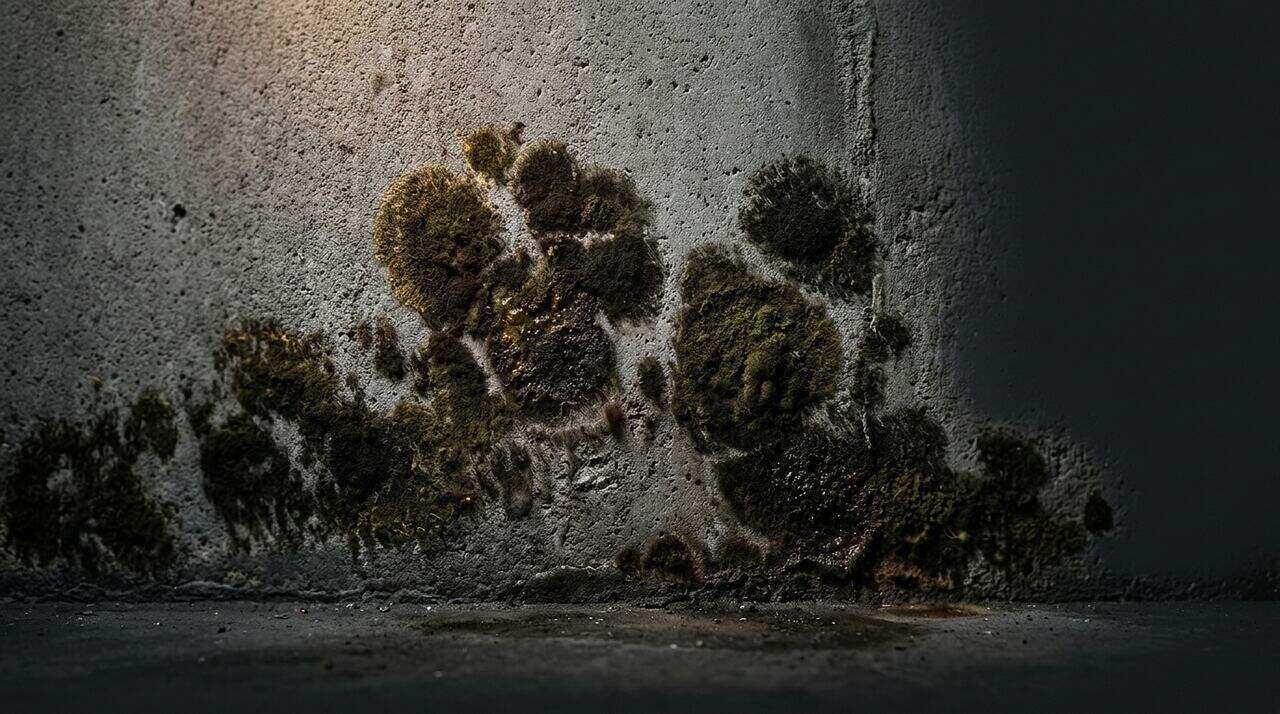
EPA and CDC name the same core genera for humid continental climates. In Illinois they concentrate in basements through late summer, and at cold winter surfaces the rest of the year.
Cladosporium
Cladosporium spp.The most commonly found indoor mold nationwide and the standard Illinois basement and window-sill find. Olive-green to black, often a fine speckle on cool poured concrete or block walls. EPA lists it among the common allergenic indoor molds.
Penicillium
Penicillium spp.Blue-green and powdery, on cardboard, paper, carpet padding and stored fabric. August and September, at 87 to 89 percent morning humidity, are its window. EPA lists Penicillium among the most frequently recovered genera in indoor air samples.
Stachybotrys chartarum
Stachybotrys chartarumThe species commonly called toxic black mold. It needs sustained wet cellulose, which in Illinois means drywall in a finished basement that stood in water after a storm or a sump failure. Visible black slimy growth on water-stained drywall is the signature. Do not disturb it. Cut it out.
Aspergillus
Aspergillus spp.Black, green or brown depending on species. It wants steady moisture and organic dust: bathroom grout in a house with a weak exhaust fan, the back of a closet on an exterior wall, a humidifier reservoir. EPA and CDC flag Aspergillus species as allergens and, in rare cases, as a cause of aspergillosis in people who are immunocompromised.
Alternaria
Alternaria alternataDark green to black, on window tracks, shower stalls and condensation-prone surfaces. It is a common allergen panel entry and is often correlated with asthma flare-ups in sensitive individuals per EPA remediation guidance.
Chaetomium
Chaetomium spp.Olive to grey and cotton-textured. It requires chronic moisture, so finding it in a basement means the condition has been there for seasons rather than since the last storm. Treat it as a dating tool for the problem.
Species information is general and informational. Health responses vary. See a licensed physician for symptom evaluation. Species sources: EPA Mold Remediation in Schools and Commercial Buildings, EPA A Brief Guide to Mold Moisture and Your Home, CDC National Center for Environmental Health guidance.
What mold remediation costs in Illinois
No Illinois agency publishes a mold remediation price schedule. IDPH's Toxicology Program does take consultation requests on indoor air quality from the public, and it publishes a Mold FAQ plus fact sheets on Mold and Your Health, Reducing Your Exposure to Mold, and Moisture in the Home. One of its school fact sheets carries the title that sums up the state's position: Testing Should Not Be the First Step.
The Illinois cost driver is the finished basement, and the state builds a lot of them. A finished basement that takes water is a demolition and rebuild: drywall out, studs exposed, carpet and pad gone, cabinetry out. The mold line on that invoice is small and the reconstruction line is large. An unfinished basement with the same water event is a pump, a dehumidifier and time.
The second driver is the sump system, because with 92 severe storm events among Illinois's 128 billion-dollar disasters, the pump is what stands between a storm and a remediation. An honest scope after a basement event includes a replacement pump, a battery or water-powered backup and a check of the discharge line before anyone talks about drywall. Remediating a basement and leaving the same single unbacked pump in place is buying the next event.
The third is that there is no state credential to check today, because the registration act is not yet in force. Bids will differ in scope as much as in price. Get an itemized written scope from each. Our national mold remediation cost guide covers what moves a quote in any market, and the cost estimator lets you scope your own job first.
On insurance: sump pump failure and sewer backup are usually separate endorsements rather than standard coverage, and in a state where storms are the dominant hazard that gap is the one that hurts. Surface-water flooding is excluded from a standard homeowners policy entirely. Check both endorsements before storm season, take disputes to the Illinois Department of Insurance, and read our guide to homeowners insurance and mold.
Mold remediation licensing in Illinois: who can legally do the work
So as of this report, Illinois licenses, certifies and registers neither mold assessors nor mold remediators.
Illinois is a halfway case and the nuance is worth getting right, because most sources get it wrong in one direction or the other. The Mold Remediation Registration Act, 410 ILCS 105, is real law, not a proposal. It was enacted as P.A. 95-456 effective January 1, 2008, and Public Act 103-0893, effective January 1, 2025, amended it to change IDPH's rulemaking power from "may adopt rules" to "shall adopt rules."
The Act defines mold remediation as the removal, cleaning, sanitizing, demolition or other treatment of mold in buildings including preventive biocide application, and it contemplates registration with proof of an active third-party certification from IICRC, NORMI or another approved national nonprofit, plus proof of financial responsibility.
But none of it binds anyone yet. IDPH published proposed rules in the Illinois Register on October 17, 2025 and states on its own site that the requirements will not take effect until the rulemaking is adopted, and that until then mold remediation professionals are not required to register. So as of this report, Illinois licenses, certifies and registers neither mold assessors nor mold remediators. Anyone telling you they are "state registered" in Illinois today is describing something that does not exist yet. Check the IDPH registration page for the current status before you rely on this.
There is also no statewide general contractor license in Illinois; contractor licensing is a city-by-city matter, and roofing is the only closely related state credential. So the practical check today is: your municipality's contractor license, IICRC certification, whether the work will follow ANSI/IICRC S520, whether the same firm is doing the assessment and the remediation, and daily moisture readings by material. The certifications the Act will eventually require, IICRC and NORMI, are the ones worth asking for now, because they are what the state has already decided are the right credentials.
Illinois mold laws and tenant rights
Illinois has no statewide implied-warranty-of-habitability statute, which surprises people. Outside Chicago and other home-rule cities with their own ordinances, a mold complaint runs through the Residential Tenants' Right to Repair Act, 765 ILCS 742.
Under section 5, if a repair is required by the lease or by any law, administrative rule or local ordinance, and its reasonable cost does not exceed the lesser of $500 or one-half of one month's rent, the tenant may notify the landlord in writing by registered or certified mail, or other restricted delivery, of the tenant's intent to have the repair made at the landlord's expense. If the landlord does not make the repair within 14 days, or more promptly in an emergency, the tenant may have it done in a workmanlike manner and deduct the paid bill from rent, capped at the statutory limit and at the customary price.
Emergencies are defined to include any condition posing an immediate threat to the health or safety of an occupant. The tenant must submit the paid bill from an unrelated tradesman and supply that tradesman's name, address and phone number. The remedy is unavailable if the tenant, the tenant's family or a guest caused the condition, and section 10 excludes federal public housing and condominiums.
Be realistic about what that gives you. The lesser of $500 or half a month's rent will cover a leaking valve or a failed bathroom fan. It will not cover a remediation. In practice the Act is useful for fixing the water source quickly and cheaply, which is often the more valuable move anyway, and for building a documented record. If you are in Chicago or another home-rule city, your local ordinance may give you considerably more, so check it first. Send the notice by registered or certified mail as the Act requires, using our landlord letter generator, and read our guide to mold and apartment rights.
General information, not legal advice. For your situation, talk to a Illinois attorney, a legal aid office, or your local tenant council.
Illinois-specific actions
The highest storm count in the region, a lot of finished basements, and a law that has not switched on. Three moves cover most of it.
A. Treat the sump system as the most important appliance in the house
With 92 severe storm events among Illinois's 128 billion-dollar disasters since 1980, the pump is what stands between a storm and a remediation invoice. Test it by pouring water into the pit rather than by looking at it. Add a battery or water-powered backup, because storms take the power and the pump at the same time. Check that the discharge line runs well away from the foundation and does not freeze shut in January, and confirm the check valve works. That package costs a fraction of one remediation.
B. Own the basement in August and September
The morning mean reaches 89 percent in August while basement floors are still holding spring's cold, the widest gap of the year between air moisture and surface temperature. Opening a basement window on a humid August morning makes the walls wetter, not drier. Run a dehumidifier with a condensate pump and hold the space below 50 percent, and outside, direct downspouts at least six feet from the foundation. Our indoor humidity calculator reports measured relative humidity plus calculated dew point.
C. Use the Right to Repair Act on the water, not the mold
765 ILCS 742 caps the tenant repair remedy at the lesser of $500 or half a month's rent, which will not fund a remediation. It will fund fixing the leaking valve, the failed bathroom fan or the disconnected dryer vent that is causing the moisture, and that is usually the higher-value move. Send the notice by registered or certified mail as the Act requires, give the landlord 14 days, use an unrelated tradesman, and keep the paid bill plus that tradesman's name, address and phone number, which the statute specifically requires you to supply.
Seasonal risk profile for Illinois
Monthly mean relative humidity across Illinois's five NOAA stations. The daily mean peaks in December and the morning mean peaks in August, which is why the state has two mold seasons with opposite fixes.
Illinois relative humidity peaks in December
The monthly mean runs from 66 percent in April to 76 percent in December, a 10 point swing across the year.
View the data
| Month | Jan | Feb | Mar | Apr | May | Jun | Jul | Aug | Sep | Oct | Nov | Dec |
|---|---|---|---|---|---|---|---|---|---|---|---|---|
| Mean RH | 74% | 73% | 70% | 66% | 67% | 68% | 71% | 73% | 71% | 69% | 72% | 76% |
August and September are the basement window. The morning mean reaches 87 to 89 percent while below-grade surfaces are still cool. This is the Penicillium window on stored cardboard and carpet padding, and it is when most Illinois basements first smell musty. Run the dehumidifier through this stretch even when the upstairs feels comfortable.
Late spring into summer is the storm window. Severe convective storms are Illinois's dominant hazard by a wide margin, and heavy rain on saturated ground is what overwhelms a sump system. Test the pump in April, not after the first storm.
December through February is the indoor-moisture window. The daily mean sits at 73 to 76 percent while the outside air carries very little water at a 41 to 45 F dew point. In a sealed, heated house every cold surface becomes a condensation target. The fix here is ventilation and a lower indoor target of roughly 30 to 35 percent, not a dehumidifier. The mold risk by ZIP tool gives you the local read.
Where to get help in Illinois
Illinois's most important mold page is the one that tells you the registration act is not yet in force. Check it before you believe any contractor's registration claim.
Questions on file
Does Illinois require mold remediation contractors to register?
Not yet, and this is the detail most sources get wrong. The Mold Remediation Registration Act, 410 ILCS 105, is enacted law, effective January 1, 2008 as P.A. 95-456, and Public Act 103-0893 amended it effective January 1, 2025 to change IDPH's rulemaking power from may adopt rules to shall adopt rules. But IDPH published proposed rules on October 17, 2025 and states that the requirements do not take effect until the rulemaking is adopted, and that until then mold remediation professionals are not required to register. Check the IDPH registration page for the current status.
Source 2, Illinois General AssemblyWhat will Illinois registration eventually require?
The Act contemplates registration with proof of an active third-party certification from IICRC, NORMI or another approved national nonprofit, plus proof of financial responsibility. It defines mold remediation as the removal, cleaning, sanitizing, demolition or other treatment of mold in buildings, including preventive biocide application. Since the state has already decided which certifications it considers adequate, those are the ones worth asking a contractor for today, even though nothing compels them yet.
Source 8, Institute of Inspection, Cleaning and Restoration CertificationHow does an Illinois tenant get mold fixed?
Outside Chicago and other home-rule cities, through the Residential Tenants' Right to Repair Act, 765 ILCS 742. If a repair is required by the lease or by any law, rule or local ordinance and costs no more than the lesser of $500 or one-half of one month's rent, the tenant notifies the landlord in writing by registered or certified mail of the intent to have it repaired at the landlord's expense. If the landlord does not act within 14 days, or more promptly in an emergency, the tenant may have it done and deduct the paid bill. The tradesman must be unrelated, and the tenant supplies their name, address and phone number.
Source 2, Illinois General AssemblyDoes Illinois have a warranty of habitability?
Not as a statewide statute, which surprises most people. Illinois's implied warranty of habitability comes from case law rather than from a habitability chapter of the kind Iowa, Oklahoma or Nevada have. What exists in statute is the capped Residential Tenants' Right to Repair Act at 765 ILCS 742. If you rent in Chicago or another home-rule municipality, the local ordinance may give you considerably more than the state statute does, so read it first. The Illinois Attorney General publishes a homeownership and rental issues resource for renters.
Source 2, Illinois General AssemblyWhy does Illinois have so many storm-driven mold jobs?
Because it has the highest disaster count in the region. NOAA counted 128 billion-dollar disasters affecting Illinois from 1980 to 2024, including 92 severe storm events and 8 flooding events, and the 2020 to 2024 annual average has run at 7.8 events against a 1980 to 2024 average of 2.8. The state's interior position, with no mountains north or south, exposes it to warm humid Gulf air in summer. Heavy rain on saturated ground overwhelms sump systems, and a finished basement that takes water becomes a demolition and rebuild rather than a cleanup.
Why do Illinois basements smell musty in August?
Because the morning humidity reaches 89 percent while the basement floor is still holding spring's cold. That is the widest gap of the year between the moisture in the air and the temperature of the surfaces it touches, so the walls and floor condense. It is a dew point problem rather than a leak, and it produces the same wet material a leak does. Run a dehumidifier through the stretch and hold the space below 50 percent, and do not open basement windows on a humid morning, which pushes wet air onto cool masonry.
Source register
Every source chip on this page points here. Agency and statute pages first, then the federal technical references.
Find the mold in your Illinois home
The scanner is open. Get a detailed photo report, next steps, testing options and estimated cleanup costs.
Scan My Photo Get the free mold checklistRelated guides on Mold Scanner AI

All 51 State Reports
Humidity, licensing and tenant law for every state.

Mold in the Basement
The Illinois failure mode, start to finish.
How to Test for Mold
When testing is worth it and when it is not.
Picking a Dehumidifier
Sizing, drain options, and the spec that matters.

What Remediation Costs
The drivers that actually move a quote.

Mold in Your Apartment
Renter rights, notice letters, and landlord duties.