
The Kentucky humidity profile
Kentucky is a river state. The Ohio River runs about 660 miles along its northern border, and the Kentucky, Green, Licking, Cumberland, and Tennessee rivers cut the interior into valley after valley. According to approximate NOAA National Weather Service climatological normals for 1991 to 2020, the state's major metros post annual average relative humidity around 68 to 72 percent. That's a few points above the U.S. average near 65 percent, and well above the 50 percent indoor ceiling EPA recommends for homes.
Kentucky isn't the Gulf Coast, and this report won't pretend it is. Louisiana metros run 73 to 77 percent and face hurricane landfalls on top of it (see our Louisiana state report for the comparison). Kentucky's problem is quieter and more structural. Summer dew points camp in the upper 60s and low 70s F in July and August, which is Gulf-grade mugginess without the Gulf. Winter then seals the house and moves the problem to cold windows and basement corners.
Water events do the rest. The January 1937 Ohio River flood put large parts of Louisville and Paducah underwater. In July 2022, days of extreme rain pushed the North Fork of the Kentucky River and its creeks out of their banks across Eastern Kentucky, killing more than 40 people and soaking thousands of homes in the hollows of Breathitt, Knott, Letcher, and Perry counties. The December 2021 tornado outbreak that hit Mayfield and Bowling Green opened thousands of roofs to rain. EPA guidance is blunt about what follows: porous materials that stay wet longer than 24 to 48 hours are at risk of mold colonization.
Want your block instead of the state average? Type your ZIP into our free mold risk by ZIP tool.
Kentucky vs U.S. average
| Metric | Kentucky | U.S. average | Source |
|---|---|---|---|
| Annual avg relative humidity (metros) | 68 to 72% | ~65% | NOAA NWS 1991-2020 (approximate) |
| July and August dew points | upper 60s to low 70s F | varies by region | NOAA NWS |
| Ohio River frontage | about 660 miles | n/a | Commonwealth of Kentucky |
| Landmark flood events | 1937 Ohio River flood; July 2022 Eastern Kentucky floods | varies | NWS, FEMA |
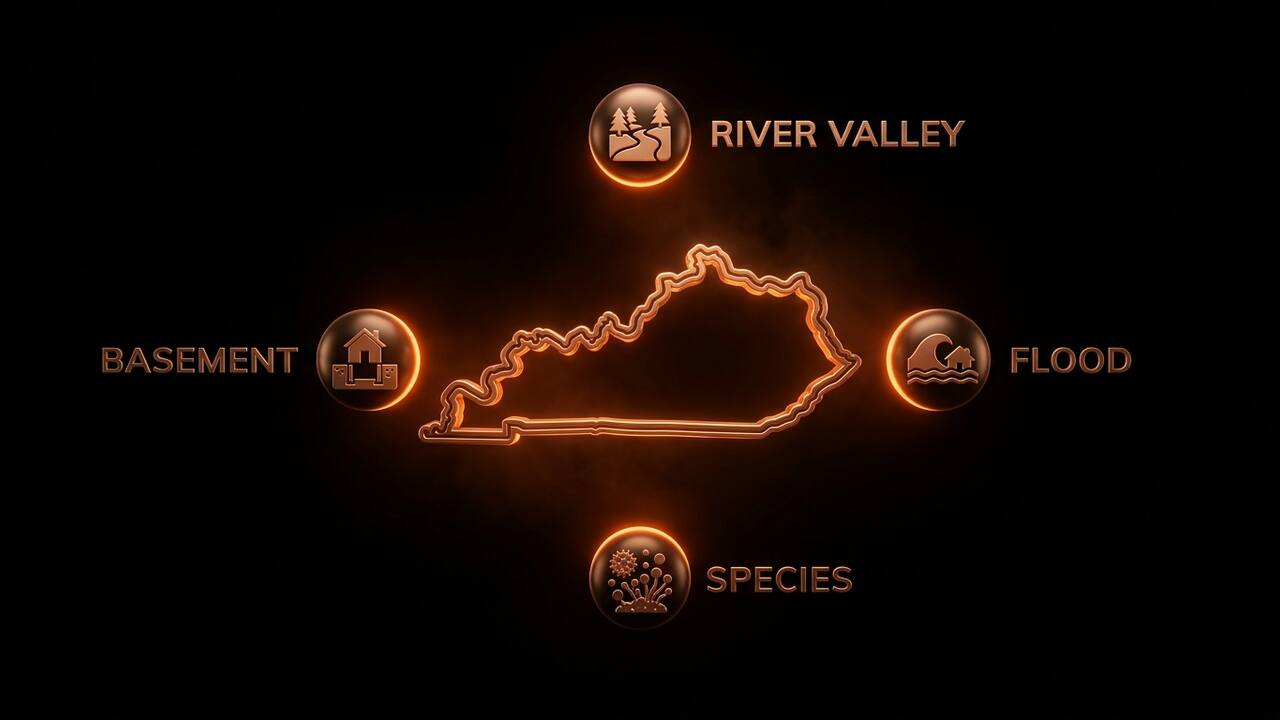
Kentucky's four metros ranked by mold risk
Methodology. Composite risk score = (annual avg RH) × (river and flood exposure weight) × (housing stock age factor). Humidity inputs are approximate annual averages from NOAA NWS 1991-2020 climatological normals for the airport station serving each metro, rounded to whole percent. Flood weighting reflects FEMA disaster declaration history and river adjacency. The ranking is editorial: relative risk between Kentucky metros, not a lab measurement.
Every place on file, ranked by avg RH approximate, from NOAA 1991-2020 normals
Paducah reads 72% against 69% at Lexington. The target for a basement is 50 percent, so every row on this chart sits above it.
View the data
| # | Place | Avg RH approximate, from NOAA 1991-2020 normals |
|---|---|---|
| 1 | Paducah | 72% |
| 2 | Louisville | 70% |
| 3 | Bowling Green | 71% |
| 4 | Lexington | 69% |
| # | Metro | Avg RH approximate, from NOAA 1991-2020 normals | Water exposure | Risk band | Notes |
|---|---|---|---|---|---|
| 1 | Paducah | 72% | Ohio and Tennessee river confluence | Very High | The most humid corner of the state. The 1937 flood drowned downtown; the floodwall marks the line. |
| 2 | Louisville | 70% | Ohio River valley | High | Valley air holds moisture, and pre-war neighborhoods sit on stone and brick basements that wick groundwater. |
| 3 | Bowling Green | 71% | Karst groundwater, sinkholes | High | Cave-riddled limestone under the city keeps water tables high and crawl spaces damp year-round. |
| 4 | Lexington | 69% | Upland plateau, creek drainage | Moderate | The Bluegrass plateau drains better and runs a touch drier, but older housing still traps summer moisture. |
Paducah
The most humid corner of the state. The 1937 flood drowned downtown; the floodwall marks the line.
Louisville
Valley air holds moisture, and pre-war neighborhoods sit on stone and brick basements that wick groundwater.
Bowling Green
Cave-riddled limestone under the city keeps water tables high and crawl spaces damp year-round.
Lexington
The Bluegrass plateau drains better and runs a touch drier, but older housing still traps summer moisture.
Why Paducah tops the ranking. Geography stacks against it. The city sits where the Tennessee River meets the Ohio, in the far-west corner of the state where humidity runs highest. The 1937 flood is the famous event, but the everyday pattern is river fog, saturated soil, and an older housing stock with plenty of below-grade space. When that soil moisture meets a cool basement wall, condensation does the rest without a single storm.
Why Lexington sits lowest but still matters. Lexington sits higher on the Bluegrass plateau, away from the big river valleys, and its annual average RH lands at the bottom of the state's metro range. That's lower risk, not low risk. Its 69 percent average still beats the national number, its summers are equally muggy, and thousands of its older homes hide dirt-floor cellars and tight crawl spaces that never fully dry. Ashland, up the Ohio in the northeast corner, lives with the same river-valley pattern on a smaller scale.
Common mold species in Kentucky homes
EPA's indoor air quality guides list the same core genera for damp temperate climates. Kentucky homes concentrate five of them.
Cladosporium
Cladosporium spp.The most common indoor mold nationwide and the usual suspect on Kentucky HVAC coils, duct interiors, and window air conditioners. Olive-green to black. It tolerates cool surfaces, so it also shows up on basement walls and winter window frames. EPA lists it as a common allergenic mold.
Aspergillus
Aspergillus spp.A large genus that favors damp, dusty organic surfaces: bathroom grout, basement clutter, and washing-machine gaskets. EPA and CDC flag Aspergillus species as allergens and, in rare cases, a cause of aspergillosis in people with weakened immune systems. See a licensed physician for any symptom concern.
Stachybotrys chartarum
Stachybotrys chartarumThe species commonly called black mold. It needs sustained wet cellulose: soaked drywall, ceiling tile, or paper-faced insulation. In Kentucky it follows floods and slow leaks, the exact pattern Eastern Kentucky saw after July 2022. Visible black slimy growth on water-stained drywall means contain it and remediate, not scrub it.
Penicillium
Penicillium spp.Blue-green and fast-moving. It colonizes carpet pad, cardboard boxes, and fabric in damp basements and storage rooms, the classic Kentucky cellar find. EPA lists Penicillium among the most frequently recovered genera in indoor air samples.
Alternaria
Alternaria alternataDark green to black. It thrives on window sills, shower stalls, and any surface that condenses moisture, so Kentucky's closed-up winters suit it well. It appears on most allergen panels, and CDC notes mold exposure can worsen asthma symptoms in sensitive people.
Species information is general and informational. CDC notes that mold exposure can trigger allergy and asthma symptoms in sensitive people; responses vary, so see a licensed physician for evaluation. Sources: EPA Mold Remediation in Schools and Commercial Buildings, EPA A Brief Guide to Mold, Moisture and Your Home, CDC National Center for Environmental Health.
Kentucky-specific actions
Three moves cover most of the mold risk a Kentucky homeowner can control. Each maps to a free Mold Scanner AI tool.
A. Dry the basement and crawl space first
Kentucky's everyday mold story isn't a named storm. It's groundwater seeping through a block wall in March and condensation beading on cool masonry in July. Start outside: clean gutters, extend downspouts 4 to 6 feet from the foundation, and grade soil away from the wall. Inside, test the sump pump every spring, lay a vapor barrier over any dirt crawl space floor, and run a dehumidifier sized to the space. A musty smell with nothing visible usually means growth out of sight; our mold behind walls guide covers the tells, and an ERMI dust test can profile the species in your dust.
B. Hold indoor humidity below 50 percent
EPA's target is 30 to 50 percent relative humidity. Put a cheap hygrometer in the basement and one on the main floor, and act when any room holds above 55 percent. Run the numbers for your rooms in our Indoor Humidity Context Calculator, then work through the prevention guide for the rest of the stack: exhaust fans, attic ventilation, and leak checks.
C. After any flood, start the 48-hour clock
The July 2022 floods taught the hard version of this lesson. EPA guidance says wet porous materials can grow visible mold within 24 to 48 hours. Get standing water out, pull saturated carpet pad and insulation, cut wet drywall a foot above the water line, and keep air moving until framing reads dry. Work the sequence in our post-flood mold risk checklist, and use the step-by-step removal guide for small patches on hard surfaces. If growth covers more than about 10 square feet, hire a qualified mold remediation professional (one who follows the IICRC S520 standard; ACAC or RIA credentials and state licenses count too).
Seasonal risk profile for Kentucky
Monthly average relative humidity follows a two-hump curve in Kentucky: a late-summer peak when river-valley mornings turn foggy, and a damp, closed-house winter. Values below are approximate statewide averages from NOAA 1991-2020 normals, rounded to whole percent.
Kentucky relative humidity peaks in August
The monthly mean runs from 63 percent in April to 73 percent in August, a 10 point swing across the year.
View the data
| Month | Jan | Feb | Mar | Apr | May | Jun | Jul | Aug | Sep | Oct | Nov | Dec |
|---|---|---|---|---|---|---|---|---|---|---|---|---|
| Mean RH | 72% | 70% | 66% | 63% | 68% | 70% | 72% | 73% | 73% | 70% | 70% | 73% |
April is the driest window, which makes it the best month for basement sealing, crawl space work, and exterior grading. June through September is dehumidifier season. Spring storm season and rare cold-season outbreaks like December 2021 add roof damage and rain intrusion.
Where to get help in Kentucky
Kentucky has no widely known state-level mold licensing program; verify current rules with the Kentucky Department for Public Health, part of the Cabinet for Health and Family Services. The agencies below are the authoritative starting points.
Questions on file
Is mold worse in Kentucky than in other states?
Kentucky runs damper than most inland states but drier than the Gulf Coast. Metro annual average relative humidity sits around 68 to 72 percent against a national average near 65 percent, based on approximate NOAA 1991-2020 normals. Louisiana metros, by comparison, run 73 to 77 percent. What pushes Kentucky up the list is structure: river valleys, flood-prone hollows, and a huge stock of homes with basements and crawl spaces that hold moisture.
Source 4, National Oceanic and Atmospheric AdministrationWhy do Kentucky basements get mold so often?
Most of the trouble starts below grade, where soil moisture pushes against foundation walls year-round. River-valley water tables and karst groundwater keep that masonry cool and damp, and in summer the cool surface condenses Kentucky's muggy air. The fix starts outside: working gutters, extended downspouts, and soil graded away from the wall. Inside, run a dehumidifier and keep the space under 50 percent relative humidity. Our basement mold guide walks the whole sequence.
Does Kentucky license mold remediation companies?
Kentucky has no widely known state-level mold licensing program; verify current rules with the Kentucky Department for Public Health. That means almost anyone can advertise mold cleanup, so the vetting falls on you. Hire a qualified mold remediation professional (one who follows the IICRC S520 standard; ACAC or RIA credentials and state licenses count too). Get the work protocol and the price in writing before anything gets cut open.
What can I do if my Kentucky landlord won't fix mold?
Start a paper trail. Report the leak or growth in writing, date it, and photograph everything before and after cleanup attempts. Kentucky's landlord-tenant rules differ by city and county, so the process in Louisville or Lexington isn't the same as in a rural county; check your local code enforcement office and the Kentucky Attorney General's consumer resources. Keep paying rent while you escalate, and get any repair promise in writing. Our renter rights guide includes a documentation letter template. This is general information, not legal advice.
Do Kentucky homes need a dehumidifier?
If the home has a basement or crawl space, almost always yes, at least from May through September. EPA's target is 30 to 50 percent indoor relative humidity, and Kentucky summers push past that anywhere air conditioning doesn't reach. Put a hygrometer in the basement and one on the main floor, then size the unit to the space with our dehumidifier guide. In winter the problem flips to condensation on cold windows and uninsulated walls, so watch those surfaces instead.
Source register
Every source chip on this page points here. Agency and statute pages first, then the federal technical references.
Find the mold in your Kentucky home
The scanner is open. Get a detailed photo report, next steps, testing options and estimated cleanup costs.
Scan My Photo Get the free mold checklistRelated guides on Mold Scanner AI
Mold in Basement
Why below-grade rooms grow mold and how to stop it.

Mold in Crawl Space
Vapor barriers, ventilation, and the dirt-floor problem.
Mold in Louisiana
How the Gulf Coast state compares, metro by metro.
Picking the Right Dehumidifier
Sizing, drain options, and the spec that matters.
Mold Growth Timeline
Hour by hour: when spores germinate and colonies appear.

Black Mold Guide
What Stachybotrys is, where it grows, what to do.