
The West Virginia humidity profile
West Virginia's four NOAA stations sit within two points of each other on annual mean relative humidity, 70 to 72 percent, which sounds ordinary. The morning column is where the state separates itself: Elkins averages 86 percent relative humidity in the morning hours across the whole year, and the statewide morning mean climbs to 92 percent in August and September. Those are saturation-adjacent readings. At 92 percent, almost any surface in a house that is even slightly cooler than the air will collect water.
That happens because of the terrain. Cold air drains into hollows and river valleys overnight and sits there, and the morning fog that West Virginians take for granted is the visible form of a wall assembly's problem. A crawl space under a house in a valley, a basement cut into a hillside, a north-facing exterior wall shaded by a ridge: all of them run cooler than the air above them for most of the summer, and all of them are wet by 7 AM.
The second mechanism is flash flooding, and West Virginia's is severe and well documented. NOAA's state climate summary records a statewide long-term average of 45.1 inches of precipitation, 50 or more inches a year in the central part of the state, and the wettest six-year stretch on record in 2015 to 2020 at 51.9 inches a year. On June 23, 2016, repeated thunderstorms over a stationary front dropped more than 7 inches of rain in 24 hours near Runa in Nicholas County. The Gauley River near Craigsville crested at 29.04 feet, beating its old record by more than three feet. Twenty-three people died, a state of emergency covered 44 of 55 counties, 12 counties received a presidential disaster declaration, and NOAA books the event at $1.3 billion. Since 1980 West Virginia has been hit by 47 billion-dollar disasters, and the two flood events in that set account for roughly 35 percent of the total cost.
West Virginia against the national picture
| Metric | West Virginia | What it means indoors | Source |
|---|---|---|---|
| Annual mean relative humidity | 70 to 72% | Ordinary on the annual mean, which is exactly why the annual mean misleads here | NOAA NCEI Comparative Climatic Data |
| Morning mean relative humidity | 82 to 86% | Among the highest morning readings in the eastern United States | NOAA NCEI Comparative Climatic Data |
| Calculated annual mean dew point | 43 to 47 F | Warm enough in summer that valley surfaces condense before dawn | Calculated from NOAA 1991 to 2020 normals |
| Annual normal precipitation | 43.5 to 47.2 in | Well above the national norm, and 50 inches or more in the central counties | NOAA NCEI 1991 to 2020 normals |
Relative humidity figures are the mean of the morning and afternoon observations NOAA publishes for each first-order station, rounded to whole percent. Dew point is calculated from the NOAA normal mean temperature and that mean relative humidity using the Magnus formula, so treat it as a derived figure rather than a published one.
How much water the sky delivers, station by station
Elkins takes 47.2 inches a year against 43.5 at Beckley. Bulk water is the mechanism behind most basement and crawl space mold, so the wettest station is the one to plan around.
View the data
| Station | Annual normal |
|---|---|
| Elkins | 47.2 in |
| Beckley | 43.5 in |
| Charleston | 46.2 in |
| Huntington | 45.1 in |

West Virginia stations ranked by measured humidity
Methodology. Ranked by annual mean relative humidity, the one input that traces to a station record rather than an opinion. Relative humidity is the mean of NOAA's published morning and afternoon values. Mean dew point is calculated from the NOAA 1991 to 2020 normal mean temperature and that mean relative humidity. The humidity band names what the column measures and nothing more. Humidity is not the whole story: a burst supply line in the driest metro on this table soaks the same drywall as a humid August, and EPA guidance treats wet porous material as at risk of mold growth after 24 to 48 hours either way.
Every place on file, ranked by mean RH
Elkins reads 72% against 70% at Charleston. The target for a basement is 50 percent, so every row on this chart sits above it.
View the data
| # | Place | Mean RH | Morning RH | Annual precip |
|---|---|---|---|---|
| 1 | Elkins | 72% | 86% | 47.2 in |
| 2 | Beckley | 71% | 82% | 43.5 in |
| 3 | Charleston | 70% | 83% | 46.2 in |
| 4 | Huntington | 70% | 83% | 45.1 in |
| # | Station | Mean RH | Morning RH | Mean dew pt | Annual precip | Humidity band | Notes |
|---|---|---|---|---|---|---|---|
| 1 | Elkins | 72% | 86% | 43 F | 47.2 in | Humid | The highest morning mean in the state at 86 percent, and the wettest station at 47.2 inches. A mountain valley that holds fog most mornings. |
| 2 | Beckley | 71% | 82% | 44 F | 43.5 in | Humid | High elevation on the southern plateau. Cooler surfaces year-round, which widens the condensation window. |
| 3 | Charleston | 70% | 83% | 47 F | 46.2 in | Humid | Kanawha Valley. The state's highest calculated dew point at 47 F, so the air carries the most water even though it reads a point lower. |
| 4 | Huntington | 70% | 83% | 47 F | 45.1 in | Humid | Ohio River valley. Same 47 F dew point as Charleston, with river flooding as the second mechanism. |
Elkins
The highest morning mean in the state at 86 percent, and the wettest station at 47.2 inches. A mountain valley that holds fog most mornings.
Beckley
High elevation on the southern plateau. Cooler surfaces year-round, which widens the condensation window.
Charleston
Kanawha Valley. The state's highest calculated dew point at 47 F, so the air carries the most water even though it reads a point lower.
Huntington
Ohio River valley. Same 47 F dew point as Charleston, with river flooding as the second mechanism.
This is the table where the morning column matters most. Four stations agree on the annual mean within two points, so the ranking looks meaningless. Look at the morning column and Elkins pulls four points clear of everything else in the state at 86 percent. Elkins is a mountain valley at roughly 2,000 feet that fogs in most mornings, and its 47.2 inches of rain is the highest reading in this report. A house in a similar hollow anywhere in the eastern half of the state has an Elkins problem regardless of which station is nominally closest.
Charleston and Huntington read lower and carry more water. Both post a calculated mean dew point of 47 F, the highest in the state, against Elkins at 43 F. The river valleys are warmer, so their relative humidity reads lower while the absolute moisture is higher. For deciding whether a basement wall will sweat, use the dew point. For deciding whether a crawl space is wet at dawn, use the morning relative humidity. Neighboring reports for Virginia, Kentucky, Ohio and Pennsylvania cover the same Appalachian mechanism under different law.
Common mold species in West Virginia homes
EPA and CDC name the same core genera for humid temperate climates. In West Virginia they concentrate in crawl spaces and basements cut into hillsides, and in whatever the last flood soaked.
Cladosporium
Cladosporium spp.The most commonly found indoor mold nationwide, and in West Virginia the standard find on crawl space joists and subfloor, where 92 percent morning air meets cool framing every summer day. Olive-green to black. EPA lists it among the common allergenic indoor molds.
Penicillium
Penicillium spp.Blue-green and powdery, on cardboard, paper, carpet padding and stored fabric. In a state where hillside basements are common, it colonizes what people store in them. EPA lists Penicillium among the most frequently recovered genera in indoor air samples.
Stachybotrys chartarum
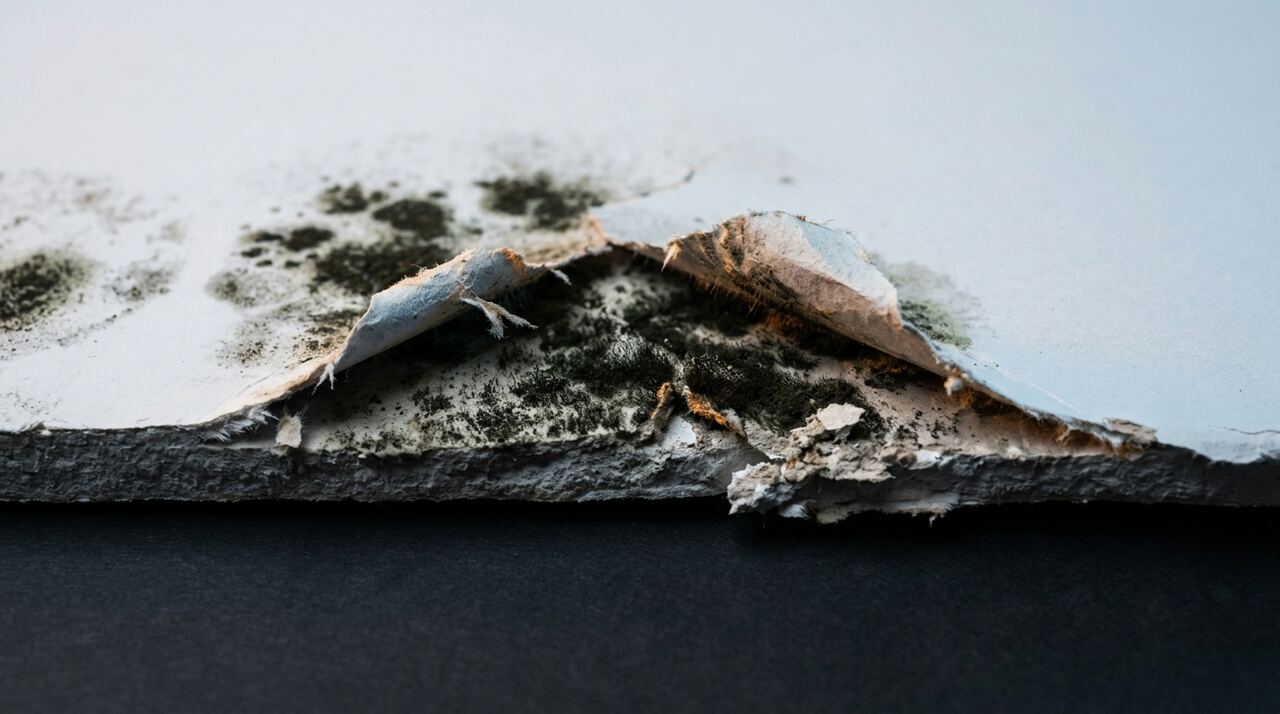
Stachybotrys chartarumThe species commonly called toxic black mold. It needs sustained wet cellulose, which after a West Virginia flash flood is exactly what a soaked wall provides: paper-faced drywall that stood in water for a day and was never removed. Visible black slimy growth on water-stained drywall is the signature. Do not disturb it. Cut it out.
Aspergillus
Aspergillus spp.Black, green or brown depending on species. It prefers steady moisture and organic dust, which describes crawl space ductwork, bathroom grout and the back of a closet on a shaded exterior wall. EPA and CDC flag Aspergillus species as allergens and, in rare cases, as a cause of aspergillosis in people who are immunocompromised.
Chaetomium
Chaetomium spp.Olive to grey and cotton-textured. It requires chronic moisture, so finding it in a crawl space means the condition has been there for seasons rather than since the last storm. Treat it as a dating tool for the problem.
Alternaria
Alternaria alternataDark green to black, on window tracks, shower stalls and condensation-prone surfaces. It is a common allergen panel entry and is often correlated with asthma flare-ups in sensitive individuals per EPA remediation guidance.
Species information is general and informational. Health responses vary. See a licensed physician for symptom evaluation. Species sources: EPA Mold Remediation in Schools and Commercial Buildings, EPA A Brief Guide to Mold Moisture and Your Home, CDC National Center for Environmental Health guidance.
What mold remediation costs in West Virginia
No West Virginia agency publishes a mold remediation price schedule. What the state does have is an unusually good institutional document: West Virginia University's Environmental Health and Safety office publishes a Mold Remediation Program with a response flowchart and remediation guidelines organized by building material. It was written for university buildings, but it is the most detailed mold guidance published on any West Virginia site and it will tell you what a competent scope looks like before you read a bid.
The first cost driver here is the crawl space, because so much West Virginia housing sits on one. Working in a 30-inch crawl space with a dirt floor, wet insulation hanging from the joists and ductwork running through it is slow, uncomfortable labor, and the cost tracks the hours rather than the square footage. The permanent fix is usually encapsulation plus a dehumidifier plus grading and gutter work outside, and that package is a bigger number than the remediation itself but it is the one that holds.
The second is flood scope. After a flash flood the question is not how much mold there is, it is how much building has to come out. Drywall to a foot above the high water line, insulation, carpet and pad, cabinetry, and anything porous that sat wet past 48 hours. EPA guidance treats porous materials wet longer than 24 to 48 hours as at risk of mold growth, and in a June flood in a 90 percent humidity valley, nothing dries in place on its own.
The third is that nobody has to be licensed for mold work here, so bids will differ in scope as much as in price. Get an itemized written scope from each. Our national mold remediation cost guide covers what moves a quote in any market, and the cost estimator lets you scope your own job first.
On insurance the West Virginia-specific point is flood coverage. A standard homeowners policy does not cover flooding from a creek or a river, and in a state where two flood events account for roughly 35 percent of all billion-dollar disaster losses since 1980, that gap is the one that ruins people. The Offices of the Insurance Commissioner publish a flood insurance page covering the National Flood Insurance Program, which carries a 30-day waiting period. Sudden and accidental discharge from a burst pipe is normally covered. Read our guide to homeowners insurance and mold.
Mold remediation licensing in West Virginia: who can legally do the work
West Virginia does not license, certify or register mold assessors or mold remediators.
West Virginia does not license, certify or register mold assessors or mold remediators. The Division of Labor's Licensing Section runs four programs, contractor licensing, HVAC technician certification, manufactured housing and plumber certification, and issues 29,000 to 30,000 licenses a year across all of them. The Contractor Licensing Board's own legislative rule at 28 CSR 2 § 6.2 lists the 16 classifications it examines for, from concrete to utilities, plus a catch-all for any other specialty classification the Board determines warrants examination. The word mold appears nowhere in the Act or in the board's rules.
What does apply is the general contractor license. W. Va. Code § 30-42-3 defines a contractor as a person undertaking construction work "where the cost of the undertaking is $5,000 or more for residential work or $25,000 or more for commercial work." A mold remediation firm doing demolition and rebuild work most often holds the residential contractor, remodeling and repair, or specialty contractor classification. That threshold is low enough that most real remediation jobs cross it, which makes the license lookup a genuine check rather than a formality.
One citation trap is worth flagging because it is everywhere online. The contractor licensing Act moved: the old provisions at W. Va. Code Chapter 21, Article 11 were repealed, and the live Act is Chapter 30, Article 42, relocated by HB 2006 in 2021. Any page still citing Chapter 21 Article 11 for contractor definitions or license thresholds is out of date, and that includes a lot of contractor marketing. Check the Contractor Licensing Board's own statutes page rather than a third party.
For the mold work itself you are building the credential check yourself. Ask for IICRC certification and ask whether the work will follow ANSI/IICRC S520, the industry consensus standard. Ask specifically about crawl space experience, because that is where most West Virginia mold lives and it is a different skill from wall work. Ask for daily moisture readings by material, which is what separates a restoration firm from a demolition crew. And verify the contractor license number with the Division of Labor before signing anything over $5,000.
West Virginia mold laws and tenant rights
West Virginia has no mold-specific statute. A mold complaint runs through W. Va. Code § 37-6-30. Subsection (a) requires a residential landlord to deliver the dwelling unit and surrounding premises in a fit and habitable condition at the start of the tenancy and to keep it that way, to meet applicable health, safety, fire and housing codes, to keep common areas in multiple housing units clean, safe and in repair, to make all repairs necessary to keep the premises fit and habitable, and to maintain electrical, plumbing, sanitary, heating, ventilating and air conditioning systems in good and safe working order.
Here is the part West Virginia tenants need to know, and it is a weakness rather than a strength: the statute sets no notice period and no cure deadline. There is no 7-day clock as in Iowa, no 14 days as in Oklahoma, no 30 days as in Kansas. Enforcement is by suit for breach of the implied warranty. Anyone telling you a West Virginia landlord has a specific number of days to fix mold is stating something § 37-6-30 does not say.
Two more limits sit in the same section. The duty falls away if the condition was caused by the tenant's own lack of reasonable care, which is the standard argument against a bathroom-mold claim in a unit with a weak exhaust fan. And subsection (c) says the landlord is not required to repair while the tenant is in arrears on rent, so withholding rent as leverage in West Virginia can remove the duty you are trying to enforce. That is close to the opposite of how it works in states with a rent escrow route.
The practical consequence is that your documentation carries more weight here than in states with a statutory clock, because "reasonable" is decided on a record. Send dated written notice, keep paying rent, photograph the growth and the water source, note every conversation, and give the landlord a specific written deadline of your own even though the statute does not supply one. Our landlord letter generator produces that notice, and our guide to mold and apartment rights covers the general playbook. Talk to a West Virginia attorney or a legal aid office before withholding anything.
General information, not legal advice. For your situation, talk to a West Virginia attorney, a legal aid office, or your local tenant council.
West Virginia-specific actions
In a state with 92 percent August mornings and steep-ground flash flooding, three moves cover most of the controllable risk.
A. Close the crawl space, do not ventilate it
The old advice to add crawl space vents is wrong in a climate with 92 percent morning humidity. Opening a crawl space to summer air pushes saturated air onto framing that is cooler than the air, and it condenses. The modern approach is to seal it: a heavy vapor barrier across the dirt floor and up the walls, vents closed, rim joist air-sealed, and a dedicated dehumidifier draining to daylight or a pump. Fix the grading and gutters outside first so bulk water is not arriving. Our guide on mold in a crawl space covers the whole sequence.
B. Know your flash flood exposure, and know it is minutes
West Virginia's flooding is not a slow river rise. On June 23, 2016 more than 7 inches fell in 24 hours near Runa and the Gauley crested more than three feet above its previous record. On steep ground the water arrives in minutes, which means the plan has to exist before the watch is issued. Know whether you are in a mapped flood plain, know your route out, and understand that a standard homeowners policy covers none of it. The National Flood Insurance Program has a 30-day waiting period, so it cannot be bought when the forecast turns.
C. Run the 48-hour clock, and photograph before you demolish
After any flood, remove standing water the same day, pull saturated carpet padding, and cut wet drywall back a foot above the high water line rather than trying to dry it in place. Get air movers and a dehumidifier running, which in a 90 percent humidity valley means bringing dry air rather than opening windows. Photograph every room before you remove anything, because the insurance and FEMA conversations both run on those photographs. Materials still reading above 16 percent moisture content after 72 hours should come out.
Seasonal risk profile for West Virginia
Monthly mean relative humidity across West Virginia's four NOAA stations. The daily mean peaks in August at 76 percent, and the morning mean peaks at 92 percent in August and September, which is the highest reading in this report.
West Virginia relative humidity peaks in August
The monthly mean runs from 63 percent in April to 76 percent in August, a 13 point swing across the year.
View the data
| Month | Jan | Feb | Mar | Apr | May | Jun | Jul | Aug | Sep | Oct | Nov | Dec |
|---|---|---|---|---|---|---|---|---|---|---|---|---|
| Mean RH | 71% | 69% | 66% | 63% | 69% | 72% | 75% | 76% | 75% | 71% | 69% | 72% |
July through September is the crawl space window. Morning humidity runs 90 to 92 percent while crawl spaces and hillside basements are still holding spring's cold. That gap between the moisture in the air and the temperature of the wood is where Cladosporium lives. If you are going to spend money on one thing in a West Virginia house, spend it here and spend it in June rather than in September.
June is the flood window. The 2016 disaster ran on June 23, and June sits at the intersection of a wet month and warm, unstable air over steep terrain. Watch the forecast rather than the calendar if you are in a hollow or below a steep slope.
April is the driest month at 63 percent and the best time to work. If you need to open a crawl space, dry a structure, or encapsulate, do it in the spring window when the ambient air is helping rather than fighting you. The mold risk by ZIP tool gives you the local read.
Where to get help in West Virginia
West Virginia's indoor air work sits in the Bureau for Public Health's Office of Environmental Health Services. The state's most detailed mold document, though, comes from WVU rather than from the state.
Questions on file
Does West Virginia require a license for mold remediation?
No. The Contractor Licensing Board's legislative rule at 28 CSR 2 § 6.2 lists the 16 classifications it examines for and mold is not among them, and the word does not appear in the Act or the board's rules. What does apply is the general contractor license: W. Va. Code § 30-42-3 defines a contractor as someone undertaking work where the cost is $5,000 or more residential or $25,000 or more commercial, most often under the residential contractor, remodeling and repair, or specialty classification. One trap: the Act moved from W. Va. Code Chapter 21 Article 11, now repealed, to Chapter 30 Article 42 in 2021, so any source citing Chapter 21 is out of date.
How long does a West Virginia landlord have to fix mold?
The statute does not say, and that is the honest answer. W. Va. Code § 37-6-30 requires the landlord to keep the unit fit and habitable and to make all repairs necessary to that end, but it sets no notice period and no cure deadline. Enforcement is by suit for breach of the implied warranty. Two limits also apply: the duty falls away if the tenant's own lack of reasonable care caused the condition, and subsection (c) says the landlord is not required to repair while the tenant is in arrears on rent, so withholding rent can remove the duty you are trying to enforce.
Why is West Virginia's morning humidity so high?
Terrain. Cold air drains into hollows and river valleys overnight and pools there, and the morning fog that is normal across the state is that process made visible. The statewide morning mean reaches 92 percent in August and September, and Elkins averages 86 percent across the entire year, which is as high as anywhere in the eastern United States. At those readings, any surface even slightly cooler than the air collects water, which is why crawl spaces and hillside basements are the state's dominant mold location.
Should I vent or seal a West Virginia crawl space?
Seal it. The old guidance to add vents assumes outdoor air is drier than the crawl space, and in a state with 92 percent August mornings it usually is not. Opening the space pushes saturated air onto framing that is cooler than the air, and it condenses on the joists. The modern approach is a heavy vapor barrier across the dirt and up the walls, vents closed, rim joist air-sealed, and a dedicated dehumidifier that drains to daylight or a pump. Fix grading and gutters outside first so bulk water is not arriving in the first place.
Does homeowners insurance cover West Virginia flood mold?
Not the flood part. A standard homeowners policy excludes flooding from a creek or river entirely, and in a state where two flood events account for roughly 35 percent of all billion-dollar disaster losses since 1980, that is the gap that does the most damage. Flood coverage comes from the National Flood Insurance Program and carries a 30-day waiting period, so it cannot be bought once a watch is issued. Sudden and accidental discharge such as a burst pipe is normally covered, and mold following a covered event is often covered up to a fixed sublimit. The Offices of the Insurance Commissioner publish a flood insurance page.
What was the 2016 West Virginia flood?
The state's benchmark water event, and a useful measure of how fast this terrain moves water. On June 23, 2016 several rounds of thunderstorms over a stationary front dropped more than 7 inches of rain in 24 hours near Runa in Nicholas County. The Gauley River near Craigsville crested at 29.04 feet, beating its previous record by more than three feet. Twenty-three people died, a state of emergency covered 44 of 55 counties, 12 counties received a presidential disaster declaration, and NOAA books the event at $1.3 billion. On steep ground the water arrives in minutes, not hours, which is why a flood plan has to exist before the forecast turns.
Source register
Every source chip on this page points here. Agency and statute pages first, then the federal technical references.
Find the mold in your West Virginia home
The scanner is open. Get a detailed photo report, next steps, testing options and estimated cleanup costs.
Scan My Photo Get the free mold checklistRelated guides on Mold Scanner AI

All 51 State Reports
Humidity, licensing and tenant law for every state.

Mold in a Crawl Space
The West Virginia failure mode, and why sealing beats venting.
Mold on Drywall
What comes out after a flood and what can stay.

Insurance and Mold
Why flood is excluded and what NFIP covers.

What Remediation Costs
The drivers that actually move a quote.

Mold in Your Apartment
Renter rights, notice letters, and landlord duties.