
The Florida humidity profile
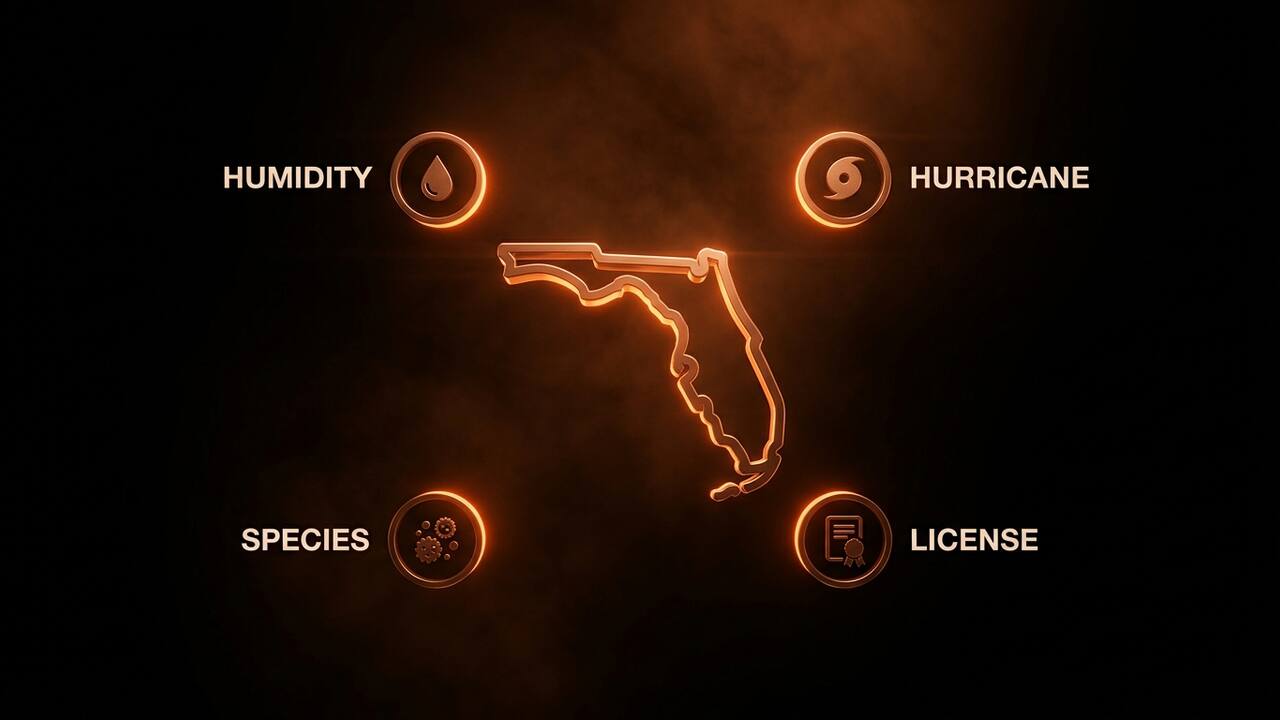
Florida is a long peninsula with warm water on three sides, and the Gulf and the Atlantic feed moist air into the state in every season. NOAA National Weather Service normals for 1991 to 2020 put every major Florida metro at an annual average relative humidity in the low to mid 70s. That sits well above the U.S. average and above the 50 percent indoor-RH threshold EPA flags as the safe upper bound for household humidity.
Dew point tells the story better than relative humidity because it does not move with temperature. Annual average dew points run from the low 60s F in north Florida to the upper 60s F in subtropical Miami, against a U.S. average near 50 F. A 68 F dew point means the air is saturated the moment any wall cavity, window, or AC coil drops to 68 F, which happens constantly here.
Florida has also been hit by more hurricanes than any other state. NOAA National Hurricane Center records show roughly 120 direct strikes since 1851, close to 40 percent of all U.S. landfalls. Each storm resets the bulk-water clock, and EPA guidance says porous materials wet longer than 24 to 48 hours are at risk of colonization. Our mold risk by ZIP tool shows how your area compares, and our Louisiana report covers the only other Gulf state with humidity this high.
Florida vs U.S. average
| Metric | Florida | U.S. average | Source |
|---|---|---|---|
| Annual avg relative humidity | 72 to 76% | ~65% | NOAA NWS 1991 to 2020 |
| Annual avg dew point | 61 to 68 F | ~50 F | NOAA NWS 1991 to 2020 |
| Days/year above 70% RH | 200 to 260 | ~120 | NOAA NWS 1991 to 2020 |
| Hurricane strikes since 1851 | 120+ | varies | NOAA NHC |
| Tropical-storm or hurricane landfalls (2000 to 2024) | 20+ | varies | NOAA NHC |
Florida’s six metros ranked by mold risk
Methodology. Composite risk score = (annual avg RH) × (days/year above 70 percent RH) × (storm-exposure weight 1.0 to 1.5 from NOAA NHC hurricane and storm-surge density within 50 miles of the metro centroid). Humidity inputs from NOAA NWS 1991 to 2020 normals for each metro’s official airport station. The ranking is editorial: humidity is high and close across all six metros, so storm-surge and flood exposure plus housing stock drive most of the spread.
Every place on file, ranked by avg RH
Pensacola reads 75% against 73% at Miami. The target for a basement is 50 percent, so every row on this chart sits above it.
View the data
| # | Place | Avg RH |
|---|---|---|
| 1 | Miami | 73% |
| 2 | Fort Myers | 74% |
| 3 | Tampa | 74% |
| 4 | Pensacola | 75% |
| 5 | Jacksonville | 75% |
| 6 | Orlando | 74% |
| # | Metro | Avg RH | Avg dew pt | Risk band | Notes |
|---|---|---|---|---|---|
| 1 | Miami | 73% | 68 F | Extreme | Hurricane alley exposure (Andrew, 1992), plus king-tide and sea-level flooding. Dense aging block-and-stucco stock. |
| 2 | Fort Myers | 74% | 66 F | Extreme | Hurricane Ian’s 2022 storm surge flooded Lee County, Fort Myers Beach, and Sanibel. Low coastal elevation and fast-built slab-on-grade housing. |
| 3 | Tampa | 74% | 65 F | Very high | Tampa Bay is one of the most storm-surge-vulnerable metros in the country. Shallow bay, low-lying neighborhoods. |
| 4 | Pensacola | 75% | 63 F | Very high | Panhandle Gulf coast with the state’s highest annual humidity. Hurricane Ivan (2004) and Sally (2020) both brought major flooding. |
| 5 | Jacksonville | 75% | 62 F | Very high | St. Johns River flooding, worst during Hurricane Irma in 2017. Large older housing stock across northeast Florida. |
| 6 | Orlando | 74% | 64 F | High | Inland, so no storm surge, but heavy summer rain, frequent flooding, and year-round humidity keep indoor risk high across a huge metro. |
Miami
Hurricane alley exposure (Andrew, 1992), plus king-tide and sea-level flooding. Dense aging block-and-stucco stock.
Fort Myers
Hurricane Ian’s 2022 storm surge flooded Lee County, Fort Myers Beach, and Sanibel. Low coastal elevation and fast-built slab-on-grade housing.
Tampa
Tampa Bay is one of the most storm-surge-vulnerable metros in the country. Shallow bay, low-lying neighborhoods.
Pensacola
Panhandle Gulf coast with the state’s highest annual humidity. Hurricane Ivan (2004) and Sally (2020) both brought major flooding.
Jacksonville
St. Johns River flooding, worst during Hurricane Irma in 2017. Large older housing stock across northeast Florida.
Orlando
Inland, so no storm surge, but heavy summer rain, frequent flooding, and year-round humidity keep indoor risk high across a huge metro.
Why Miami tops the ranking. Three factors compound. Humidity: Miami posts the warmest year-round dew points in the state, so its air holds moisture even in winter. Geography: much of Miami-Dade sits low over porous limestone, and king tides push groundwater up through that rock, keeping slabs damp. Housing stock: a huge inventory of mid-century concrete-block-and-stucco homes traps moisture against interior finishes. Add the most direct hurricane exposure of any major U.S. metro (Hurricane Andrew in 1992) and the composite lands at extreme. After any flood, watch for black mold on wet drywall, and know the worst growth often hides behind walls where block meets framing.
Why Orlando is the lowest of the six but still “high”. Orlando sits inland, so it has no storm surge and slightly lower dew points, which pulls its composite down. But central Florida is the wettest summer-rain corridor in the state, it floods often in the wet season, and it shares Florida’s no-dry-season humidity. A fast-built housing stock that leans hard on air conditioning keeps indoor RH problems common even without a hurricane.
Common mold species in Florida homes
Every EPA indoor air quality guide lists the same core species for warm humid climates. Florida homes concentrate five of them, and the state’s outdoor air keeps feeding spores indoors all year.
Cladosporium
Cladosporium spp.The most common indoor mold nationwide and the one most often found on Florida HVAC evaporator coils and supply registers. Olive-green to black. It tolerates cold surfaces, so it colonizes AC condensate lines and duct interiors. EPA lists it as a common allergenic mold.
Aspergillus niger
Aspergillus nigerBlack or dark-brown. It prefers high moisture and organic dust, which is why it shows up on bathroom grout, caulking, and washing-machine gaskets across the Gulf South. EPA and CDC flag Aspergillus species as allergens and, rarely, as a cause of aspergillosis in people with weakened immune systems.
Stachybotrys chartarum
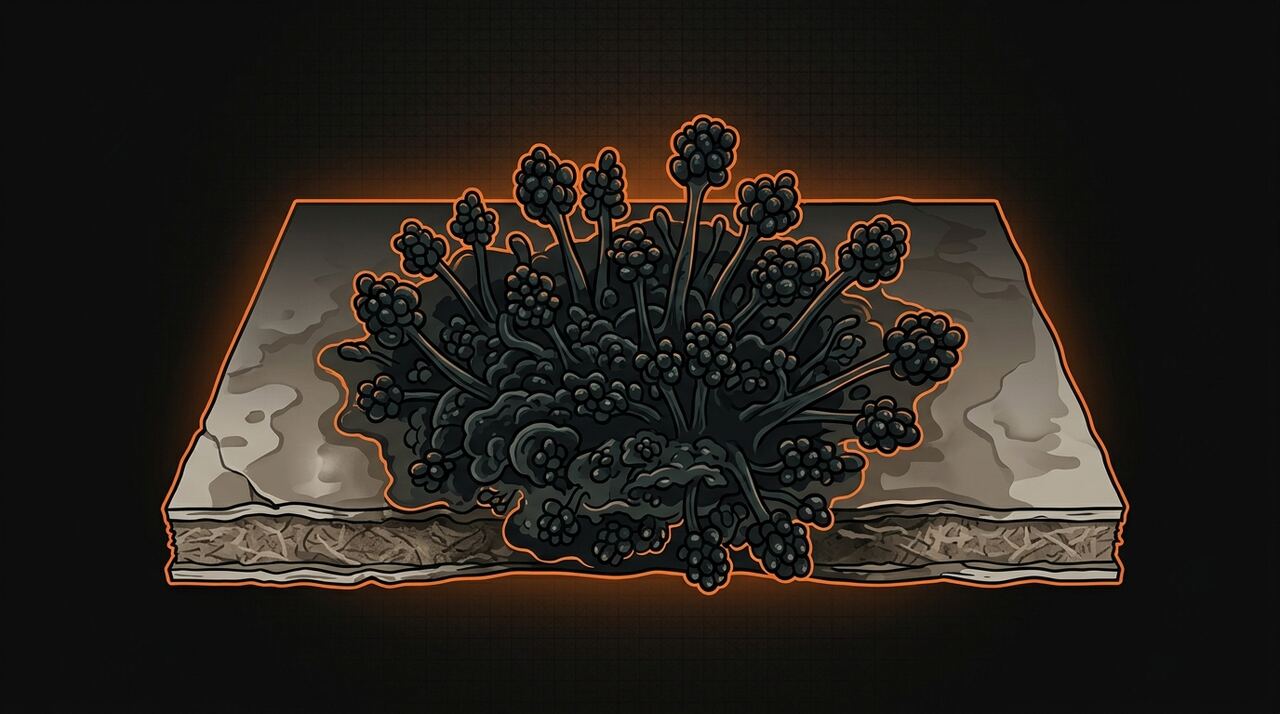
Stachybotrys chartarumThe species many people call “toxic black mold.” It needs sustained wet cellulose such as wet drywall, ceiling tile, or paper-faced insulation. In Florida it is most common 72 hours or more after bulk water intrusion from a hurricane, roof failure, or plumbing leak. When to worry: black slimy growth on water-stained drywall after a flood. Do not disturb it. Contain and remediate.
Penicillium
Penicillium spp.Blue-green. It grows on carpet padding, wallpaper, and damp fabric. Florida’s long warm seasons and the lived-in humidity of older homes create a year-round habitat. EPA lists Penicillium among the most frequently recovered genera in indoor air samples.
Alternaria
Alternaria alternataDark green to black. It thrives in windows, shower stalls, and around any surface that collects condensation. It is commonly flagged on allergenic panels and often tracks with asthma flare-ups in sensitive people. The EPA Mold Remediation Guide names it a dominant indoor genus in humid climates.
One thing sets Florida apart: the outdoor spore load barely dips. Most of the country gets a winter freeze that cuts outdoor mold counts for months. Florida does not, so Cladosporium and Alternaria spores stay airborne all year and every open door, window, and HVAC intake keeps seeding indoor surfaces. For a dust-based species profile of your home, an ERMI test can help, though it has real limits.
Species information is general and informational. Health responses vary. See a licensed physician for symptom evaluation. Species sources: EPA Mold Remediation in Schools and Commercial Buildings, EPA A Brief Guide to Mold Moisture and Your Home, CDC National Center for Environmental Health guidance.
Florida-specific actions
Three actions handle most of the mold risk you can control in a Florida home. Each maps to a free Mold Scanner AI tool.
A. Run a hurricane-season checklist every June
Before the storm (by June 1): Inspect the roof, clear gutters, service the HVAC, lift removable contents above the flood line, and confirm your flood policy is active (NFIP has a 30-day waiting period). First 48 hours after landfall: Remove standing water, open windows only when outdoor RH is below indoor, run any working AC or a generator-powered dehumidifier, and photograph the damage. First 7 days: Cut wet drywall a foot above the water line, pull saturated insulation and carpet padding, dry framing with air movers, and log moisture readings daily. Material still above 16 percent moisture after 72 hours should come out. Our post-flood checklist and storm damage timer walk the order step by step.
B. Keep indoor RH below 50 percent year-round
Use a reliable hygrometer and repeat readings in different living zones. EPA generally advises keeping indoor relative humidity between 30 and 50 percent when possible. Our Indoor Humidity Context Calculator reports measured RH plus calculated dew point and absolute humidity without a mold-risk score, and the prevention guide provides general moisture-control context.
C. Scan quarterly, and after every storm
Florida’s high-risk windows are June and September (hurricane season and its peak), the wet-season afternoons of July and August, and the spring HVAC switchover. If you find growth, fix the water source first, then read our pillar guide on how to get rid of mold before you touch it. For anything past a small patch, hire a qualified mold remediation professional (one who follows the IICRC S520 standard; ACAC or RIA credentials and state licenses count too).
Seasonal risk profile for Florida
Monthly average relative humidity, statewide. These are approximate statewide averages in whole percents, from NOAA NWS normals 1991 to 2020. Florida shows a clear shape: a dip in the spring dry season, then a long wet summer peak.
Florida relative humidity peaks in August
The monthly mean runs from 71 percent in April to 80 percent in August, a 9 point swing across the year.
View the data
| Month | Jan | Feb | Mar | Apr | May | Jun | Jul | Aug | Sep | Oct | Nov | Dec |
|---|---|---|---|---|---|---|---|---|---|---|---|---|
| Mean RH | 76% | 74% | 73% | 71% | 73% | 78% | 79% | 80% | 80% | 77% | 76% | 76% |
Even in the spring dry season, Florida’s average RH sits above 70 percent. There is no true off-season. Summer (June through September) is the peak, and hurricane landfalls are accelerants on an already high baseline.

Where to get help in Florida
Florida is one of the few states that licenses mold professionals, through the DBPR. The agencies below are the authoritative starting points for homeowners and renters.
Questions on file
Is mold worse in Florida than other states?
Yes. Florida ranks at or near the top of U.S. states for indoor mold risk. Annual average relative humidity across Florida metros sits in the low to mid 70s percent, and most of the state runs more than 200 days a year above the 70 percent indoor-RH threshold EPA cites as the growth zone for common household molds. Florida has also been hit by more hurricanes than any other state since 1851, and each storm adds bulk-water intrusion that speeds up mold growth on cellulose surfaces. There is no real dry season, so the risk runs year-round.
Do Florida landlords have to fix mold?
There is no single statewide Florida law that sets a specific mold standard for rentals. What does apply is Florida’s residential landlord-tenant law, which requires landlords to keep units in a safe and habitable condition. A serious mold problem caused by a leak or moisture the landlord is responsible for can fall under that habitability duty. Tenants usually have to give written notice and a chance to repair. Read your lease, document everything with photos, and see our apartment mold guide for the notice steps. This is general information, not legal advice.
Does Florida license mold remediators?
Yes. Florida licenses both mold assessors and mold remediators through the Department of Business and Professional Regulation, the DBPR. State law also separates the two roles. On most projects the same company cannot both assess the mold and perform the remediation, which is meant to remove the conflict of interest of an inspector grading their own cleanup work. Always confirm a contractor holds a current DBPR mold license before you sign.
Source 2, Florida Department of Business and Professional RegulationWhat mold species are common in Florida homes?
Cladosporium, Aspergillus, and Penicillium dominate indoor air samples across Florida homes. Stachybotrys chartarum, often called black mold, shows up after sustained water intrusion, which is common after a hurricane or a plumbing leak. Alternaria rounds out the typical panel. Florida also carries one of the highest year-round outdoor mold spore loads in the country because there is no hard winter freeze to knock counts down. EPA notes all molds can cause reactions in sensitive people. See a licensed physician for symptom evaluation. This page is general information, not medical advice.
Do Florida homes need dehumidifiers year-round?
For most of the state, yes. EPA recommends keeping indoor relative humidity below 50 percent to slow mold growth. Florida outdoor dew points stay high for much of the year, and air conditioning alone often is not enough during mild stretches when the AC runs less. A whole-home dehumidifier or a high-capacity portable unit is standard guidance for the Gulf Coast and the Florida peninsula.
Does homeowners insurance cover mold in Florida?
General information only. Florida homeowners policies vary widely on mold, and many cap or limit mold coverage. Most standard policies pay for mold only when it results from a covered sudden and accidental water event, like a burst pipe. Flood damage from hurricanes or storm surge is not covered by a standard policy and needs a separate NFIP flood policy. Read your own policy and ask a licensed Florida agent. The Florida Department of Financial Services runs a consumer helpline for insurance questions.
Source register
Every source chip on this page points here. Agency and statute pages first, then the federal technical references.
Find the mold in your Florida home
The scanner is open. Get a detailed photo report, next steps, testing options and estimated cleanup costs.
Scan My Photo Get the free mold checklistRelated guides on Mold Scanner AI
Mold in Louisiana
The other Gulf state with humidity this high.
Picking the Right Dehumidifier
Sizing, drain options, and the spec that matters.
How to Prevent Mold
The moisture sources most homes miss.
Mold Growth Timeline
Hour by hour: when spores germinate and colonies appear.
Black Mold, Explained
What Stachybotrys is, and when to worry.

The ERMI Test
What a dust species profile can and cannot tell you.