
The Colorado humidity profile
Colorado's five NOAA stations report 46 to 54 percent annual mean relative humidity and 7.4 to 15.9 inches of precipitation. NOAA puts statewide total annual precipitation at 18.0 inches on average, ranging from 11.9 inches in 2002 to 25.5 inches in 1941, with local totals from about 7 inches in the middle of the San Luis Valley to more than 60 inches at a few mountain locations, and mountain snowfall from 150 to more than 400 inches a year. The calculated annual mean dew point runs 27 to 35 F. Outdoor air in Colorado does not wet indoor surfaces.
That makes the diagnosis unusually clean. Mold in a Colorado home means water arrived from somewhere: a supply line that froze and split, a water heater, a slab leak, an ice dam, a roof under snow load, or a flood. NOAA counts 76 billion-dollar weather and climate disasters affecting Colorado from 1980 to 2024, and the 2020 to 2024 annual average of 4.4 events is well above the 1980 to 2024 average of 1.7. FEMA's disaster declaration record for Colorado holds 111 declarations of all types, but only 25 of those are major disaster declarations, and 13 of the 25 are floods against 6 fires. The other 79 are Fire Management Assistance declarations, which is a different instrument.
Fire is the Colorado wrinkle that surprises people. Wildfire puts water into buildings twice: suppression water during the event, and post-fire flooding afterward, because burned ground sheds rain instead of absorbing it. The September 2013 Front Range floods produced two separate federal declarations days apart. Denver's 50 percent morning humidity is the lowest morning reading in this report, and it does not protect a house whose basement took six inches of runoff. EPA guidance treats porous materials wet longer than 24 to 48 hours as at risk of mold growth, in a desert exactly as in a swamp.
Colorado against the national picture
| Metric | Colorado | What it means indoors | Source |
|---|---|---|---|
| Annual mean relative humidity | 46 to 54% | Among the lowest in the country, so ambient air is not the cause | NOAA NCEI Comparative Climatic Data |
| Morning mean relative humidity | 50 to 69% | Denver's 50 percent is the lowest morning reading in this report | NOAA NCEI Comparative Climatic Data |
| Calculated annual mean dew point | 27 to 35 F | Below freezing in the mountain valleys, so all indoor water is indoor water | Calculated from NOAA 1991 to 2020 normals |
| Annual normal precipitation | 7.4 to 15.9 in | Under 16 inches at every station, with mountain snowfall the real reservoir | NOAA NCEI 1991 to 2020 normals |
Relative humidity figures are the mean of the morning and afternoon observations NOAA publishes for each first-order station, rounded to whole percent. Dew point is calculated from the NOAA normal mean temperature and that mean relative humidity using the Magnus formula, so treat it as a derived figure rather than a published one.
How much water the sky delivers, station by station
Colorado Springs takes 15.9 inches a year against 7.4 at Alamosa. Bulk water is the mechanism behind most basement and crawl space mold, so the wettest station is the one to plan around.
View the data
| Station | Annual normal |
|---|---|
| Alamosa | 7.4 in |
| Pueblo | 12 in |
| Colorado Springs | 15.9 in |
| Grand Junction | 9.1 in |
| Denver | 15.4 in |

Colorado stations ranked by measured humidity
Methodology. Ranked by annual mean relative humidity, the one input that traces to a station record rather than an opinion. Relative humidity is the mean of NOAA's published morning and afternoon values. Mean dew point is calculated from the NOAA 1991 to 2020 normal mean temperature and that mean relative humidity. The humidity band names what the column measures and nothing more. Humidity is not the whole story: a burst supply line in the driest metro on this table soaks the same drywall as a humid August, and EPA guidance treats wet porous material as at risk of mold growth after 24 to 48 hours either way.
Every place on file, ranked by mean RH
Alamosa reads 54% against 46% at Grand Junction. The target for a basement is 50 percent, so every row on this chart sits above it.
View the data
| # | Place | Mean RH | Morning RH | Annual precip |
|---|---|---|---|---|
| 1 | Alamosa | 54% | 69% | 7.4 in |
| 2 | Pueblo | 50% | 63% | 12 in |
| 3 | Colorado Springs | 49% | 58% | 15.9 in |
| 4 | Grand Junction | 46% | 56% | 9.1 in |
| 5 | Denver | 46% | 50% | 15.4 in |
| # | Station | Mean RH | Morning RH | Mean dew pt | Annual precip | Humidity band | Notes |
|---|---|---|---|---|---|---|---|
| 1 | Alamosa | 54% | 69% | 27 F | 7.4 in | Dry | San Luis Valley at 7,500 feet. The highest relative humidity in the state on very cold air, and the lowest dew point at 27 F. |
| 2 | Pueblo | 50% | 63% | 35 F | 12.0 in | Very dry | The state's highest calculated dew point at 35 F. Arkansas River valley, warmer and carrying more actual water. |
| 3 | Colorado Springs | 49% | 58% | 32 F | 15.9 in | Very dry | The wettest station in the state at 15.9 inches, on the Front Range where upslope storms stall against the mountains. |
| 4 | Grand Junction | 46% | 56% | 33 F | 9.1 in | Very dry | Western slope desert. Low humidity and low rainfall, so growth here is a plumbing event almost by definition. |
| 5 | Denver | 46% | 50% | 31 F | 15.4 in | Very dry | The narrowest daily swing in the state, 50 percent morning against 43 percent afternoon, and the metro with the most housing at risk. |
Alamosa
San Luis Valley at 7,500 feet. The highest relative humidity in the state on very cold air, and the lowest dew point at 27 F.
Pueblo
The state's highest calculated dew point at 35 F. Arkansas River valley, warmer and carrying more actual water.
Colorado Springs
The wettest station in the state at 15.9 inches, on the Front Range where upslope storms stall against the mountains.
Grand Junction
Western slope desert. Low humidity and low rainfall, so growth here is a plumbing event almost by definition.
Denver
The narrowest daily swing in the state, 50 percent morning against 43 percent afternoon, and the metro with the most housing at risk.
Alamosa reads highest and is the driest place on this table. Its 54 percent annual mean sits on air at a 27 F calculated dew point, at 7,500 feet in the San Luis Valley, which is one of the coldest and driest inhabited spots in the country. The percentage is high because the air is cold, not because it is wet. Pueblo, eight points lower on relative humidity, carries a dew point eight degrees higher and therefore substantially more actual water.
Denver's flat daily curve is the row that matters for most Coloradans. A 50 percent morning against a 43 percent afternoon is a seven-point swing, by far the narrowest in the state, which means the air is essentially the same all day and never approaches saturation. In practice that is why a Denver basement does not grow mold on its own and why, when it does grow mold, everybody in the house is surprised. Neighboring reports for Wyoming, New Mexico, Utah, Kansas and Nebraska cover the states Colorado borders.
Common mold species in Colorado homes
EPA and CDC name the same core genera everywhere. In a dry state the mix skews toward species that exploit a specific wet spot, which makes what you find a useful clue about how long the water has been there.
Cladosporium
Cladosporium spp.The most commonly found indoor mold nationwide, and in Colorado the usual find on cold window glass during a January cold snap and inside humidifier reservoirs, which are common in a climate this dry. Olive-green to black. EPA lists it among the common allergenic indoor molds.
Aspergillus
Aspergillus spp.Black, green or brown depending on species. It needs steady moisture and organic dust: a bathroom with a weak exhaust fan at altitude, the cabinet under a slow-leaking sink, an unvented crawl space. EPA and CDC flag Aspergillus species as allergens and, in rare cases, as a cause of aspergillosis in people who are immunocompromised.
Penicillium
Penicillium spp.Blue-green and powdery, on cardboard, paper and damp fabric. In Colorado it turns up where a burst line has wicked into carpet padding in a finished basement, which can run unnoticed because nothing else in the house feels damp. EPA lists Penicillium among the most frequently recovered genera in indoor air samples.
Stachybotrys chartarum
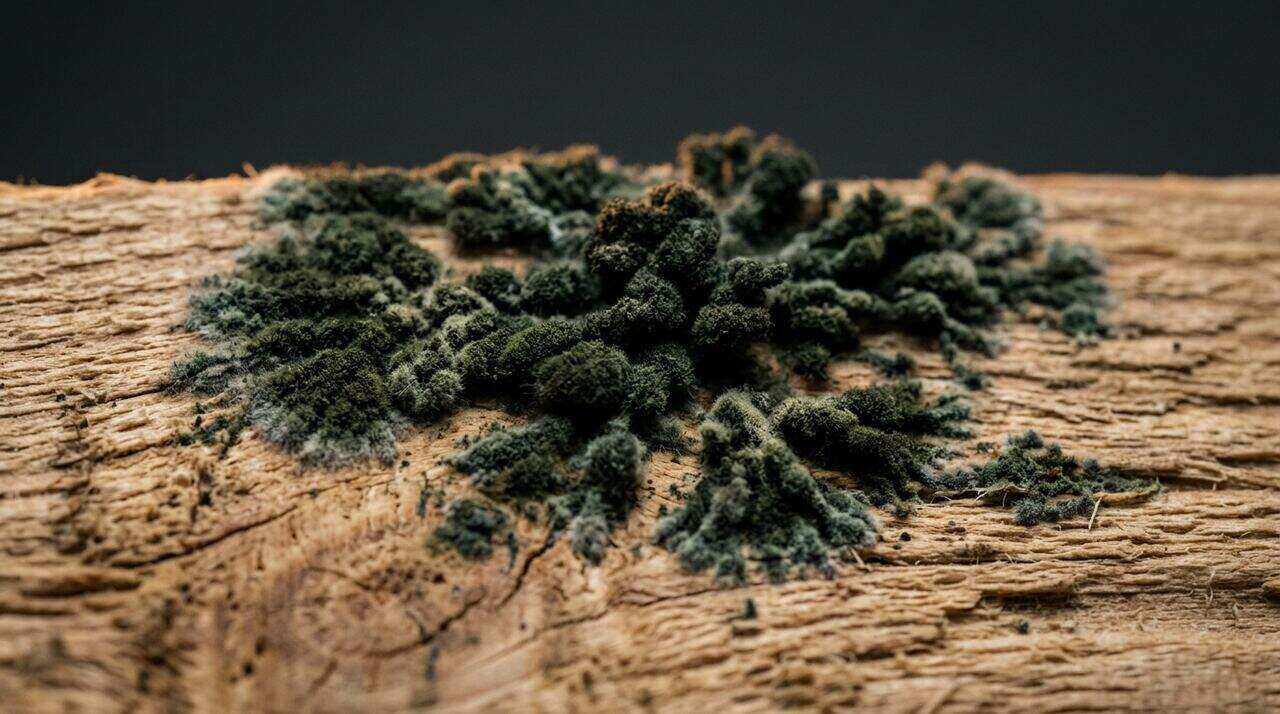
Stachybotrys chartarumThe species commonly called toxic black mold. It needs sustained wet cellulose, so in Colorado it is strong evidence that water has been present for a long time rather than since last week. Visible black slimy growth on water-stained drywall is the signature. Do not disturb it, and note that C.R.S. 38-12-505 names mold associated with dampness as an uninhabitability condition.
Chaetomium
Chaetomium spp.Olive to grey and cotton-textured. Like Stachybotrys it needs chronic moisture, so finding it dates the problem to seasons rather than weeks. In a rental that is worth documenting, because the statute's remedies key off notice and the landlord's response time.
Alternaria
Alternaria alternataDark green to black, on shower stalls, window tracks and condensation-prone surfaces. It is a common allergen panel entry and is often correlated with asthma flare-ups in sensitive individuals per EPA remediation guidance.
Species information is general and informational. Health responses vary. See a licensed physician for symptom evaluation. Species sources: EPA Mold Remediation in Schools and Commercial Buildings, EPA A Brief Guide to Mold Moisture and Your Home, CDC National Center for Environmental Health guidance.
What mold remediation costs in Colorado
No Colorado agency publishes a mold remediation price schedule, and the state health department has taken its mold page down, which leaves the statute as the operative state authority on this subject. That is unusual and it changes the cost conversation, because in a rental the statute answers the question of who pays.
C.R.S. 38-12-503(2.7)(a) is the sentence to know: a landlord who receives notice of a habitability issue described in 38-12-505(1) is responsible for remediating the premises to a habitable standard at the landlord's expense, and submitting an insurance claim is not evidence of remediation. In a Colorado rental, a landlord cannot answer a mold complaint by filing a claim and waiting.
For an owner-occupied home, the cost drivers are the dry-state ones. Diagnosis first, because ambient humidity cannot be the explanation at a 27 to 35 F dew point, and a remediator who cannot say where the water came from has not finished the assessment. Then the repair, which is usually a plumbing or roofing job that costs more than the mold work. Then the finished basement, which is a demolition and rebuild rather than a cleanup wherever one is involved.
The Colorado-specific driver is altitude and distance. Mountain communities are a long drive from the Front Range restoration companies, and a job in a resort town carries mobilization the same job in Aurora does not. Ask about it explicitly. Get an itemized written scope from each bidder, and check the containment and HEPA steps against what 38-12-503(2.2) actually requires, because that sequence is the state's own definition of adequate work. Our national mold remediation cost guide covers the drivers that move a quote in any market, and the cost estimator lets you scope your own job first.
On insurance: a sudden and accidental discharge such as a frozen and split supply line is normally the covered event, long-term seepage usually is not, and flooding, including post-fire flooding, is not covered by a standard homeowners policy at all. Take coverage questions to the Colorado Division of Insurance, and read our guide to homeowners insurance and mold.
Mold remediation licensing in Colorado: who can legally do the work
Colorado does not license, certify or register mold assessors or mold remediators.
Colorado does not license, certify or register mold assessors or mold remediators. The Division of Professions and Occupations at DORA runs the state's occupational licensing and has program pages for trades like electrical and plumbing but none for mold. Colorado also has no statewide general contractor license, which is a city and county matter here, so the answer to whether a contractor is licensed depends on which municipality your property sits in.
That makes Colorado unusual in an interesting way: the state regulates the outcome rather than the practitioner. Instead of a licensing scheme, Colorado wrote a mold remediation sequence into landlord-tenant law, so the legal duty attaches to the landlord and to whether the work was actually done, not to a credential the contractor holds.
For a homeowner that means the credential check is entirely yours, and the statute gives you an unexpectedly good yardstick to run it against. Ask a bidder how they will do the five things C.R.S. 38-12-503(2.2) requires: establish protections for workers and occupants, eliminate or limit moisture sources and dry all materials, decontaminate or remove damaged materials as appropriate, evaluate whether the premises has been successfully remediated, and reassemble the premises to control moisture and nutrients so mold does not come back. A contractor who cannot describe that sequence is proposing something the state of Colorado would not consider complete.
On top of that, run the standard checks: IICRC certification, whether the work follows ANSI/IICRC S520, whether the same firm is doing the assessment and the remediation, daily moisture readings by material, and the local city or county contractor registration. And note one Colorado gap while you are at it: the state health department has unpublished its mold page, so there is no state guidance document to hold a contractor to. The statute is what you have.
Colorado mold laws and tenant rights
Colorado has one of the few mold remediation protocols written directly into statute, and it is worth reading in full if you rent. Under C.R.S. 38-12-505(1)(a), a residential premises is deemed uninhabitable if there is mold associated with dampness, or any other condition causing the premises to be damp, which if not remedied would materially interfere with the health or safety of the tenant, excluding the presence of mold that is minor and found on surfaces that can accumulate moisture as part of their proper functioning and intended use.
C.R.S. 38-12-503(2.2) then sets the clock. Within 96 hours of reasonably complete written or electronic notice, the landlord must mitigate the immediate risk by installing a containment, stopping active sources of water to the mold, and installing a HEPA filtration device to reduce the tenants' exposure. The landlord must maintain that containment until the full remediation is executed. Then, within a reasonable time, the landlord must establish appropriate protections for workers and occupants, eliminate or limit moisture sources and dry all materials, decontaminate or remove damaged materials as appropriate, evaluate whether the premises has been successfully remediated, and reassemble the premises to control sources of moisture and nutrients so mold does not return.
Two more provisions matter. Section 38-12-503(2.5) requires the landlord to respond to the tenant within 24 hours of the notice, and that response must state what the landlord intends to do and estimate when remediation will start and finish. And for conditions that materially interfere with life, health or safety, section 38-12-503(4)(a) requires the landlord, at the tenant's request, to provide a comparable dwelling unit or a hotel room at no cost to the tenant.
Section 38-12-503(2.7)(a) puts the bill where it belongs: the landlord remediates to a habitable standard at the landlord's expense, and submitting an insurance claim is not evidence of remediation. Waiving or modifying the warranty of habitability is void as contrary to public policy. All of this turns on reasonably complete written or electronic notice that includes permission to enter, so the notice is the whole ballgame. Our landlord letter generator produces a dated written notice, and our guide to mold and apartment rights covers the general playbook. One caveat on currency: the statute text here is from the official Colorado Revised Statutes 2023 edition, whose source notes show the most recent amendments as HB 23-1254 and SB 23-148. Check the current text before relying on it in a dispute.
General information, not legal advice. For your situation, talk to a Colorado attorney, a legal aid office, or your local tenant council.
Colorado-specific actions
A dry state where water arrives suddenly, and a legal clock that starts the moment you write it down. Three moves cover most of it.
A. Winterize against the split supply line
Colorado's dominant mold event begins with a freeze. Insulate supply lines in exterior walls, in crawl spaces and in unheated garages. Disconnect and drain hose bibs before the first hard freeze. Know where the main shutoff is and make sure everyone in the house does. If you leave a mountain property empty in winter, either keep the heat above 55 F or drain the system properly, because a split line in an empty house runs for days and at a 31 F dew point nothing outside is going to dry it.
B. If you rent, put the notice in writing the same day
Colorado's protections are strong and every one of them keys off reasonably complete written or electronic notice that includes permission to enter. The landlord then owes you a response within 24 hours, containment plus water shutoff plus HEPA filtration within 96 hours, and remediation at their expense. None of that starts from a phone call. Describe the condition, the location and the water source specifically, date it, include permission to enter, and keep a copy. Our landlord letter generator produces exactly that.
C. Know your burn-scar exposure before monsoon and spring melt
FEMA's Colorado record holds 111 declarations of all types, of which 79 are Fire Management Assistance declarations and 25 are major disaster declarations, and fire and flood are linked: burned ground sheds rain instead of absorbing it, so a normal storm over a burn scar becomes a flash flood. Wildfire also puts suppression water into buildings during the event itself. If you are below a recent burn, know your route out and understand that a standard homeowners policy covers no flood damage at all. The National Flood Insurance Program has a 30-day waiting period.
Seasonal risk profile for Colorado
Monthly mean relative humidity across Colorado's five NOAA stations. The winter peak is a cold-air artifact and the June low of 42 percent is close to the driest reading in this report. Neither end grows mold on its own.
Colorado relative humidity peaks in January
The monthly mean runs from 42 percent in June to 59 percent in January, a 17 point swing across the year.
View the data
| Month | Jan | Feb | Mar | Apr | May | Jun | Jul | Aug | Sep | Oct | Nov | Dec |
|---|---|---|---|---|---|---|---|---|---|---|---|---|
| Mean RH | 59% | 55% | 47% | 45% | 46% | 42% | 45% | 48% | 45% | 47% | 53% | 59% |
December and January read highest and mean the least. The daily mean reaches 59 percent on air at a 27 to 35 F dew point, so almost no water is present. What winter does produce is the split pipe and the ice dam, plus condensation on cold glass from interior moisture in a tightly heated house. Keep indoor humidity nearer 30 to 35 percent and resist the urge to run a humidifier hard at altitude.
June is the driest month at 42 percent and the best time to work. If you need to dry a structure, open a wall or replace subfloor, the ambient air is helping you rather than fighting you. Schedule remediation for early summer where you can.
Late summer is the flash flood window, especially below a burn scar. Monsoon moisture reaching Colorado's high terrain produces intense, localized rain, and post-fire ground cannot absorb it. Watch the forecast rather than the calendar if you are downstream of a recent fire. The mold risk by ZIP tool gives you the local read.
Where to get help in Colorado
Colorado's health department has unpublished its mold page, so the statute and the courts carry more weight here than agency guidance does. These are the reachable authorities.
Questions on file
Does Colorado require a license for mold remediation?
No. The Division of Professions and Occupations at DORA licenses trades like electrical and plumbing and has no mold program, and Colorado has no statewide general contractor license either, so that is a city and county matter. What Colorado regulates instead is the outcome: C.R.S. 38-12-503(2.2) writes a mold remediation sequence into landlord-tenant law, so the legal duty attaches to the landlord and to whether the work was done properly rather than to a credential. Use that sequence as your yardstick when you compare bids.
What is Colorado's 96-hour mold rule?
Under C.R.S. 38-12-503(2.2), within 96 hours of reasonably complete written or electronic notice, a landlord must mitigate the immediate risk by installing a containment, stopping active sources of water to the mold, and installing a HEPA filtration device to reduce the tenants' exposure, and must maintain that containment until the full remediation is executed. Separately, section 38-12-503(2.5) requires the landlord to respond within 24 hours of the notice, stating what they intend to do and estimating when remediation will start and finish. All of it keys off written or electronic notice that includes permission to enter.
Does Colorado law say mold makes a rental uninhabitable?
Yes, in as many words. C.R.S. 38-12-505(1)(a) deems a residential premises uninhabitable if there is mold associated with dampness, or any other condition causing the premises to be damp, which if not remedied would materially interfere with the health or safety of the tenant. It excludes mold that is minor and found on surfaces that can accumulate moisture as part of their proper functioning and intended use, which is the carve-out for a bit of growth on shower grout. Waiving or modifying the warranty of habitability is void as contrary to public policy.
Who pays for mold remediation in a Colorado rental?
The landlord. C.R.S. 38-12-503(2.7)(a) says a landlord who receives notice of a habitability issue described in 38-12-505(1) is responsible for remediating the premises to a habitable standard at the landlord's expense, and it adds that submitting an insurance claim is not evidence of remediation. On top of that, for conditions that materially interfere with life, health or safety, section 38-12-503(4)(a) requires the landlord, at the tenant's request, to provide a comparable dwelling unit or a hotel room at no cost to the tenant.
Can mold grow in a climate as dry as Colorado's?
Yes, but essentially never from the outdoor air. Colorado's five NOAA stations report 46 to 54 percent annual mean relative humidity with a calculated mean dew point of 27 to 35 F, and NOAA puts statewide precipitation at 18.0 inches on average. Ambient air at those levels does not wet indoor surfaces. When mold appears in a Colorado house, water came from a specific source: a frozen and split supply line, a water heater, a slab leak, an ice dam, a roof under snow load, or a flood. That is good news, because the fix is usually permanent.
Why does Colorado have so much flooding if it is so dry?
Because of fire. FEMA's Colorado record holds 111 declarations of all types, of which 79 are Fire Management Assistance declarations and 25 are major disaster declarations, and 13 of those 25 major disasters are floods. Fire and flood are connected here: burned ground becomes water-repellent, so rain runs off almost instantly instead of soaking in, and a normal storm over a burn scar produces a flash flood. Wildfire also puts water into buildings directly through suppression. The September 2013 Front Range floods produced two separate federal declarations days apart. A standard homeowners policy covers no flood damage at all, and National Flood Insurance Program coverage has a 30-day waiting period.
Source register
Every source chip on this page points here. Agency and statute pages first, then the federal technical references.
Find the mold in your Colorado home
The scanner is open. Get a detailed photo report, next steps, testing options and estimated cleanup costs.
Scan My Photo Get the free mold checklistRelated guides on Mold Scanner AI

All 51 State Reports
Humidity, licensing and tenant law for every state.

Mold in Your Apartment
Renter rights, notice letters, and landlord duties.
Mold Behind Walls
Signs of hidden growth from a split supply line.

What Remediation Costs
The drivers that actually move a quote.
How to Get Rid of Mold
Containment, removal and drying, in order.

Insurance and Mold
Covered perils, exclusions, and sublimits.