Does Mold Die on Its Own?
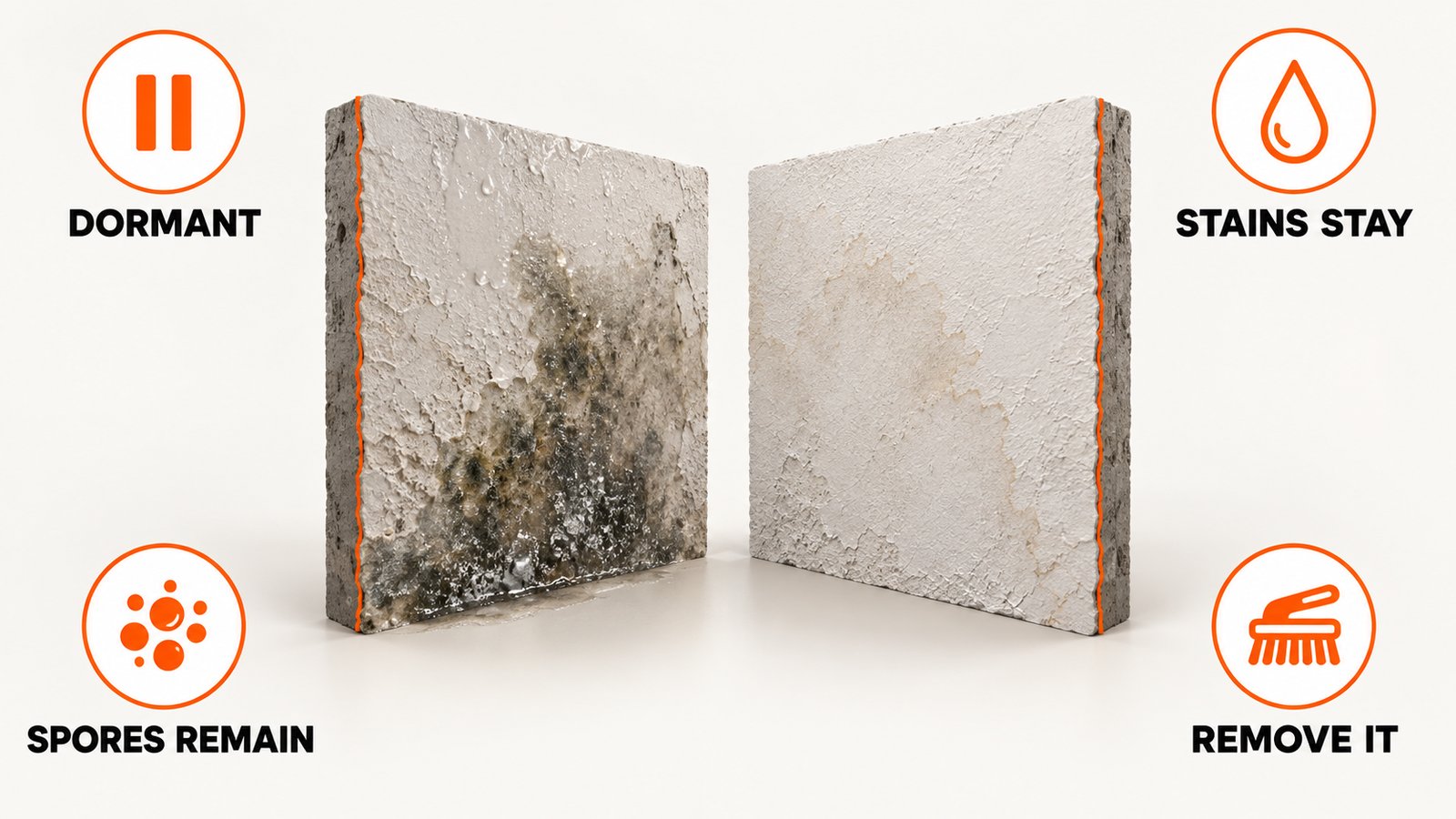
Does mold die on its own? Not in a way you can count on. When the water goes away, growth stops, but the mold doesn't vanish. What's left on the wall is dry, inactive growth and spores, and both can still matter indoors.
Here is the plain version. The EPA says there are many types of mold and none of them will grow without water or moisture. So a leak that's fixed and a wall that dries out will stop a patch from spreading. That part is real, and it's the reason every agency puts moisture control first.
What drying doesn't do is clean anything. The EPA also says dead mold may still cause allergic reactions in some people, so it's not enough to simply kill the mold, it must also be removed. A patch that has dried is in the same position: it may be inactive, but it's still there until someone cleans it off or throws the material away.
Below: what dormant means, what we could and could not verify, how to dry a wet area, and when to get help. For removal steps, see our guide to how to get rid of mold.
Will Mold Die Without Moisture?
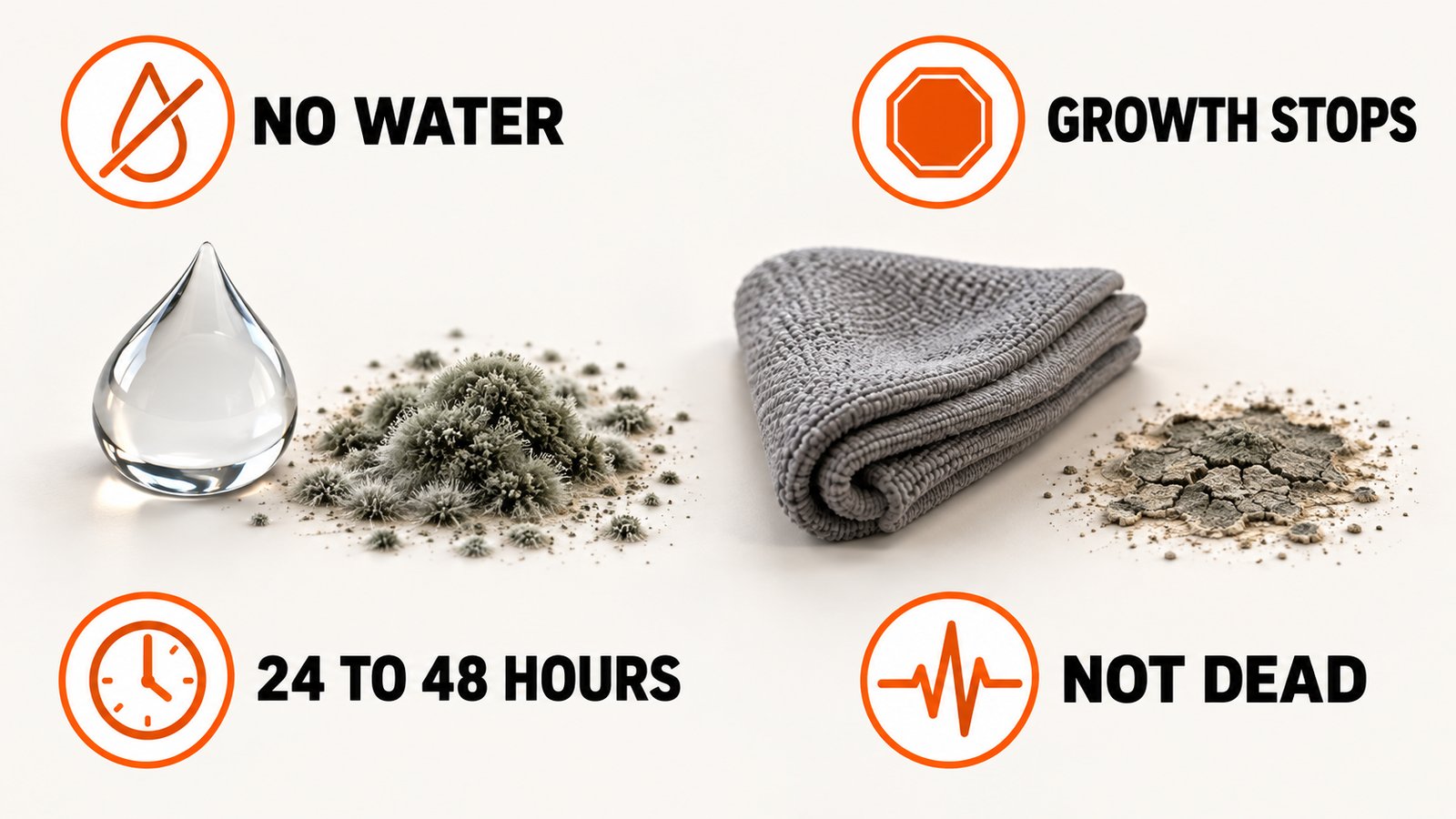
Will mold die without moisture? Growth stops without it. Whether the mold itself is dead is a harder question, and the agencies we read don't answer it with a yes.
The EPA says mold may begin growing indoors when spores land on wet surfaces, and none of the many types of mold will grow without water or moisture. Its mold course adds that moisture is the most important factor influencing mold growth indoors.
That's a statement about growth, not death. The EPA doesn't say a dried-out colony dies, and it gives no survival time. It does say spores are always around: in its guidance for schools and commercial buildings it notes that mold spores waft through indoor and outdoor air continually, and that it is impossible to eliminate all mold and mold spores indoors.
So moisture works like a switch, and the next leak, flood or stretch of high humidity can flip it back on. That's why the EPA says to dry water-damaged areas and items within 24 to 48 hours, and why the CDC says the same after a flood.
Heat and sun can inactivate mold in the right conditions, but neither cleans it off. See does heat kill mold and does sunlight kill mold.
Will Black Mold Die Without Moisture?
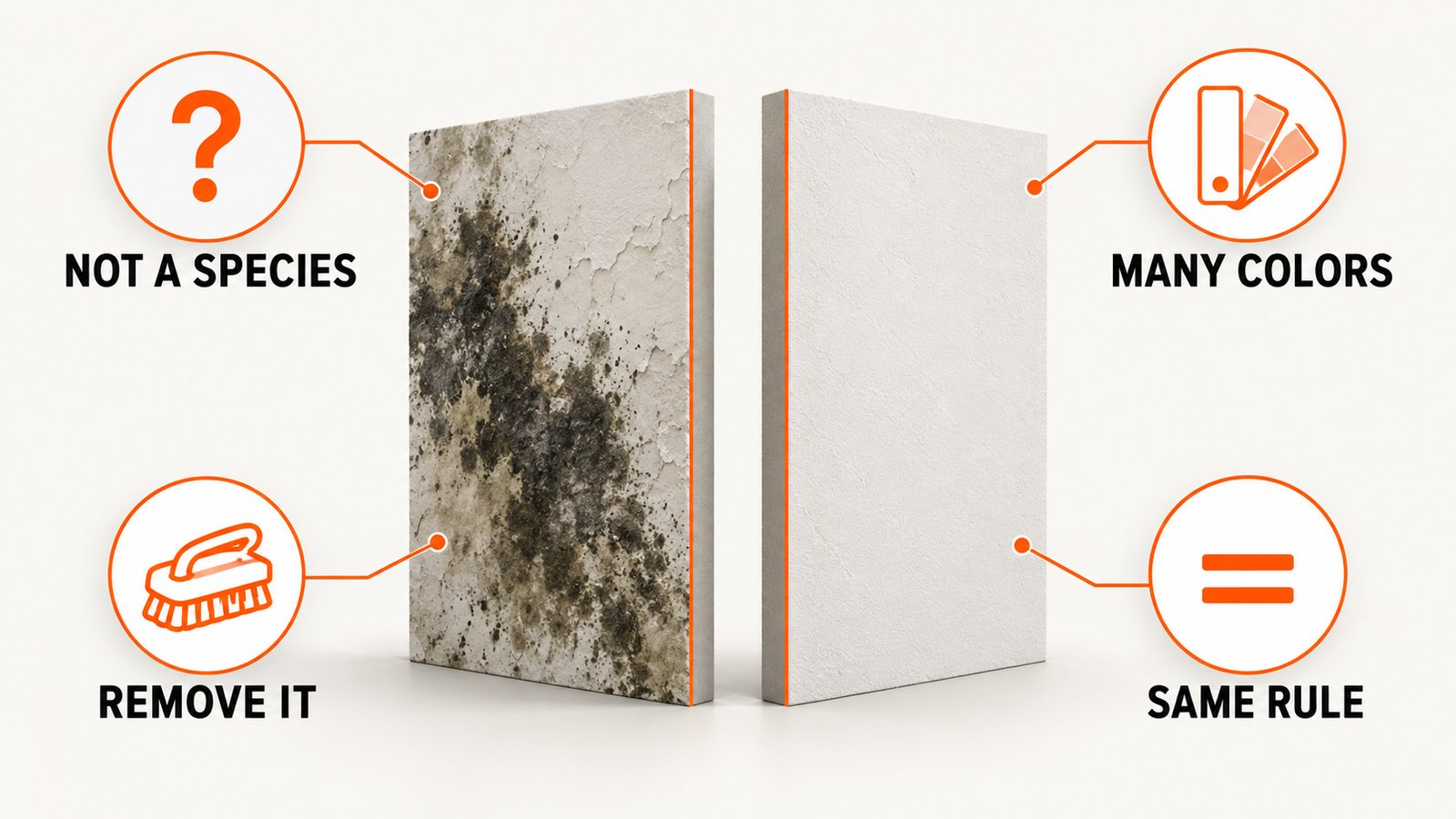
Will black mold die without moisture? The same rule applies to it as to every other mold. It stops growing when it dries out, and it doesn't leave on its own.
People ask this separately because "black mold" sounds like a special case. The EPA's mold course says "black mold" is not a species or specific kind of mold, and neither is "toxic mold." Molds come in many colors, and you can't tell which one you have by looking.
The CDC says you don't need to know. Its guidance on home testing says that no matter what type of mold is present, you need to remove it. So the plan for a dark patch that has dried out matches the plan for a green or white one: fix the water, clean hard surfaces, and replace materials that can't be cleaned. Our black mold guide and black mold removal page go through the details, and black mold vs regular mold covers how the two compare.
What Dormant Mold Means
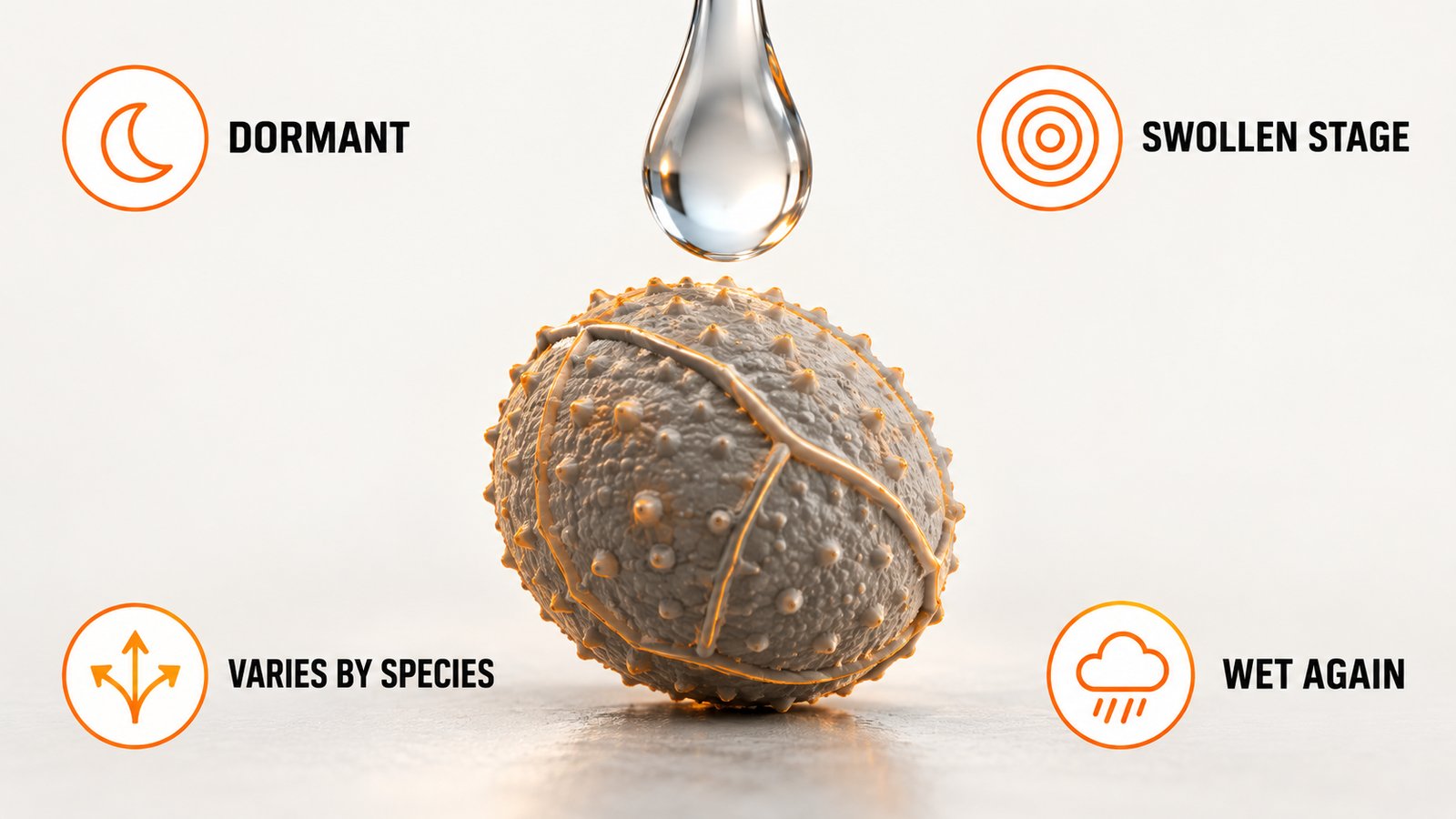
Dormant means paused, not finished. A dormant spore is alive but not growing. It's waiting for conditions to change.
We need to be careful about what we can back up here. The EPA pages we read don't use the word "dormant." The best peer-reviewed work we found is a 2022 study in the journal Chemosphere from Hong Kong Baptist University. The authors tested three common indoor molds, Aspergillus penicillioides, Cladosporium cladosporioides and Aspergillus niger. They started with dormant spores, grew them to a swollen stage, then held them at three dryness levels for up to 15 days. Their abstract reports that the mold species that survived better under wet and dry cycles also had less oxidative damage and stronger antioxidant activity, and that drier air put more oxidative stress on two of the three species.
It's a lab study on three species. It shows survival under drying differs by species and by how dry it gets. It gives no number of days for a home, and it doesn't say a dried patch on your wall is alive or dead.
Put together: spores settle on surfaces constantly and grow when a surface is wet (EPA), some indoor molds survive repeated drying with results that vary by species (Chemosphere), and dead mold can still cause allergic reactions (EPA). None of that supports leaving a dried patch alone.
How Long Spores Survive
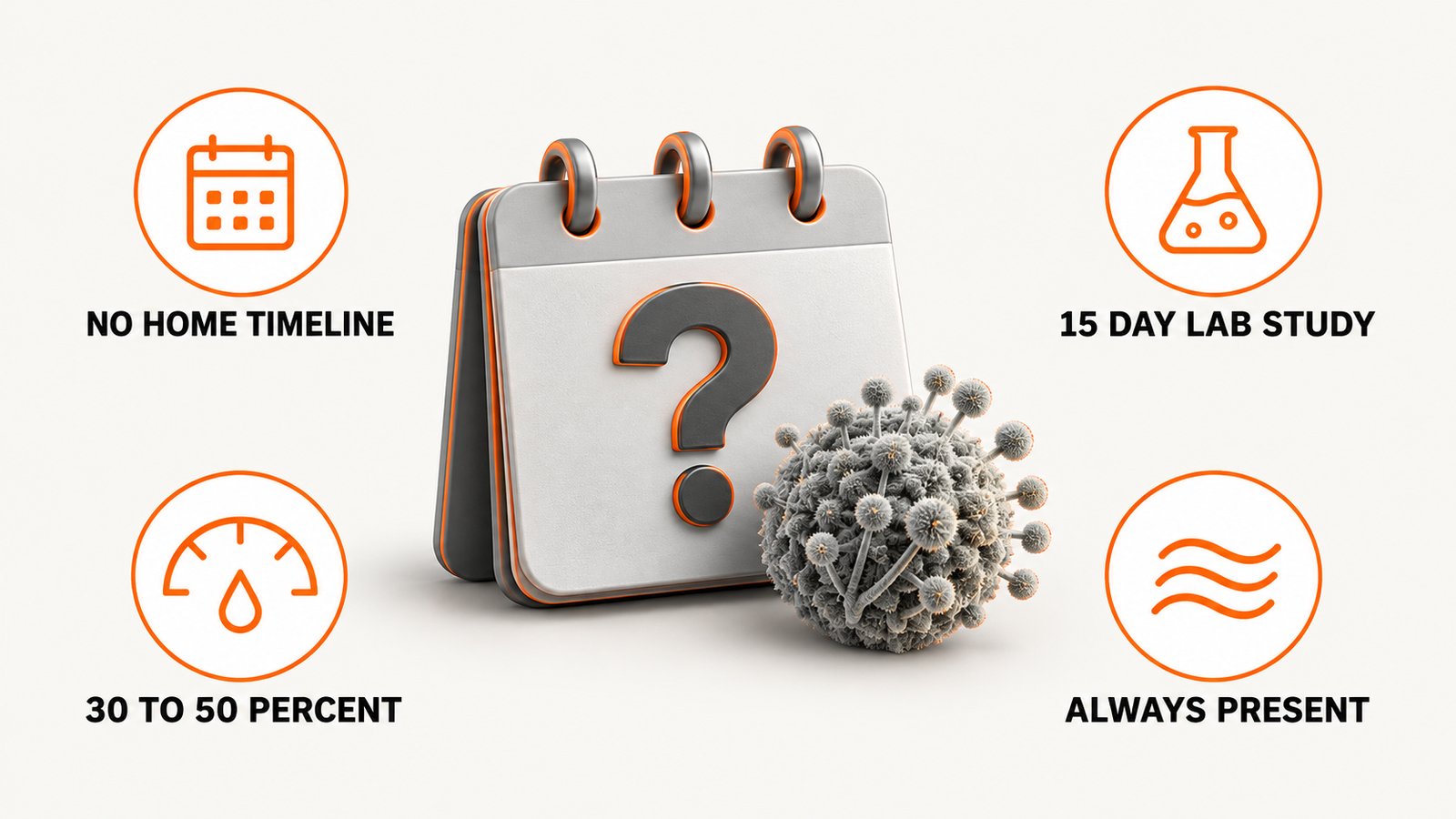
We can't give you a number of days, months or years, because we didn't find an authoritative source that states one for household mold.
We checked the EPA homeowner guide, its mold course, its guidance for schools and commercial buildings, and the CDC mold pages. None says how long indoor spores stay viable when dry. The Chemosphere study ran up to 15 days in a lab, which describes the experiment, not your house. Sites that say "spores last for years" or "mold dies in 48 hours" with no citation are guessing.
What the agencies do give you are working rules that don't depend on a survival time:
- Dry within 24 to 48 hours. The EPA says that if wet or damp materials are dried within 24 to 48 hours after a leak or spill, in most cases mold will not grow.
- Keep humidity low. The EPA says to keep indoor relative humidity below 60 percent, ideally between 30 and 50 percent. The CDC says no higher than 50 percent, all day long.
- Assume spores are present. The EPA says they're always around, so the fix is controlling moisture, not hoping the spores are gone.
A patch that dried long ago and stayed dry has stopped growing, but that doesn't tell you the surface is clean. Our guide to preventing mold covers keeping the area dry.
Why Dry Isn't the Same as Gone
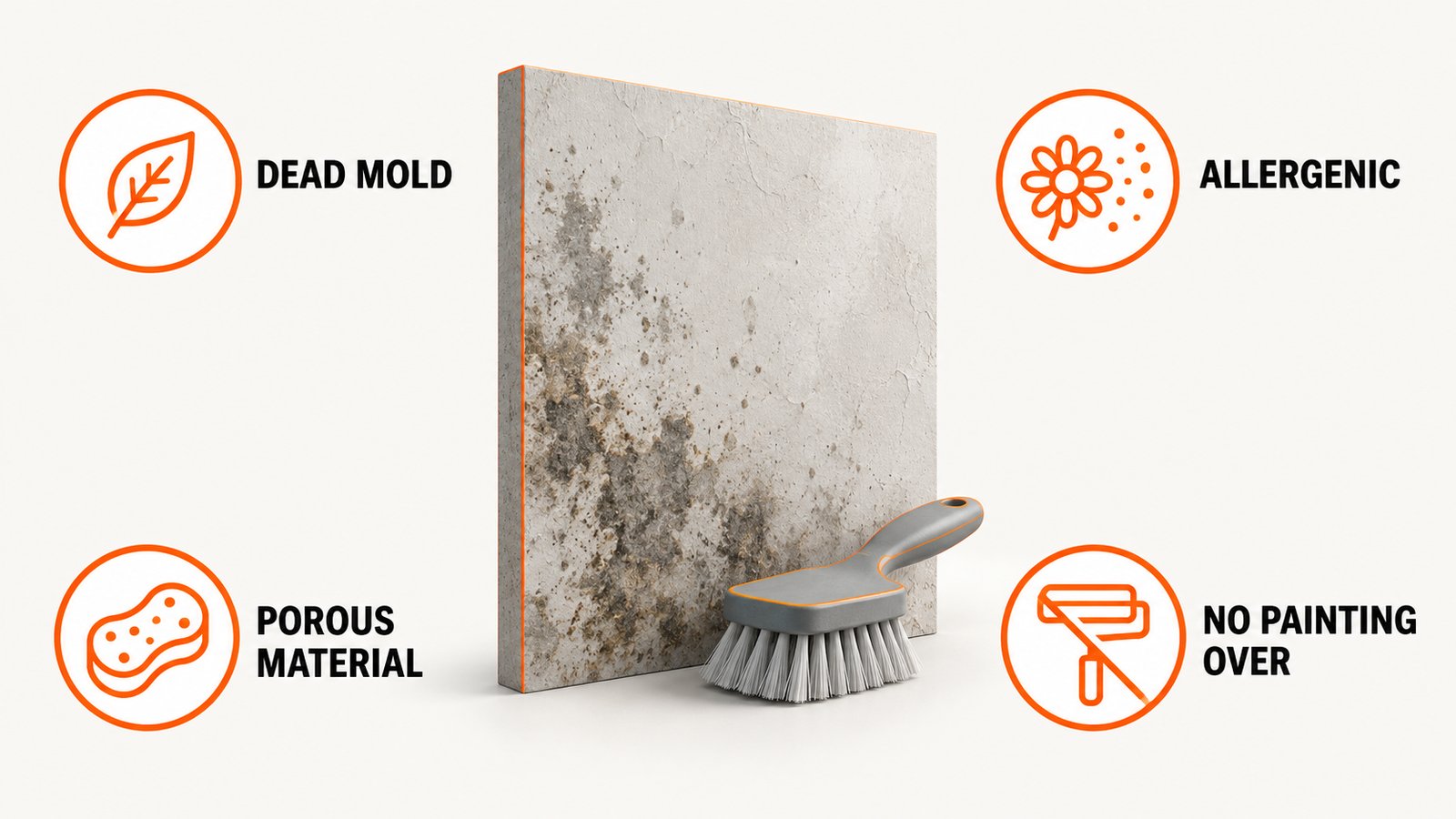
"It dried out" and "it's gone" are different statements, and three things explain the gap.
Dead or dormant mold is still material on the surface. The EPA says dead mold may still cause allergic reactions in some people. The EPA's mold course makes the same point as a note on biocides: it's not enough to simply kill the mold, it must also be removed. Drying is not removal.
Porous materials hold it. The EPA's cleanup tips say absorbent or porous materials, such as ceiling tiles and carpet, may have to be thrown away if they become moldy, because mold can grow on or fill in the empty spaces and crevices of porous materials, so it may be difficult or impossible to remove completely. Drywall, insulation and carpet pad fall in that group.
Stains stay. The EPA notes that mold may cause staining and cosmetic damage, and that it may not be possible to clean an item so its original appearance is restored. A dark mark on a dry wall can be old growth, a stain, or both, and the mark alone doesn't tell you which.
Also, the EPA says not to paint or caulk moldy surfaces. Clean up the mold and dry the surface first, because paint over mold is likely to peel.
Drying stops the growth. Cleaning or removal is the second step. Our page on what kills mold explains why a kill claim on a label doesn't replace it, and the mold remediation process page shows what pros do on bigger jobs.
What EPA Says About Removing Mold, Not Just Killing It
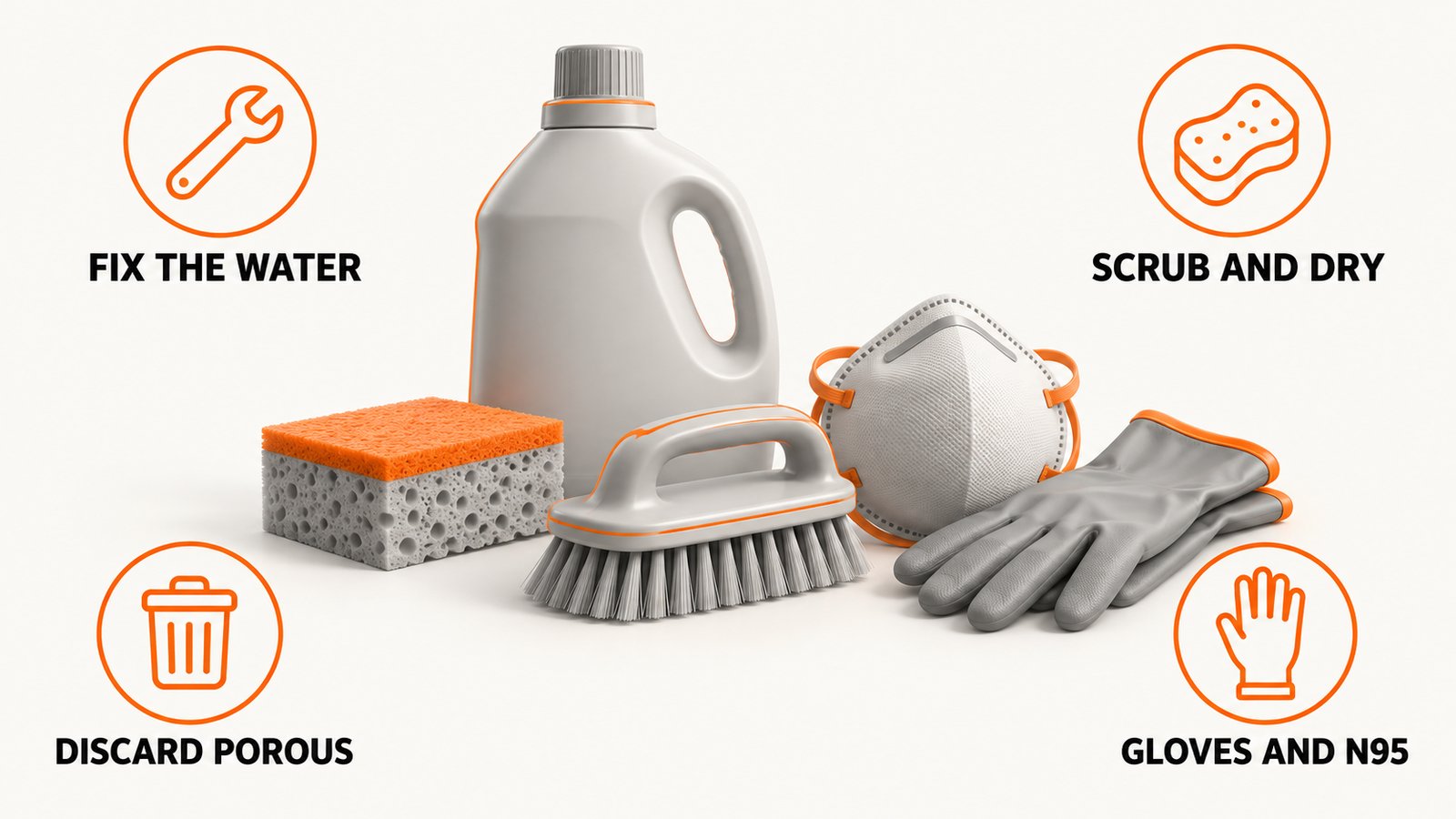
The EPA's position is steady across its homeowner and professional guidance: find and fix the water, remove the mold, and dry the area.
For a small job: fix water problems as soon as possible, dry all items completely, scrub mold off hard surfaces with detergent and water, dry completely, and throw away absorbent or porous materials that can't be cleaned.
On size, the EPA says that if the moldy area is less than about 10 square feet, less than roughly a 3-foot by 3-foot patch, in most cases you can handle the job yourself. If there has been a lot of water damage, or mold growth covers more than 10 square feet, it points you to its guidance for professionals.
On biocides, the EPA's homeowner guide says that using a biocide such as chlorine bleach is not recommended as a routine practice during mold cleanup. On protection, it suggests gloves, goggles and an N-95 respirator, and says to avoid breathing in mold or mold spores. Never mix bleach with ammonia or other cleaners, because toxic fumes can result.
The CDC is just as direct: if you see or smell mold, you should remove it. This isn't medical advice. Take symptoms or health questions to a licensed clinician. Cleaning steps are in our removal guide.
How to Dry an Area Fast After a Leak
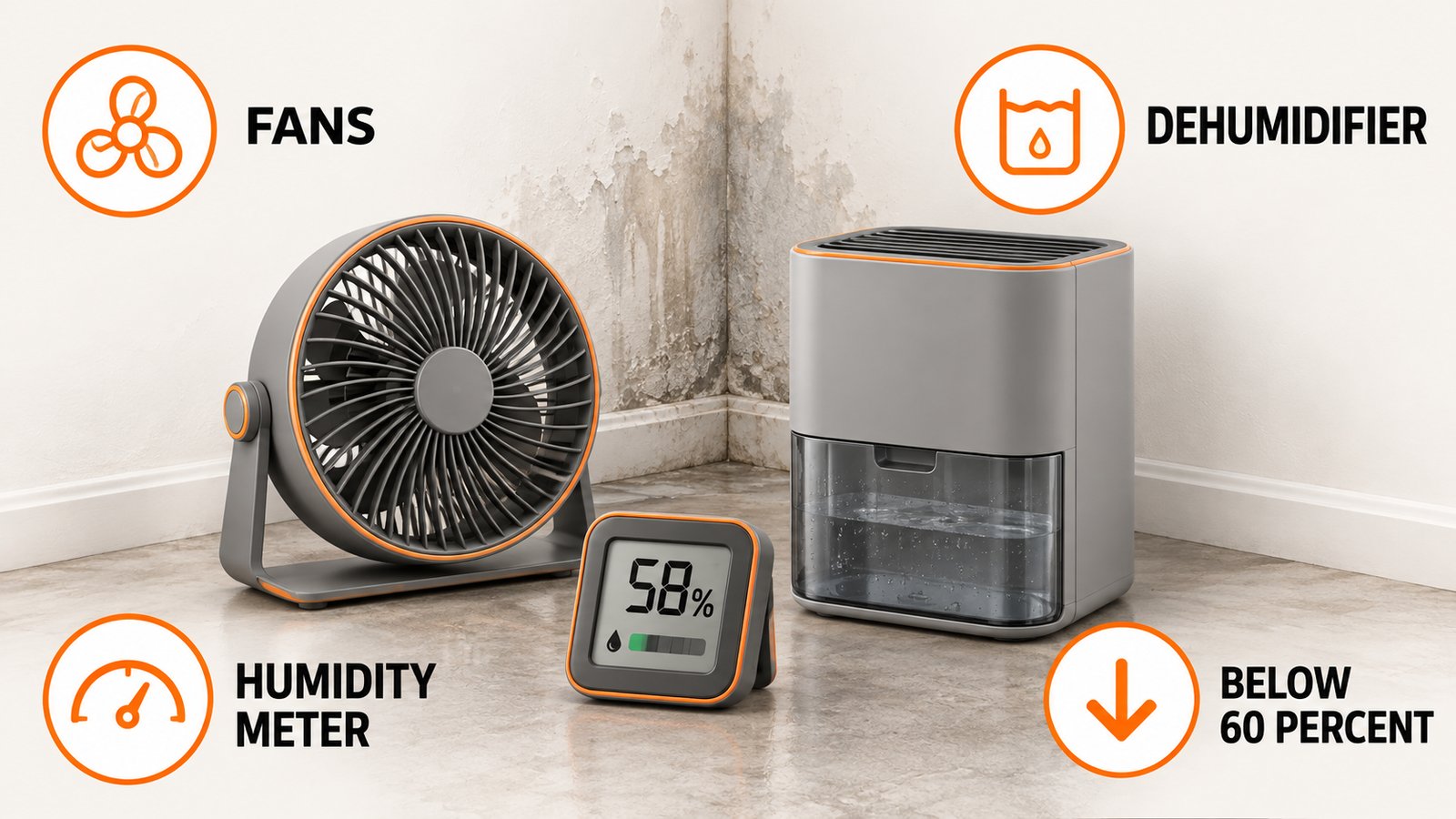
Speed matters more than any product. The EPA and CDC both give the same window: dry the area within 24 to 48 hours.
- Stop the water first. Fix the leak or shut off the supply. The EPA says to fix plumbing leaks and other water problems as soon as possible. Drying a wall while it's still being fed is wasted work.
- Clear the area. Move furniture and boxes so air can reach the wet surface. The CDC says to remove or replace carpets and upholstery that are soaked and can't be dried right away.
- Move air. The EPA lists increasing ventilation or air movement by opening doors and windows when practical, and using fans as needed. Point fans across the wet surface, not just into the room.
- Pull the humidity down. The EPA says to use air conditioners or dehumidifiers when needed. Our dehumidifier guide and size calculator help you pick one.
- Measure it. The EPA says relative humidity can be measured with a moisture or humidity meter, a small instrument it prices at $10 to $50 at many hardware stores. Aim below 60 percent, ideally 30 to 50 percent.
- Know what can't dry. Drywall or insulation still wet past 48 hours is a materials question, not a drying question.
A humidity meter reads the air, not the inside of a wall. For water inside walls or above ceilings, the EPA says mold can sit on the back of drywall, wallpaper or paneling and inside walls around leaking pipes. See mold behind walls and the post-flood checklist.
Sewage or other contaminated water is a separate case. The EPA says to call a professional with experience cleaning buildings damaged by contaminated water.
How to Tell Active Mold From Old Staining
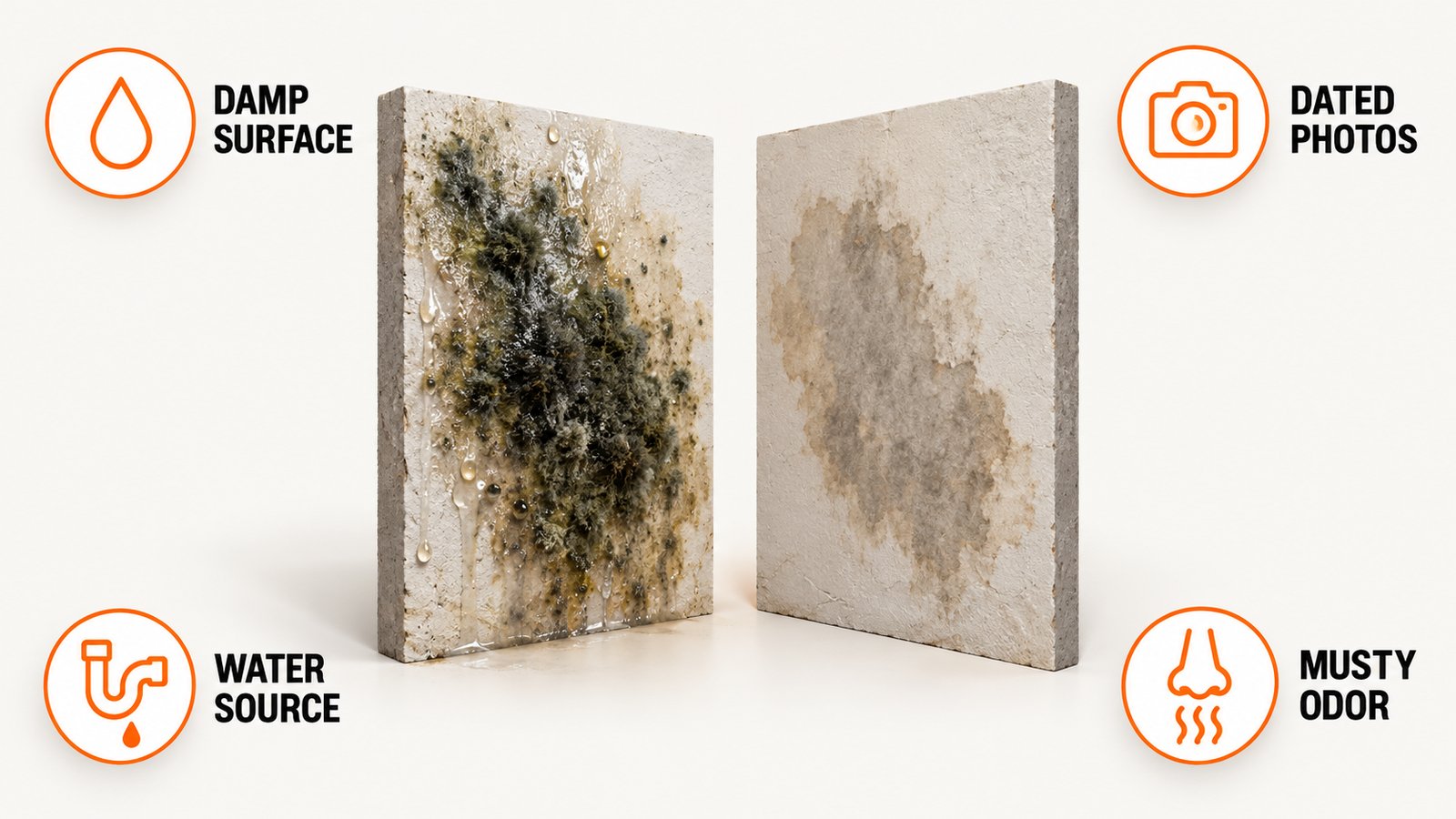
No agency publishes a home test that sorts "active" from "old" by sight, and color alone can't identify mold. Our signs of mold in house page covers the same limit. What you can do is run a few plain checks and read them together. These are practical checks, not an official test.
| Check | Points toward active growth | Points toward old staining |
|---|---|---|
| Is the surface damp? | Feels damp, or sits next to a leak, condensation or a humid room | Dry, with no water source nearby |
| Did it change? | Bigger or darker over days, based on dated photos | Same shape and shade across dated photos |
| Does it come off? | Returns after cleaning if the surface stays damp | Cleaned and dried, the mark stays the same |
| Water history | Recent leak, spill or flood | Old, fixed leak |
On smell, the EPA says a moldy odor suggests mold is growing in the building and should be investigated. Treat it as a reason to look for moisture, not proof of what's growing. If you find a current water source, treat the spot as active.
On testing, the CDC does not recommend it: sampling can't tell you whether someone might become sick, and whatever type of mold is present, you need to remove it. The EPA adds that when visible mold is present, sampling is usually unnecessary. See also is this mold.
When a Photo Check or a Pro Makes Sense
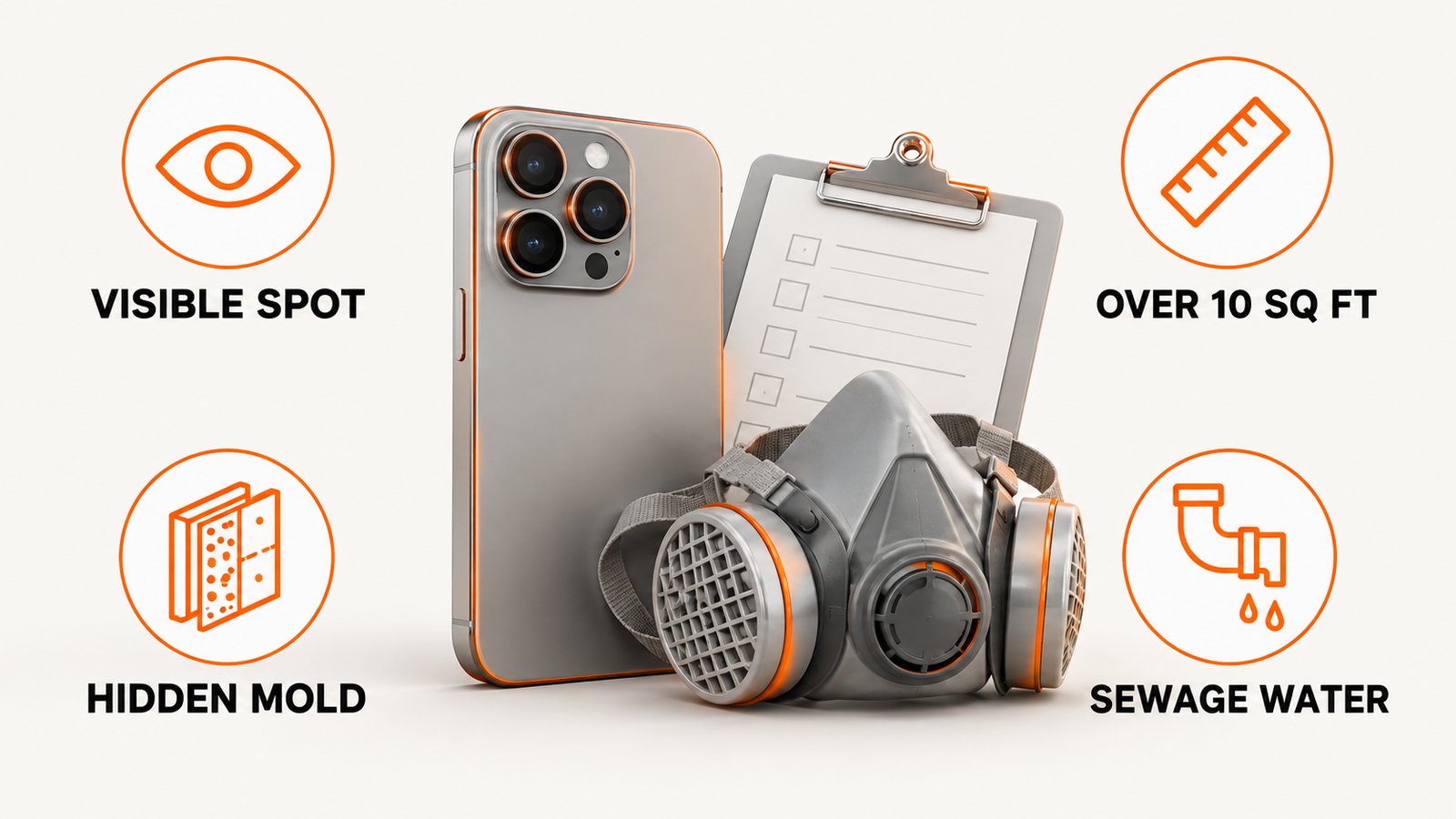
A photo check fits when you can see the spot and want a second look. It doesn't fit when you can't see the problem.
Mold Scanner AI gives an AI-assisted visual screening of what is visible in the photo. Processing time varies. It can't see inside a wall or measure moisture, and it doesn't diagnose health conditions. Use it to document a surface and track change. Our home mold test page covers what DIY options can tell you.
Call a professional when any of these are true:
- The area is bigger than about 10 square feet. That's the EPA's line for pointing you to professional guidance.
- Water damage was extensive or came from sewage or another contaminated source.
- You suspect hidden mold. The EPA says investigating hidden mold may be difficult and requires caution, since removing wallpaper, for example, can release a lot of spores at once. It suggests hiring an experienced professional if you believe you have a hidden mold problem.
- HVAC may be involved. Don't run the system if you know or suspect it's contaminated.
- You're sensitive to mold or have health concerns. The EPA says to consult a health professional before starting cleanup if you have health concerns.
Our pages on mold inspection, mold remediation and remediation cost explain what to expect when you hire out.
Frequently asked questions
Does mold die on its own?
Not reliably. Growth stops when the moisture is gone, since the EPA says none of the many types of mold will grow without water or moisture. But the mold doesn't disappear. The EPA says dead mold may still cause allergic reactions in some people, so it has to be removed, not just left to dry.
Does mold die when it dries out?
Drying stops it from growing. It doesn't clean anything up. Lab work on three indoor molds found survival under wet and dry cycles varies by species, so a dried patch can't be assumed dead. Clean it off or remove it, then keep the area dry.
Will mold die without moisture?
Growth ends without moisture, and that's the reason moisture control is the first step in every agency's guidance. We found no authoritative source stating how long indoor mold survives when dry, so we can't give you a timespan. What we can say is the EPA's rule: dry wet areas within 24 to 48 hours, and in most cases mold will not grow.
Will black mold die without moisture?
It stops growing without moisture, like every other mold, and it doesn't go away by itself. The EPA says black mold is not a species or specific kind of mold. A dark patch can be one of several molds, and the CDC says that no matter what type of mold is present, you need to remove it.
Can dormant mold come back?
It can when water returns. The EPA says mold may begin growing when spores land on wet surfaces, and spores are always in the air. Keep indoor humidity below 60 percent, ideally 30 to 50 percent.
When should I call a professional?
Call one for growth over about 10 square feet, extensive water damage, sewage or contaminated water, suspected mold inside walls, a possible HVAC link, or when someone in the home is sensitive to mold.
Sources
Every claim on this page traces to one of these. Links open the primary document.