Every Home Mold Test, Compared
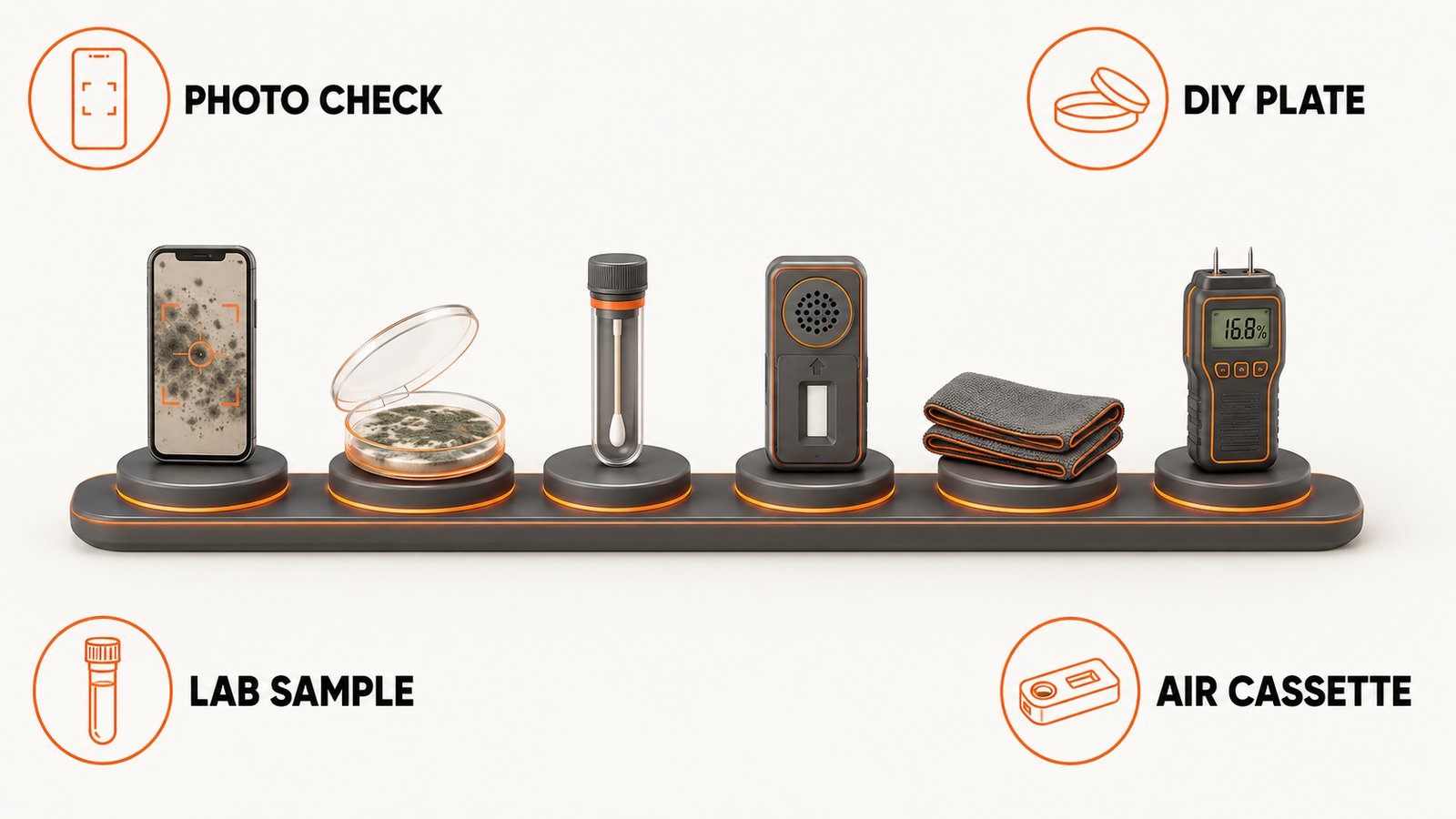
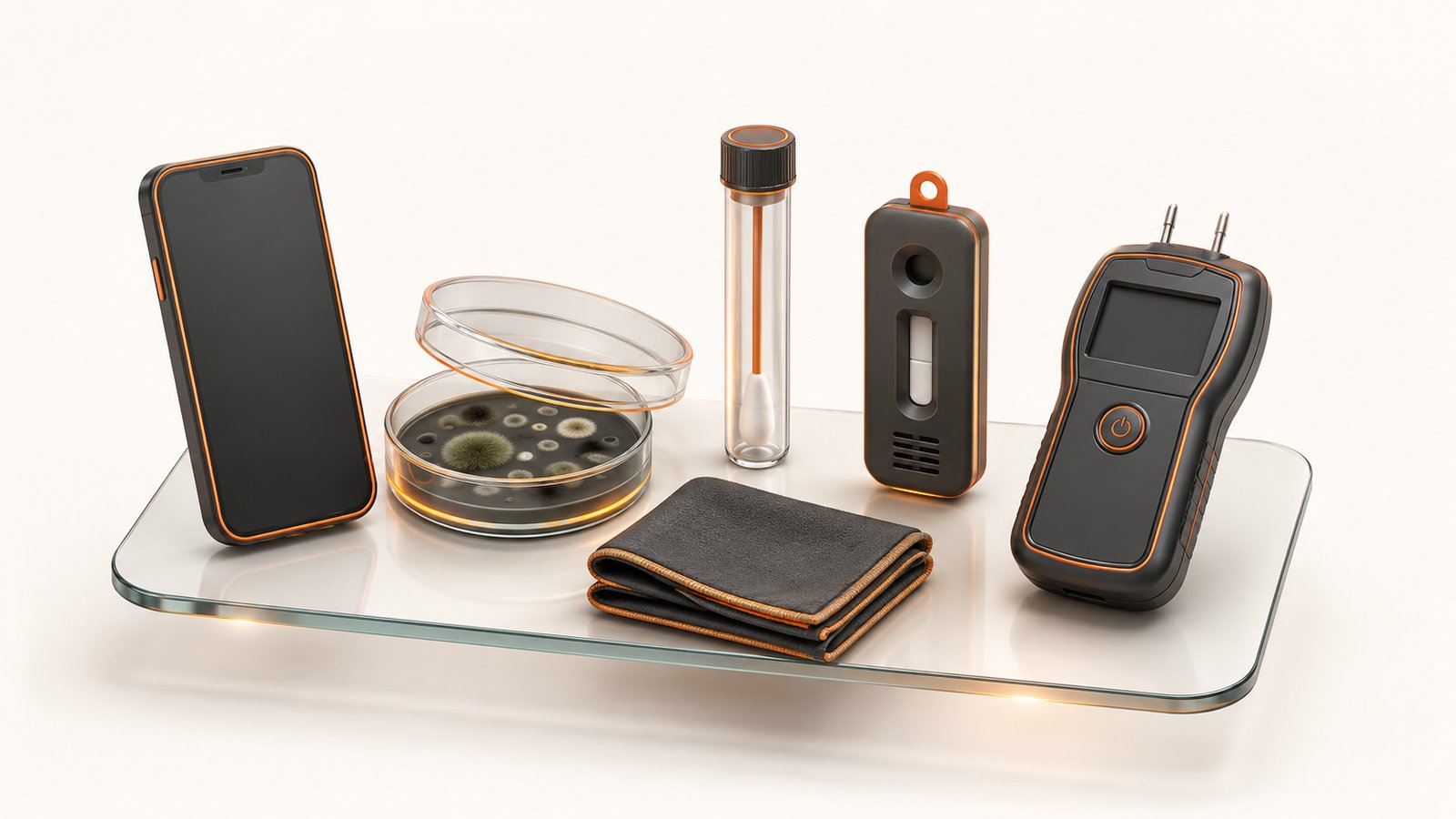
Six methods sit under the phrase mold test for home. They measure different things, they cost different amounts, and they answer different questions. The table below is the whole decision in one place. Prices are listed prices checked on September 2, 2026, and they move.
| Method | What it measures | Time to result | Typical cost | What it can and cannot settle |
|---|---|---|---|---|
| Photo check | What is visible on the surface you photographed | Processing time varies | Free to start | Gives you a read on a visible surface. Cannot see inside a wall and cannot name a species. |
| Settling plate kit | Whatever spores fall onto an agar dish in the room | 2 to 5 days for growth | $9.98 for the Mold Armor DIY kit | Proves spores exist in the room, which is always true indoors. Almost never changes what you do next. |
| Swab or tape lift, lab analyzed | What is growing on one specific surface | Days, set by the lab and shipping | Kit plus a per-sample lab fee | Names the genera on that one spot. Says nothing about the rest of the house. |
| Air cassette kit, lab analyzed | Spore counts in the air at one moment, per sample | Days, set by the lab and shipping | $199.00 for the GOT MOLD one-room kit with lab fees included | Gives an indoor count against an outdoor control. There is no federal number to compare it to. |
| ERMI dust index | DNA of 36 mold species in a settled-dust sample | Days to weeks, set by the lab | $240 to $435 at EnviroBiomics | A research index. The EPA says it has not been validated for non-research purposes. |
| Professional inspection | Moisture, building history, and targeted samples if warranted | Same visit, plus lab turnaround | Varies by market and scope | The only method that finds the water source and writes a scope you can hand to a contractor. |
Read the last column first. Most people buy a home mold test hoping it will answer a question the test was never built to answer. A settling plate cannot tell you whether your house is unusually moldy, because spores are in every indoor space on earth. The EPA puts it plainly: it is impossible to get rid of all mold and mold spores indoors, and some spores will always be floating through the air and sitting in house dust.
The other thing the table hides is that there is nothing to compare a result against. The EPA states that standards or Threshold Limit Values for airborne concentrations of mold, or mold spores, have not been set, and that there are currently no EPA regulations or standards for airborne mold contaminants. A lab can hand you a number. No agency will tell you whether that number is a pass or a fail.
Start With a Photo, Not a Kit
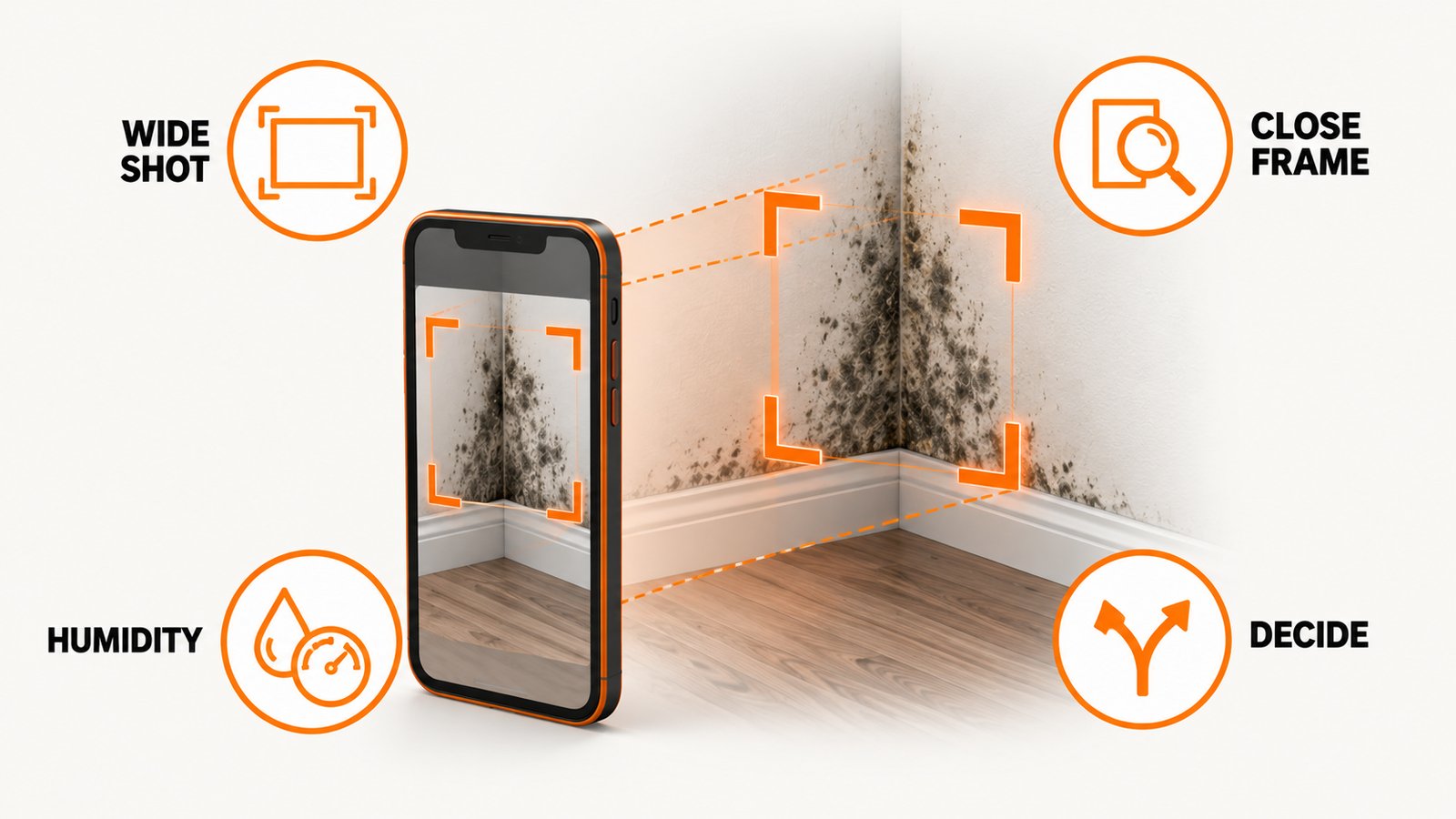
Before you spend a dollar, photograph what you are looking at. Take one wide shot that shows the whole wall or ceiling, then move close and take a second frame with good light on the texture. Photograph it, and get an AI-assisted visual screening of the surface in the shot. Processing time varies. It costs nothing to start and it tells you whether you are looking at a stain, at surface mildew on paint, or at something spread far enough that the spray bottle is no longer the right tool.
A photo check has a hard limit and it is worth saying out loud. It reads the surface in the frame. It does not see behind drywall, it does not name a species, and it is not an inspection. What it does well is triage: it turns a vague worry into a decision about whether to clean, to keep watching, or to pay someone. If you want a second opinion on the picture itself, our guide to reading a photo walks through the visual cues that separate mildew from a water stain, and is this mold covers the lookalikes people misread most often.
Do the same free measurement on the air while you are there. A moisture or humidity meter is a small instrument the EPA prices at $10 to $50 at many hardware stores, and indoor relative humidity should sit below 60 percent, ideally between 30 and 50 percent. If your bathroom reads 72 percent every evening, you have found the reason mold keeps returning, and no lab report was needed to find it. Our humidity tool turns that reading into a plain risk picture.
Two free steps, then decide. Most homes never need step three.
DIY Settling-Plate Kits: What a Mold Test Kit for Home Use Actually Proves
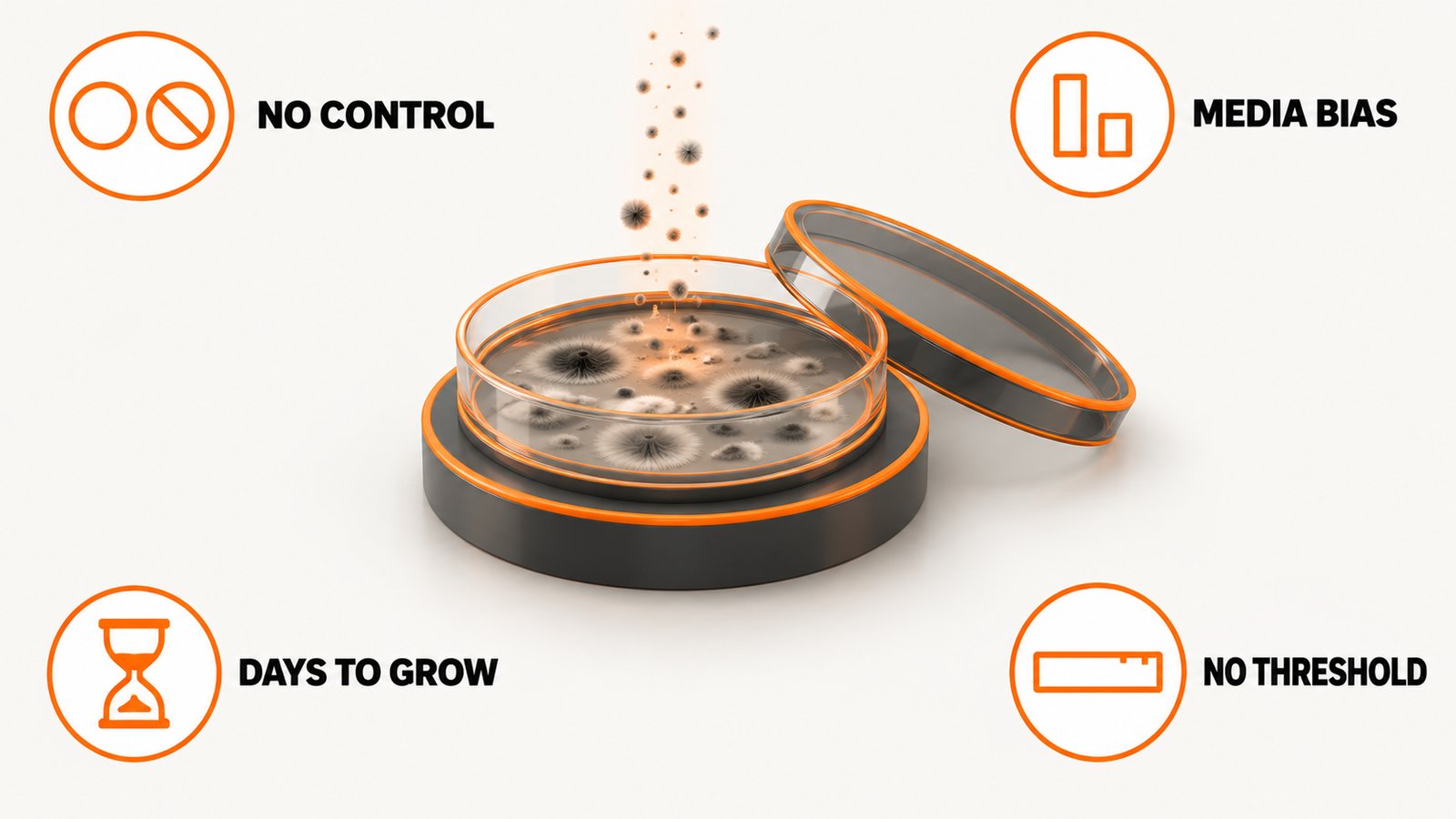
The cheapest mold test kit for home use is a petri dish with a layer of agar in it. You take the lid off, leave it in a room for an hour, close it, and wait a few days for colonies to appear. The Mold Armor DIY Mold Test Kit lists at $9.98 on Amazon, which is why it is the first thing most people buy.
Here is what a colony on that plate proves: airborne spores exist in your home. That is true in every building, in every season, everywhere. The EPA is explicit that mold spores are found floating through the air and in house dust, and that they will not grow if moisture is not present. A plate that grows something is not evidence of a problem. A plate that grows nothing is not evidence you are clear either, because an hour of settling in one room is a tiny sample of a moving target.
Settling plates have three specific weaknesses worth knowing before you buy one:
- No control, no meaning. Serious sampling always pairs an indoor sample against an outdoor one taken the same day, because outdoor air is the baseline every indoor reading is judged against. A single kitchen plate has nothing to compare itself to.
- Growth media pick winners. Different species grow at different speeds on the same agar. Fast growers cover the plate and hide the slow ones, so the colonies you count are a story about the agar as much as about your air.
- Counting colonies is not a measurement. There is no published threshold that turns a count of colonies on a hardware-store plate into a verdict, because as the EPA notes, no federal limits for mold or mold spores exist.
Most of these kits sell a mail-in lab upgrade for a separate per-sample fee, which is a genuinely different product and worth considering when you have a specific surface in question. Our mold testing kit breakdown separates the kits that include lab analysis from the ones that just grow something on your counter, and black mold test kits covers the versions marketed specifically for dark growth.
Lab-Analyzed Swab and Tape-Lift Kits
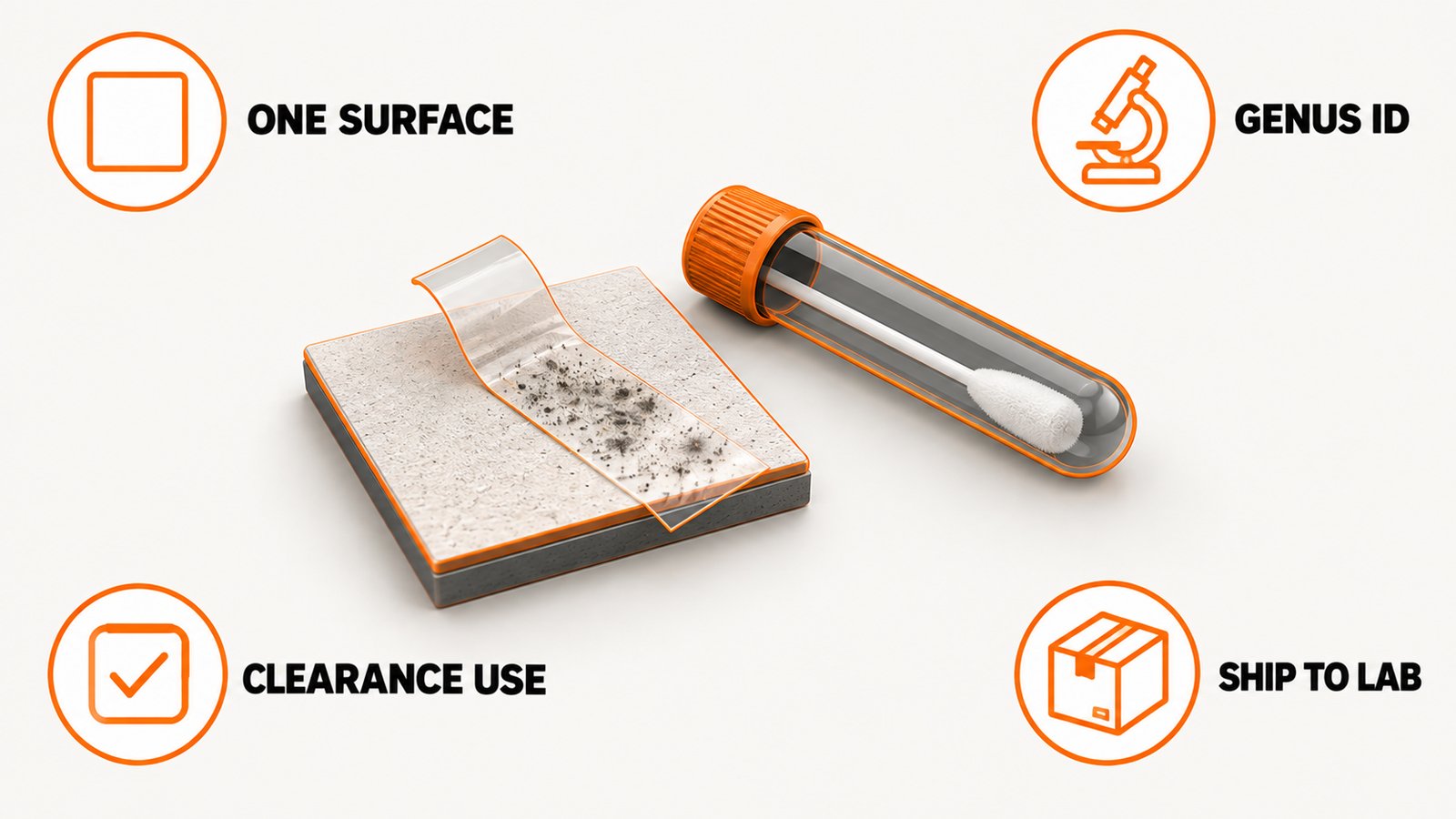
A swab kit and a tape lift both sample one surface rather than the air. You wipe or press the sample onto the collection medium, seal it, ship it, and a laboratory identifies the fungal genera present under a microscope or by culture. This is the most useful cheap test in the set, because its question is narrow enough to be answerable.
The EPA agrees on the one job surface sampling does well: it may be useful to determine if an area has been adequately cleaned or remediated. That is the clearance use case. You cleaned a spot, you want to know whether the cleaning worked, and a before-and-after surface sample is a defensible way to check.
What a surface sample cannot do is generalize. A tape lift from the bathroom ceiling tells you about the bathroom ceiling. It says nothing about the crawl space, the HVAC plenum, or the wall cavity behind the shower. People routinely pay for one swab and treat the result as a verdict on the whole house, which is a category error, not a lab error.
Two practical notes. First, the EPA advises that sampling for mold should be conducted by professionals who have specific experience in designing mold sampling protocols, sampling methods, and interpreting results, and that analysis should follow methods recommended by the American Industrial Hygiene Association, the American Conference of Governmental Industrial Hygienists, or other professional organizations. A homeowner can absolutely collect a swab, but the interpretation is the hard part. Second, ask the lab in advance what it will report and what it will not, so you know what you are buying. Our page on professional mold testing covers the questions to ask before you send anything.
Air-Cassette Kits You Send to a Lab
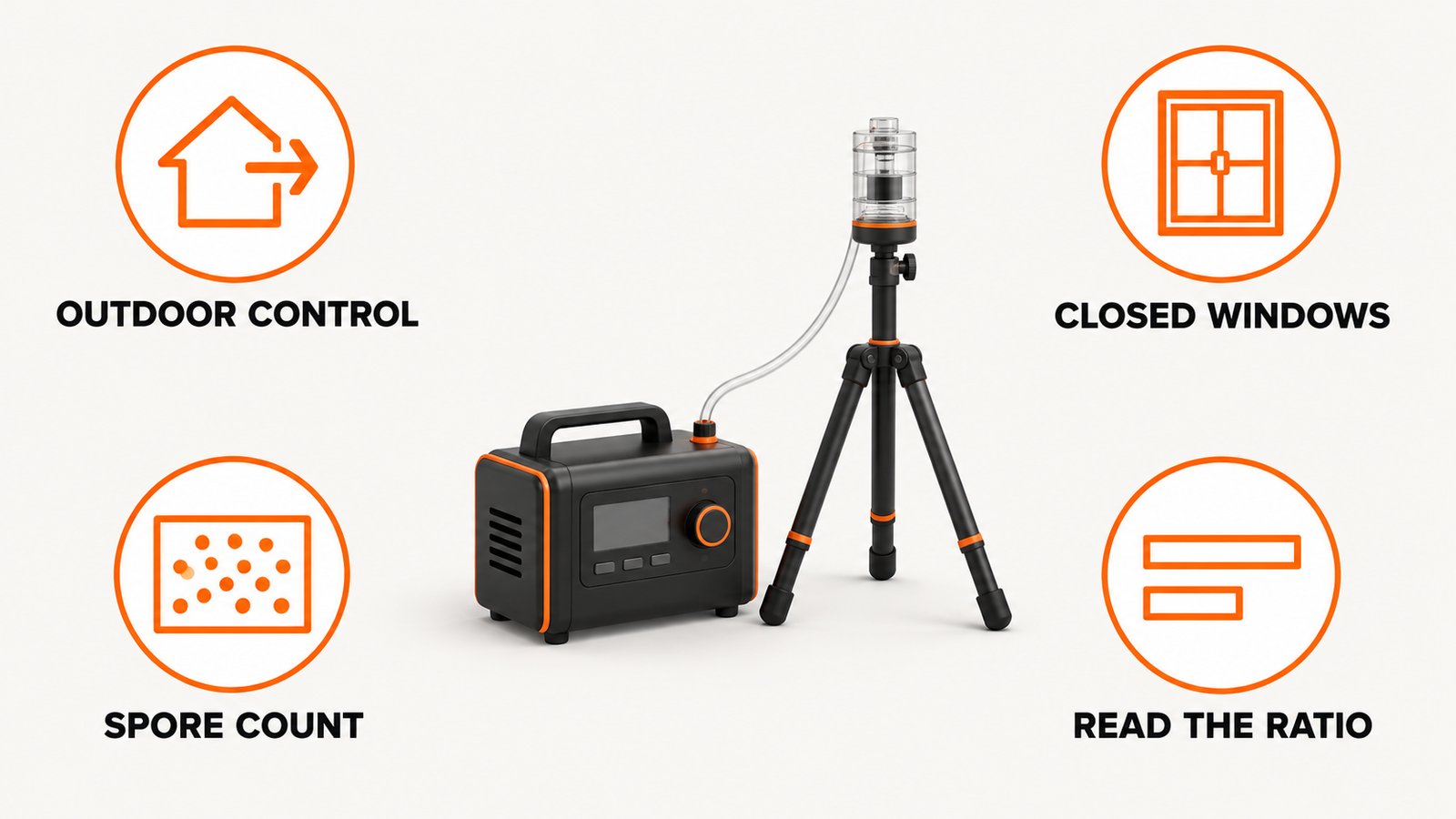
An air-cassette kit pulls a measured volume of air through a spore trap and a lab counts what landed on the slide. This is the same physical method a professional uses, sold as a boxed product. The GOT MOLD one-room kit lists at $199.00 on Amazon with lab fees included, which is roughly what you would expect once analysis is bundled in.
Air sampling has real uses. It is the standard approach when you smell something and cannot find it, when you want a number before and after a remediation job, and when you need a reading in a space nobody can visually inspect without opening it up. It is also the method most sensitive to how carefully it is run.
Three conditions decide whether the result is worth reading:
- An outdoor control taken the same day. Without it, the indoor count is a number with no scale. Outdoor spore counts swing with season, weather, and time of day.
- Normal conditions during the sample. Windows closed, HVAC in its usual state, nobody vacuuming. A sample taken while the room is disturbed reads high for reasons that have nothing to do with growth.
- Someone who can interpret it. A raw spore count is not a verdict. There is no federal threshold, so interpretation depends on the indoor-to-outdoor comparison, the genera present, and the building itself.
We cover the method in depth, including how to read the indoor-to-outdoor ratio and what the report actually shows, on our air quality test for mold page. If the concern is the duct system rather than the room, start with mold in air ducts instead, because sampling a supply register and sampling a bedroom answer different questions.
ERMI and Dust-Based Indexes
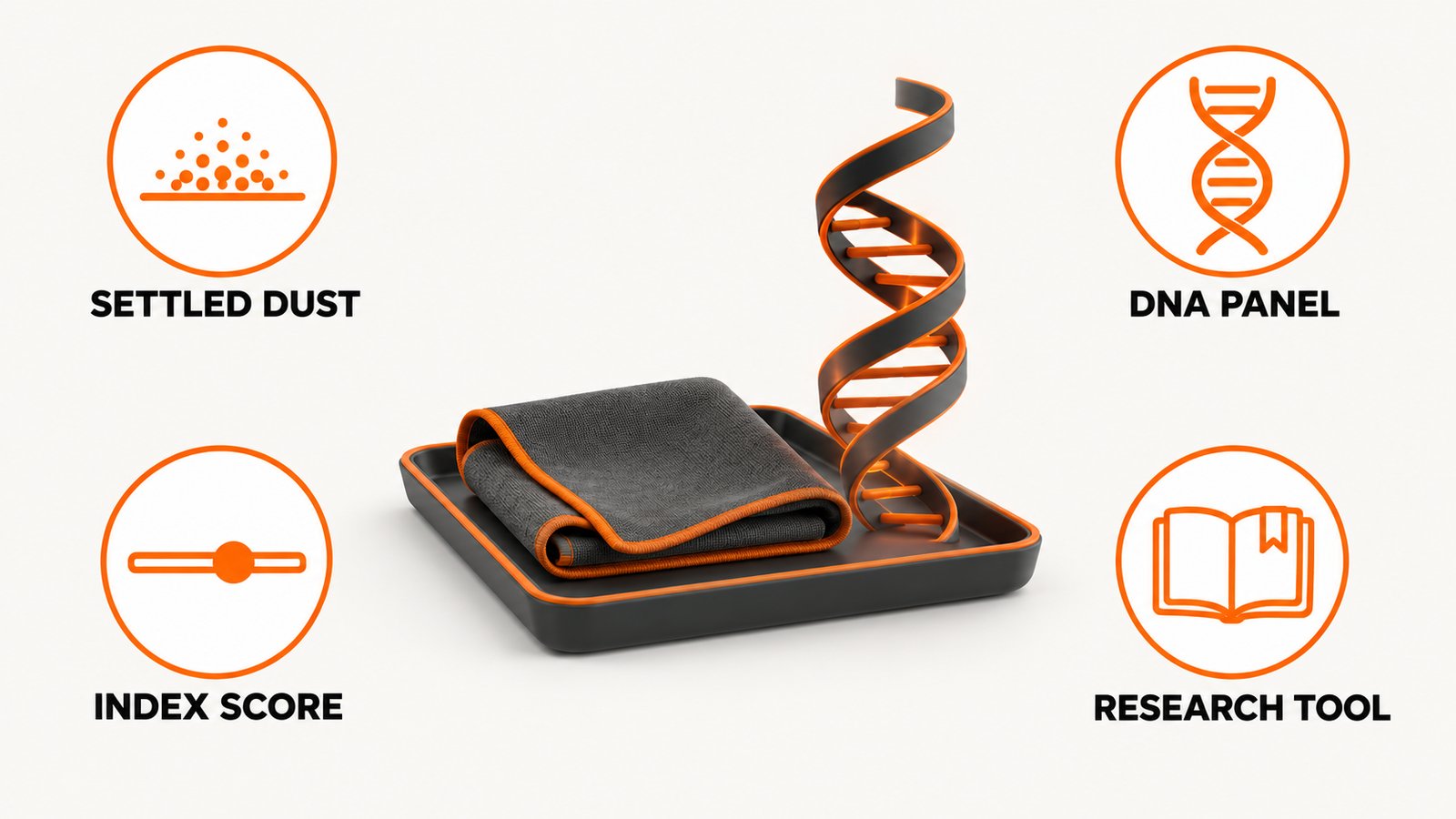
The Environmental Relative Moldiness Index takes a settled-dust sample, usually from carpet or a dust cloth, and uses DNA analysis to quantify a fixed panel of species. EnviroBiomics publishes a price range of $240 to $435 for its ERMI test, describing it as a DNA-based dust analysis covering 36 mold species.
Dust has one genuine advantage over air: it accumulates. An air sample is a snapshot of one moment, while settled dust is a record of what has been in the space over a longer stretch. That makes ERMI attractive to people chasing an intermittent problem.
Now the part vendors tend to skip. The EPA, which developed the index, describes ERMI as a research tool developed by EPA scientists for estimating mold contamination, and states that it has been peer reviewed for research purposes but has not been validated for non-research purposes. That is the agency that built it, saying it was not validated for the use it is most often sold for. A high ERMI score is a reason to look harder at the building. It is not a finding about whether a home is safe to live in, and no score decides that question.
If you are weighing an ERMI, read our ERMI test kit comparison and the method breakdown on what an ERMI test is before ordering. Both cover how the score is calculated and what the labs do and do not include in the price.
Professional Inspection and Sampling
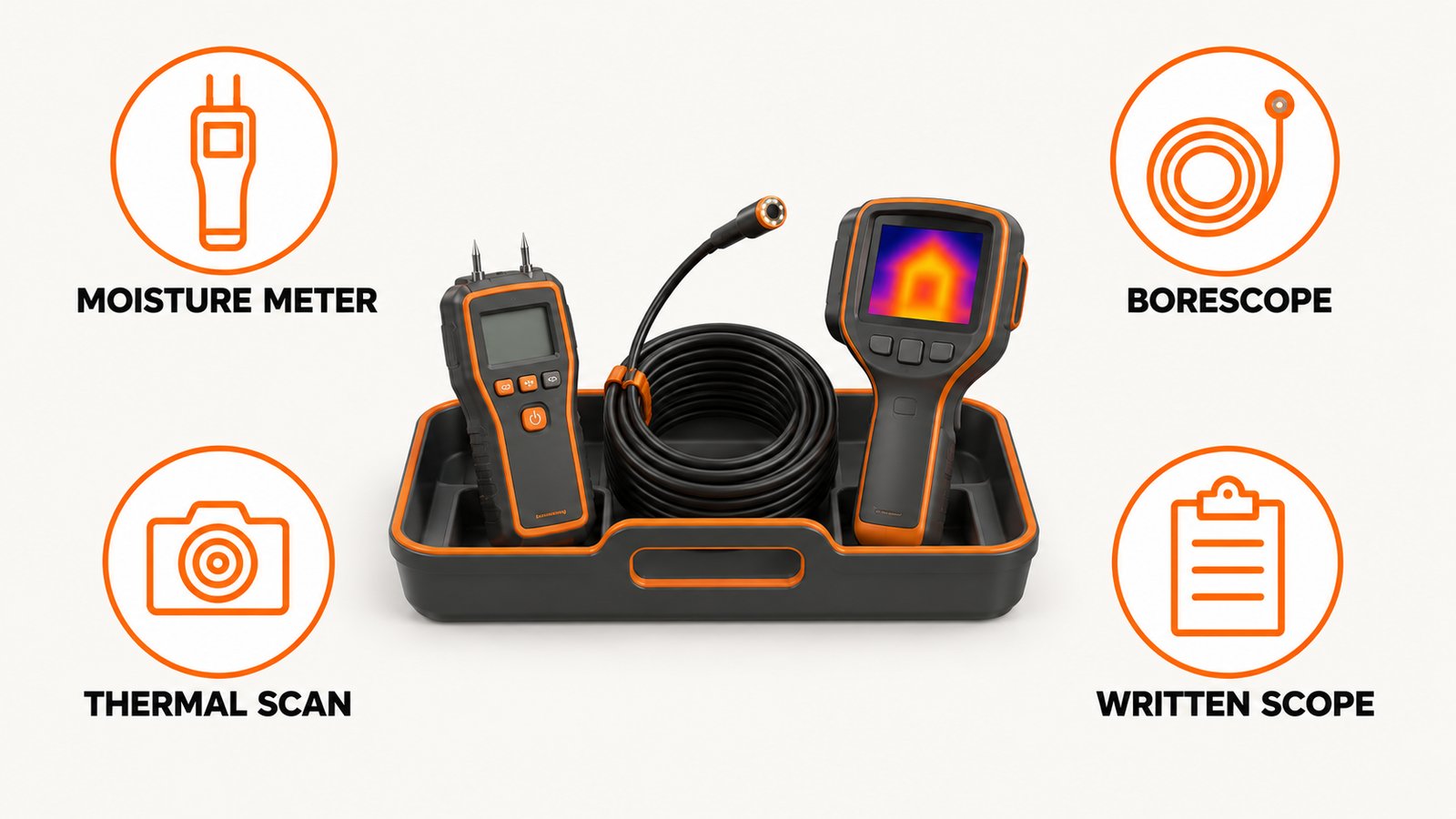
An inspection is a different product from a test. A kit measures one thing. An inspector reads the building: the roof line, the grading, the plumbing runs, the HVAC condensate, the exterior envelope, and the moisture readings that show where water is now. Sampling, when it happens at all, comes after that walkthrough and is aimed at a specific question the walkthrough raised.
That order matters, because the EPA states that in most cases, if visible mold growth is present, sampling is unnecessary. If you can see it, the finding is already made, and the money is better spent on finding and stopping the water. An inspector who leads with a sampling package before looking at the building is selling the wrong thing first.
Where an inspection earns its fee:
- You cannot find the source. A moisture meter and a thermal camera find wet material behind a finished surface far faster than guesswork does.
- You need a written scope. Remediation contractors bid against a scope. Without one, you are comparing three different jobs at three different prices.
- You are buying or selling. A third-party report carries weight in a transaction that a plate from your kitchen counter never will.
- The job is bigger than a spray bottle. The EPA sets the DIY line at about 10 square feet, roughly a 3-foot by 3-foot patch. New York State health guidance uses the same 10-square-foot line for calling in a licensed contractor.
Some states regulate this work directly. New York licenses mold assessors and remediation contractors under Article 32 of the Labor Law and prohibits the same individual from performing both the assessment and the remediation on the same property, which is a structural fix for the obvious conflict of interest. Texas licenses seven categories of mold professional through the Department of Licensing and Regulation. Our mold remediation certification page maps who is licensed where, and mold inspection cost covers what the visit runs.
When a Mold Test for Home Use Is Worth Paying For
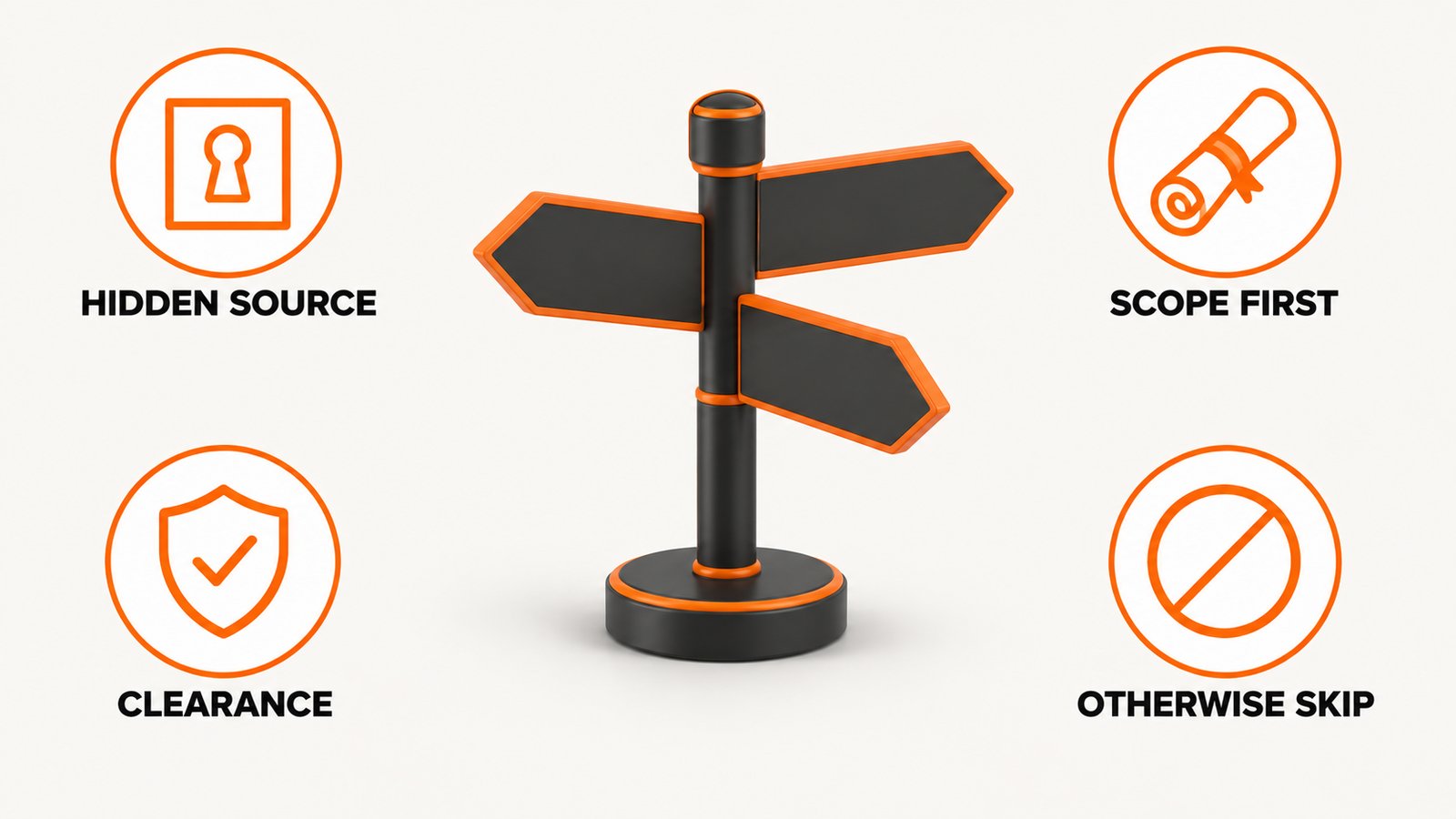
The CDC states plainly that it does not recommend mold testing, and adds that you do not need to know the type of mold. New York State's health department goes further: mold testing is not recommended, nor is it required by any regulatory agency, there is no state or federal standard for mold in homes, and knowing the kinds of mold present does not change this advice. Testing can also cost more than simply cleaning and repairing the water problem that let the mold grow.
That is the default. Against that default, three situations genuinely justify paying:
1. You suspect a problem you cannot see. A musty smell in a room with no visible growth, or a history of water damage in a finished space, is a reason to investigate. Start with a moisture inspection rather than a lab kit, because finding wet material is more useful than counting spores. Our page on mold behind walls covers the signs worth acting on.
2. You need a scope written before remediation. If you are hiring out a job, an independent assessment defines what gets removed, what gets contained, and what gets tested afterward. New York requires exactly this: an independent mold assessment to define the scope of the remediation work.
3. You need clearance after remediation. This is the use the EPA endorses for surface sampling, checking whether an area has been adequately cleaned or remediated. New York requires a post-remediation assessment as part of its minimum work standards.
Outside those three, the money almost always does more good on a dehumidifier, a bathroom fan that actually vents outside, or a plumber. Fix the water and the mold stops. Test the air and the water is still there.
One more caution on how results get used. Building tests measure buildings. They do not measure people, and they cannot tell you whether mold caused a symptom you are experiencing. Health questions belong with a licensed physician, and New York's health department makes the same point: discuss health concerns with your doctor, because the symptoms of mold exposure could be caused by other exposures and illnesses.
When to Call a Pro
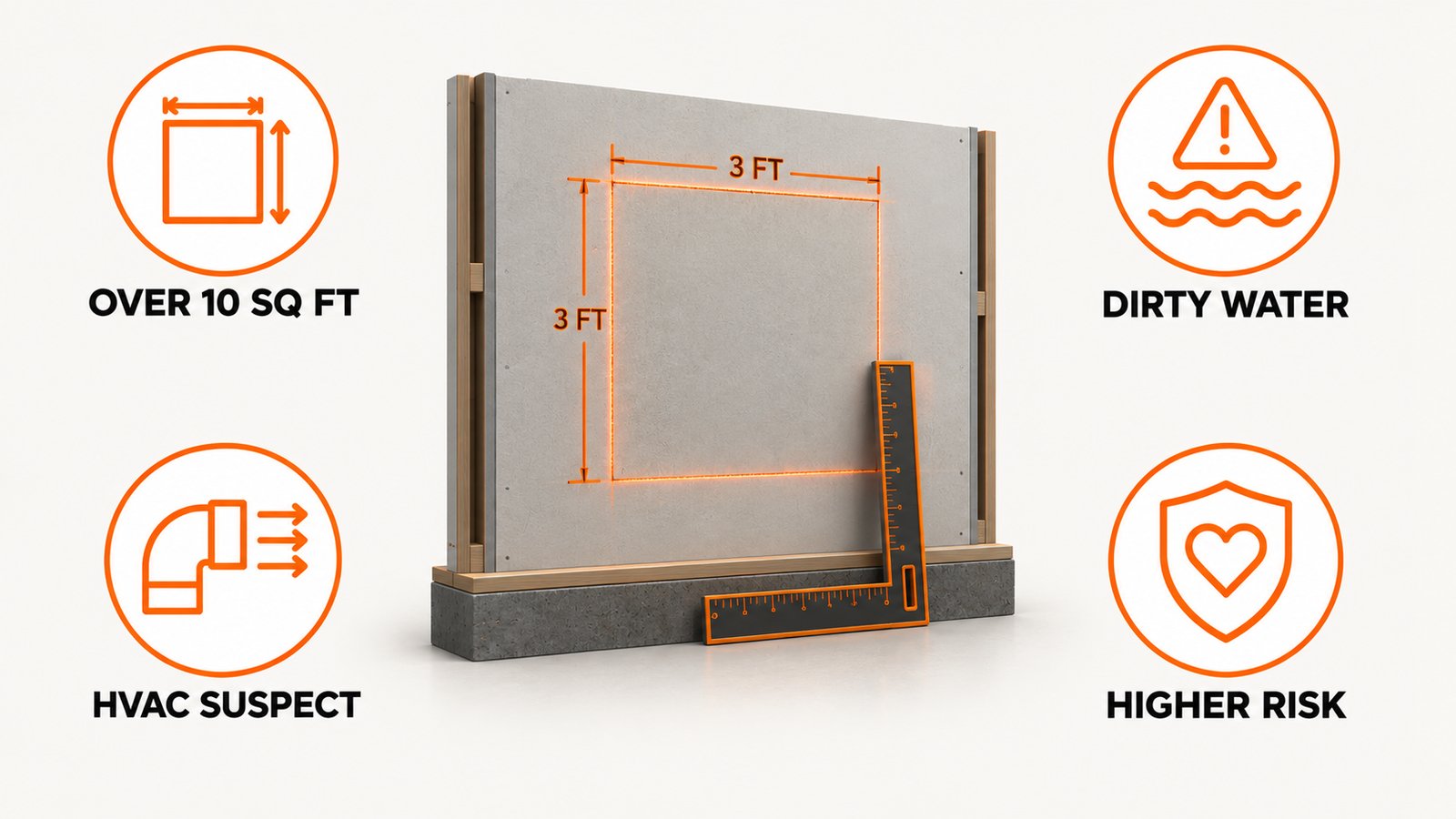
Skip the kit entirely and hire someone when any of these are true:
- More than about 10 square feet of growth. The EPA's threshold for handing off a cleanup, roughly a 3-foot by 3-foot patch. Above that, its guidance points to the professional remediation document rather than a DIY method.
- Contaminated water was involved. If sewage or other contaminated water caused the damage, the EPA says to call in a professional who has experience cleaning and fixing buildings damaged by contaminated water. That is a health call, not a preference.
- You suspect the HVAC system. The EPA advises consulting its duct-cleaning guide before acting, and specifically warns not to run the HVAC system if you know or suspect it is contaminated, because that can spread mold throughout the building.
- Anyone in the home is at higher risk. The CDC notes that people with asthma or who are allergic to mold may have severe reactions, and that immune-compromised people and people with chronic lung disease may get infections in their lungs from mold. The EPA advises consulting a health professional before starting cleanup if you have health concerns.
Look for a contractor who follows the ANSI/IICRC S520 standard for professional mold remediation, and check whether your state licenses this work. In a licensed state, verifying the license takes two minutes and rules out the worst operators immediately.
When you do hire, the sequence that protects you is the same one New York wrote into law: an independent assessment, a written scope, remediation by a different party, then a post-remediation check. Our mold remediation guide walks through what each stage should include, and how to get rid of mold covers everything you can safely handle yourself before it gets to that point.
Frequently asked questions
Do I need a mold test for my home if I can already see mold?
In most cases, no. The EPA states that in most cases, if visible mold growth is present, sampling is unnecessary. If you can see it, the finding is already made, and the useful next step is finding the water that is feeding it and cleaning the material. Testing does not change that plan and it does not make the cleanup easier.
Is a $10 home mold test kit worth buying?
Rarely. A hardware-store settling plate proves that airborne spores exist in your home, which is true of every indoor space. It has no outdoor control to compare against, the agar favors fast-growing species, and there is no published threshold that turns a colony count into a verdict. Spend the money on a humidity meter instead, which the EPA prices at $10 to $50 and which tells you something you can act on.
What is the most accurate mold test for home use?
There is no single accurate answer, because the methods measure different things and none of them is scored against a federal standard. The EPA states that no EPA or other federal limits have been set for mold or mold spores, so no result can be checked for compliance. A professional inspection with moisture readings is the most useful, because it finds the water source. Surface sampling is the most defensible for checking whether an area was adequately cleaned.
How much does a mold test for a home cost?
Checked on September 2, 2026, a Mold Armor DIY settling-plate kit lists at $9.98, a GOT MOLD one-room air kit with lab fees included lists at $199.00, and EnviroBiomics publishes a range of $240 to $435 for an ERMI dust analysis. A professional inspection varies by market and scope. Lab fees on mail-in kits are charged per sample and are often separate from the kit price.
How long does a home mold test take to give results?
A settling plate shows visible colonies in roughly two to five days. Mail-in swab, tape-lift and air-cassette kits depend on shipping plus the laboratory's turnaround, so plan on days rather than hours. ERMI dust analysis runs on the laboratory's schedule and labs sell faster turnaround as a paid option. A professional inspection gives you the moisture findings during the visit.
Should I get an ERMI test for my house?
Only with clear expectations. The EPA developed the Environmental Relative Moldiness Index and describes it as a research tool for estimating mold contamination that has been peer reviewed for research purposes but has not been validated for non-research purposes. A score is a reason to inspect the building more carefully. It does not decide whether a home is safe to occupy, and no index score decides that.
Do I need to know what type of mold it is before cleaning it?
No. The CDC states that you do not need to know the type of mold, and New York State's health department adds that knowing the kinds of mold present does not change the advice. The response to visible growth is the same either way: fix the moisture, clean or discard the material, and dry the area completely.
Can a mold test tell me if mold is making me sick?
No. A building test measures a building, not a person. New York State's health department advises discussing health concerns with your doctor, because the symptoms of mold exposure could be caused by other exposures and illnesses. Use testing to make decisions about the property, and take health questions to a licensed physician.
Sources
Every claim on this page traces to one of these. Links open the primary document.