When You Need Professional Mold Testing
Visible moisture or growth does not always require laboratory sampling. A qualified professional should first define the building question and explain how a proposed sample will answer it.
1. Persistent odor or unexplained moisture indicators. A musty odor can have more than one cause. Inspection and moisture measurements may identify areas that need further investigation, but no camera or air sample can inspect every concealed cavity.
2. Someone in the household has symptoms. Building tests cannot confirm or rule out mold as the cause of symptoms. Consult a licensed physician for medical evaluation and assess the building separately with a qualified professional.
3. A landlord, insurer, or other party requests documentation. Requirements and evidentiary value vary by jurisdiction and contract. Ask the relevant authority or licensed adviser what documentation is required before ordering samples.
4. A real-estate transaction involves known moisture damage. Use qualified local professionals and a written scope appropriate to the transaction. No single sample can establish the condition of an entire property.
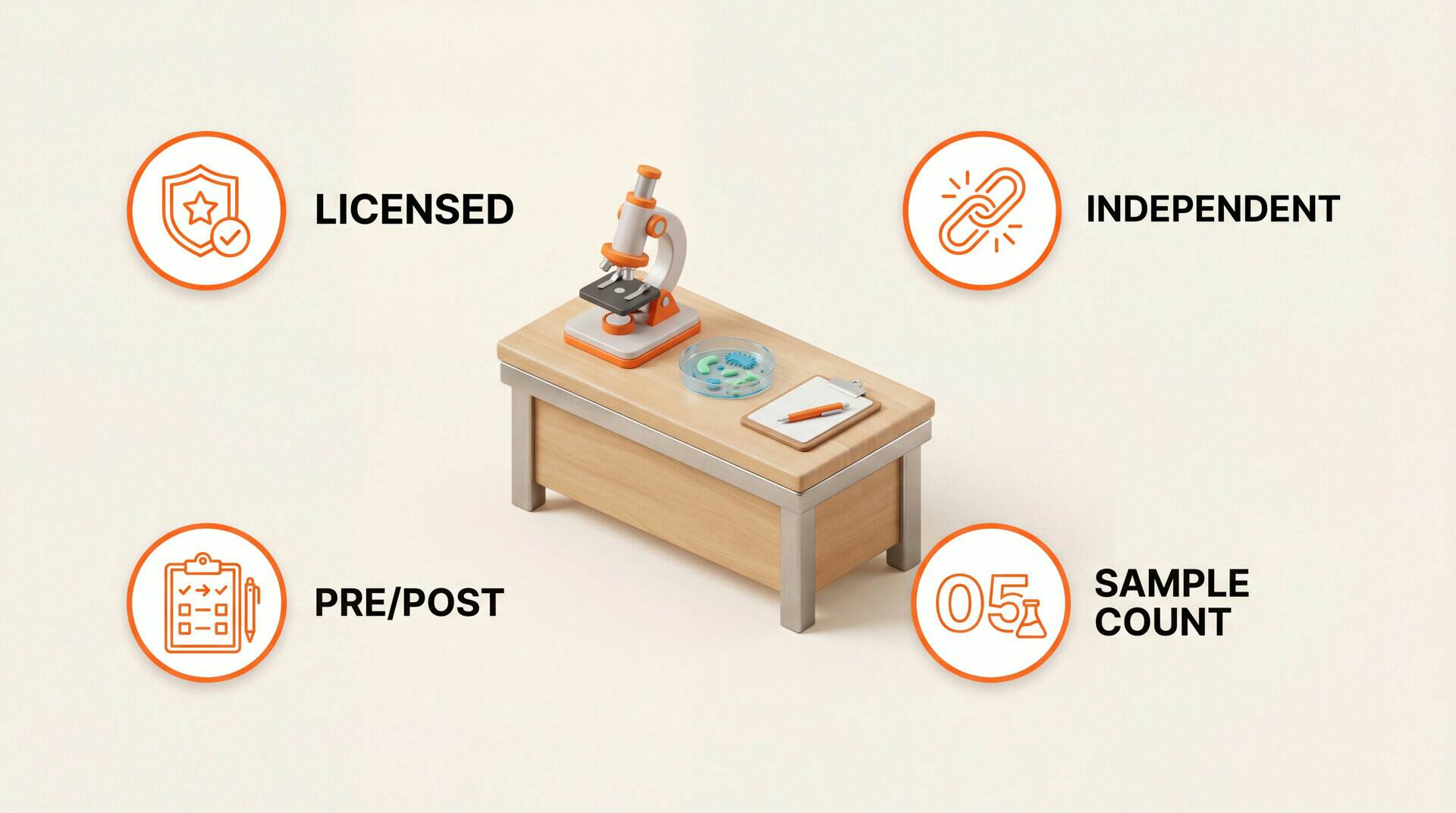
5. Post-remediation verification. Inspection, moisture criteria, and selected samples may contribute to verification when they are defined in advance. A result is not a universal guarantee of safety or future conditions.
Types of Professional Mold Tests
Air Sampling
A calibrated pump can draw a known volume of air through a collection device for laboratory analysis. The report may classify particle or spore types and estimate concentrations, depending on the method.
The number and location of samples should follow a defined sampling plan. Costs and turnaround times vary by provider and laboratory.
Limitation: Air sampling is a snapshot. Spore counts change throughout the day based on air movement, humidity, and whether anyone disturbed the mold. A single air test can miss mold that is not actively releasing spores at that moment.
Surface Sampling (Swab or Tape Lift)
An inspector may collect material from a specific visible spot with a swab or tape lift. Laboratory identification may be limited to a genus, spore type, or other category depending on the sample and method. A result from one spot does not describe the entire building.
Limit: A surface result does not establish a person's exposure, diagnose illness, or rank the building's health risk.
ERMI Dust Analysis
ERMI (Environmental Relative Moldiness Index) is a research index calculated from DNA measurements of selected molds in settled dust. Collection area, dust history, cleaning, and laboratory methods affect the result.
ERMI is not a universal pass-or-fail home test, a health diagnosis, or a safety and re-entry threshold. A qualified professional should explain whether settled-dust analysis fits the building question.
Specialty Dust Analysis
Some specialty laboratories offer analysis of selected compounds in dust. Results depend on collection and analytical methods and do not establish personal exposure, diagnose illness, identify a symptom's cause, or declare a building safe.
What Happens During a Professional Mold Inspection
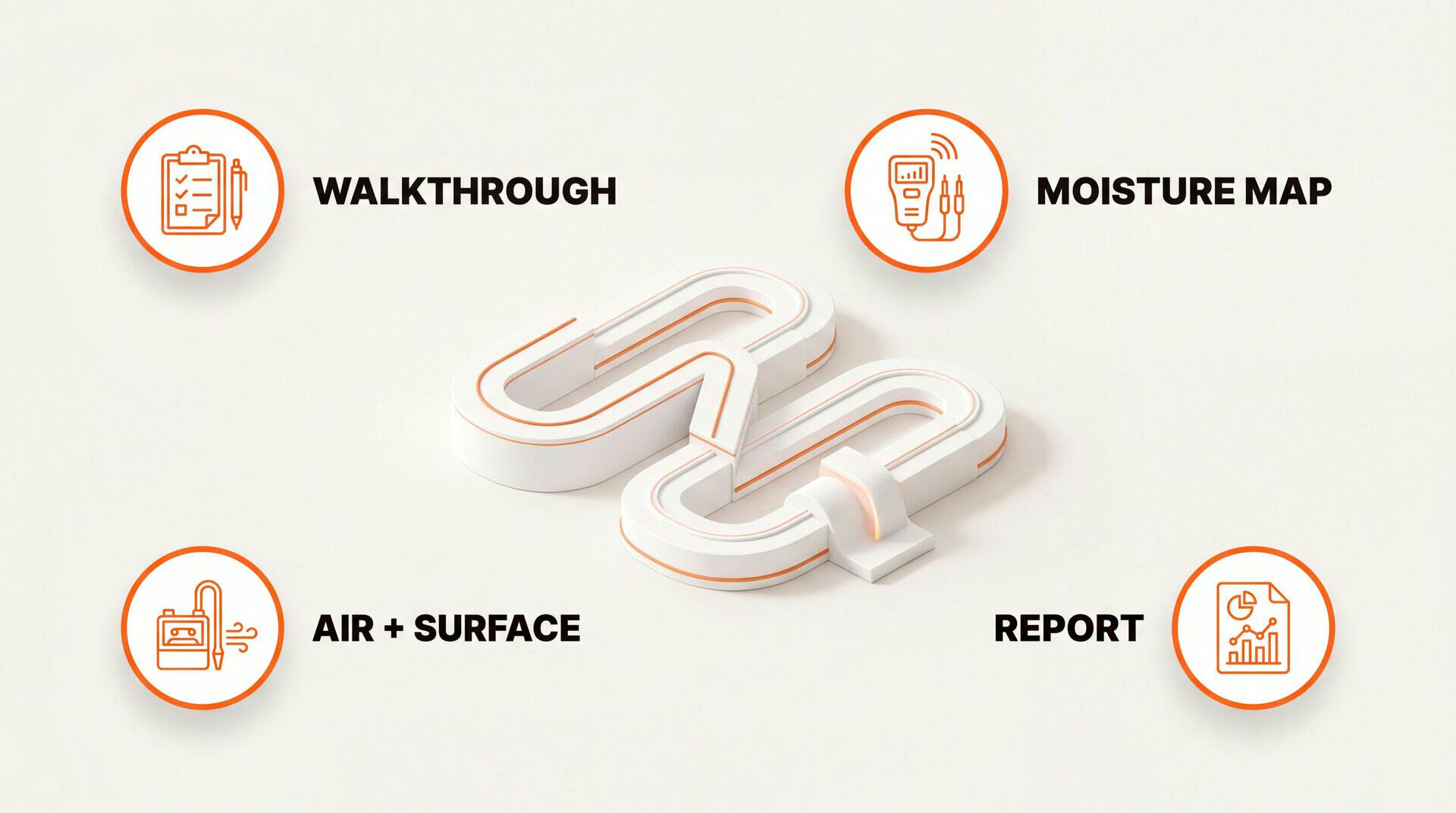
The exact process should follow the written scope. Ask what areas are accessible, what methods will be used, and which limitations will be documented.
Pre-inspection setup: Preparation depends on the sampling plan. Follow the provider's written instructions rather than a universal window, door, or HVAC rule.
Visual inspection: The inspector reviews accessible areas for moisture indicators, water-damaged materials, visible growth, and relevant building history.
Moisture evaluation: Moisture meters and thermal imaging can guide follow-up. Neither instrument directly detects mold, and readings require material-specific interpretation.
Sample collection: Air, surface, or dust samples should be collected only when tied to a defined question and suitable method.
Report delivery: A useful report separates observations, measurements, laboratory findings, interpretation, and limitations. It should not claim to diagnose health effects or guarantee safety.
How to Read Mold Test Results
Laboratory numbers require the sampling plan, building context, analytical method, and stated limitations.
Air sample results describe particles collected during a specific sampling period. Indoor and outdoor comparisons can provide context, but they are not a universal pass-or-fail rule.
Names and counts do not establish health risk. A genus, spore type, or concentration cannot by itself determine toxicity, personal exposure, or the cause of symptoms.
ERMI and HERTSMI-2 are indices, not medical or safety thresholds. Do not use a score to diagnose illness, confirm symptom causation, or declare re-entry safe. Have a qualified building professional interpret building data and a licensed physician evaluate symptoms.
Professional vs DIY Mold Testing
DIY mold test kits cost $10 to $50 at hardware stores. They use petri dishes or cassettes that you mail to a lab. They have serious limitations.
Settle plate tests show that biological material can grow under the test conditions. They do not quantify a building, inspect hidden areas, or determine whether a home is safe.
DIY cassette tests vary in pump calibration, sampling instructions, and laboratory interpretation. Read the stated limits before purchasing.
Professional advantages: A qualified professional can connect building history, moisture evaluation, access limits, sampling design, and interpretation. Credentials and scope still matter.
When a sample adds value: Sample only when the result will answer a defined building question or satisfy a stated requirement. A laboratory result cannot attribute symptoms to mold or replace a building assessment.
How to Choose a Mold Inspector
Not all mold inspectors are equal. Use these criteria to find a good one.
Certification: Look for ACAC accreditation (CMI or CIEC), a state license where required, or IICRC certification for remediation. These require training, testing, and continuing education. Avoid inspectors with no verifiable credentials.
Independence: Ask whether the inspector also sells remediation and how conflicts of interest are handled. Requirements and common practices vary by jurisdiction.
Laboratory: Ask which laboratory and analytical method will be used, whether the lab holds relevant accreditation, and what the result can and cannot establish.
Insurance: The inspector should carry errors and omissions (E&O) insurance. This protects you if they miss something or make a mistake in their report.
Report quality: Ask for a sample report before hiring. Look for photos, moisture readings, sample locations, methods, laboratory results, interpretation, and explicit limitations.
Frequently asked questions
How much does professional mold testing cost?
Cost varies by location, building size, access, inspection scope, number of samples, laboratory method, and reporting. Obtain a current written quote that separates inspection, sampling, laboratory, and follow-up fees.
Is professional mold testing worth it?
Sampling may be useful when a qualified building professional has a defined question that a sample can answer. It cannot determine whether symptoms were caused by mold, declare a home safe, or replace legal or medical advice.
What is the difference between mold inspection and mold testing?
An inspection evaluates building history, accessible conditions, moisture indicators, and visible materials. Testing collects air, surface, or dust samples for laboratory analysis. Sampling is one tool within an assessment and should be tied to a defined question.
How long does professional mold testing take?
Inspection time and laboratory turnaround vary with building size, access, sample count, analytical method, and provider. Ask for the expected schedule in writing before the appointment.
Can I stay in my home during mold testing?
That depends on the building condition and sampling method. Some methods are minimally disruptive, while opening or handling damaged materials can disturb debris. Follow the qualified professional's preparation and occupancy instructions for the specific scope.
Sources
Every claim on this page traces to one of these. Links open the primary document.