Mold Test Cost Summary
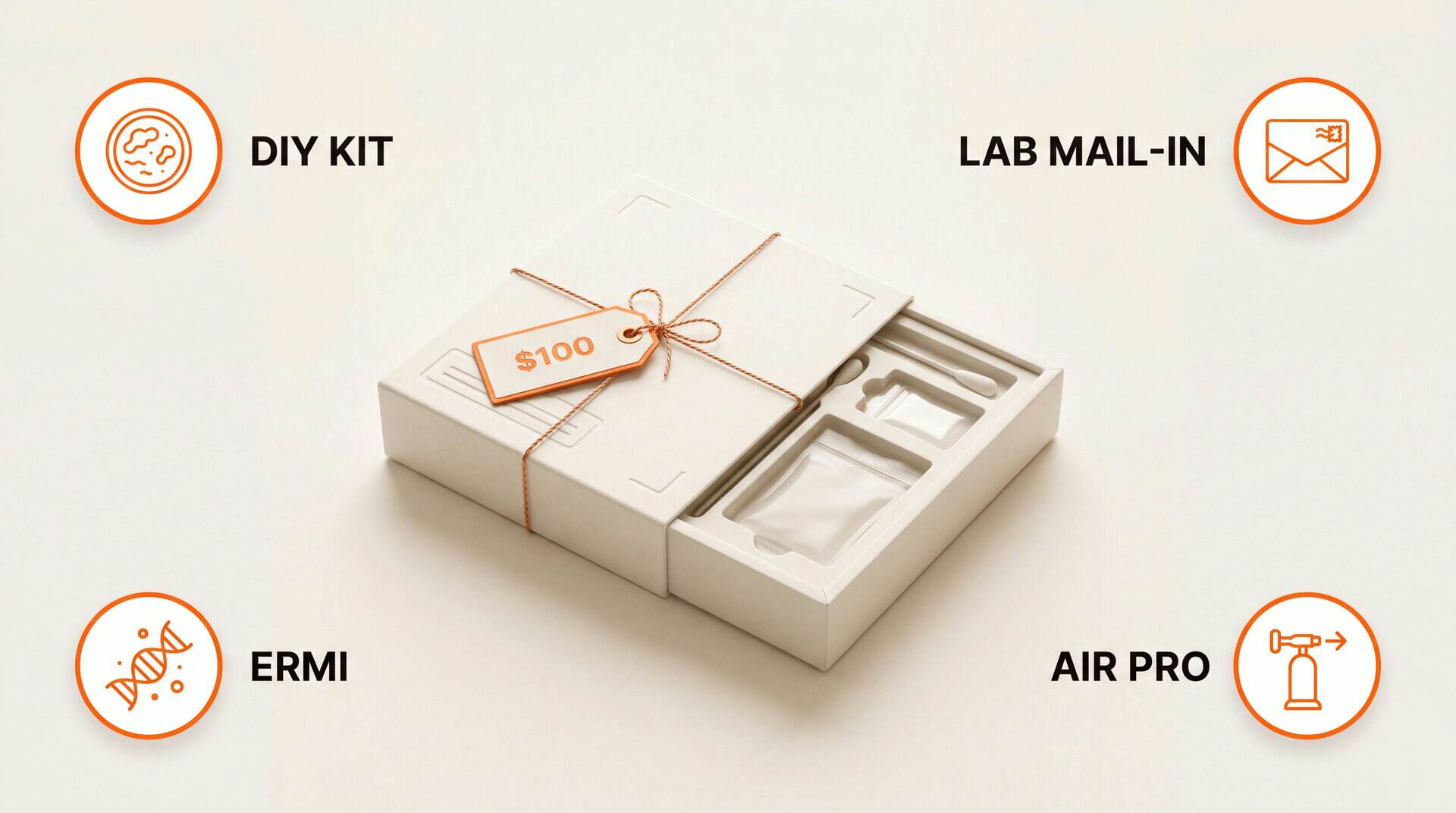
Common cost categories include:
- Direct moisture investigation: time on site, instruments, access, and written findings.
- Laboratory sampling: collection supplies, controls, shipping, analysis, and interpretation.
- Post-remediation verification: an agreed scope, visual and moisture checks, reporting, and any justified samples.
- High-stakes work: property transactions, disputes, insurance, or litigation may require more documentation and qualified specialists.
- Visual organization: Mold Scanner AI is a paid pre-launch app with 3 free scans. It can organize visible-surface photos, but it is not a mold test or inspection.
Prices and included services change. Compare written scopes rather than headline package names.
DIY Mold Test Costs
Settle plates
A plate grows organisms that land on it and can grow under the culture conditions. A positive plate is expected in many environments, while a negative plate does not establish clean air. It does not represent a whole home or measure health risk.
Surface samples
A laboratory may characterize material collected from one visible spot. The result does not establish the extent, source, exposure, or health significance. Avoid disturbing material solely to collect a consumer sample.
DIY air cassettes
Air samples capture material during a defined window. Pump calibration, flow, duration, outdoor conditions, ventilation, location, and controls affect interpretation. NIOSH notes that short-term samples may not represent actual exposure.
ERMI-style dust collection
DNA analysis can measure targeted molds in the collected dust, but EPA describes ERMI as a research tool and does not recommend it for routine public use. An index is not a health-based safety threshold or whole-home clearance.
Professional Mold Test Costs
Inspection without routine sampling
A qualified investigator may be able to answer the moisture question through history, direct observation, measurements, and accessible material assessment. Sampling is not automatically required.
Inspection with targeted sampling
When a sample is justified, the quote should identify the question, locations, controls, laboratory, analytical method, and interpretation. More samples are not automatically better.
High-stakes investigation
Real-estate, insurance, legal, or complex remediation decisions may require a defensible scope, qualified specialists, chain-of-custody documentation, and detailed reporting. Ask for current credentials and applicable licenses.
Post-remediation verification
Verification should follow the project scope and check source correction, dryness, cleanliness, and agreed acceptance criteria. Sampling may be included when it answers a defined question. Independence from the remediation contractor can reduce conflicts of interest.
Do not use a body test as a building test
CDC has warned about unvalidated urine mycotoxin tests used to diagnose illness. A genetic result, urine panel, antibody panel, visual-contrast screen, or unvalidated biomarker panel does not prove that a building caused symptoms or tell you where growth is located.
Discuss symptoms and any proposed clinical test with a qualified clinician. Investigate leaks and damp materials in the building as a separate question. Do not let a home-testing quote bundle medical conclusions into an environmental scope.
What Drives the Price Up or Down
Building size and complexity. More areas, systems, access constraints, and moisture events can require more investigation time.
Number and type of samples. Each justified sample adds collection, control, shipping, laboratory, and interpretation costs.
Reporting objective. A basic moisture investigation, post-remediation verification, property transaction, and legal dispute require different documentation.
Location and turnaround. Labor, travel, laboratories, and expedited service vary by market. Confirm current terms in writing.
Qualifications. Verify applicable state licensing, relevant training, insurance, laboratory accreditation, and the limits of any credential. A title alone does not guarantee a correct scope.
Is Mold Testing Worth the Money?
Sampling may be useful when:
- A defined question cannot be answered through direct observation.
- A qualified professional explains how the result will change the scope or decision.
- A post-remediation plan includes justified sampling and clear acceptance criteria.
- A property, insurance, or legal decision requires defensible documentation.
Sampling may add little when:
- Visible growth and the moisture source are already clear and the cleanup decision does not require identification.
- The proposed test has no defined question or decision rule.
- You expect a sample, app, or environmental score to diagnose symptoms or prove safe occupancy.
Frequently asked questions
How much does professional mold testing cost?
There is no reliable national flat price. Cost varies with location, building size, inspection scope, sample count, laboratory fees, reporting, and whether post-remediation verification is included. Get a current itemized quote tied to a written scope.
Are cheap mold test kits worth it?
Only when the kit answers a defined question and its limits are acceptable. A culture plate, air sample, dust sample, or surface sample describes what was collected under specific conditions. A low price does not make a result representative of a whole home.
Does insurance cover mold testing?
Coverage depends on the policy, cause of loss, exclusions, notice requirements, and local law. Ask the insurer for a written coverage decision before assuming that testing or remediation will be reimbursed.
How often should you test for mold?
CDC and EPA generally emphasize finding and correcting moisture rather than routine sampling. Test only when a defined question cannot be answered by direct observation and the result will change a decision. Post-remediation verification should follow the project scope, not an arbitrary calendar.
What is the lowest-cost first step?
Start with a direct check for leaks, damp materials, condensation, and visible damage. If sampling is still needed, define the question before choosing a method. Mold Scanner AI can organize photos of visible surfaces, but it cannot inspect hidden areas, identify species, or decide that testing is unnecessary.
Sources
Every claim on this page traces to one of these. Links open the primary document.