What mold in lungs actually refers to
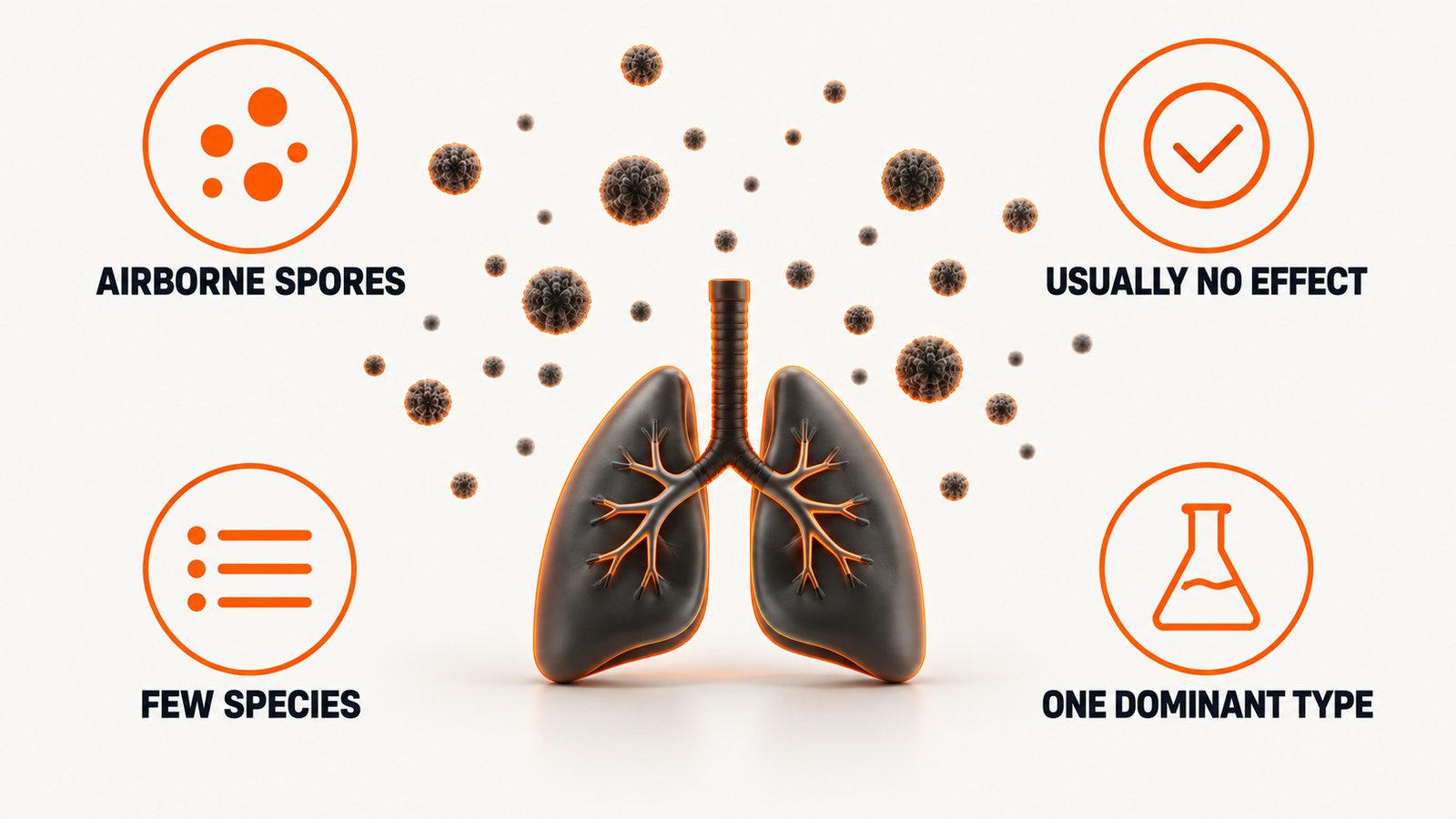
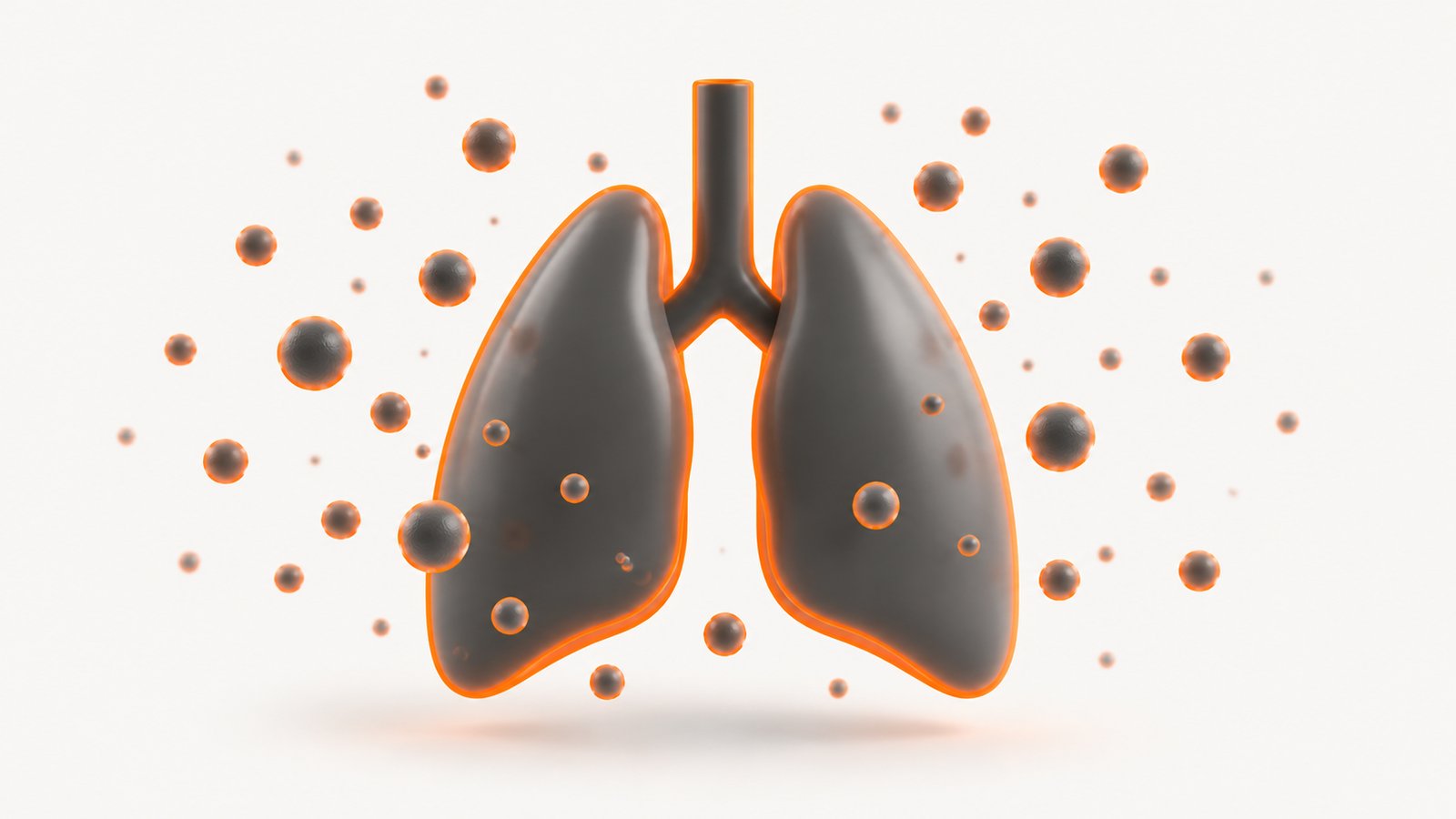
The phrase covers several different things that get collapsed into one. Before separating them, the base rate is worth stating, because it changes how everything else reads. CDC's position is plain: most people breathe in Aspergillus spores every day without getting sick, and it may not be possible to completely avoid breathing in some Aspergillus spores.
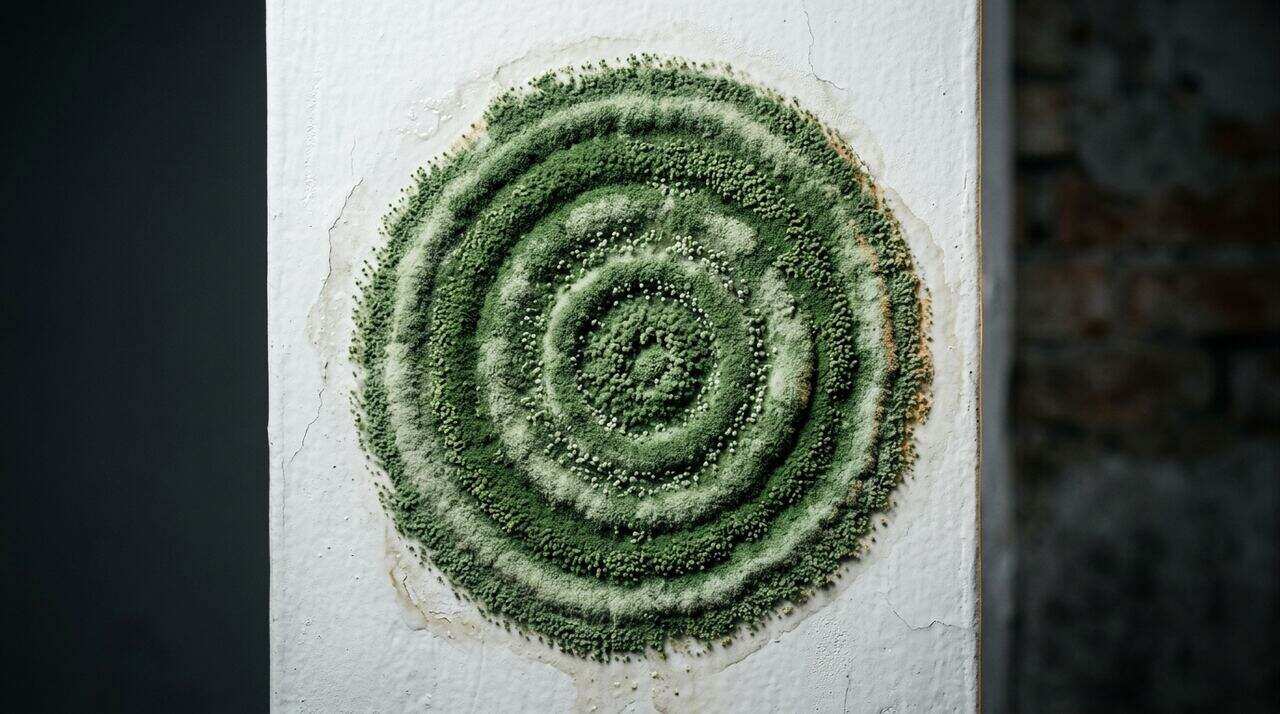
Fungal spores are a normal component of air. EPA states that mold spores are invisible to the naked eye and float through outdoor and indoor air, and that it is impossible to eliminate all mold and mold spores in the indoor environment. A spore count above zero is the ordinary condition of a building, not a finding.
Of the fungi that exist, only a small subset is involved. CDC notes there are approximately 180 species of Aspergillus, with fewer than 40 known to cause infections in humans, and names Aspergillus fumigatus as the most common cause of human Aspergillus infections. The genus itself is profiled on the Aspergillus page.
People searching this phrase are usually asking one of three questions. Is there an infection, meaning a fungus growing in lung tissue? Is there an allergic or immune reaction to inhaled material, a different mechanism entirely? Or is this general irritation from a damp indoor space, the most common situation and the one covered on mold exposure symptoms. Those three have different mechanisms, different risk groups, and different answers.
The named conditions public-health agencies describe
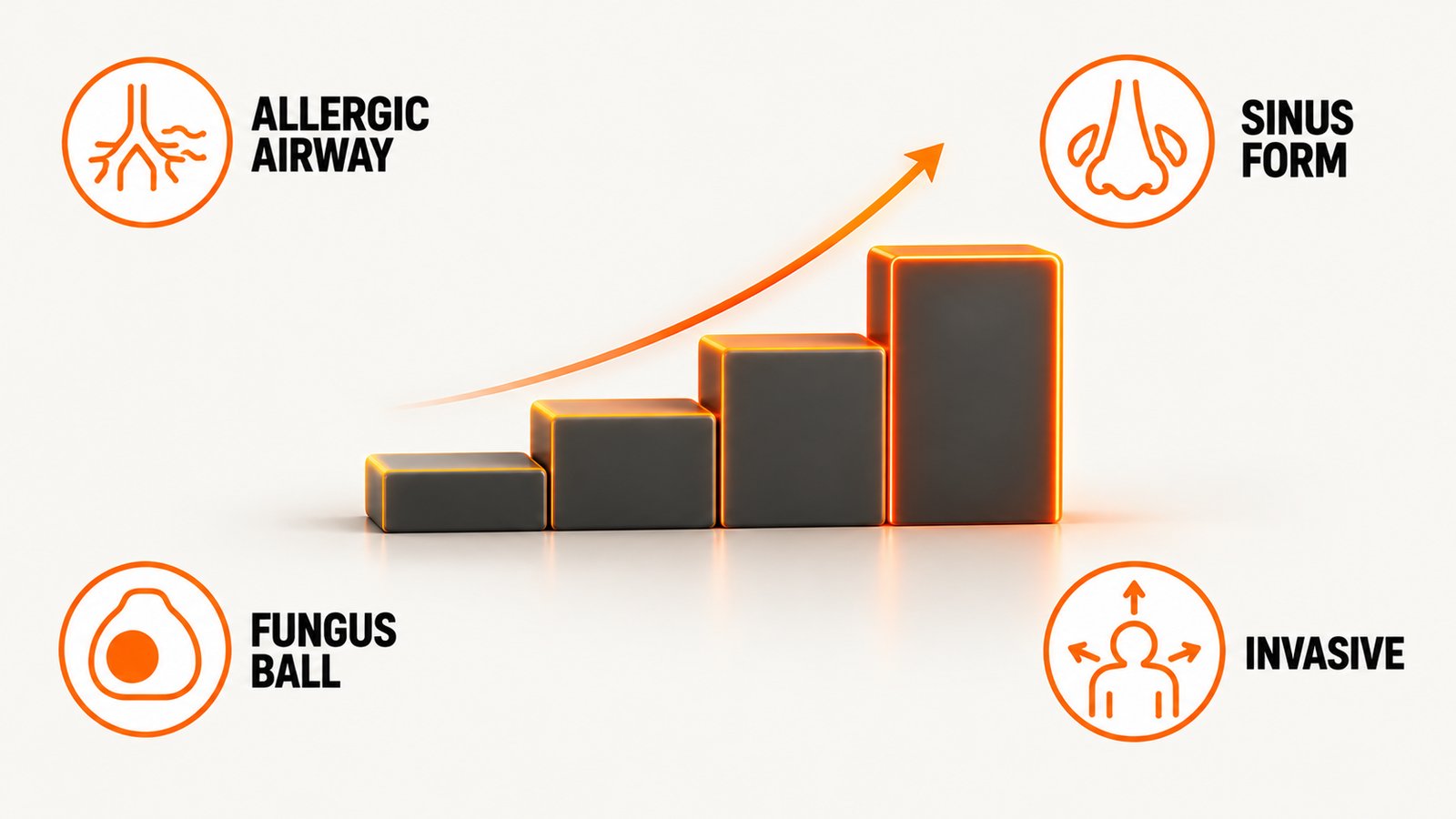
CDC names several distinct forms of aspergillosis and describes each one separately. What follows is a plain summary of what CDC publishes. It is not a diagnostic tool, and no reader should match themselves to a row of it.
| Form CDC names | What CDC describes |
|---|---|
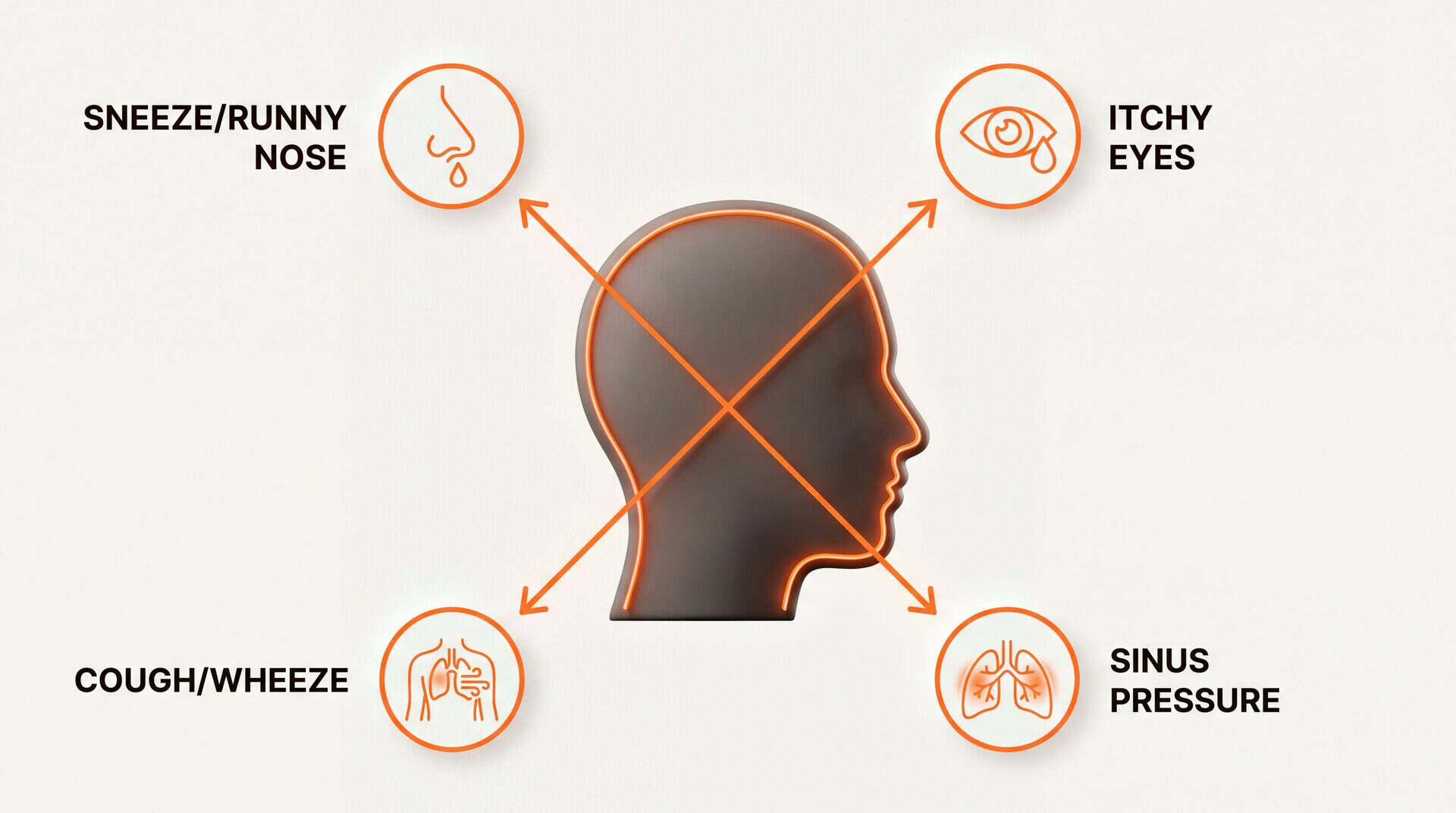
| Allergic bronchopulmonary aspergillosis | An allergic reaction in the airways. CDC lists wheezing, shortness of breath, cough, and in rare cases fever. |
| Allergic Aspergillus sinusitis | An allergic reaction in the sinuses rather than the lungs. CDC lists stuffiness, runny nose, headache, and reduced ability to smell. |
| Aspergilloma, a fungus ball | A mass that can form in an existing cavity. CDC lists cough, coughing up blood, and shortness of breath. |
| Chronic pulmonary aspergillosis | A long-running form. CDC lists weight loss, cough, coughing up blood, fatigue, and shortness of breath. |
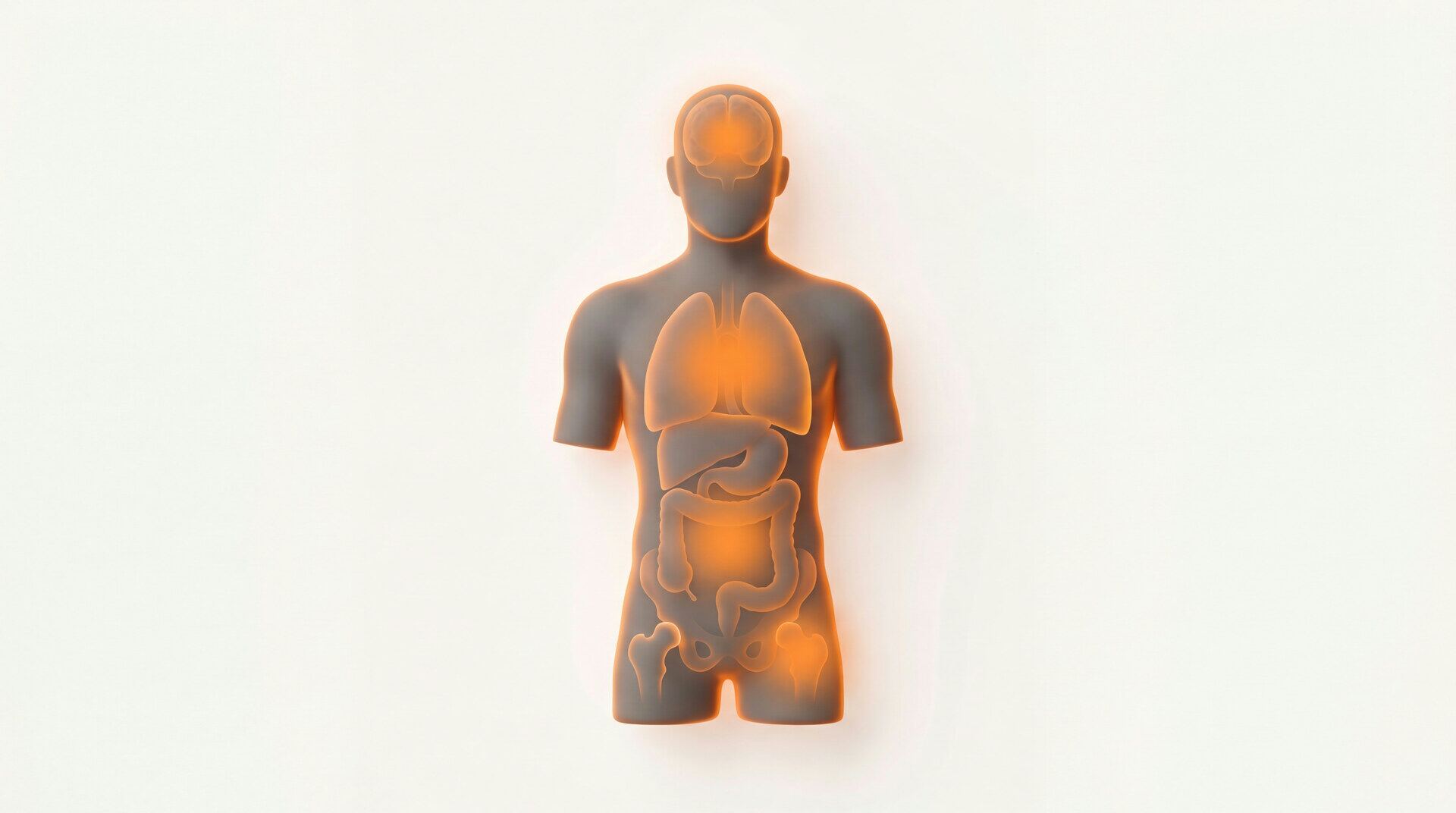
| Invasive aspergillosis | CDC calls this the most severe form, occurring when the infection spreads from the lungs to other parts of the body. |
Two things are worth pulling out of that table. The first two entries are allergic reactions rather than infections, a different mechanism from the last three. And the severe forms are described in the context of people who already have a serious underlying condition.
CDC's guidance on what to do with any of this is one sentence: contact your healthcare provider if you have symptoms that you think are related to any form of aspergillosis. No website, photograph, or home test kit substitutes for that.
Hypersensitivity pneumonitis is a different mechanism
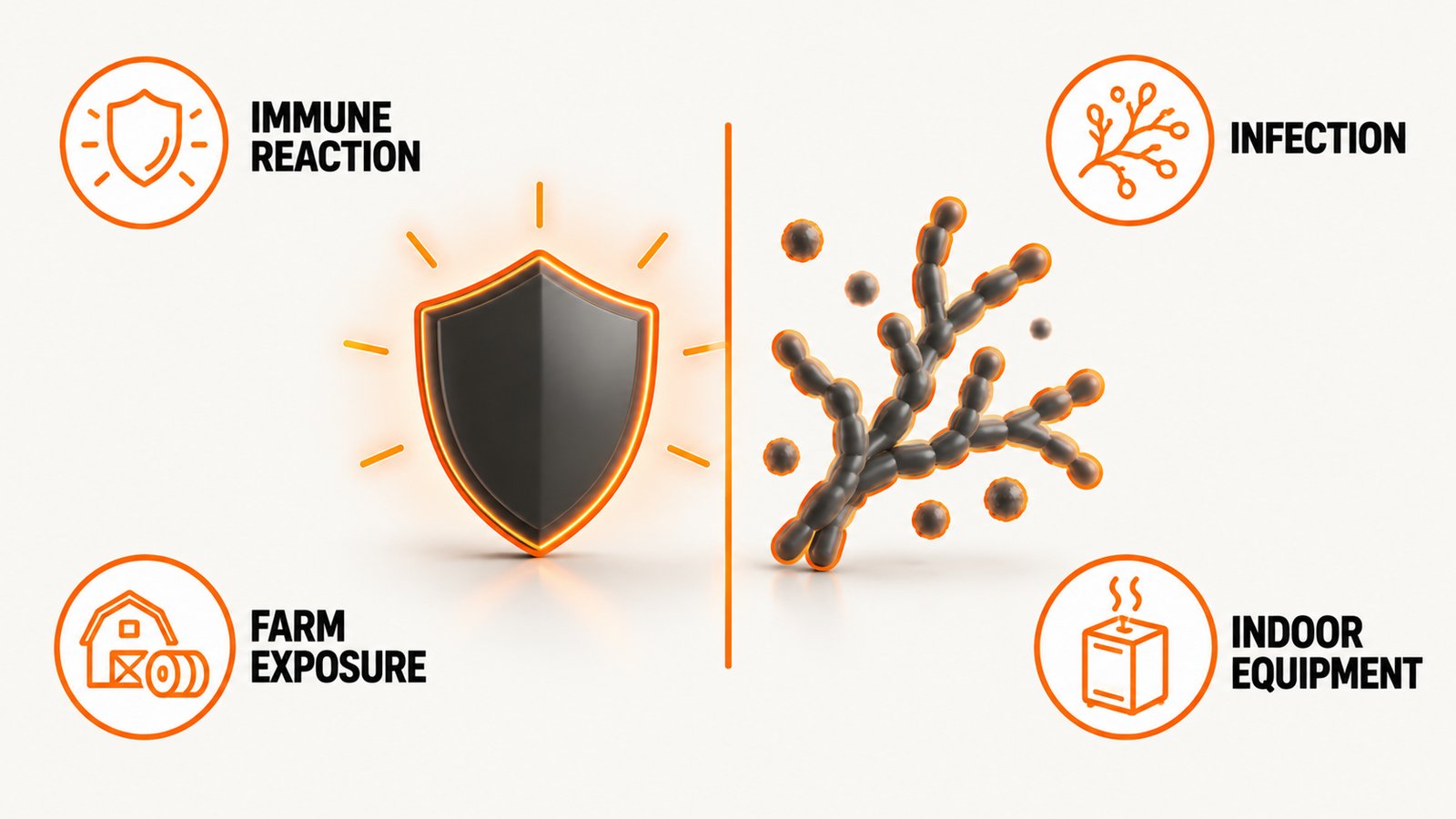
The other condition that comes up in this search is hypersensitivity pneumonitis, and it works differently from an infection. The National Heart, Lung, and Blood Institute describes it as happening in some people after they breathe in certain substances in the environment, such as mold or the skin cells shed by animals with fur, with those substances triggering the immune system and causing inflammation. Nothing is colonizing tissue. The reaction is to the material itself.
It carries several informal names depending on the exposure: NHLBI lists bird fancier's lung, extrinsic allergic alveolitis, farmer's lung, hot tub lung, and humidifier lung as names for the same disorder. Those names point at where the exposures are found, and NHLBI names air conditioners, humidifiers, and ventilation systems among the sources, alongside bird droppings and agricultural settings.
NHLBI also notes that symptoms can develop quickly or slowly and worsen over months or years, and that without treatment it can cause permanent damage to the lungs. Risk is higher with more exposure, which NHLBI illustrates with farmers, people who breed animals or birds, woodworkers, and wine makers.
The practical relevance for a home is the equipment list. A humidifier tank, a window air conditioner pan, and a duct system all hold standing water inside something that then moves air into a room. They are worth keeping clean regardless of anybody's health, and the maintenance is on mold in a humidifier, mold in a window air conditioner, and mold in air ducts.
Who federal guidance says is most at risk
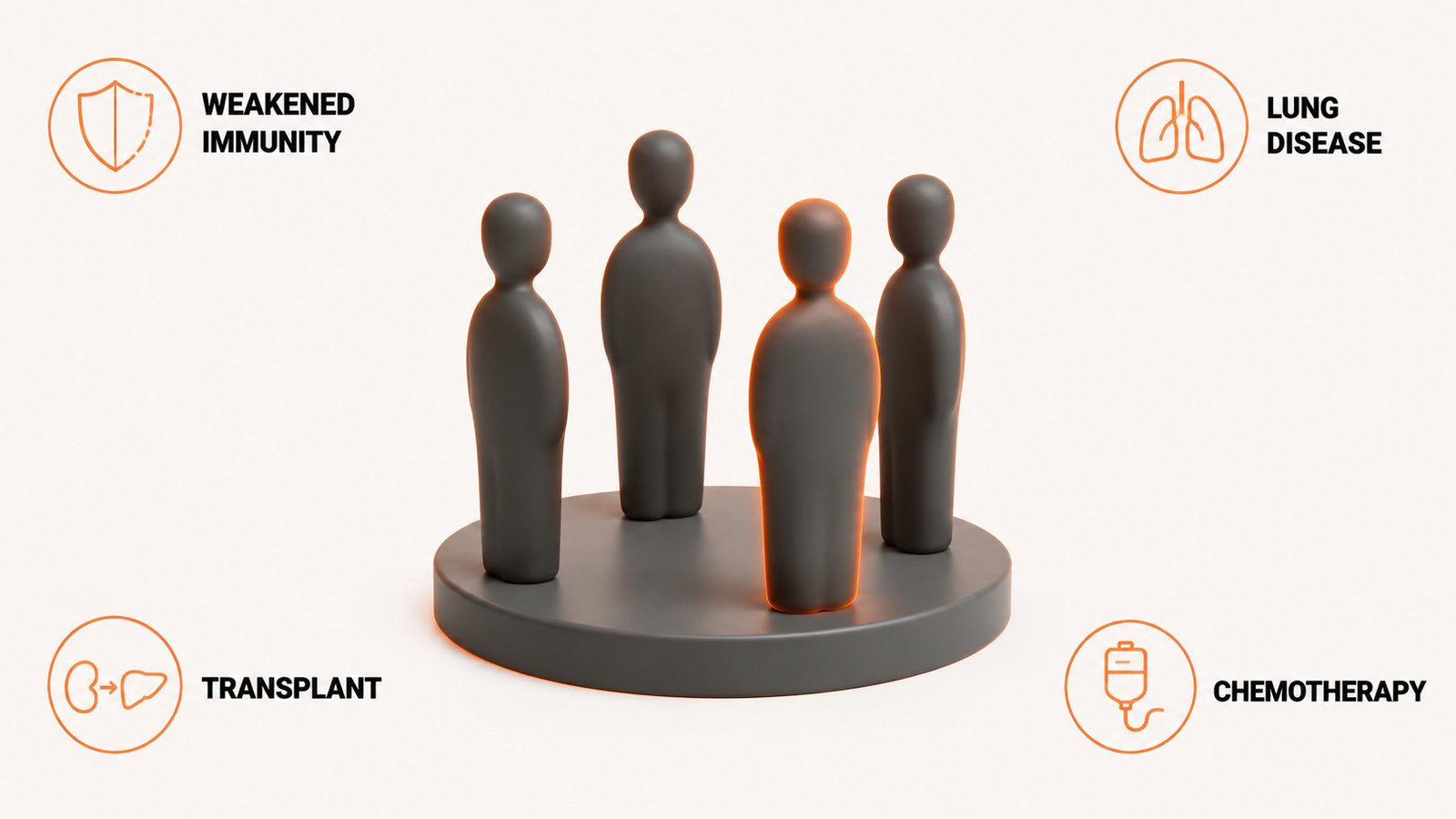
This is the part that most changes how a reader should weigh everything above. CDC states that people with weakened immune systems or lung diseases are most at risk, and specifically includes people who recently had organ or stem cell transplants.
CDC's general mold guidance lines up with that: people with asthma or who are allergic to mold may have severe reactions, and immune-compromised people and people with chronic lung disease may get infections in their lungs from mold. The infection risk is named for those two groups, not for the general population.
For everyone else the base rate from the first section is the honest framing. A damp room in an otherwise healthy household is a building problem to fix, and the evidence for what damp buildings are associated with, respiratory irritation and worse asthma control rather than infection, is summarized on is mold dangerous and what the toxic mold evidence supports.
CDC does publish prevention advice, and it is aimed squarely at people with weakened immune systems. It suggests trying to avoid dusty areas like construction or excavation sites, wearing an N95 respirator if those areas cannot be avoided, avoiding activities involving close contact with soil or dust, wearing shoes, long pants, and long sleeves during outdoor activities, and cleaning skin injuries well with soap and water. CDC adds an honest caveat that although these actions are recommended, they have not been proven to prevent aspergillosis.
If you are in one of these groups, plan your exposure with the clinician managing your underlying condition, not with a contractor and not with a website.
What testing can and cannot answer
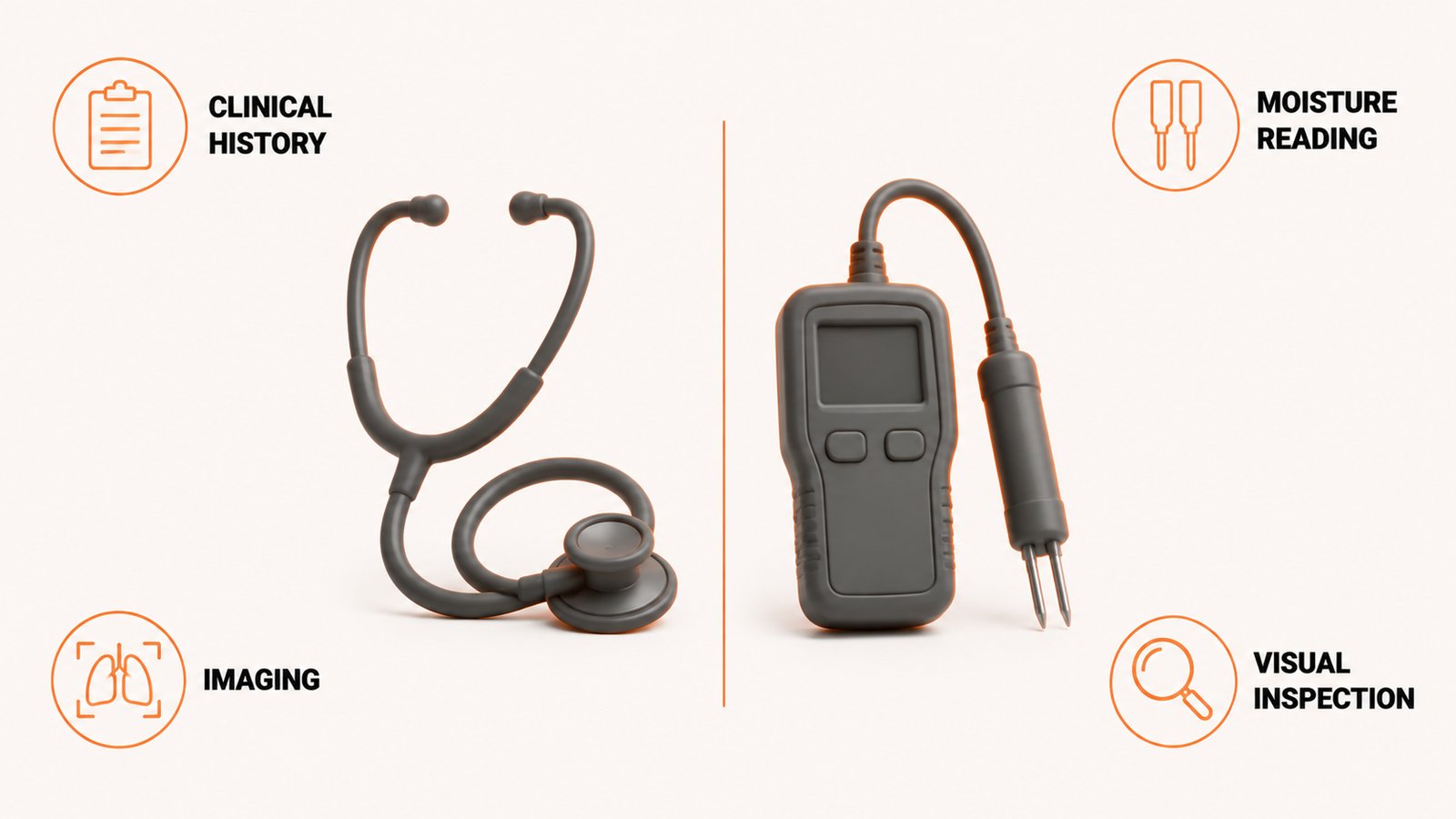
Clinical evaluation looks at the person. A licensed clinician can take a history, examine you, and order imaging or laboratory work when appropriate. That work is interpreted in the context of your medical history, and nothing on a website substitutes for it.
Building investigation looks at the structure. Visual inspection, moisture readings, and a sampling plan designed by a qualified professional describe conditions in a building. It cannot diagnose a person. There is also no federal exposure limit for indoor mold to compare a spore count against, so a laboratory number has no health threshold behind it.
Both federal agencies are direct about the limits of home testing. CDC states that it does not recommend mold testing and that you cannot rely on sampling and culturing to know whether someone might become sick, and that you do not need to know the type of mold. NIOSH states that it does not recommend routine air sampling for mold with building air quality evaluations, having found thorough visual inspections or detecting problems by musty odors more reliable.
Consumer kits sit at the bottom of the range. A settle plate grows whatever lands on it and returns a positive-looking result almost anywhere. Method tradeoffs are on how to test for mold, mold testing kits, and professional mold testing.
Mold Scanner AI sits in the building lane and only part of it. The app screens visible surfaces in submitted photos. It does not assess health, identify a species, or find anything behind a wall.
Reducing exposure in the building
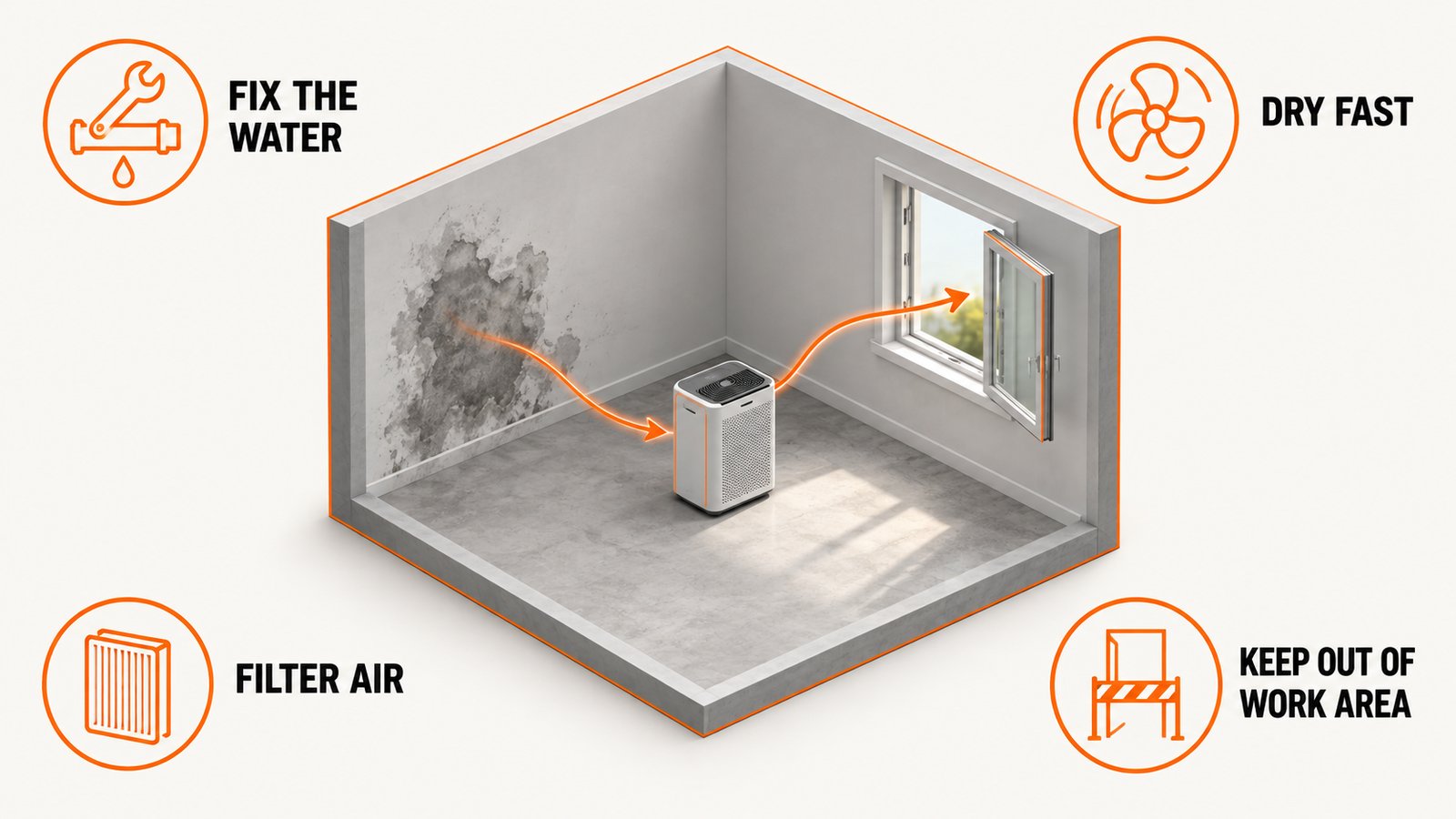
The building actions are the same regardless of which of the three questions brought you here, and they are the part a homeowner actually controls.
Fix the water first. EPA is explicit that the way to control indoor mold growth is to control moisture, and that no mold grows without water or moisture. It also advises drying water-damaged areas and items within 24 to 48 hours to prevent growth. Material dried inside that window usually stays in service.
Hold humidity in range. EPA advises keeping indoor relative humidity below 60 percent, ideally between 30 and 50 percent, measurable with an inexpensive humidity meter. The free humidity tool converts a reading into a straight answer, and a dehumidifier is the tool when a room sits above the range.
Remove growth rather than only killing it. EPA's instruction is to clean mold off hard surfaces with water and detergent and dry completely, and it notes that dead mold may still cause allergic reactions in some people, so it is not enough to simply kill the mold, it must also be removed.
Wear the gear. For homeowner cleanup CDC advises wearing an N95 respirator at a minimum, goggles, and protective gloves, and to ensure the cleanup is complete before reoccupying a home. EPA lists the same three items.
Filtration is a supplement, not a fix. A true HEPA filter is defined to remove at least 99.97 percent of airborne particles at 0.3 microns, the most penetrating particle size. It reduces what is circulating during a repair. It does not remove growth from a wall. Units are compared on best air purifiers for mold.
If someone in the household is in one of the higher-risk groups above, keep them out of the work area entirely while material is being disturbed, and out of it until the area is clean and dry.
When to see a professional
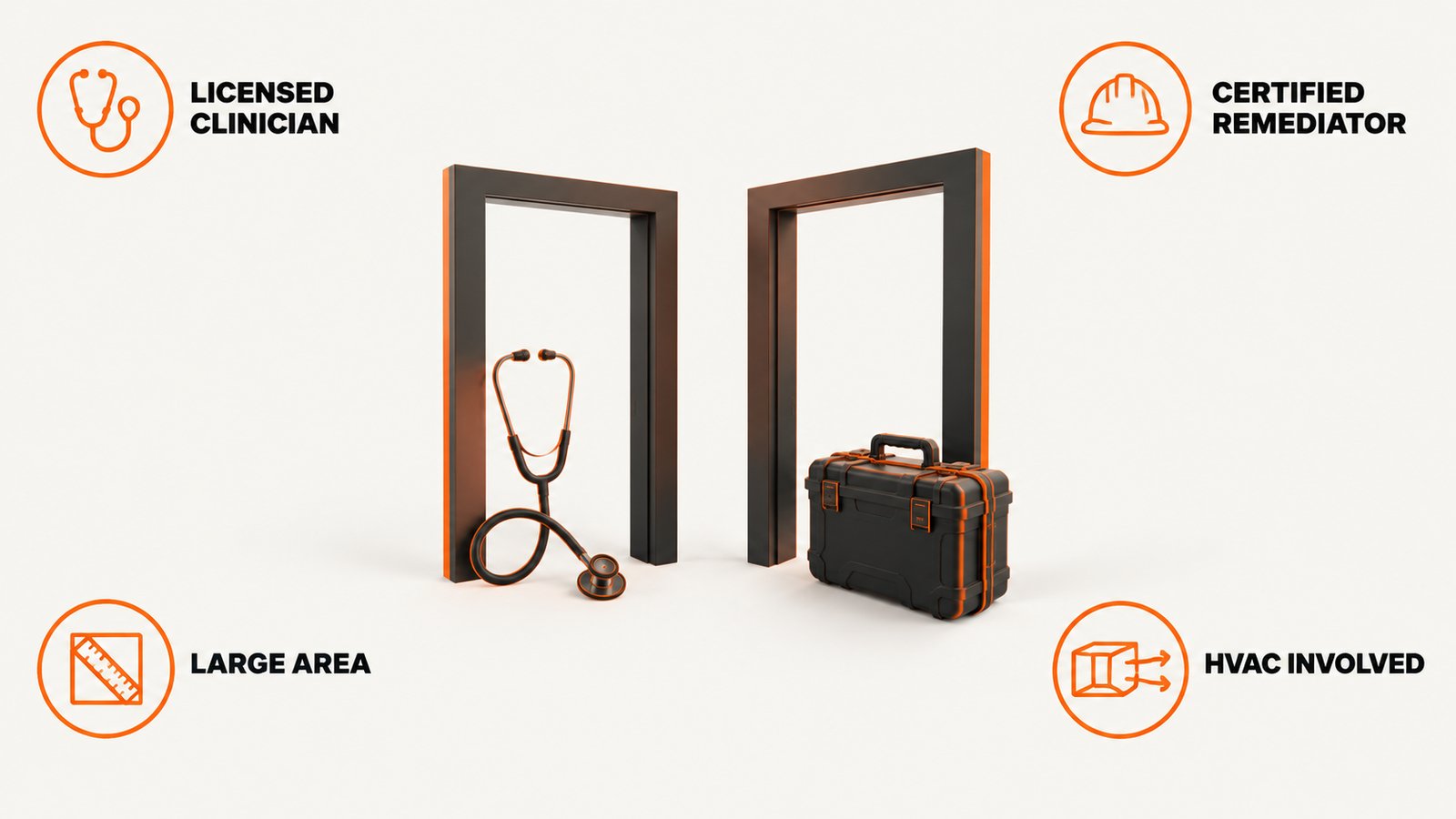
This question needs two different professionals, and they do not overlap.
The clinician. CDC's instruction is to contact your healthcare provider if you have symptoms that you think are related to any form of aspergillosis. Severe breathing difficulty is a medical emergency and needs urgent care. People with a suppressed immune system, a transplant history, chronic lung disease, or asthma should raise exposure questions with the clinician managing that condition. Nothing here should be used to rule anything in or out.
The building professional. EPA gives a size guide rather than a health threshold: if the moldy area is less than about 10 square feet, roughly a three-foot by three-foot patch, in most cases you can handle the job yourself. Call a qualified remediator when:
- The affected area is larger than about 10 square feet, or the extent keeps growing once you open things up.
- The water was contaminated by a sewage backup or floodwater, which is a different job with different handling.
- An air-handling system is involved. Do not open ducts or disturb duct lining yourself.
- The growth is concealed behind finishes or inside a wall cavity, so opening it releases material into occupied space. See mold behind walls.
- Someone in a higher-risk group lives there and cannot be kept out of the work area for the duration.
Look for firms that follow the ANSI and IICRC S520 standard for professional mold remediation, and get a written scope covering containment, removal, drying, and verification before anyone starts. What a scope contains is on mold remediation, and pricing is on mold remediation cost.
Frequently asked questions
Does everyone who breathes in Aspergillus spores get sick?
No. CDC states that most people breathe in Aspergillus spores every day without getting sick, and that it may not be possible to completely avoid breathing in some Aspergillus spores. EPA adds that mold spores float through outdoor and indoor air and that it is impossible to eliminate all mold and mold spores in the indoor environment, so a spore count above zero is the ordinary condition of a building.
How many Aspergillus species actually cause infections?
CDC notes there are approximately 180 species of Aspergillus, with fewer than 40 known to cause infections in humans, and names Aspergillus fumigatus as the most common cause of human Aspergillus infections. That is a small fraction of a single genus, and the genus itself is one of many that turn up in ordinary indoor air.
Who does CDC name as most at risk?
CDC states that people with weakened immune systems or lung diseases are most at risk, and specifically includes people who recently had organ or stem cell transplants. Its general mold guidance says immune-compromised people and people with chronic lung disease may get infections in their lungs from mold, and that people with asthma or a mold allergy may have severe reactions.
What prevention advice does CDC give people with weakened immune systems?
CDC suggests trying to avoid dusty areas like construction or excavation sites, wearing an N95 respirator when those areas cannot be avoided, avoiding activities involving close contact with soil or dust, wearing shoes, long pants and long sleeves for outdoor activities, and cleaning skin injuries well with soap and water. It adds that although these actions are recommended, they have not been proven to prevent aspergillosis.
Can a home mold test answer a lung question?
No. CDC states that it does not recommend mold testing and that you cannot rely on sampling and culturing to know whether someone might become sick. NIOSH states that it does not recommend routine air sampling for mold with building air quality evaluations, having found thorough visual inspections or detecting problems by musty odors more reliable. There is also no federal exposure limit for indoor mold to compare a result against.
Does an air purifier remove mold spores from indoor air?
A true HEPA filter is defined as removing at least 99.97 percent of airborne particles at 0.3 microns, which is the most penetrating particle size, so it does reduce what is circulating. It does nothing about growth on a wall or a wet material, and running one instead of repairing a moisture source changes nothing about the source. Treat filtration as a supplement during a repair rather than a fix.
How much indoor mold can a homeowner clean up?
EPA gives a size guide rather than a health threshold: if the moldy area is less than about 10 square feet, roughly a three-foot by three-foot patch, in most cases you can handle it yourself. CDC advises wearing an N95 respirator at a minimum, goggles, and protective gloves, and ensuring the cleanup is complete before reoccupying a home. Above that size, or with contaminated water, air-handling involvement, or concealed growth, it is a professional job.
Sources
Every claim on this page traces to one of these. Links open the primary document.