Where Mold in a Furnace Really Starts
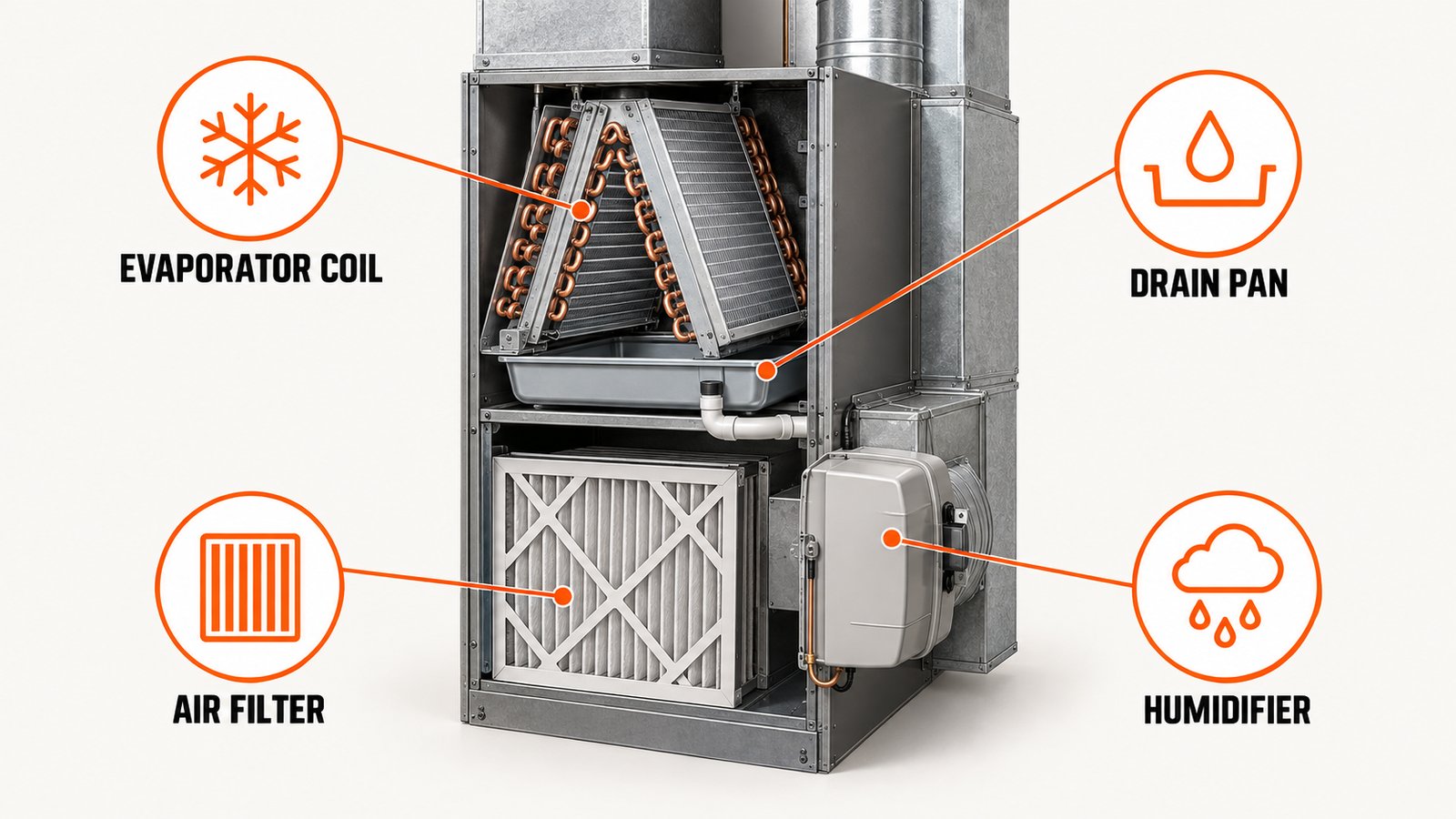
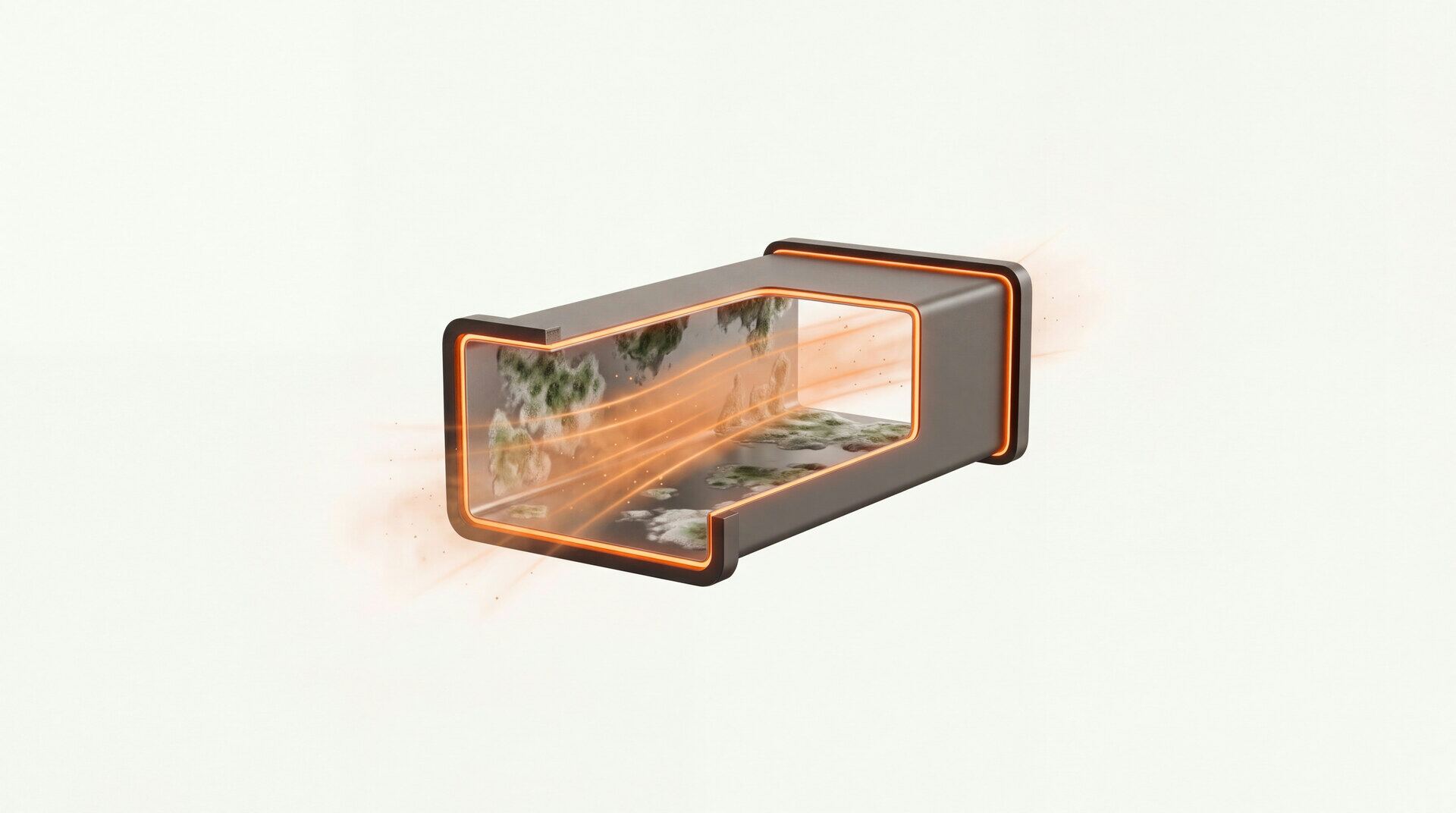
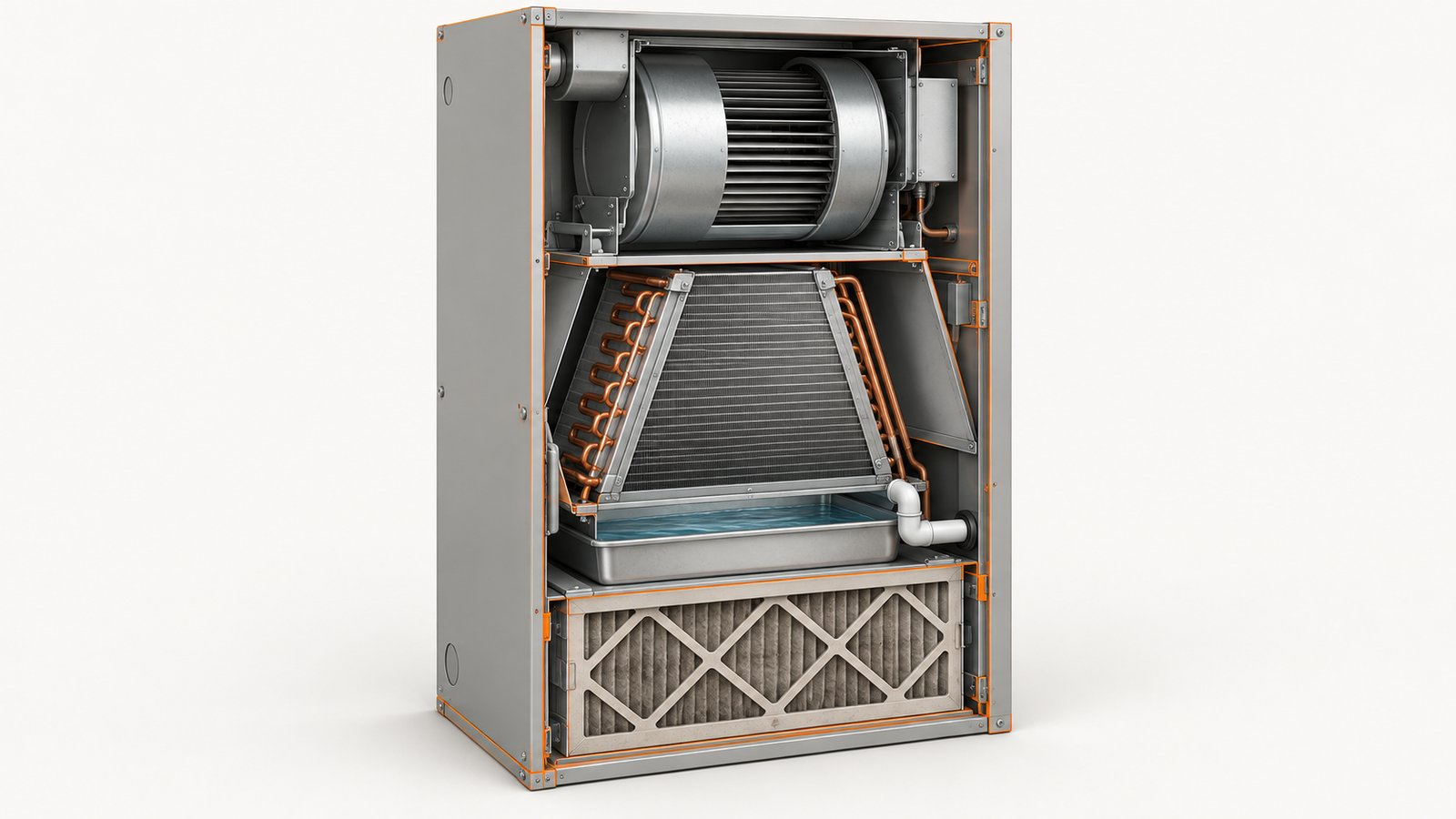
People say "furnace" for the whole box in the basement, closet or attic. In many homes that box holds the heater, the blower and the coil that cools the air in summer. Mold needs moisture and something to eat, and dust is the food. So it grows where the cabinet gets wet or stays damp, not on the parts that make heat.
The CDC says mold can get into a home through "heating and air conditioning systems," and that it can grow in dust and insulation. The EPA adds that if moisture is present in these components, "the potential for microbiological growth (e.g., mold) is increased." Here are the usual spots.
| Spot | Why it gets damp or dusty | Who handles it |
|---|---|---|
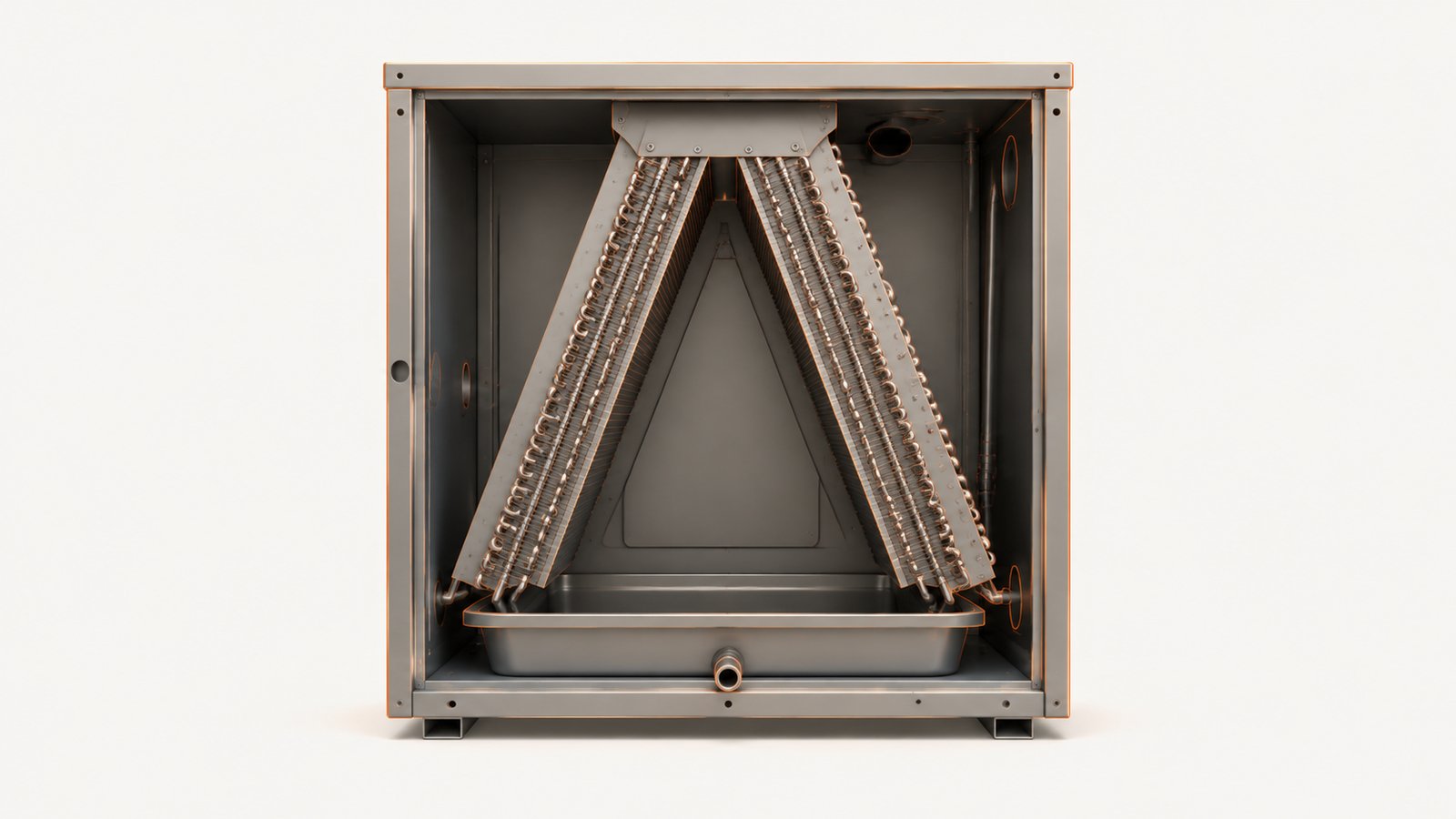
| Evaporator coil | It sweats every time the A/C runs, and dust sticks to the wet fins. | HVAC technician |
| Drain pan and condensate line | Water that cannot leave sits in a dark pan. | You, if it is in plain view. Otherwise a technician. |
| Air filter | A loaded filter holds dust, and humidity keeps it damp. | You |
| Whole-house humidifier | It adds water to the air on purpose. | You, by the maker's manual |
| Blower compartment | Dust builds on the wheel and housing. | HVAC technician |
| Insulation lining the cabinet | It is porous, so wet insulation stays wet. | HVAC technician or contractor |
Suspect the cooling coil first. The EPA's duct guidance calls condensation on or near cooling coils "a major factor in moisture contamination of the system." If the coil sits above or beside your furnace, a winter smell may be a summer moisture problem that never dried out. Our guides to mold in an air conditioner and mold in air ducts cover the coil, pan and ductwork in detail.
One boundary: the burners, gas valve, ignition parts, flue and heat exchanger are combustion parts. Nothing here asks you to open, clean or adjust them.
Signs of Mold in Your HVAC System
Start with what you can notice without touching anything:
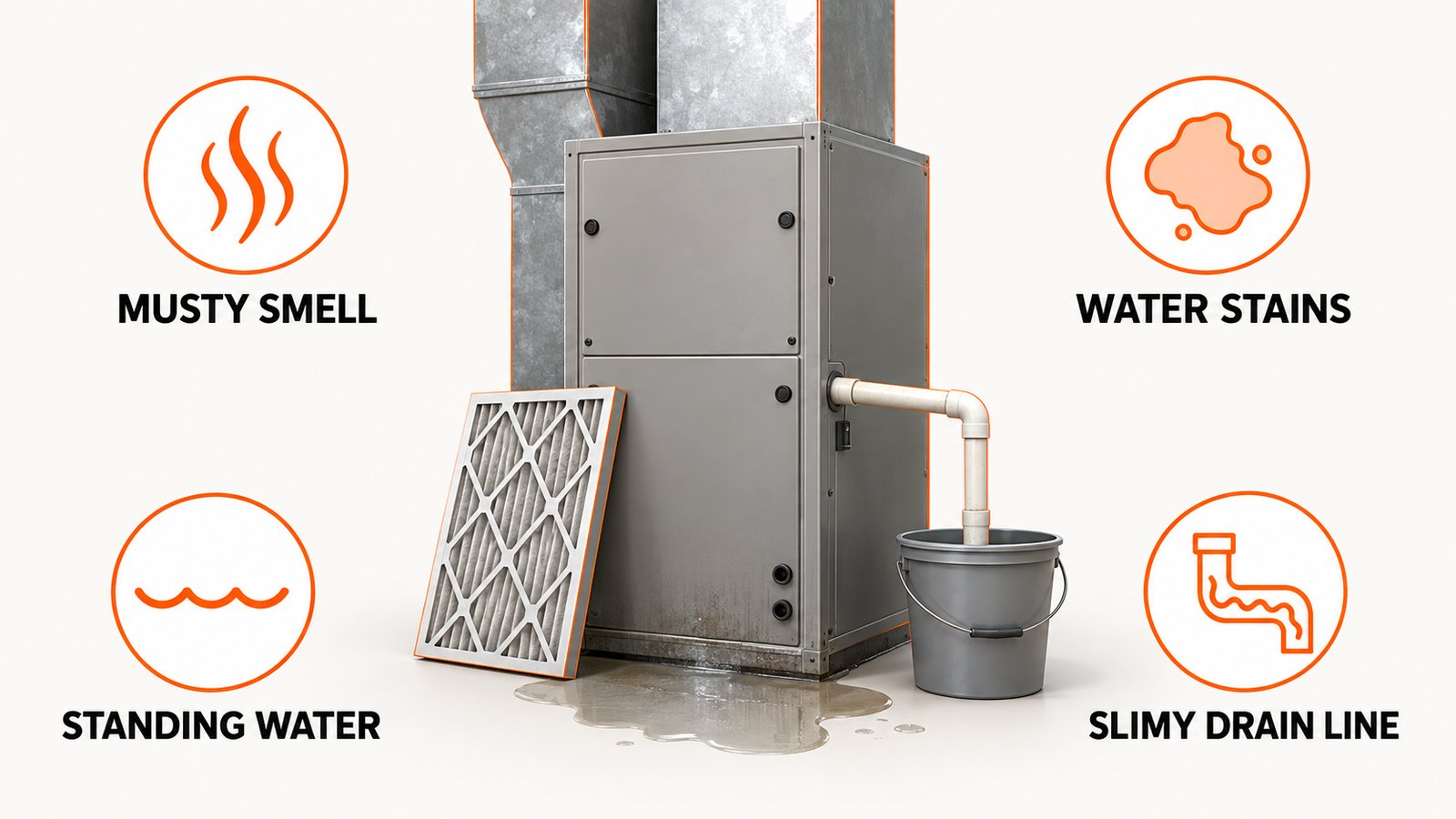
- A musty smell when the system starts. The CDC says mold "can smell musty." Drains, wet carpet and stored boxes smell the same, as our mold smell in house guide explains.
- Water where it should not be. Drips, rust streaks or a damp patch at the base of the unit mean condensate is not leaving.
- Standing water in the drain pan, or a slimy film in the line. The EPA says "the presence of substantial standing water and/or debris indicates a problem requiring immediate attention."
- A damp or spotted filter. A filter should be dry.
- Dark spots at a register. Cold metal in humid air sweats, and staining can be dust stuck to condensation.
Every item on that list has a limit. Odor, dust and staining each have more than one cause. The EPA says that "although a substance may look like mold, a positive determination of whether it is mold or not can be made only by an expert and may require laboratory analysis." Much of the system is out of sight, so it advises you to "ask the service provider to show you any mold they say exists."
That fits our air duct page: HVAC concerns need moisture control, not assumptions. A smell is a reason to look for water. It is not a lab result.
What Mold in an Air Handler Unit Looks Like
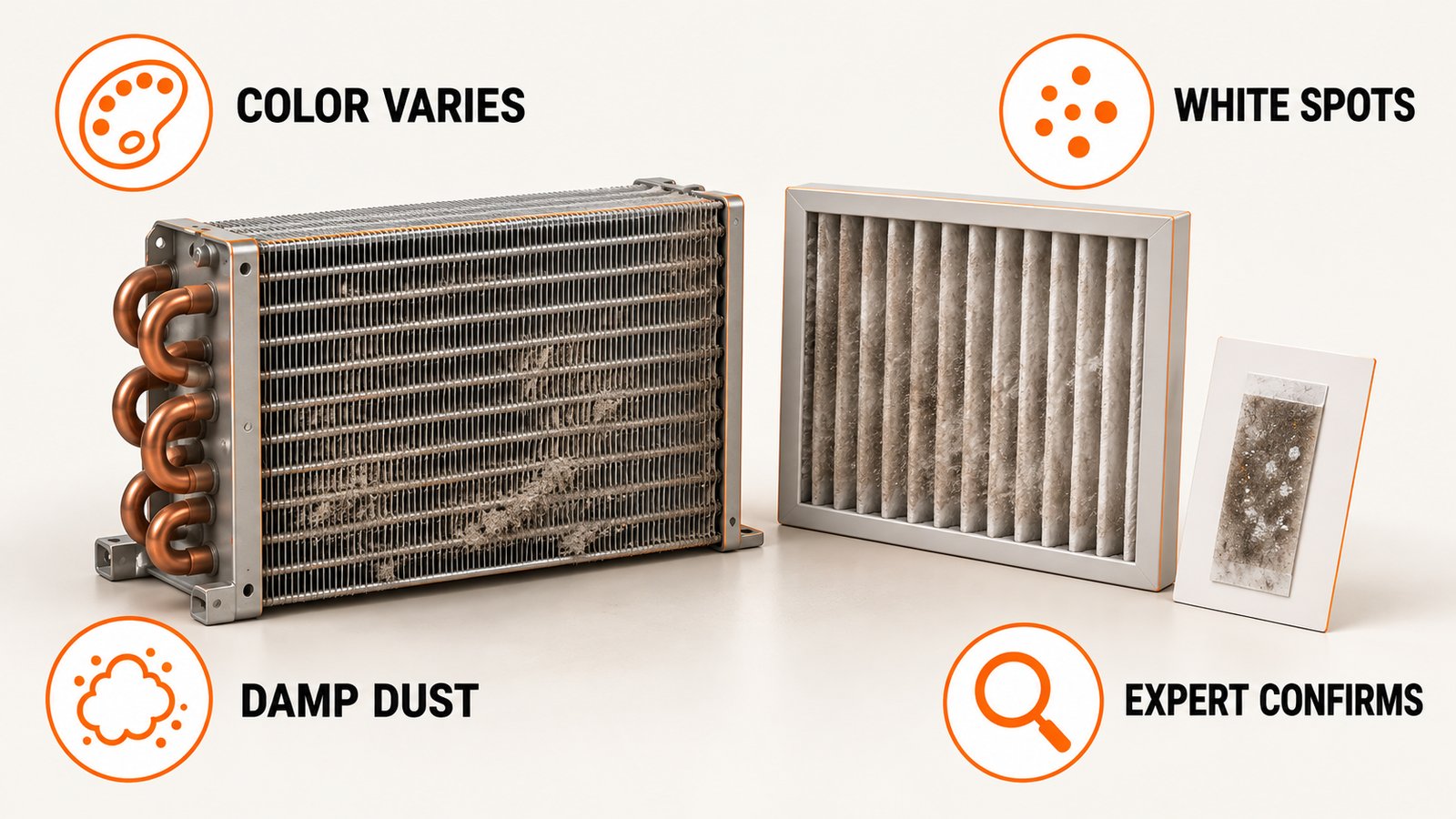
The CDC says mold "can look like spots of many different colors." That is why photos of one "scary" color are not much use. People usually report these looks, and other things can look the same:
- Filter. Gray, green or dark speckles on the pleats, often with a sour smell.
- Drain pan and line. A slimy film in pink, orange, black or green, and water that sits.
- Coil fins. Fuzzy or powdery growth between the fins. A technician can see this with a light. You usually cannot.
- Blower area. A gray crust of damp dust on the blades or housing.
- Cabinet lining. Stained, sagging or fuzzy insulation, usually near a leak or the coil.
Air handler coils with white spots
White spots on a coil can be dust, mineral residue, corrosion or mold. You cannot sort them out by eye. The EPA notes that "for about $50, some microbiology laboratories can tell you whether a sample sent to them on a clear strip of sticky household tape is mold or simply a substance that resembles it." Ask your technician to show you the spots in place and take a tape sample if the answer matters. Do not scrub the coil. A bent coil costs more to fix than a dirty one.
For a spot you can see in the open, such as a filter or a register, our app gives an AI-assisted visual screening of what is visible in the photo. Processing time varies, and it does not replace an expert.
Mold in a Furnace Humidifier
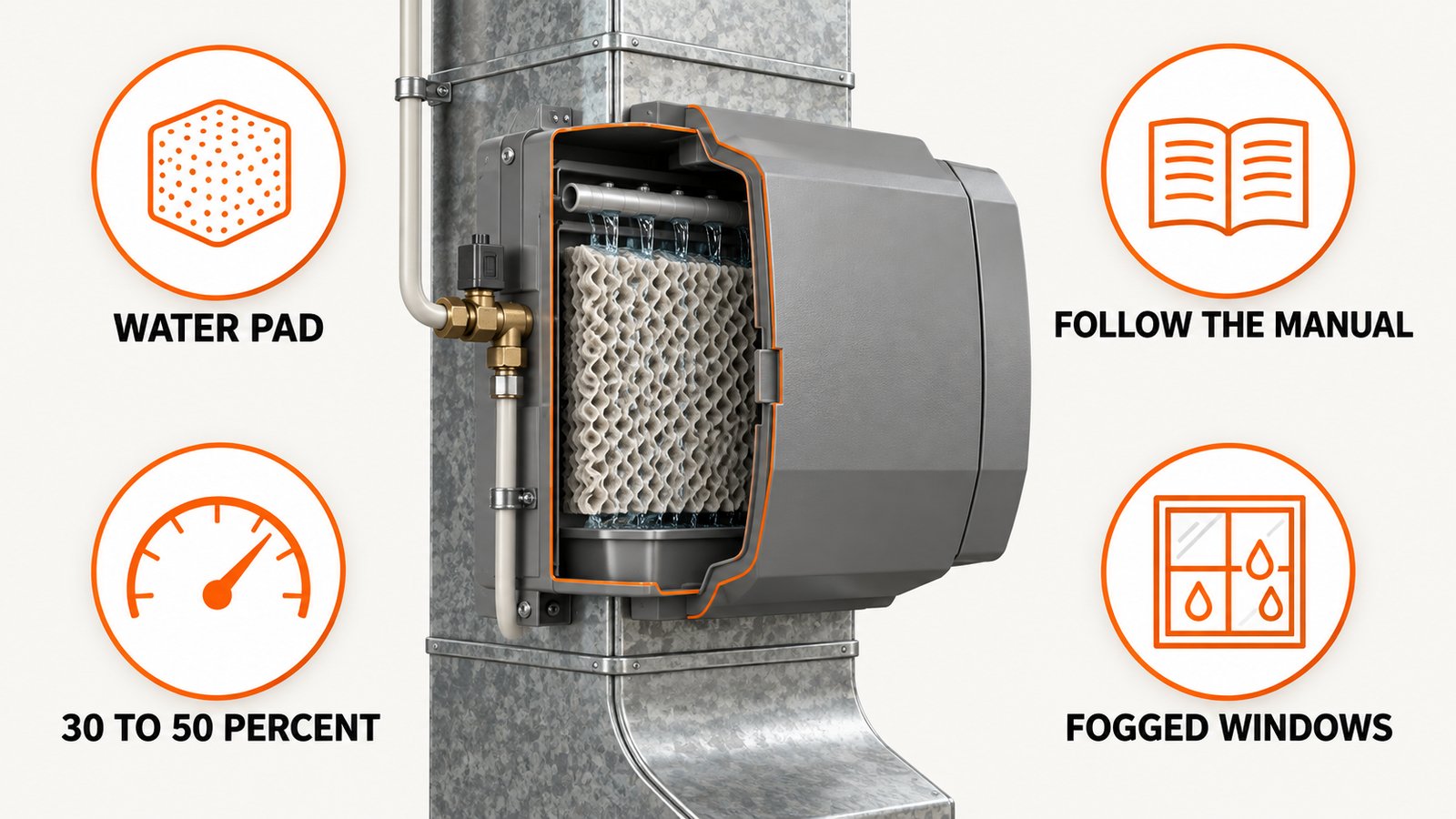
A whole-house humidifier attaches to the furnace or its duct and feeds water vapor into the airflow. That puts a wet part in the same cabinet as the dust, which is the recipe for a drain pan all over again. The EPA's instruction for this equipment is short: "operate and maintain the humidifier strictly as recommended by the manufacturer." Your manual decides how often to replace the pad, how to clean the tray, and how to shut the unit down for summer so it does not sit wet.
On the setting, use a number, not a feeling. The EPA says to keep indoor humidity below 60 percent, ideally between 30 and 50 percent, and the CDC says no higher than 50 percent. A humidity meter costs about $10 to $50, according to the EPA. The agency also says that if you see condensation on windows, walls or pipes, act quickly to dry the surface and reduce the moisture source. Fogged windows in January mean the setting is worth lowering.
A portable unit is a different case, covered in mold in a humidifier. If your furnace humidifier looks slimy or crusted, turn the system off and call a technician.
What You Can Check With the Power Off
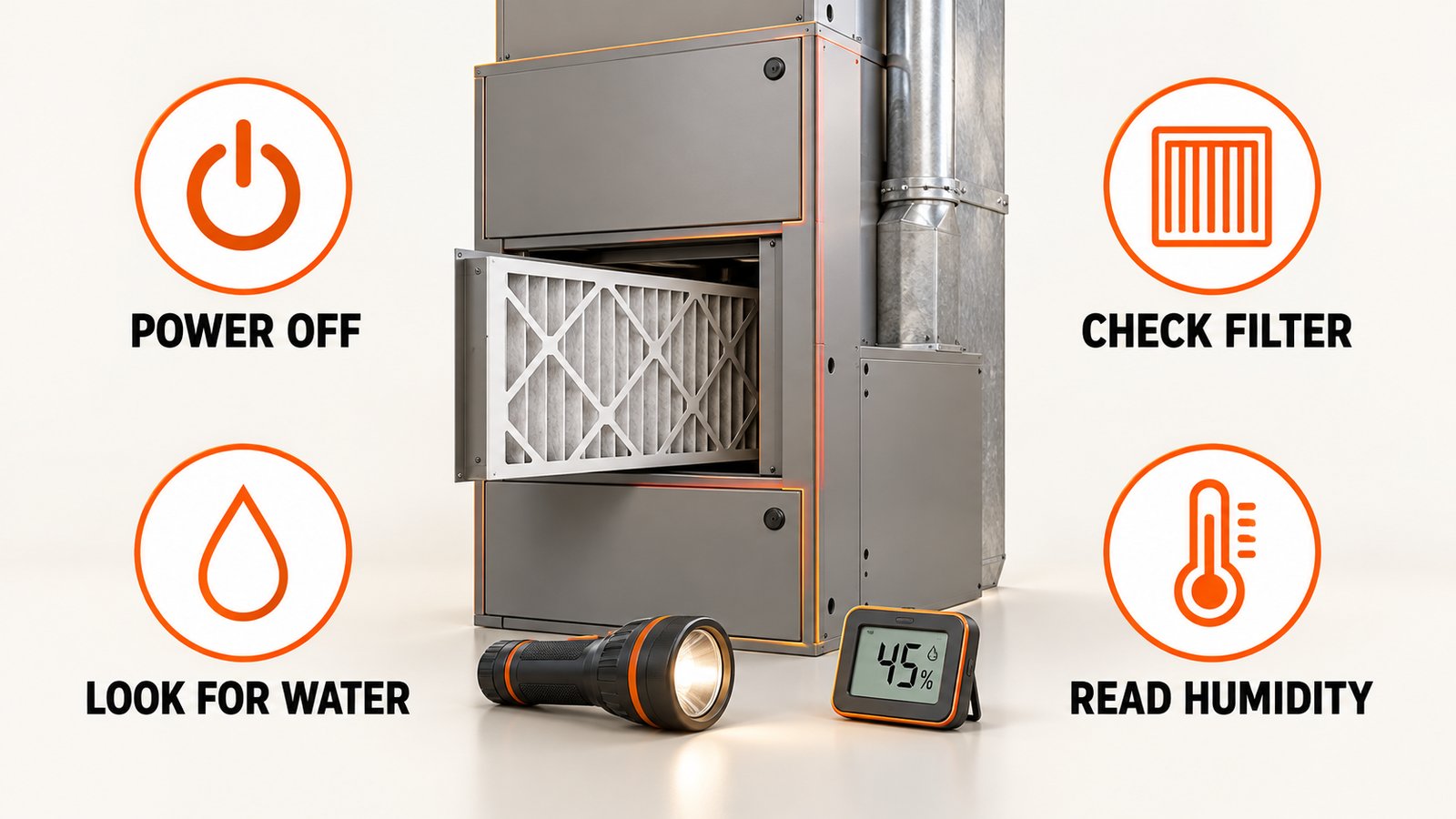
Our air duct guide tells readers not to open equipment panels or enter ductwork to investigate, and this page agrees. These checks stay outside the cabinet, except for the filter slot, which is made to open.
- Turn the system off at the thermostat and the breaker or service switch. Blowers start without warning.
- Pull the filter and look at it. Is it dry? Does it smell sour? Wear gloves, goggles without vent holes and an N-95 respirator, which is the EPA's gear for limiting exposure. Bag a moldy disposable filter and throw it away. Do not vacuum it and reuse it.
- Look at the outside of the unit. Check the floor, the cabinet sides and the end of the condensate line for water, rust or stains. Use a flashlight and take dated photos.
- Read the humidity. A plain meter shows whether the house sits in the EPA range of 30 to 50 percent.
Write down when the smell happens: at startup, while heating, only in summer. A technician can use that. Window and wall units are covered in mold in a window air conditioner.
What to leave alone
- Gas valves, burners, ignition parts, the flue and the heat exchanger. If you ever smell gas, leave the house and call your gas utility or 911.
- Wiring, the control board and the blower motor.
- The coil and blower wheel, which are easy to damage.
- Any panel or register you would have to unscrew.
Should the furnace keep running while you wait? The EPA says, "Do not run the HVAC system if you know or suspect that it is contaminated with mold," because it could spread mold throughout the building. In winter that can mean a cold house, so book the technician fast and ask how to stay warm safely meanwhile.
Do HVAC Mold Fogger Sprays Work?
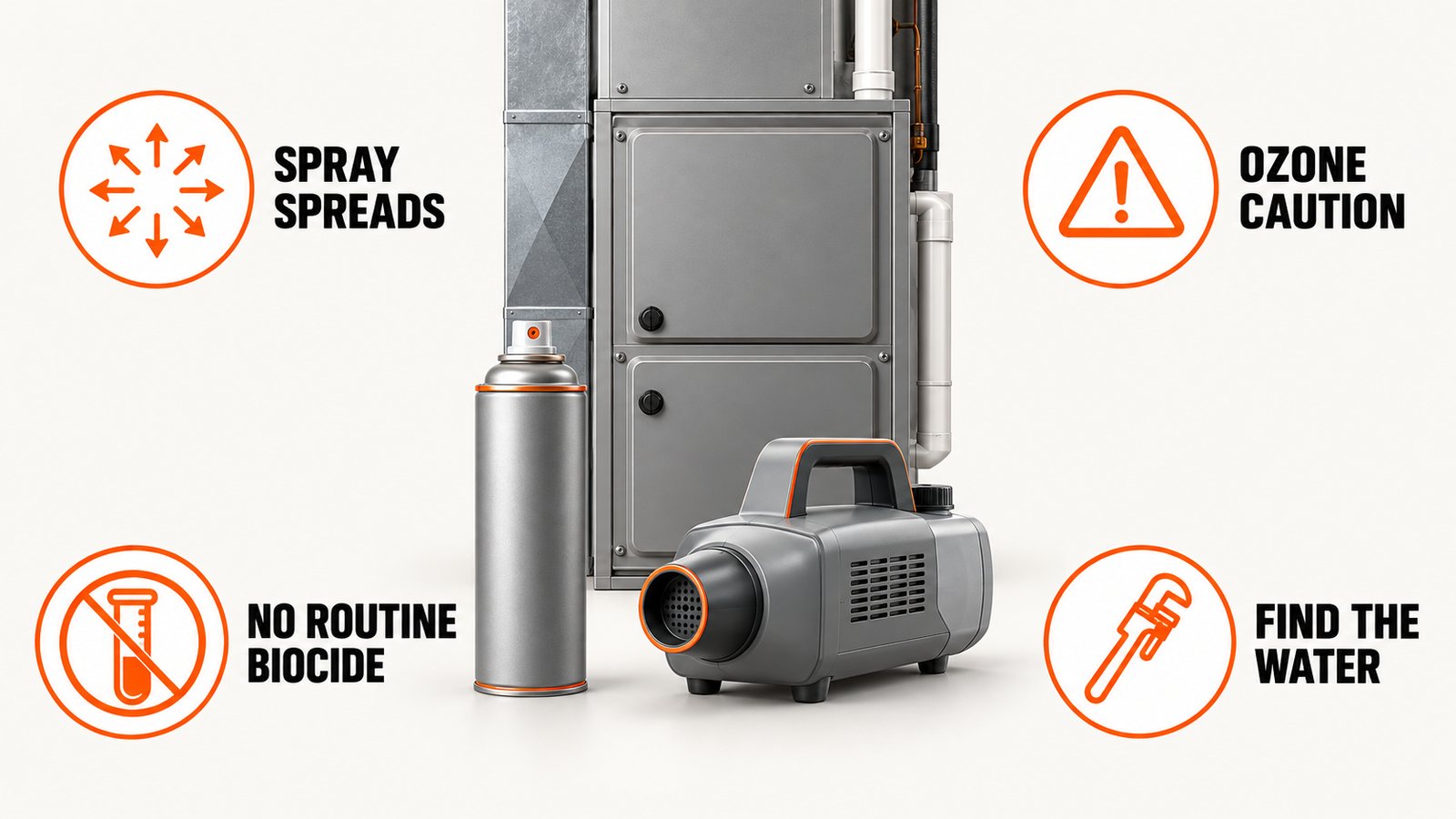
Search for an HVAC mold fogger or removal spray and you will find cans that promise a one-step fix. The EPA wrote about ducts, and the same logic applies to anything sprayed into a running system:
- "Little research has been conducted to demonstrate the effectiveness of most biocides and ozone when used inside ducts."
- "Simply spraying or otherwise introducing these materials into the operating duct system may cause much of the material to be transported through the system and released into other areas of your home."
- Ozone is "a highly reactive gas that is regulated in the outside air as a lung irritant."
On cleanup in general, the EPA says that using a chemical or biocide that kills organisms such as mold "is not recommended as a routine practice during mold cleanup." Killing is not the goal. Removing the growth and fixing the water is. Or in the agency's words, "If the conditions causing the mold growth in the first place are not corrected, mold growth will recur."
If a technician finds real growth on the coil or pan, they clean those parts and fix the drain. A seller who leads with a fog or an ozone machine instead of finding the water has the order wrong. We did not find an authoritative source that weighs UV lamps in a furnace, so this page does not judge them.
How to Keep Mold From Coming Back
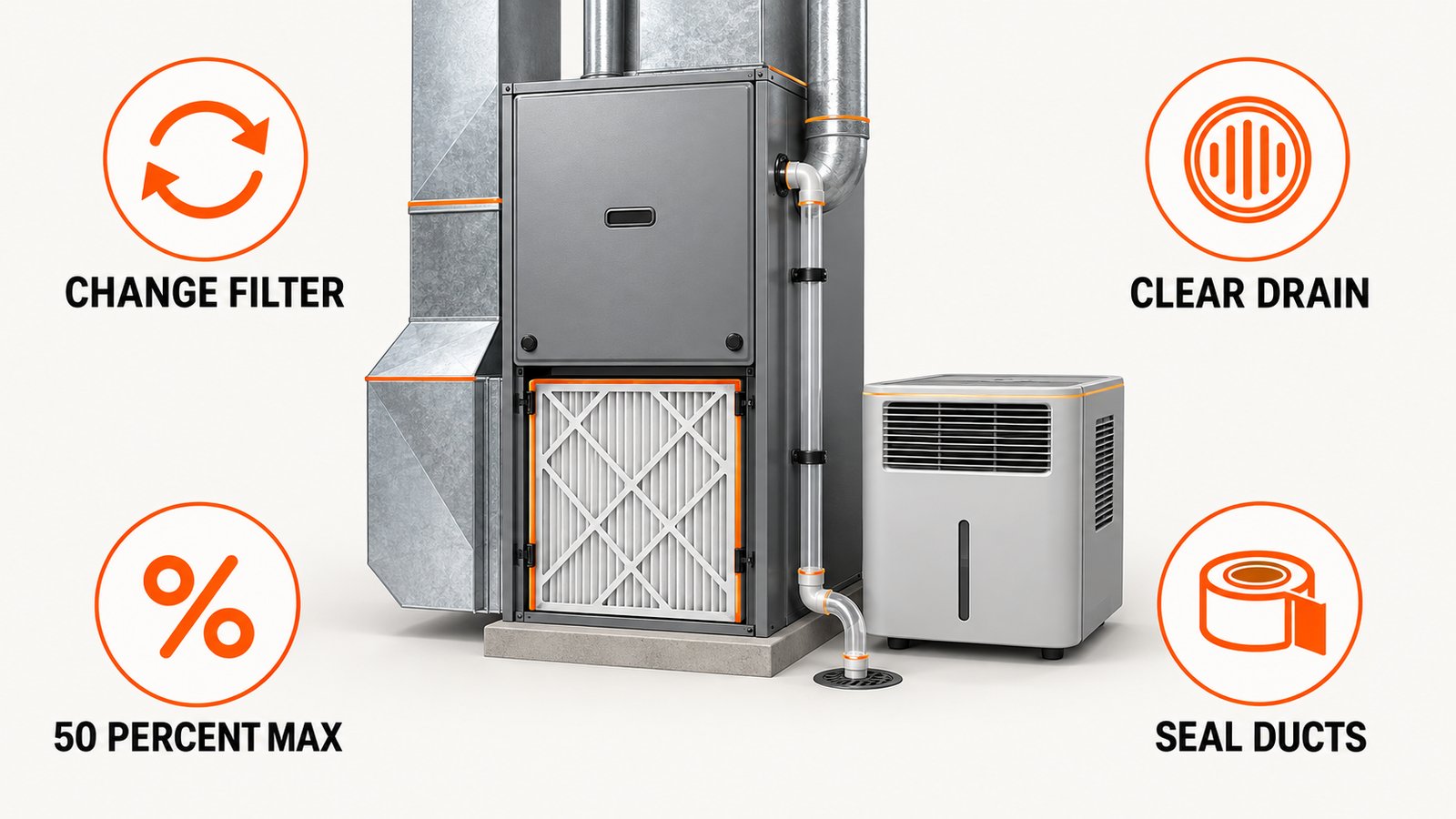
The EPA says, "Controlling moisture is the most effective way to prevent biological growth in air ducts." Most of this list is moisture control with a calendar attached.
- Change the filter. The EPA says to use the highest efficiency filter the system's maker recommends, change it regularly, change it more often if it clogs, and make sure air cannot slip around the holder.
- Keep the pan and line working. The EPA says to "keep air conditioning drip pans clean and the drain lines unobstructed and flowing properly," and to ask your technician at each visit to clean the cooling coils and drain pans.
- Check insulation near the coil for wet spots, and tell the technician if you find any.
- Hold humidity in range. A dehumidifier helps in a damp basement. See our dehumidifier guide and moisture meters.
- Seal and insulate ducts that run through attics and crawl spaces, which the EPA ties to stopping condensation.
- Do not oversize the equipment. The EPA warns that "a unit that is too big will cycle on and off frequently, resulting in poor moisture removal."
The EPA also recommends that a fuel-burning furnace be inspected and serviced before each heating season to protect against carbon monoxide poisoning. Book that visit and the coil and pan cleaning together. An air cleaner helps with airborne particles in a room but does not dry a pan or a coil. See air cleaners and mold and how to prevent mold.
When to Call a Pro
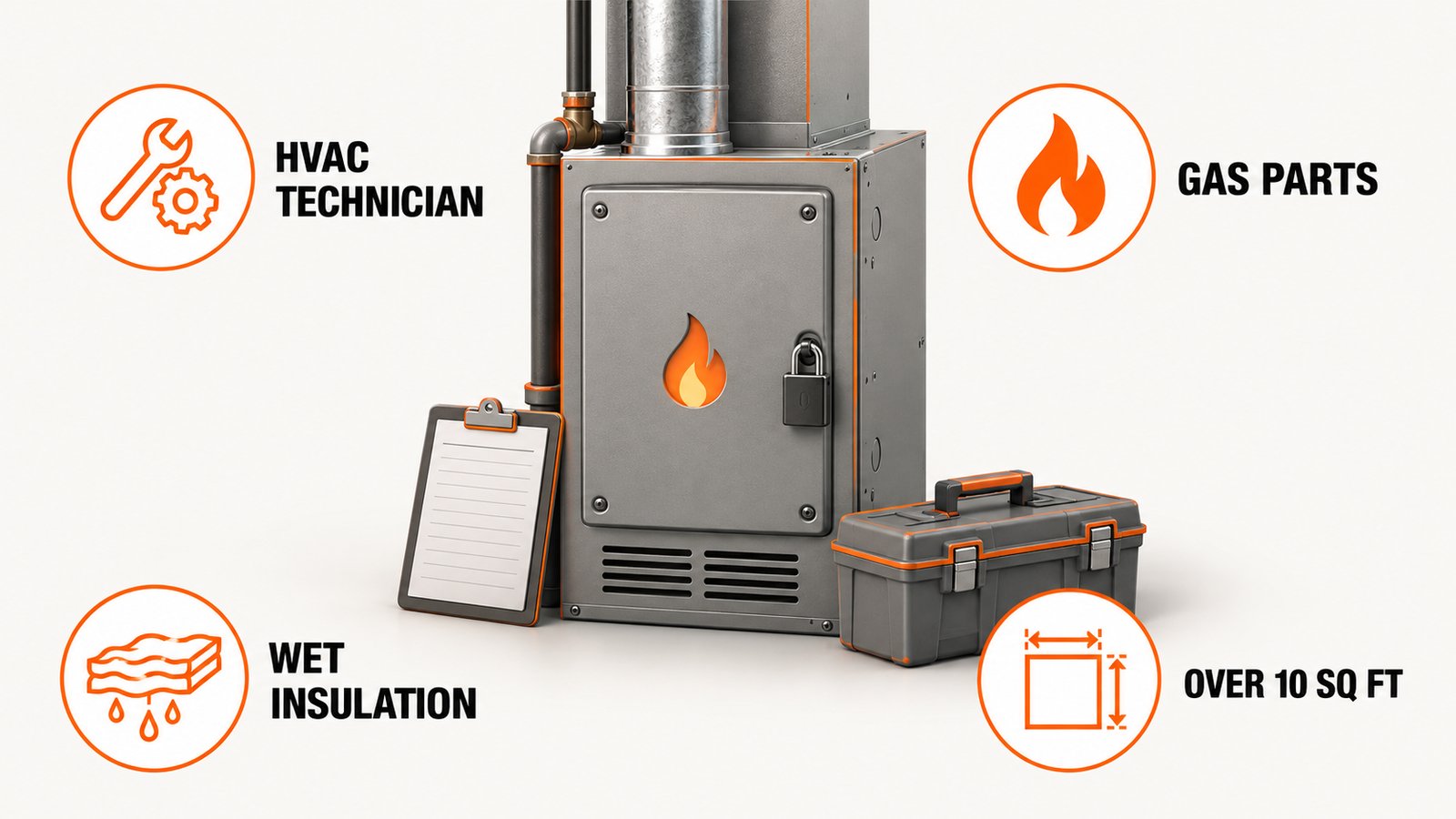
Call an HVAC technician for any of these:
- Growth or heavy dust on the coil, blower or inside the cabinet.
- Standing water in the pan, a line that keeps clogging, or an overflow switch that keeps shutting the system off.
- Wet or moldy insulation. The EPA says that for insulated air ducts, insulation that "gets wet or moldy it cannot be effectively cleaned and should be removed and replaced." Ask whether the same applies to your cabinet lining.
- A musty smell that returns every time the system starts.
- Anything on the gas, burner, flue or heat exchanger side.
The EPA puts the do-it-yourself line at moldy areas under about 10 square feet, roughly a 3 foot by 3 foot patch. Inside a furnace cabinet that rule is a poor fit, because you cannot safely reach most of it. Use it for the room around the unit, such as a damp wall, and read the remediation process and how to choose a mold specialist if growth spread.
On cost, the EPA says cleaning a whole heating and cooling system typically, but not always, runs $450 to $1,000 per system, depending on the services, size, access, region and level of contamination. That is cleaning only. Water damage repairs cost extra, and our mold remediation cost guide covers larger jobs. Ask for a written scope that names the coil, the pan, the blower and the moisture fix.
Health questions belong with a licensed clinician. The CDC says exposure to damp and moldy environments "may cause a variety of health effects, or none at all."
Frequently asked questions
Can mold grow in a furnace?
Mold can grow in the cabinet around a furnace wherever moisture and dust collect: the evaporator coil, drain pan, condensate line, filter, a whole-house humidifier, the blower compartment and wet insulation. Burners and the heat exchanger are for a licensed technician only.
What are the signs of mold in an HVAC system?
A musty smell at startup, water or rust around the unit, standing water in the pan, a slimy condensate line, a damp or spotted filter, and dark spots at a register. None of these confirms mold. The EPA says only an expert can make a positive determination, which may need laboratory analysis.
Can I run my furnace if I think it has mold?
The EPA says not to run an HVAC system you know or suspect is contaminated with mold, because it could spread mold through the building. Turn it off and call a technician quickly. In cold weather, ask how to stay warm safely meanwhile.
Can I clean mold out of my furnace myself?
Not the inside. You can replace the filter, inspect the outside of the cabinet and run the humidifier by its manual. The coil, blower, cabinet lining and all gas parts belong with a technician. Wear gloves, goggles and an N-95 respirator for what you do touch.
How much does HVAC mold removal cost?
The EPA says cleaning a whole heating and cooling system typically, but not always, costs $450 to $1,000 per system. Water damage and wet building materials cost more and are priced separately. Get a written scope that names the moisture fix.
Does an HVAC mold fogger work?
The EPA says little research shows that most biocides and ozone work inside ducts, and that spraying them into a running system may carry much of the material into other parts of the home. Find and fix the water first.
Does a whole-house humidifier cause mold?
It adds moisture, so neglect or a high setting can contribute. The EPA says to maintain it strictly as the manufacturer recommends and to keep indoor humidity below 60 percent, ideally 30 to 50 percent.
Sources
Every claim on this page traces to one of these. Links open the primary document.