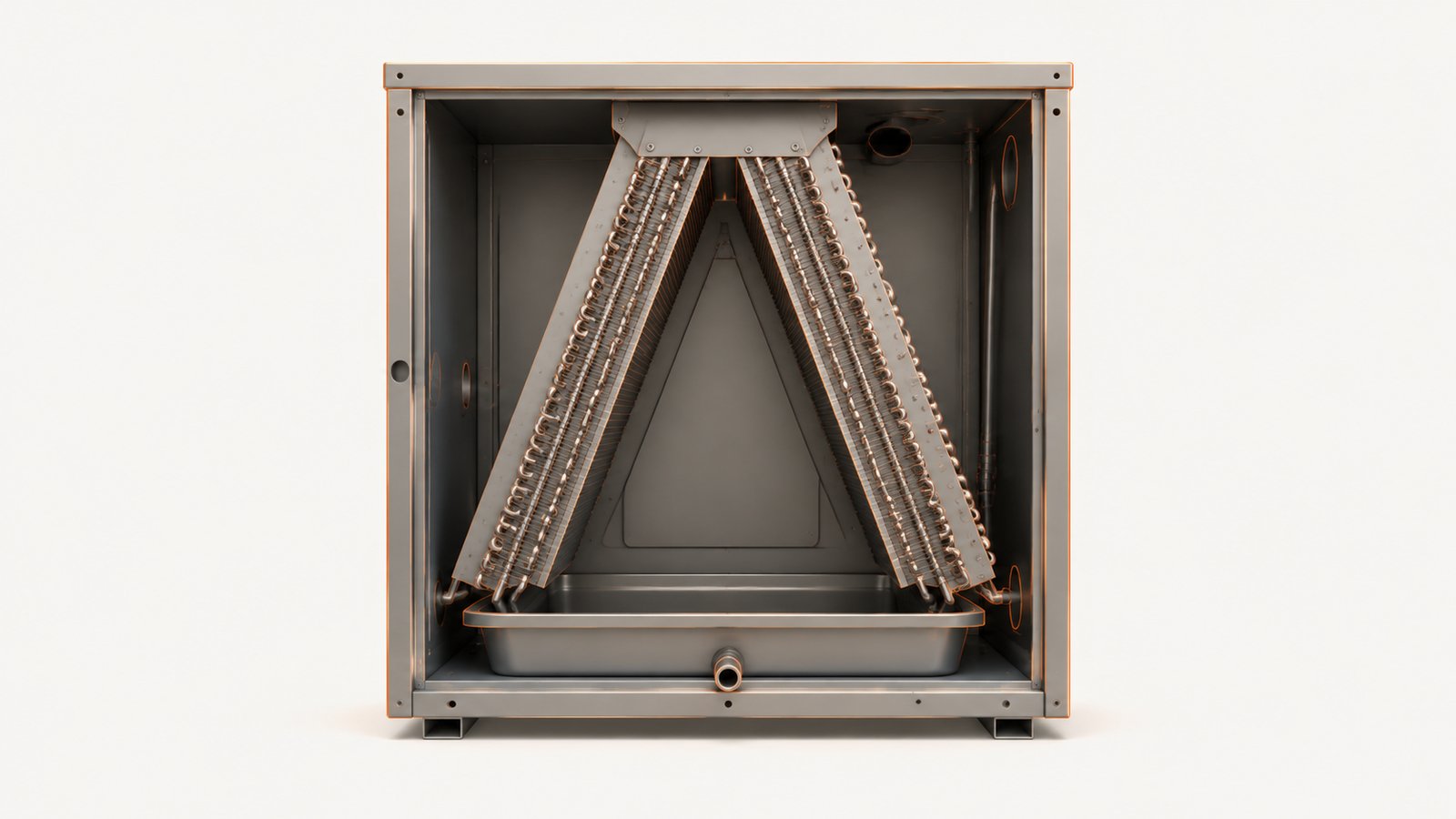
Where mold grows inside an air conditioner
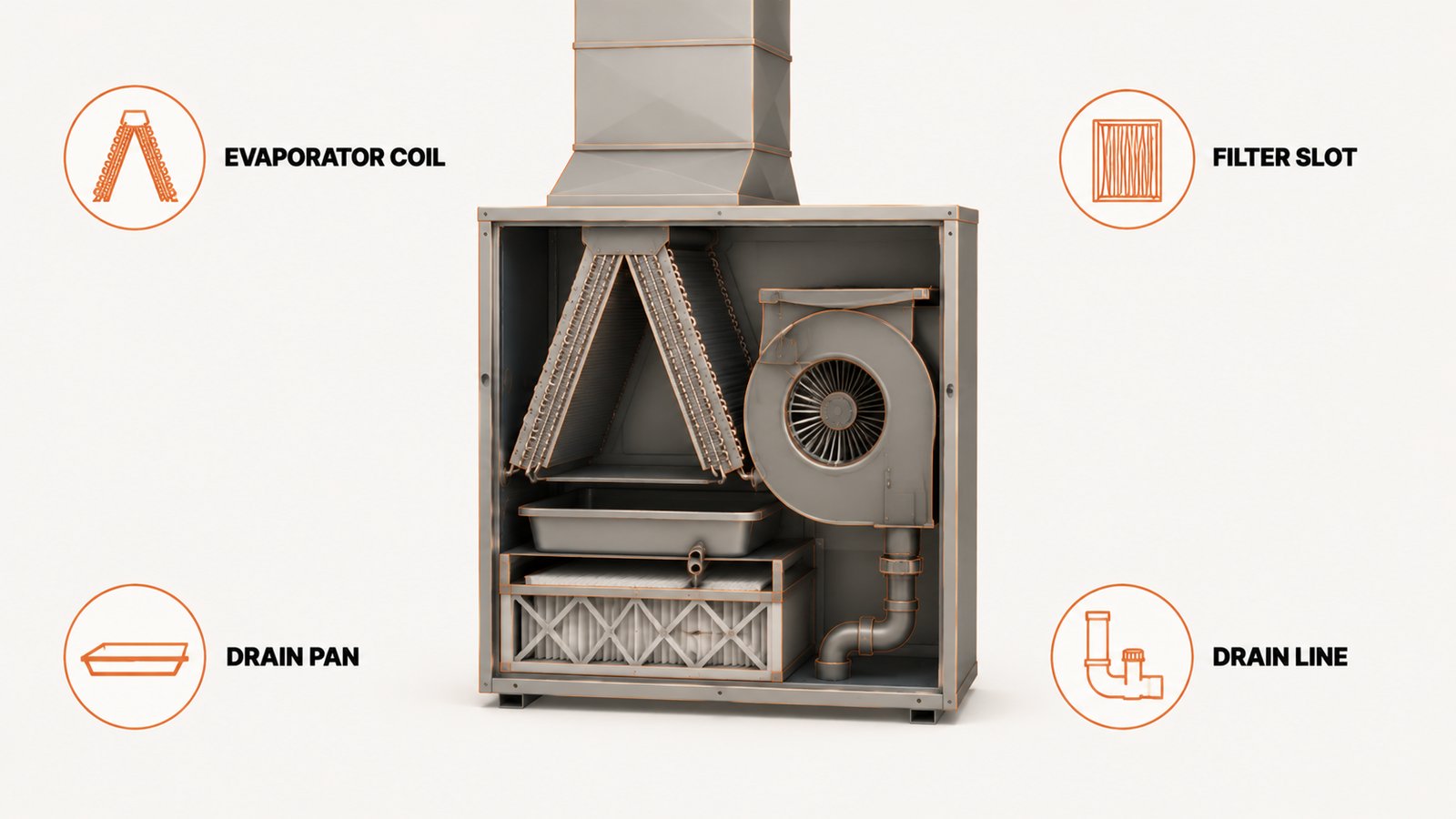
An air conditioner dehumidifies by making water. Warm indoor air passes over a cold coil, moisture condenses out of it, and that water drips into a pan and leaves through a drain. Every part of that path is a candidate, and the failure is almost always the same one: the water stopped leaving.
| Part | Why growth starts there | Who handles it |
|---|---|---|
| Evaporator coil | It is wet by design. Condensation forms on it every time the system runs, and dust settles onto the wet fins. | HVAC technician. It sits inside the air handler and damages easily. |
| Condensate drain pan | It holds standing water whenever the drain is slow, sloped wrong or blocked. | Technician, or you if the pan is accessible with the power off. |
| Condensate drain line | Biological slime blocks the line, then the pan overflows into the cabinet or the ceiling below. | Often a homeowner job at the cleanout, otherwise a technician. |
| Air filter | A loaded filter holds dust, and dust plus humidity is the starting condition. | You. This is the one maintenance item nobody needs a service call for. |
| Blower wheel and cabinet | Damp dust builds on the blades and on the inside of the housing. | Technician. The wheel usually has to come out to be cleaned properly. |
| Duct insulation and duct board | Porous lining that got wet. EPA says wet or moldy duct insulation cannot be effectively cleaned. | Contractor, and the answer is removal and replacement rather than cleaning. |
| Supply registers and grilles | Cold metal in humid air sweats, and the wall or ceiling around it stays damp. | You, for the grille and the surface around it. |
Two related cases have their own pages, because the equipment differs. A self-contained unit in a window is covered in mold in a window air conditioner, and the ductwork itself is covered in mold in air ducts. A rooftop unit on a camper follows the same rules in a smaller package, covered in mold in an RV.
The signs, and the limit of each one
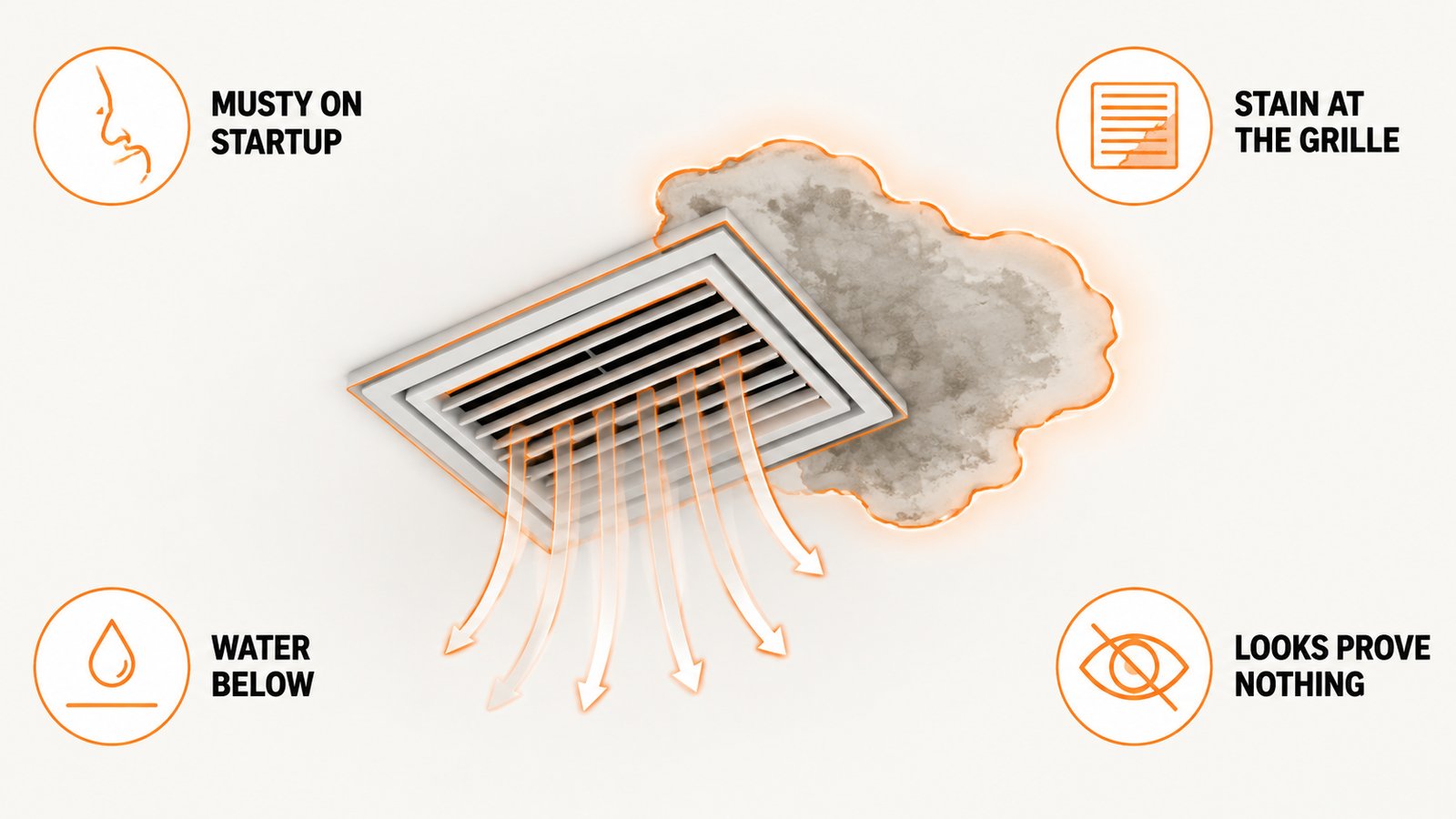
A musty smell that appears when the system starts. The clearest signal, because it points at the air path rather than the room. It justifies an inspection, and it does not identify anything by itself.
Visible growth at a supply register. Worth looking at closely, and easy to misread. Cold metal in humid air sweats, and dark staining on the grille or the ceiling around it can be dust bound to condensation rather than growth.
Water where it should not be. A wet ceiling under an attic air handler, water in the cabinet, or an overflow switch that keeps shutting the system down all mean the condensate is not leaving. That is a maintenance problem that becomes a mold problem.
What none of it proves. EPA makes the point precisely in its duct-cleaning guidance: many sections of a heating and cooling system may not be accessible for a visible inspection, so you should ask a service provider to show you any mold they claim exists. It also notes that although a substance may look like mold, a positive determination can be made only by an expert and may require laboratory analysis, and that for about $50 some microbiology laboratories can tell you whether a sample sent in on a clear strip of sticky household tape is mold or a substance that resembles it.
Worth remembering when a technician quotes a large job from a photo of a dark patch. Ask to see it in place. The same limit applies everywhere, which is why black mold cannot be identified by color either.
Why not to run a system you suspect
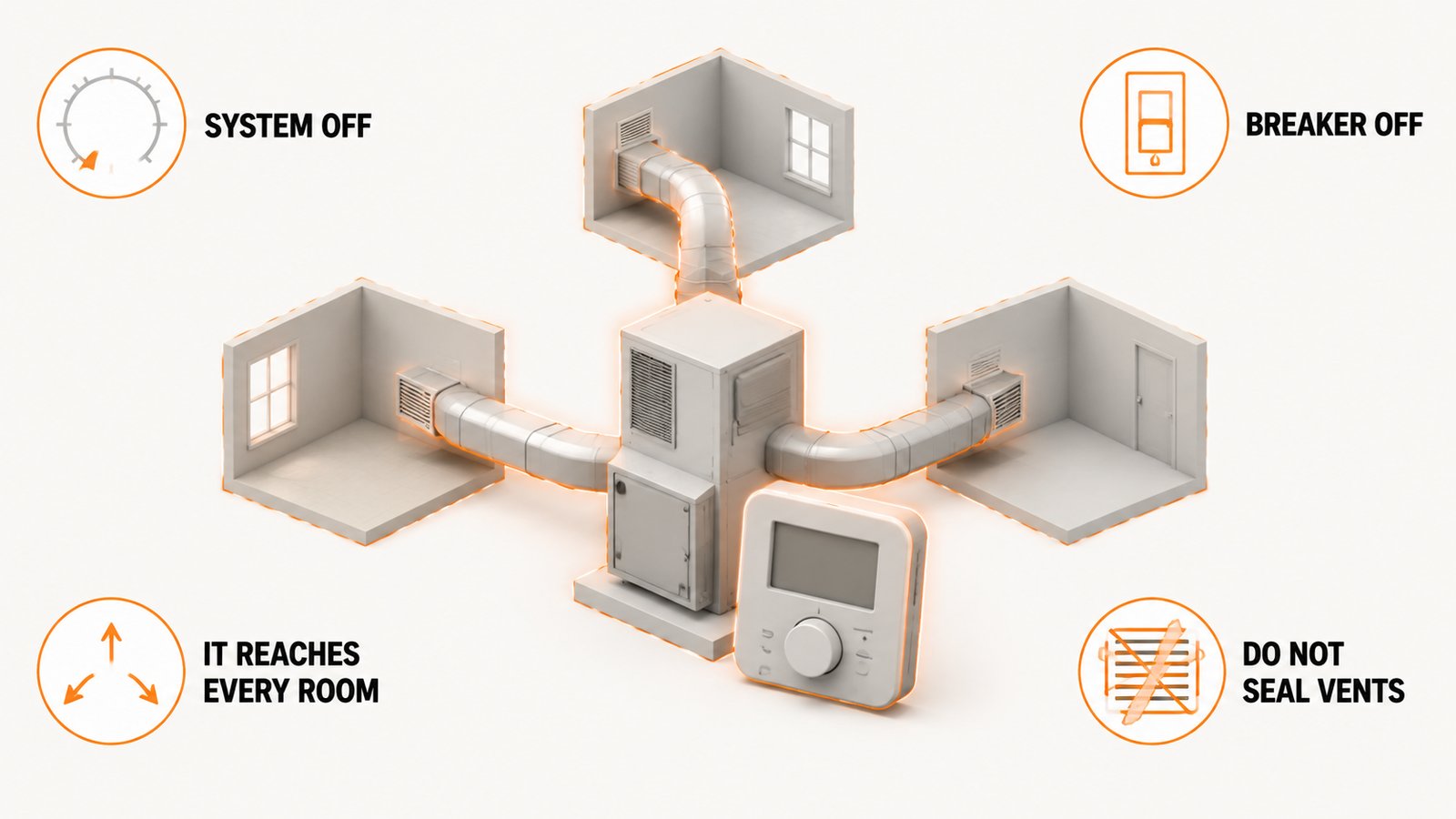
EPA's instruction is unambiguous: do not run the HVAC system if you know or suspect that it is contaminated with mold, because it could spread mold throughout the building. If you suspect contamination, for example because the system is part of an identified moisture problem or there is growth near the intake, the agency says to consult its guide on air duct cleaning before taking further action.
The reason is mechanical rather than medical. An air handler is a distribution device. Whatever is on the coil, in the pan or on the blower is in the airstream that reaches every supply register in the house. Running the system to air the place out does the opposite.
Two practical consequences:
- Turn it off at the thermostat and at the breaker before opening anything. Blowers start on a call for cooling with no warning.
- Do not seal the vents and keep running it. Closing registers raises static pressure and changes airflow without addressing the source.
In hot weather, shutting down has its own cost, since humidity climbs without cooling. That is a reason to get a technician out fast rather than a reason to keep running a contaminated system. A portable dehumidifier bridges the gap, and sizing one is covered in dehumidifiers for mold.
What you can clean yourself
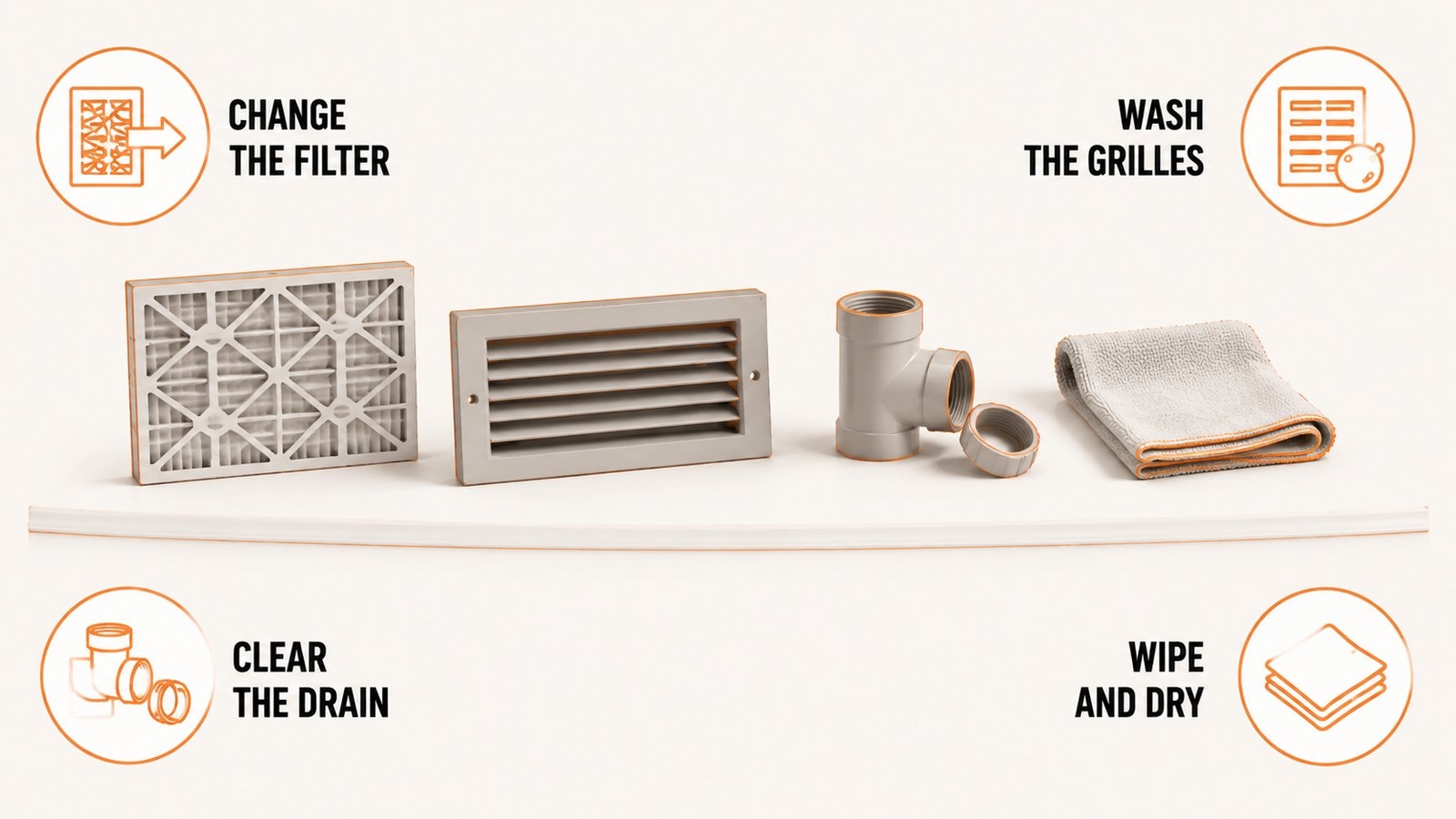
The line between homeowner work and technician work runs where the electricity and the refrigerant start.
Power off first, at the thermostat and the breaker. Then work.
The filter. Replace a disposable one, or wash and dry a permanent one completely before it goes back. A filter that goes back damp is a new problem.
Supply and return grilles. Unscrew them, wash them in hot soapy water, dry them fully. Wipe the surrounding ceiling or wall with detergent and water and dry it, which is EPA's method for hard surfaces.
The condensate drain line cleanout. Most systems have an accessible cleanout tee near the air handler. Clearing the line is the single highest-value maintenance task on this list, because a blocked line is what turns a working drain pan into a standing pond.
An accessible drain pan. If you can see and reach it with the power off, wipe it out and confirm it drains. If it is a secondary pan in an attic, note whether it is holding water and tell the technician.
Wear protection. EPA's guidance is gloves, goggles without ventilation holes and an N-95 respirator, and it advises against touching mold or moldy items with bare hands.
What to leave alone: the evaporator coil, the blower wheel, the inside of the ducts and anything requiring the cabinet to come apart. Coil fins bend under a cloth, and a damaged coil is an expensive repair on top of the original problem.
Ducts, biocides and ozone: what EPA says
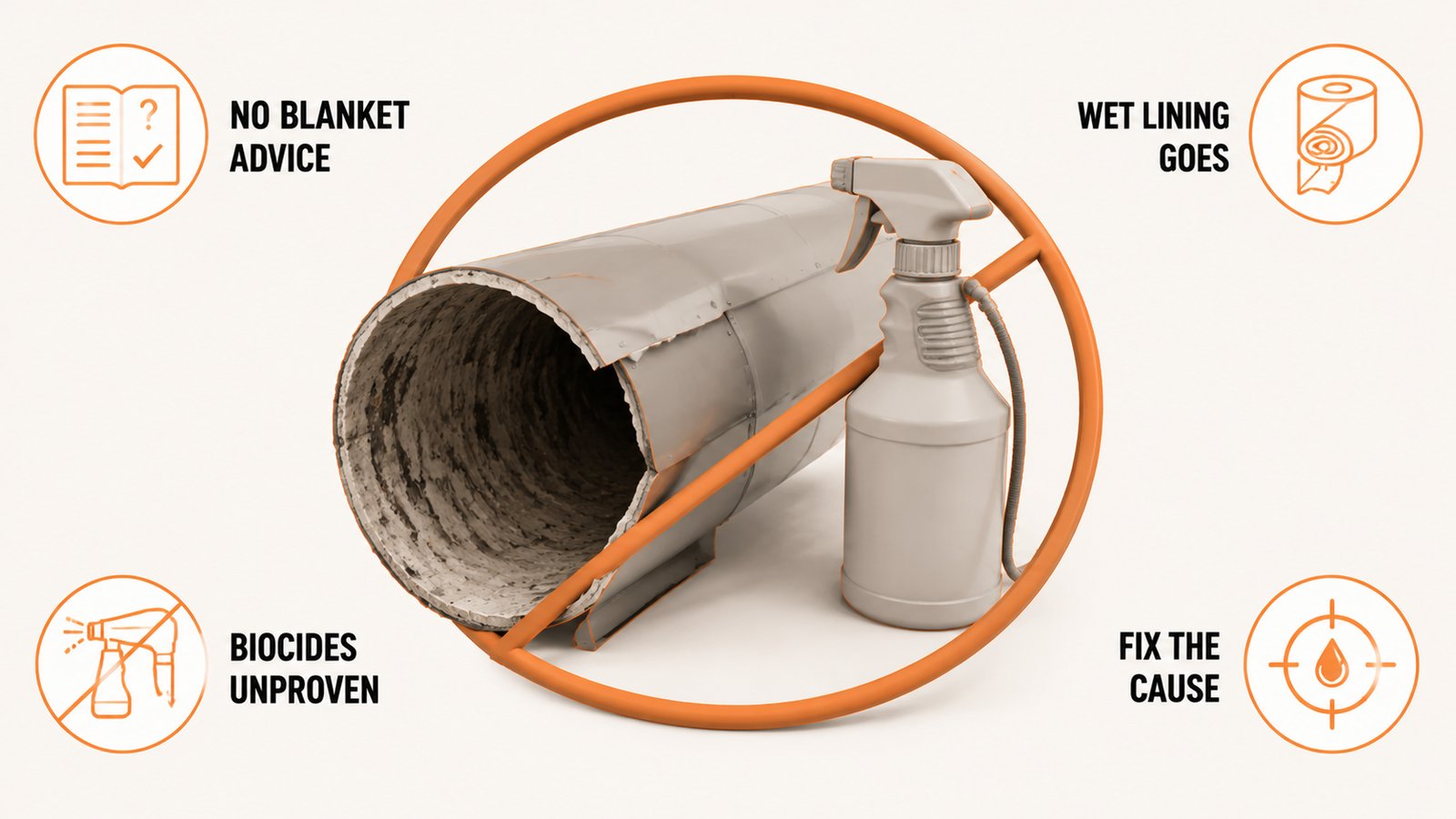
Duct cleaning is sold aggressively, and EPA's actual position is more careful than either the sales pitch or the dismissal.
No blanket recommendation exists. EPA states that knowledge about air duct cleaning is in its early stages, so a blanket recommendation cannot be offered on whether you should have the ducts in your home cleaned. It also says duct cleaning has never been shown to actually prevent health problems, and that studies do not conclusively demonstrate that particle levels in homes increase because of dirty ducts.
Substantial visible growth is a reason to consider it. EPA lists that first among the conditions where you should consider having ducts cleaned: substantial visible mold growth inside hard surface ducts, such as sheet metal, or on other components of the heating and cooling system.
Wet insulation is replaced, not cleaned. If insulated air ducts get wet or moldy, EPA says the insulation cannot be effectively cleaned and should be removed and replaced.
Fix the cause or it comes back. EPA states plainly that if the conditions causing the growth in the first place are not corrected, growth will recur. Cleaning ahead of the moisture repair is money spent twice.
Biocides and ozone carry real caveats. EPA notes that no products are currently registered by it as biocides for use on fiberglass duct board or fiberglass lined ducts, so it matters whether your system contains those materials before anyone applies anything. It describes considerable controversy over introducing chemical biocides or ozone into ductwork, notes that little research demonstrates their effectiveness inside ducts, warns that spraying material into an operating system may transport much of it into other areas of the home, and points out that ozone is a highly reactive gas regulated in outdoor air as a lung irritant.
The practical filter: a provider who leads with fogging or ozone rather than with finding the water is selling the wrong thing first.
Keeping the system dry
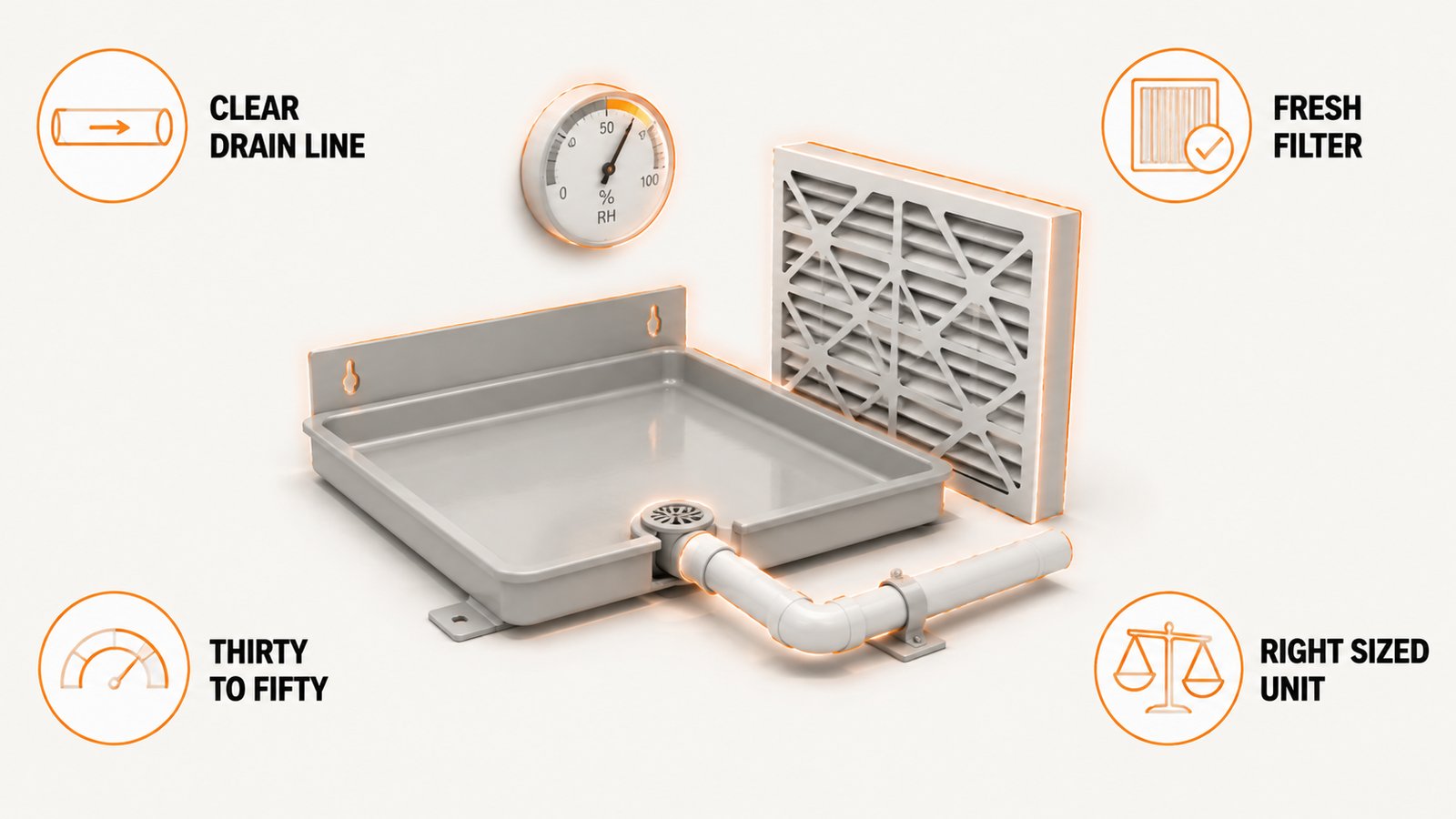
EPA's prevention list includes the line that matters most here: keep air conditioning drip pans clean and the drain lines unobstructed and flowing properly.
- Clear the condensate line on a schedule, before cooling season and again mid-season in a humid climate.
- Change filters on the manufacturer's interval, and always after any dusty work in the house.
- Hold indoor humidity in range. EPA asks for below 60 percent and ideally between 30 and 50 percent. A hygrometer settles the question.
- Watch out for oversized equipment. EPA notes that in hot regions, air conditioners that cool the air too quickly may not run long enough to remove excess moisture from the air. A system that satisfies the thermostat in short bursts leaves the house cold and clammy, which is a moisture problem created by the equipment itself.
- Evaporative coolers need their own attention. EPA notes that evaporative coolers used in the Southwest can encourage the growth of biological pollutants, and warns generally that dehumidifiers and air conditioners should not become sources themselves.
- Insulate cold surfaces that sweat. Registers, plenum sections and refrigerant lines running through humid space all condense. EPA's general fix for condensation is to raise the temperature of the cold surface or lower the humidity around it.
Whole-house habits are in how to prevent mold, and filtration questions are covered in air purifiers for mold, which help with particles in a room and do nothing about water in a drain pan.
When to call a pro
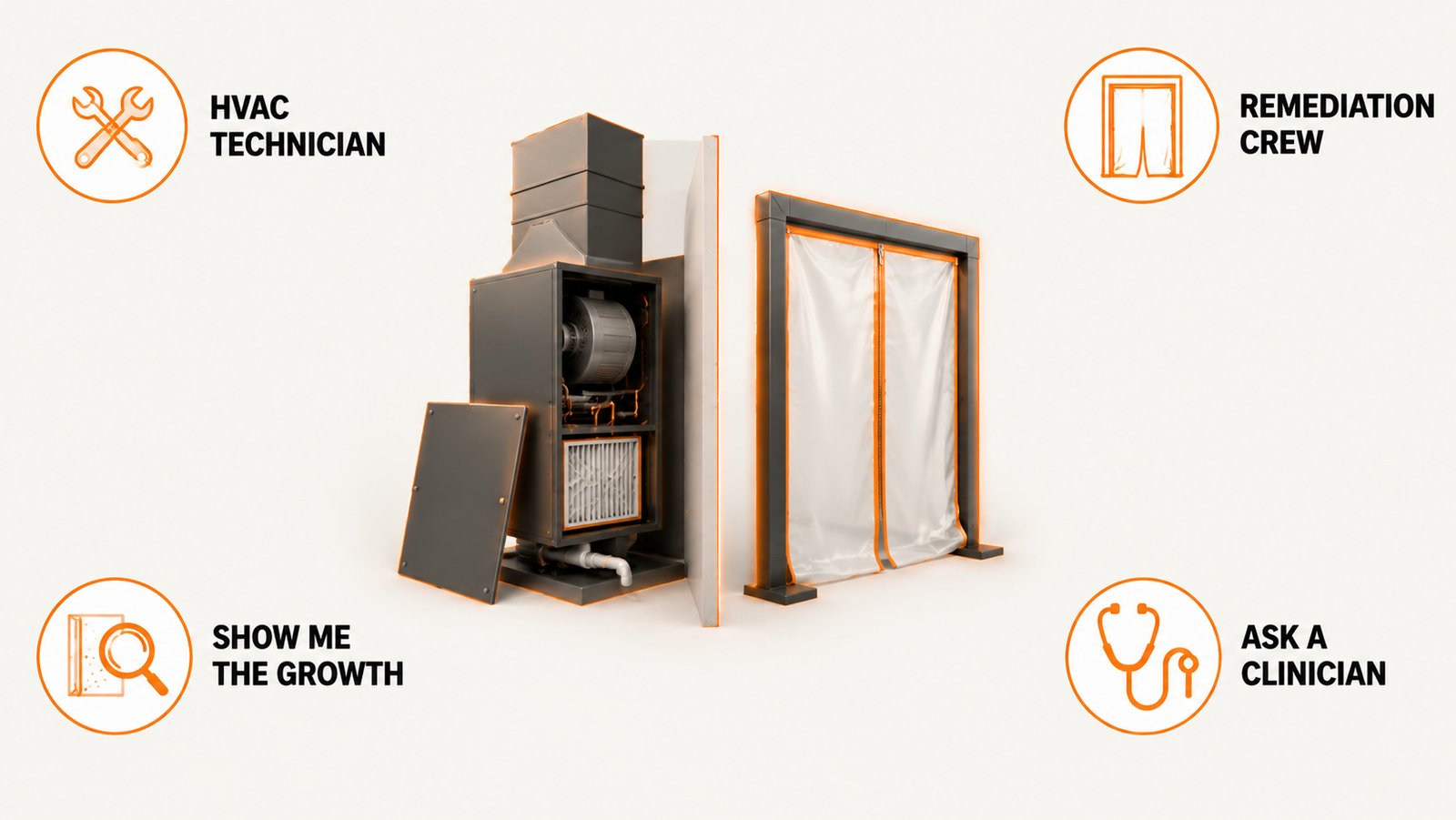
An HVAC technician handles the equipment. Coil cleaning, blower wheel removal, drain pan replacement, pan slope correction, refrigerant work and anything behind an electrical panel. Ask them to show you what they found in place, which is exactly what EPA advises.
A remediation contractor handles the building. If water from the system has soaked drywall, ceiling or insulation, that is a separate scope. EPA puts the do-it-yourself line at growth under about 10 square feet, less than roughly a 3 foot by 3 foot patch, and recommends a contractor with mold experience beyond that, working to its remediation guide, the ACGIH guidelines or the IICRC standard. Who does what is covered in mold specialist, and the sequence of the work in the remediation process.
Health questions go to a clinician. CDC states that exposure to damp and moldy environments may cause a variety of health effects or none at all, that people with asthma or a mold allergy may have severe reactions, and that immune-compromised people and people with chronic lung disease may get lung infections from mold. EPA advises consulting a health professional before starting cleanup if you have health concerns.
Frequently asked questions
What causes mold in an air conditioner?
Water that does not leave. The evaporator coil condenses moisture out of the air every time the system runs, and that water is supposed to drip into a pan and drain away. When the drain line blocks or the pan holds water, the wet parts stay wet between cycles, and dust that settles on them supplies the rest. Filters, blower wheels and porous duct lining downstream all follow from the same failure.
Can I run the AC if I think there is mold in it?
EPA says not to. Its guidance is that you should not run the HVAC system if you know or suspect that it is contaminated with mold, because it could spread mold throughout the building, and that you should consult its duct-cleaning guide before taking further action. An air handler distributes whatever is on the coil or in the pan to every supply register in the house.
How do I know it is really mold and not dust?
You often cannot tell by looking, and EPA says so. It notes that many sections of a heating and cooling system are not accessible for visible inspection, so you should ask a service provider to show you any mold they say exists, and that a positive determination can be made only by an expert and may require laboratory analysis. It also mentions that for about $50, some microbiology laboratories can identify a sample sent in on a clear strip of sticky household tape.
Is duct cleaning worth it?
It depends on the condition, and EPA offers no blanket recommendation because knowledge about duct cleaning is in its early stages. It does list substantial visible mold growth inside hard surface ducts or on other system components as a reason to consider cleaning. It also says duct cleaning has never been shown to prevent health problems, and that growth will recur if the conditions that caused it are not corrected.
Should a contractor spray a biocide or use ozone in my ducts?
Be cautious and ask what your ducts are made of. EPA states that no products are currently registered by it as biocides for use on fiberglass duct board or fiberglass lined ducts. It describes considerable controversy over introducing biocides or ozone into ductwork, notes little research demonstrating their effectiveness inside ducts, warns that material sprayed into an operating system may be transported into other areas of the home, and notes that ozone is regulated in outdoor air as a lung irritant.
What can I clean myself on an AC system?
With the power off at the thermostat and the breaker: the filter, the supply and return grilles, the surfaces around them, an accessible drain pan, and the condensate drain line at its cleanout. Use detergent and water on hard surfaces and dry completely, wearing gloves, goggles without ventilation holes and an N-95 respirator. Leave the coil, the blower wheel and the duct interior to a technician.
Why does my system smell musty when it first turns on?
Because the first air of a cycle passes over the parts that stayed wet since the last one, usually the coil and the pan. It is a signal worth investigating rather than a diagnosis. Check the drain line and the pan first, since a blocked drain is the most common reason those parts stay wet, and note that EPA considers a musty smell with no visible source a reason to suspect hidden growth.
Sources
Every claim on this page traces to one of these. Links open the primary document.