What the Midea Cube actually does for mold prevention
Start with what a dehumidifier is and is not. It pulls moisture out of room air. It does not clean mold off a wall, floor, or ceiling, and it does not fix the leak or condensation source that let mold start growing in the first place. The EPA and the IICRC S520 remediation standard both treat moisture control as the maintenance step, not the fix: stop the water, remove or clean the affected material, then keep humidity down so mold cannot re-establish. Household mold generally needs relative humidity above 60 percent to take hold, and most guidance recommends keeping indoor humidity under 50 percent as the target.
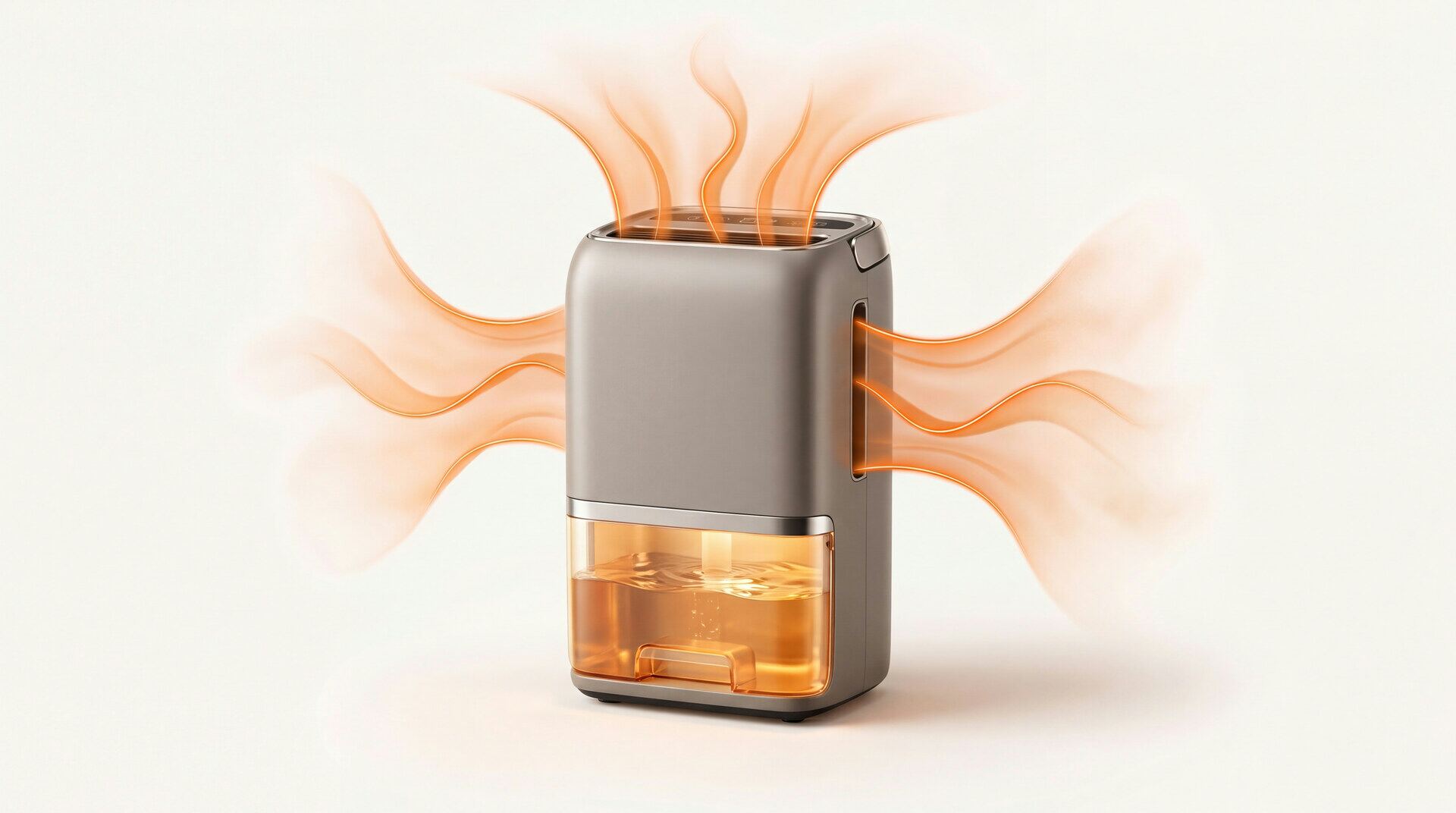
Inside that lane, the Midea Cube is a strong performer. It is manufacturer rated to remove up to 50 pints of water a day, and independent lab testing by Dehumidifier Buyers Guide measured it dropping a sealed test room from 90 percent to 40 percent relative humidity in under 8 minutes, the fastest result of any 50-pint dehumidifier that outlet had tested at the time. That speed matters most right after a leak or a flood, when getting ambient humidity down quickly limits the window mold has to establish. If growth is already visible on a porous surface like drywall or wood, running a dehumidifier next to it does not replace cutting the material out.
Verified specifications
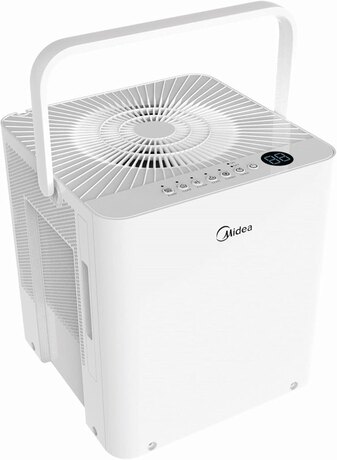
| Product | Midea Cube 50 Pint Dehumidifier with Built-in Pump (ASIN B091BYVD2W) |
| Moisture removal | 50 pints per day, manufacturer rated |
| Coverage claim | Up to 4,500 sq ft (manufacturer rating, ideal conditions) |
| Tank capacity | 4.2 gallons / 19 liters, removable bucket |
| Drainage | Built-in condensate pump plus included drain hose for continuous operation |
| Dimensions | 14.76 in wide x 14.45 in deep x 14.57 in tall |
| Weight | About 42 lbs empty |
| Max power draw | 425 watts |
| Humidity range | 35% to 85%, adjustable |
| Operating temperature | 41 degrees F to 95 degrees F |
| Noise, measured | 42.5 dB low, 49 dB high (independent bench test) |
| Smart control | WiFi app (2.4 GHz only) and Alexa voice compatible |
| Energy efficiency | ENERGY STAR certified, rated 1.8 liters removed per kWh |
| Warranty | 1 year, manufacturer |
Midea sells the Cube 50-pint line under several model numbers depending on retailer, color, and whether the pump is included. The ASIN reviewed here, B091BYVD2W, is the WiFi-enabled unit with the built-in pump.
The coverage number to trust
Midea rates the Cube 50-pint for spaces up to 4,500 square feet, and like most dehumidifier coverage figures, that number assumes ideal, warm, very humid starting conditions rather than a guaranteed real-world result. A unit's actual pint-per-day removal drops as the room gets cooler and drier, which is normal physics for every compressor-based dehumidifier, not a defect specific to this one.
For planning purposes, most single-level basements run 700 to 1,500 square feet. At that size, this unit has real headroom, which is a genuine advantage: it can hit and hold a 45 to 50 percent humidity target without running constantly, and it still has capacity in reserve for a very wet spring or a fresh water event. For a single bedroom or bathroom, a 4,500 sq ft rated unit is more machine and more money than the room needs; a 30-pint model sized for under 1,000 sq ft is the better fit there. Pair it with HEPA air purification if airborne spore capture is also a concern, since a dehumidifier addresses humidity, not particles already in the air.
Noise, reliability, and running cost
Noise. Independent bench testing by HouseFresh measured the Cube at 42.5 dB on its low setting and 49 dB on high, quiet for a 50-pint class unit. Low is close to a quiet office; high is closer to a running refrigerator, tolerable in a basement or utility room but noticeable in a bedroom.
Reliability. This is the honest catch behind the strong test numbers. Alongside good moisture-removal performance, there is a recurring pattern across Home Depot and Amazon owner reviews describing units icing up or failing to dehumidify entirely right around the 11 to 12 month mark, just past the 1-year manufacturer warranty window. Some owners also report the WiFi companion app disconnecting or feeling under-maintained, and it only supports 2.4 GHz networks, which trips up 5 GHz-only routers. Not every unit fails this way, but the pattern is common enough across independent sources that it belongs in the decision. Register the unit at purchase and hold onto the receipt.
Running cost. Maximum draw is 425 watts, and the unit is ENERGY STAR certified at 1.8 liters removed per kilowatt-hour. HouseFresh's own worst-case model, assuming continuous operation at full output for a full year, puts the ceiling near $447 in electricity. Realistic day-to-day cost is well under that ceiling for most households, since a dehumidifier cycles off once it hits its humidity target rather than running at full output nonstop, but it is the number to plan around if you expect to run it through an entire wet season without a break.
Emptying. The 4.2 gallon tank holds roughly 3 times what a standard portable dehumidifier tank holds, which means far fewer trips to the sink if you are not using the pump. The tradeoff is weight: the unit alone is about 42 lbs, and a full tank adds real weight on top of that, so several owners note it is awkward to lift and carry without the pump and drain hose set up to handle it automatically.
Pros and cons
Pros: Fastest measured moisture removal among 50-pint units in independent lab testing, dropping a test room from 90 percent to 40 percent relative humidity in under 8 minutes. 4.2 gallon tank holds roughly 3 times more water than a standard tank before it needs emptying. Built-in condensate pump plus drain hose for genuine hands-free continuous drain, uphill or away from the unit. Quiet for its class: measured 42.5 dB on low, 49 dB on high. ENERGY STAR certified. WiFi app and Alexa voice control for remote monitoring. Adjustable humidity target from 35% to 85%. Lift-and-twist design keeps the footprint compact for storage.
Cons: Only a 1-year manufacturer warranty, short for this price class. A real, recurring pattern of owner reports describing units icing up or failing right around the 11 to 12 month mark, just past that warranty. WiFi app is 2.4 GHz only and some owners describe it as poorly maintained or prone to dropping connection. Unit plus a full tank is heavy to lift and carry if the pump and hose are not set up. Running cost can climb toward roughly $447 a year in a worst-case, continuous-run estimate. Does not clean mold off a surface or fix the moisture source causing it.
Our rating: 4 out of 5. It wins on the number that matters most, how fast it actually pulls moisture out of the air, and loses some ground on warranty length and a real cluster of post-warranty failure reports.
Bottom line: The Midea Cube 50 pint is the strongest performer we found for basement and whole-home humidity control tied to mold prevention, and it is our best-overall pick in the best dehumidifier for mold guide. Buy it if fast, high-capacity moisture removal matters most to you and you are willing to register the warranty and keep an eye on it past month 11. If a longer warranty matters more than raw performance, compare it against the other picks in that same guide before you buy. It sits alongside the rest of our tested gear on the best mold products hub.
Skip this product if
- A long warranty matters more to you than peak performance. 1 year is short, and some rivals cover longer.
- You are risk-averse about reliability past the first year. There is a real, recurring pattern of owner-reported failures right around the 11 to 12 month mark.
- You need it dead silent for a bedroom. 42.5 dB on low is quiet for its class, but it is not silent.
- Your space is small. A 4,500 sq ft rated unit is more capacity, size, and cost than a single room needs.
- You do not want to deal with app setup. The WiFi app is 2.4 GHz only and some owners report it is flaky; the unit still runs fine without it.
- You expect it to remove existing mold. It controls humidity. Growth already on a surface needs cleaning or the material needs replacing.
Our #1 dehumidifier pick · built-in pump · ENERGY STAR. Affiliate link.
Frequently asked questions
Does the Midea Cube 50 pint dehumidifier help with mold?
It helps prevent mold by pulling moisture out of the air, not by treating mold that has already grown. The EPA and IICRC S520 standard both point to indoor humidity above 60 percent as a mold trigger, and to keeping humidity under 50 percent as the main prevention step. The Midea Cube is manufacturer rated to remove up to 50 pints of water a day, and independent lab testing measured it dropping a test room from 90 percent to 40 percent relative humidity in under 8 minutes, the fastest of the 50-pint units that outlet tested. It does not clean mold off a surface or fix a leak. Those still need a cleaning product and a repair.
How big of a space can the Midea Cube 50 pint actually cover?
Midea's own listing rates it for spaces up to 4,500 square feet, but that figure assumes ideal, warm, very humid starting conditions, the way most dehumidifier coverage numbers are marketed. Most single-level basements run 700 to 1,500 square feet, so this unit has real headroom for a full basement, a basement plus a main floor, or a large crawl space. For a single bedroom or bathroom, it is more capacity than you need.
Is the Midea Cube 50 pint dehumidifier reliable long term?
This is the honest catch. Alongside strong moisture-removal performance in independent testing, there is a recurring pattern in owner reviews at Home Depot and Amazon describing units icing up or quitting entirely around the 11 to 12 month mark, just past the 1-year manufacturer warranty. Not every unit fails this way, but the pattern shows up often enough to flag. Register the unit and keep the receipt in case you need to make a warranty claim early.
How loud is the Midea Cube 50 pint dehumidifier?
Independent bench testing by HouseFresh measured it at 42.5 dB on its low setting and 49 dB on high, quiet for a unit in the 50-pint class. That is roughly the level of a quiet office on low and a running refrigerator on high.
Does the Midea Cube have a pump, and how does the continuous drain work?
Yes. It ships with a built-in condensate pump plus a drain hose, so you can route water uphill to a sink, a window, or a floor drain instead of carrying the bucket. Once the hose is set up and the unit is set to continuous drain mode, it runs unattended without filling the internal tank.
How big is the water tank and how often do you empty it?
The removable bucket holds 4.2 gallons (about 19 liters), roughly 3 times the capacity of a standard portable dehumidifier tank, so it needs emptying far less often if you are not using the pump. The tradeoff is weight: a full bucket is heavy to lift out and carry, and several owners note the unit and full tank together are awkward to move without the pump and drain hose set up.
Is the Midea Cube WiFi app worth using?
It works for basic remote monitoring and Alexa voice control, and lets you set a humidity target from your phone. It only connects to 2.4 GHz WiFi networks, which trips up some households on a 5 GHz-only router. Some owners also report the companion app has not been well maintained, with occasional connection drops. Treat smart control as a convenience feature, not a reason to buy this unit over a non-WiFi model.
How much does the Midea Cube cost to run?
It draws up to 425 watts at maximum output and is ENERGY STAR certified, rated to remove about 1.8 liters of water per kilowatt-hour. HouseFresh's own worst-case model, run continuously at full output for a year, put the ceiling near $447 a year in electricity. Most households do not run a dehumidifier at full output around the clock, so realistic day-to-day cost is well under that ceiling, but it is the number to budget against if you plan to run it non-stop through a wet season.
Is the Midea Cube 50 pint dehumidifier worth it?
Yes, with two real caveats. It earns 4 out of 5 here. Independent testing found it removed moisture faster than other 50-pint units tested, the tank is large enough to go long stretches without emptying, and the built-in pump makes hands-free continuous drain easy to set up. The catches are a short 1-year warranty and a real cluster of owner reports of units failing right around that warranty's edge. Buy it if you want the fastest-tested moisture removal in its class and you register the warranty. Skip it if a longer warranty matters more to you than raw performance.
Sources
Every claim on this page traces to one of these. Links open the primary document.