What the HPA300 actually does about mold
Start with the honest version, because most air purifier marketing skips it. A purifier moves room air through a filter and holds whatever the filter can catch. That is the whole mechanism. It does not dry a damp wall, it does not lift growth off tile or drywall, and it does nothing about the leak or the humidity that started the problem. The EPA is blunt on the order of operations: fix the moisture, clean or remove the affected material, then keep humidity down. A purifier supports that work. It never replaces it.
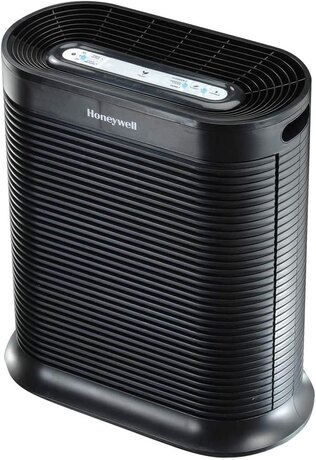
Inside that lane, the HPA300 does its core job well for the price. Household mold spores run roughly 2 to 10 microns across. The HPA300 uses a True HEPA filter rated to capture 99.97 percent of particles down to 0.3 microns, backed by a thin bonded activated carbon pre-filter for larger debris and some odor control. That capture rating comfortably covers spore size, and its 320 CFM dust CADR is high for a unit that typically sells under $250.
The trade-off shows up in the parts Honeywell spent less on: the carbon layer is thinner than what pricier units use, so odor control lags behind spore capture, and there is no smart sensor or Auto mode to manage the fan for you. If the growth is on a porous surface like drywall or wood, the material still has to come out regardless of which purifier is running nearby.
Verified specifications
| Model | HPA300 |
| CADR | Dust 320 CFM, Smoke 300 CFM, Pollen 300 CFM |
| Filtration | True HEPA filter (3 small cartridges) plus a bonded activated carbon pre-filter. Rated 99.97 percent at 0.3 microns |
| Coverage claim | 465 sq ft at 4.8 air changes per hour (some listings also print 2,250 sq ft at 1 air change per hour) |
| Dimensions | 20.8 in deep x 10.83 in wide x 22.38 in tall |
| Weight | 17 pounds |
| Rated speeds | 4: Germ, General Clean, Allergen, Turbo, plus a 2/4/8 hour timer |
| Noise, measured | 43.6 dB speed 1, 48.8 dB speed 2, 53.9 dB speed 3, 59.5 dB Turbo (measured 3 ft away) |
| Power draw, measured | 28.35W speed 1, 42.92W speed 2, 55.8W speed 3, 76.2W Turbo |
| Replacement filters | True HEPA Filter R (HRF-R3), every 12 months. Carbon Pre-Filter A, every 3 months |
| Smart control | None. No app, no WiFi, no remote |
| Certifications | ENERGY STAR certified |
| Warranty | 5 years |
Two rows are worth reading twice. Honeywell's own spec sheet lists 465 square feet as the recommended room size, but some retail listings advertise a much bigger 2,250 square foot number on the same page. Both are technically true, they just measure different things, which the next section untangles.
The room size number to trust
Honeywell prints two coverage figures in different places and they describe very different things. 465 square feet is the manufacturer's own recommended room size, rated at 4.8 air changes per hour. 2,250 square feet, which shows up in some retail listing titles, is the area the fan can move through once in an hour, a single air change.
For mold work, 465 square feet is the number to plan around. One air change per hour means spores you stir up while scrubbing spend most of the hour still in the room. Roughly five changes per hour, which is what the 465 square foot rating delivers, is where a purifier starts meaningfully lowering what stays airborne during and after cleanup. Read the 2,250 figure as a marketing number, not a room you should actually put this unit in.
Placement matters as much as room size. Put it in the room you are working in, not the hallway, keep it a foot or so off the wall so the intake is not choked, and close the door to the rest of the house so you are not asking it to clean the whole floor plan. If you are treating a basement, pair it with a dehumidifier holding humidity under 50 percent, because the purifier does nothing about the moisture that caused this.
Noise and what it costs to run
Noise. Independent bench testing measured the HPA300 from 3 feet away at 43.6 dB on Germ (speed 1), 48.8 dB on General Clean (speed 2), 53.9 dB on Allergen (speed 3), and 59.5 dB on Turbo. There is no dedicated sleep or silent mode, which is the single most common complaint from people who want to run it overnight. Speed 1 is the only setting that stays under 45 dB, and it is not the setting that clears a room fast. In a 728 cubic foot test room, the same testers measured Turbo clearing incense smoke in 20 minutes, speed 2 reaching zero in 34 minutes, and speed 1 taking 50 minutes. There is a real speed-for-quiet trade here, not a free lunch.
Running cost. Filters are the fixed cost regardless of speed: a True HEPA filter (Filter R) about once a year and a carbon pre-filter (Filter A) about every 3 months, together running roughly $89 a year for genuine Honeywell parts. Electricity scales with speed. Measured draw runs from 28.35 watts on speed 1 up to 76.2 watts on Turbo, and running Turbo literally around the clock for a year would add roughly $116 in electricity, for a worst-case total near $205 a year. Most households never run Turbo continuously, so real-world electricity cost is usually well under that ceiling; the filter cost is the part that does not change.
What you do not get. No app, no WiFi, and no remote. Controls are a physical touch panel: four fan speeds, a timer, and a dimmer for the display lights. The front panel also clips into place rather than screwing down, and it can pop loose if you grab the unit by the wrong edge while moving it between rooms. None of this affects filtration, but it is worth knowing before the box is open.
Pros and cons
Pros: 320 CFM dust CADR at a price well under most large-room rivals, among the best CADR-per-dollar ratios we have reviewed. True HEPA filtration rated 99.97 percent at 0.3 microns, comfortably below mold spore size. Ready to run straight out of the box with simple, responsive touch controls. Small footprint with inset side handles, easy to carry between rooms. ENERGY STAR certified. 5 year manufacturer warranty, long for this price class. Genuine and third-party replacement filters are widely available and easy to swap in about 30 seconds.
Cons: No sleep or silent mode, and Turbo measured 59.5 dB, loud enough to be the focus of a room. No app, WiFi, or remote control. The bonded carbon pre-filter is thin and weaker on odor control than thicker rivals. Power draw at top speed, 76.2 watts measured, runs higher than several similarly priced competitors. The front panel clips on rather than locking down and can pop loose in transit. The 2,250 square foot coverage figure printed on some listings is a one-air-change number and overstates the usable room size.
Our rating: 3.5 out of 5. It earns its keep on the number that matters most for mold, spore capture per dollar, and loses ground on comfort features and noise.
Bottom line: Buy the HPA300 if the purchase price is the deciding factor and you can live with a purifier that has an opinion about how loud a room should be. Run it while you clean and keep it running afterward on a lower speed. Then go fix the water, because that is the part that actually ends the problem. It is our budget pick in the best air purifier for mold guide, and it sits alongside the rest of our tested gear on the best mold products hub. If quiet overnight operation or app control matter more to you than price, see our Levoit Core 600S review instead.
Skip this product if
- You need it running quietly overnight. There is no sleep or silent mode, and even speed 1 measured 43.6 dB from 3 feet away.
- You want app or WiFi control. The HPA300 has none. Controls are a physical panel only.
- Odor control matters as much as spore capture. The carbon pre-filter is thin. A unit with a thicker or loose-fill carbon layer will do more for musty smells.
- You expect it to remove mold. It filters air. Growth on a surface has to be cleaned off or the material cut out and replaced.
- You have not fixed the water yet. Running a purifier over an active leak treats the symptom forever. Find the source first.
- You are set on the biggest coverage number. Plan around the 465 sq ft rating, not the 2,250 sq ft marketing figure.
Best budget pick · True HEPA · 5 year warranty. Affiliate link.
Frequently asked questions
Does the Honeywell HPA300 remove mold spores?
It captures airborne mold spores that pass through its filter. Household mold spores run roughly 2 to 10 microns across, and the HPA300 uses a True HEPA filter rated to capture 99.97 percent of particles down to 0.3 microns, which comfortably covers spore size. What it cannot do is touch mold already growing on a wall, floor, or ceiling, or fix the moisture that let it grow there.
How big a room does the Honeywell HPA300 actually cover?
Honeywell's own spec sheet rates it at 465 square feet with 4.8 air changes per hour, which is the number worth planning around. Some retail listings also print a 2,250 square foot claim, but that figure is one air change per hour, a much weaker cleaning rate. For mold work, treat 465 square feet as this unit's honest ceiling, not 2,250.
How loud is the Honeywell HPA300?
Independent bench testing by HouseFresh measured it from 3 feet away at 43.6 dB on Germ (speed 1), 48.8 dB on General Clean (speed 2), 53.9 dB on Allergen (speed 3), and 59.5 dB on Turbo (speed 4). There is no dedicated sleep or silent mode. Speed 1 is the only setting that stays under 45 dB, and Turbo is loud enough that most people run it only to clear a room fast, then step it back down.
What does the Honeywell HPA300 cost to run per year?
HouseFresh calculated about $205 a year in the worst case: roughly $116 in electricity if you ran it on Turbo 24 hours a day, plus about $89 a year in filters (a True HEPA filter every 12 months and a carbon pre-filter every 3 months). Realistic day-to-day cost is lower, since most people do not run Turbo around the clock, but the filter cost is fixed regardless of speed.
Does the Honeywell HPA300 have a sleep mode or app control?
No. There is no WiFi, no app, and no remote. Controls are a physical touch panel with four fan speeds (Germ, General Clean, Allergen, Turbo), a 2/4/8 hour timer, and a dimmer for the display lights. It has no dedicated sleep or silent setting, which is the most common complaint from nighttime users.
Will an air purifier fix a mold problem on its own?
No. A purifier filters particles out of the air passing through it. It does not dry a wet wall, it does not clean growth off a surface, and it does not stop the leak feeding the problem. The EPA is direct about the order of operations: fix the moisture source first, clean or remove the affected material, then keep indoor humidity down. A purifier supports that work. It never replaces it.
Honeywell HPA300 or Levoit Core 600S for a mold room?
The HPA300 is the cheaper unit and has a slightly higher dust CADR (320 versus the Core 600S's rating), but it runs louder at every matched speed, has no app or Auto mode, and draws more power on its top setting (76 watts measured versus 48). The Core 600S costs more up front but adds smart control and a quieter ceiling. Buy the HPA300 if price is the deciding factor and you can live with the noise. Buy the Core 600S if you want app control and a quieter top speed.
How often do you need to replace the Honeywell HPA300 filters?
Honeywell calls for replacing the True HEPA filter (Filter R, part HRF-R3) about once every 12 months and the activated carbon pre-filter (Filter A) about once every 3 months. Because the HPA300 uses three small HEPA filters instead of one large one, you can buy a single replacement, a pair, or all three depending on how dirty each one is.
Is the Honeywell HPA300 worth it?
For the price, yes, with real trade-offs. It earns 3.5 out of 5 here. You get a True HEPA filter and a high CADR rating for spore capture at a budget price, ready to run out of the box. The catches are real: it gets loud with no sleep mode, has no app or remote, and its carbon layer is thinner than pricier rivals, so odor control lags behind spore capture. Buy it if the budget matters most. Skip it if you need quiet overnight operation or smart controls.
Sources
Every claim on this page traces to one of these. Links open the primary document.