Does salt kill mold?
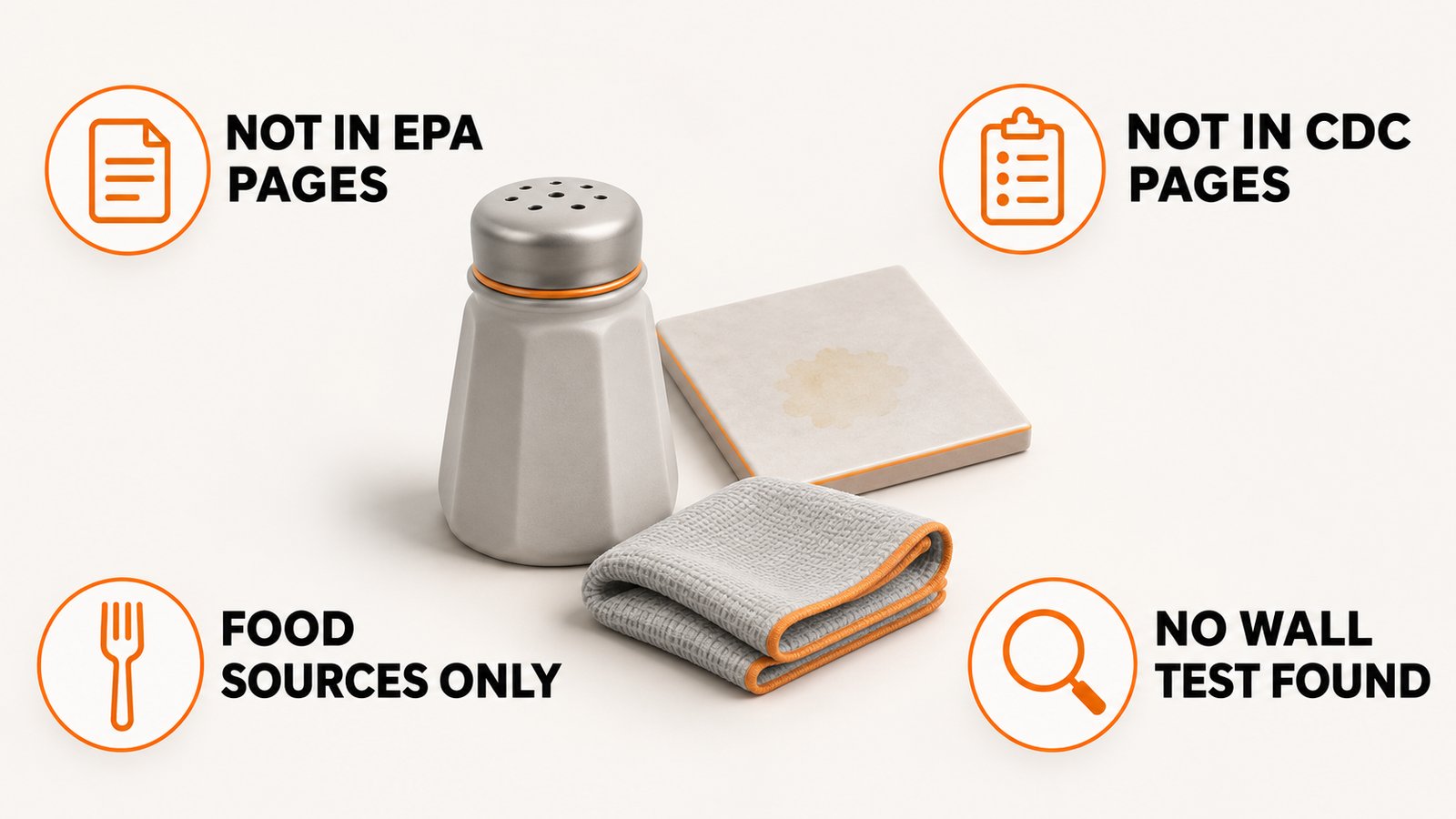
We can't say that it does. For mold in a home, the sources that count are the EPA and CDC cleanup pages. We searched every EPA and CDC page we cite for "salt" and "desiccant": EPA's cleanup page, its brief guide, mold course chapters 3, 4 and 9, and two CDC cleanup pages. None recommends salt, and none mentions a desiccant. The only hit was a note that a white, soluble material on crawl space soil may be alkaline salts, not mold.
That is a finding about what the agencies say, not a test of salt. We found no agency or university test of table salt on mold growing on drywall, wood or grout. Salt does appear in food research and lab dishes, and the next sections say where those stop applying to a home. Table salt is sodium chloride; borax and baking soda are different compounds. For a wider look, see what kills mold.
Can salt stop mold growing in food?
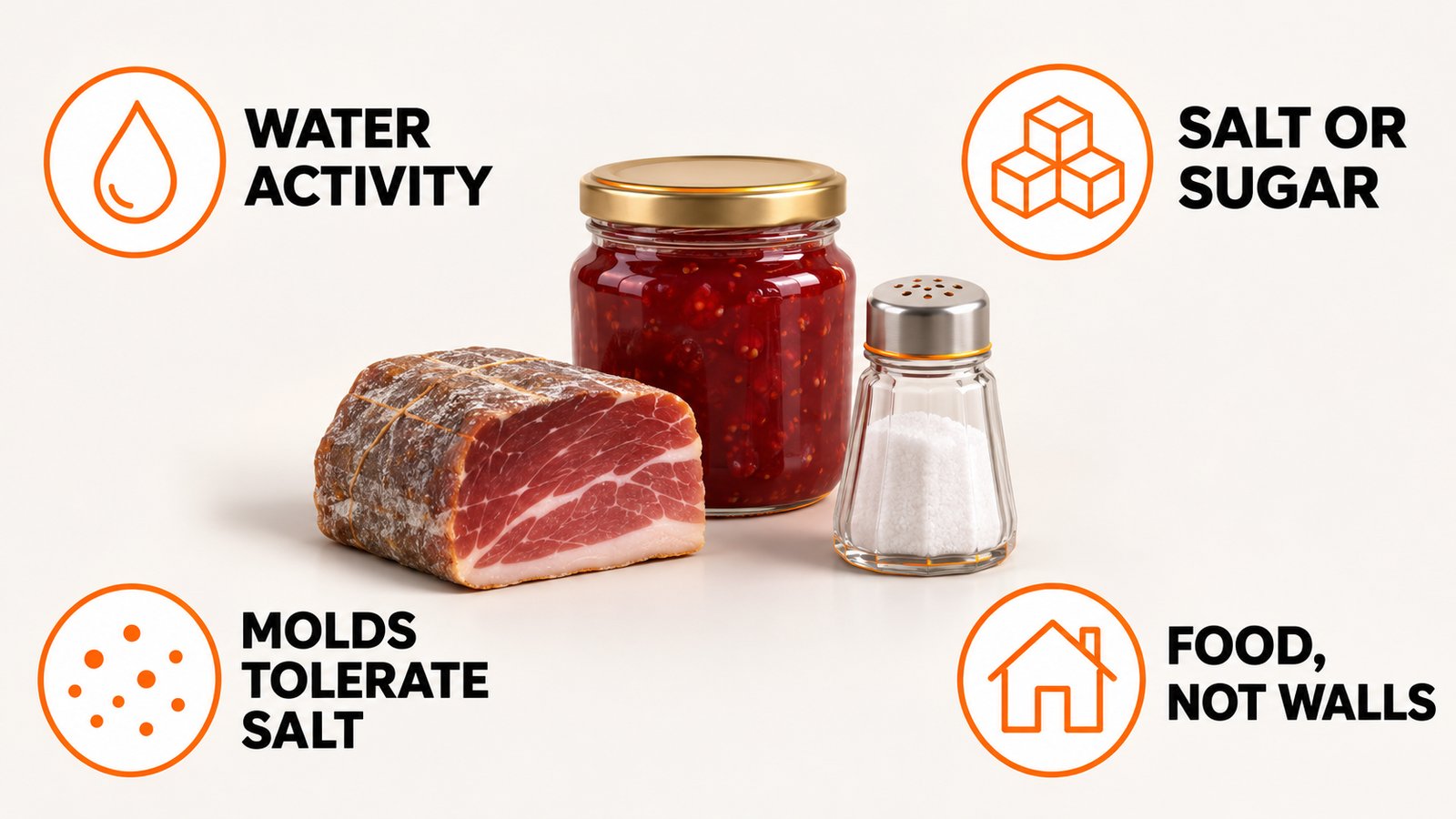
Salt is used in food preservation, but even there it does not make food mold-proof. USDA's Food Safety and Inspection Service says: "Molds also tolerate salt and sugar better than most other food invaders." It adds that molds can grow in refrigerated jams and jellies and on cured, salty meats.
The FDA explains the measure behind food preservation, water activity. A water activity of 0.80, it says, means the vapor pressure of the food is 80 percent of that of pure water. It says most foods have a water activity above 0.95, which provides enough moisture for bacteria, yeasts and mold, and that the available moisture "can be reduced to a point which will inhibit the growth of the organisms." In the canned foods it lists, it says water activity is usually controlled by the use of salt or sugar, and that a salt or sugar solution has a lower vapor pressure than pure water.
Our reading is that salt works in food by tying up water. That is about a food product measured in a lab. We found no agency source that applies it to drywall, wood or a bathroom wall. This page makes no claim that any salted or cured food is safe to eat.
Does salt water kill mold on a wall?
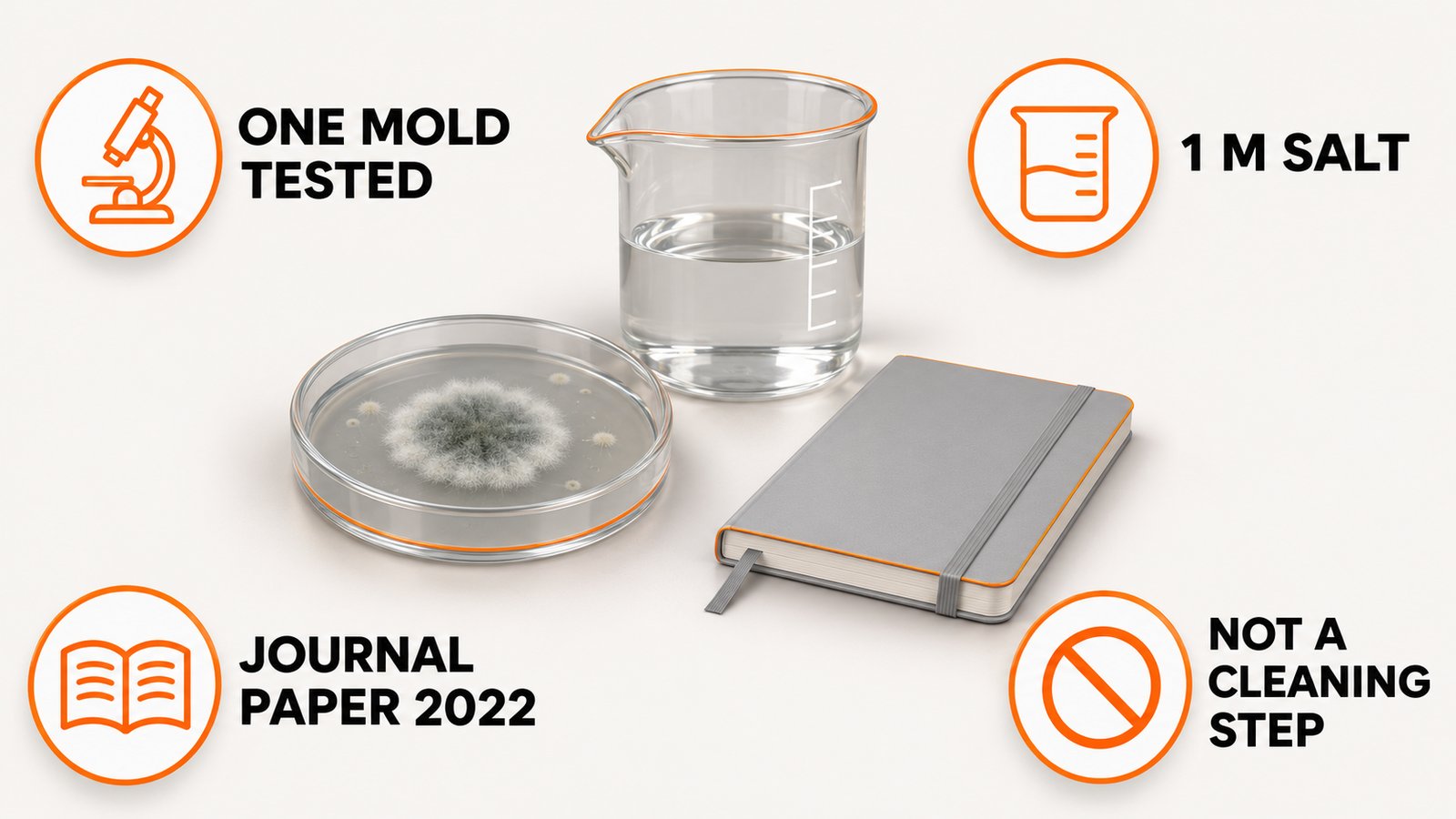
We can't say that it does, and no agency we cite gives a salt-water recipe for mold. The closest research we found is one peer-reviewed lab paper: "Salt tolerance of Chaetomium globosum, a common indoor mold," published in the journal BIOS in 2022. We read the abstract only; the full text was blocked to us.
Here is what the abstract says was tested. The authors grew isolates of that one mold, found in buildings and homes, on malt extract agar or broth that had been amended with sodium chloride, potassium chloride, calcium chloride or magnesium chloride at 0 to 2 M. They measured spore germination, spore production, growth and the fruiting structures called perithecia. Spore germination was inhibited by 1 M sodium chloride, spore production and growth were inhibited at 1 M, and perithecia formation at 1 and 2 M. The authors also wrote that the isolates "appeared to be halotolerant and only relatively high concentrations of salt inhibited the growth, ascospore synthesis, germination, and perithecia production." The abstract notes two exceptions: a much lower level of calcium chloride, 100 mM, inhibited ascospore synthesis, and 1 M potassium chloride did not inhibit germination.
One molar sodium chloride is about 58 grams of salt in each liter of liquid, by our arithmetic from the molar mass. The paper covers one organism in a lab medium, "inhibited" is not "killed," and it is not a cleaning instruction: it does not say how much salt to put on a surface, or whether to. Salt water on a wall is still water on a wall, and EPA's advice for damp materials is to dry them within 24 to 48 hours.
Does a bowl of salt absorb moisture and stop mold?
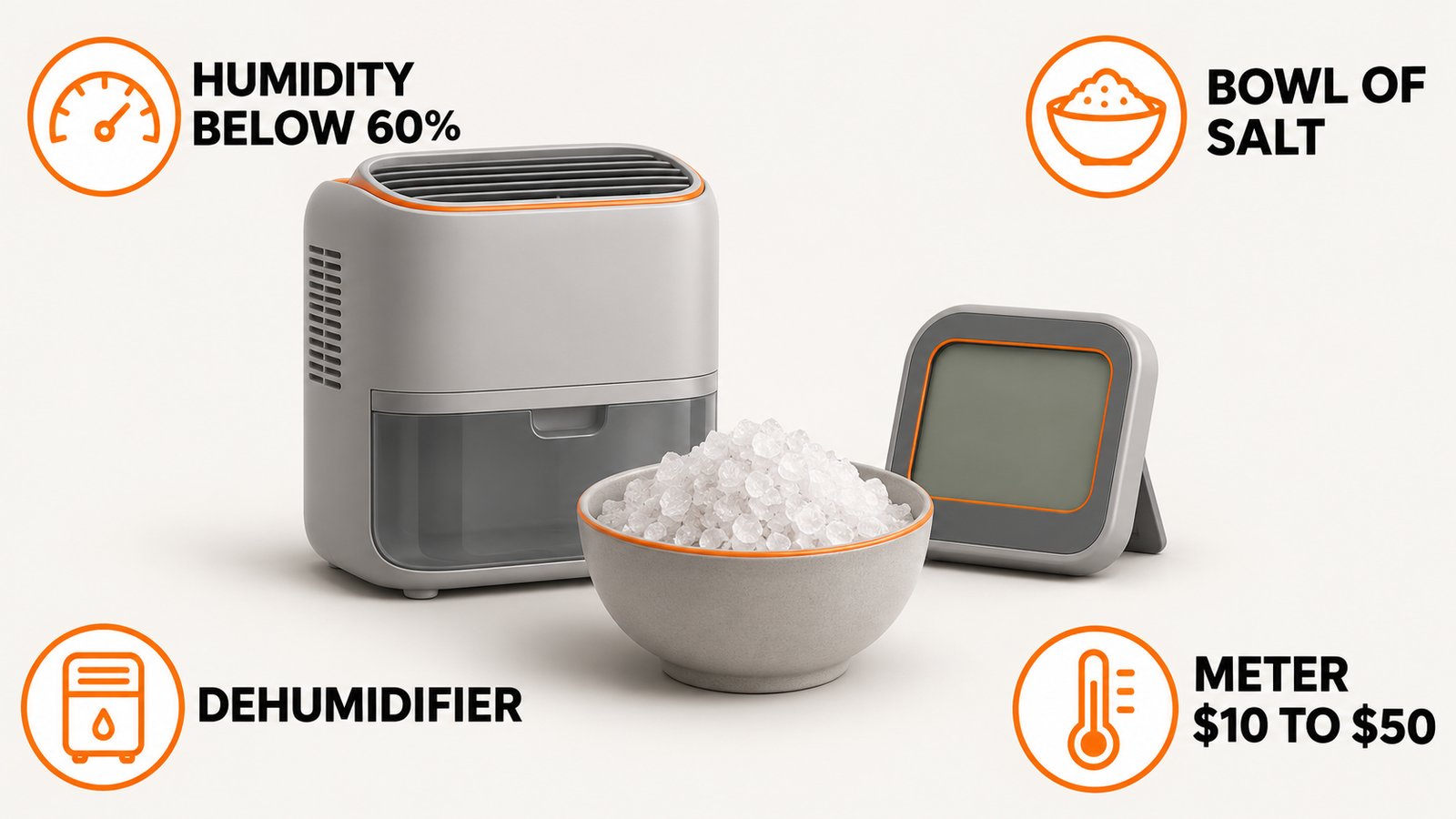
We can't say how much it helps, because we found no agency or university test of a bowl of salt in a room. The FDA's food guide does say that saturated salt solutions maintain a constant humidity as long as the amount of salt present is above saturation level. The FDA uses salts that way to calibrate humidity instruments, with a range of 0.758 to 0.969 across three salts. It does not say which value belongs to table salt, so we don't quote one.
Our reading is that a salt in damp air settles at a humidity set by the salt, not at the target you want. Only a meter can tell you where your room lands. EPA's guidance is below 60 percent relative humidity, ideally between 30 and 50 percent, and it says a moisture or humidity meter costing $10 to $50 can measure it.
| Question | What EPA says | What we found on salt |
|---|---|---|
| Target | Indoor humidity below 60 percent, ideally 30 to 50 percent. | No agency test of a bowl of salt against that target. |
| How to lower humidity | Air conditioners or dehumidifiers when needed, vented appliances, the bathroom fan. | Salt is not on EPA's list. |
| The source of the water | Fix leaks. Dry wet areas within 24 to 48 hours. | A bowl does not stop a leak or dry a wet wall. |
If humidity is the question, our dehumidifier guide and humidity risk calculator are the better place to start. The calculator compares a reading from your own hygrometer with EPA's 30 to 50 percent range. See also mold in a closet and mold in a basement.
Is the white powder on my wall salt or mold?
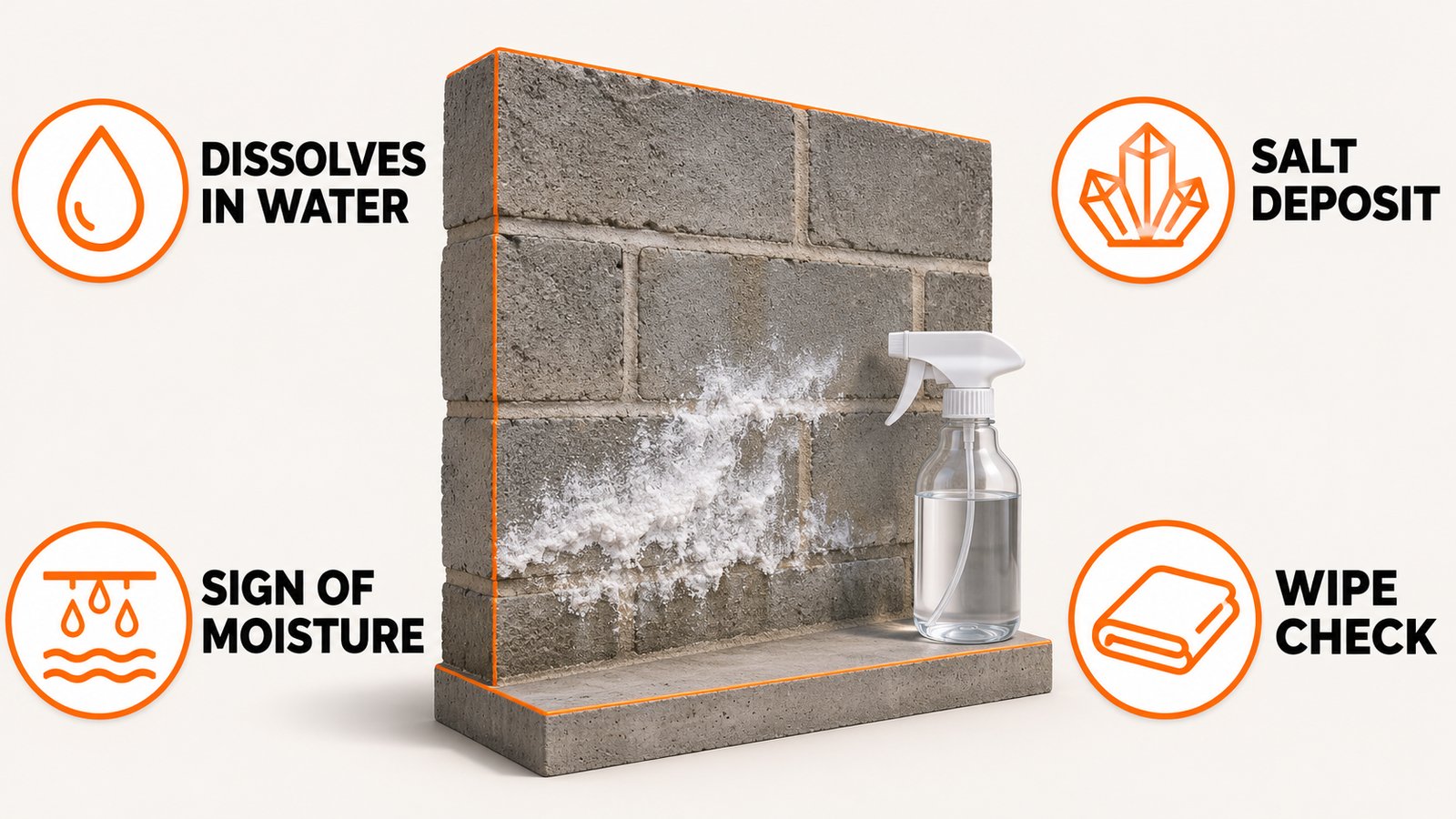
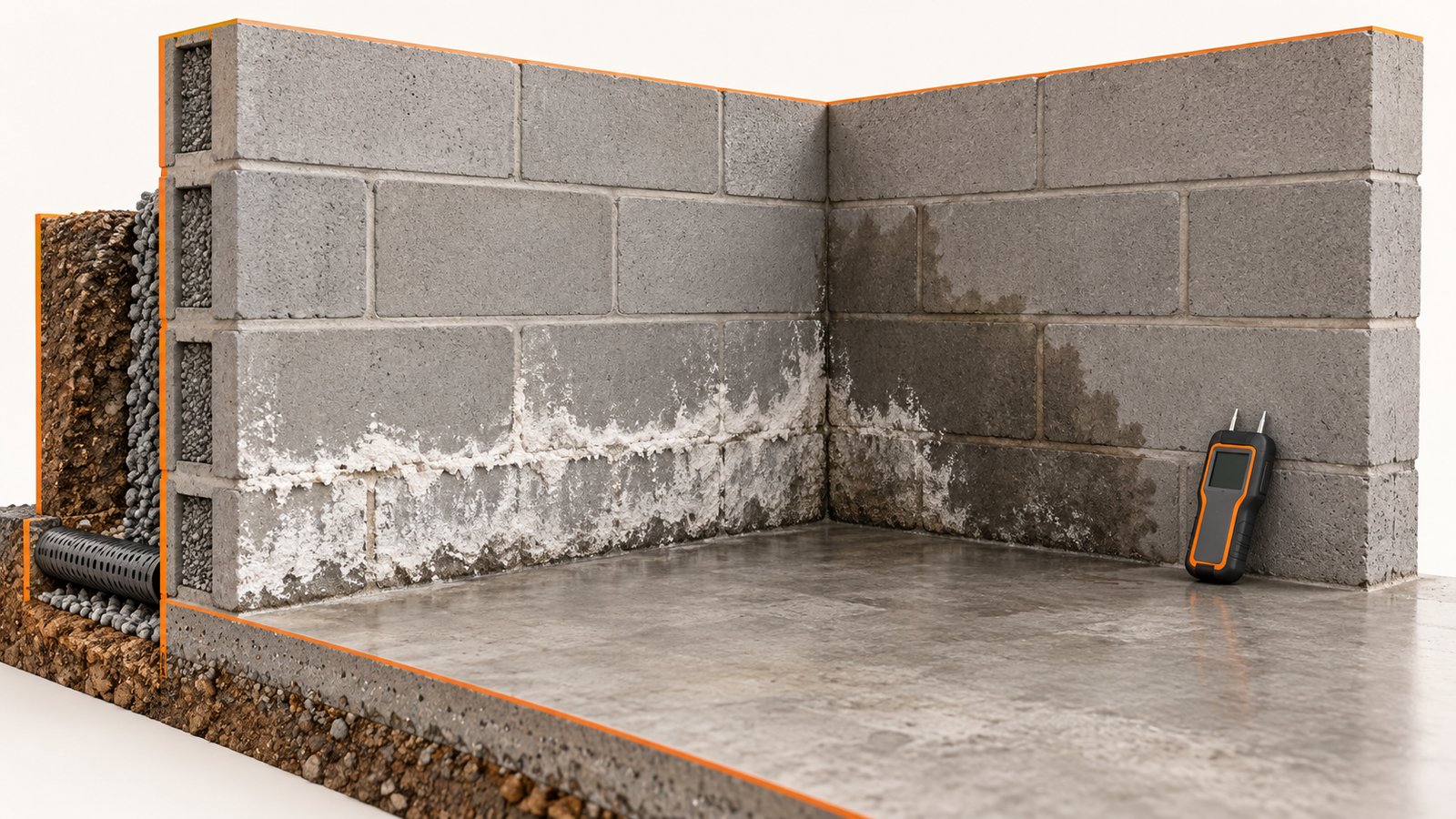
It can be either, and the two need different responses. North Dakota State University Extension says moisture coming through a basement floor or wall may deposit a light-colored salt and other minerals that are sometimes thought to be mold, and that the deposits "should quickly dissolve and disappear when wet with water if they are a salt." EPA's mold course makes a similar point about crawl spaces: a white, soluble material on the soil may be alkaline salts, not mold, indicating moisture has been a problem and suggesting that the area should be more extensively inspected.
A damp-cloth wipe is our own quick check, not an agency test. If the patch dissolves, it was probably salt. If it does not, or if you are unsure, treat it as possible mold. The wipe has limits: it cannot rule out mold growing underneath, and thin growth can lie flat. Either way, moisture is the problem to find.
Our efflorescence vs mold guide shows how to tell them apart. The Mold Scanner app also offers AI-assisted visual screening of a photo. Processing time varies, and it is not a lab test.
What works instead of salt for mold?
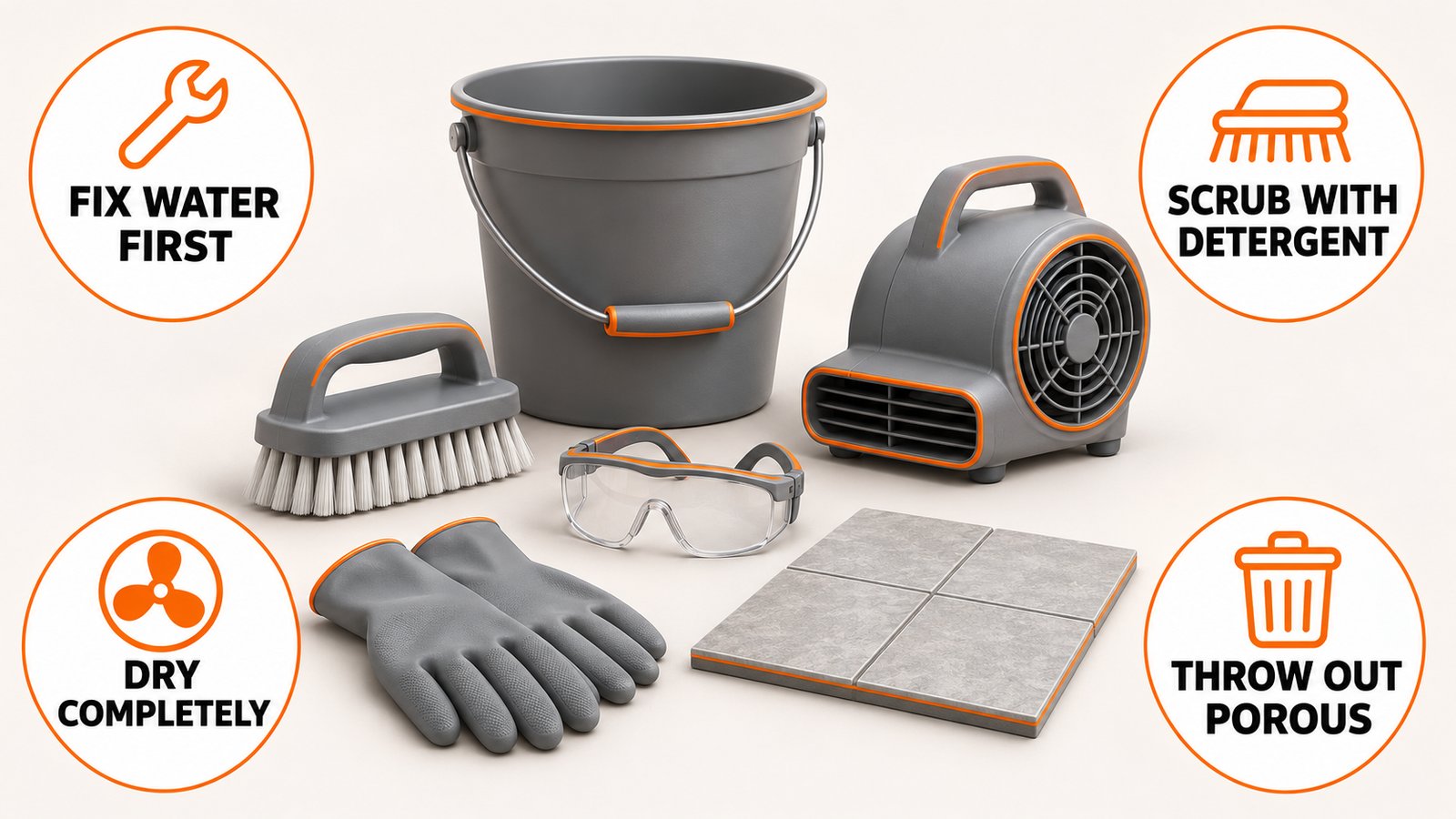
EPA's method, in its own order. Fix plumbing leaks and other water problems as soon as possible, and dry all items completely. Scrub mold off hard surfaces with detergent and water, and dry completely. Absorbent or porous materials, such as ceiling tiles and carpet, may have to be thrown away if they become moldy.
EPA's brief guide adds two points. "Dead mold may still cause allergic reactions in some people, so it is not enough to simply kill the mold, it must also be removed." And if you clean up the mold but don't fix the water problem, then, most likely, the mold problem will come back.
For protection, EPA says you may want to wear an N-95 respirator, and that goggles without ventilation holes are recommended. CDC says never to mix bleach with ammonia or any other cleanser. See how to get rid of mold, how to prevent mold and mold cleaning products.
When to call a pro
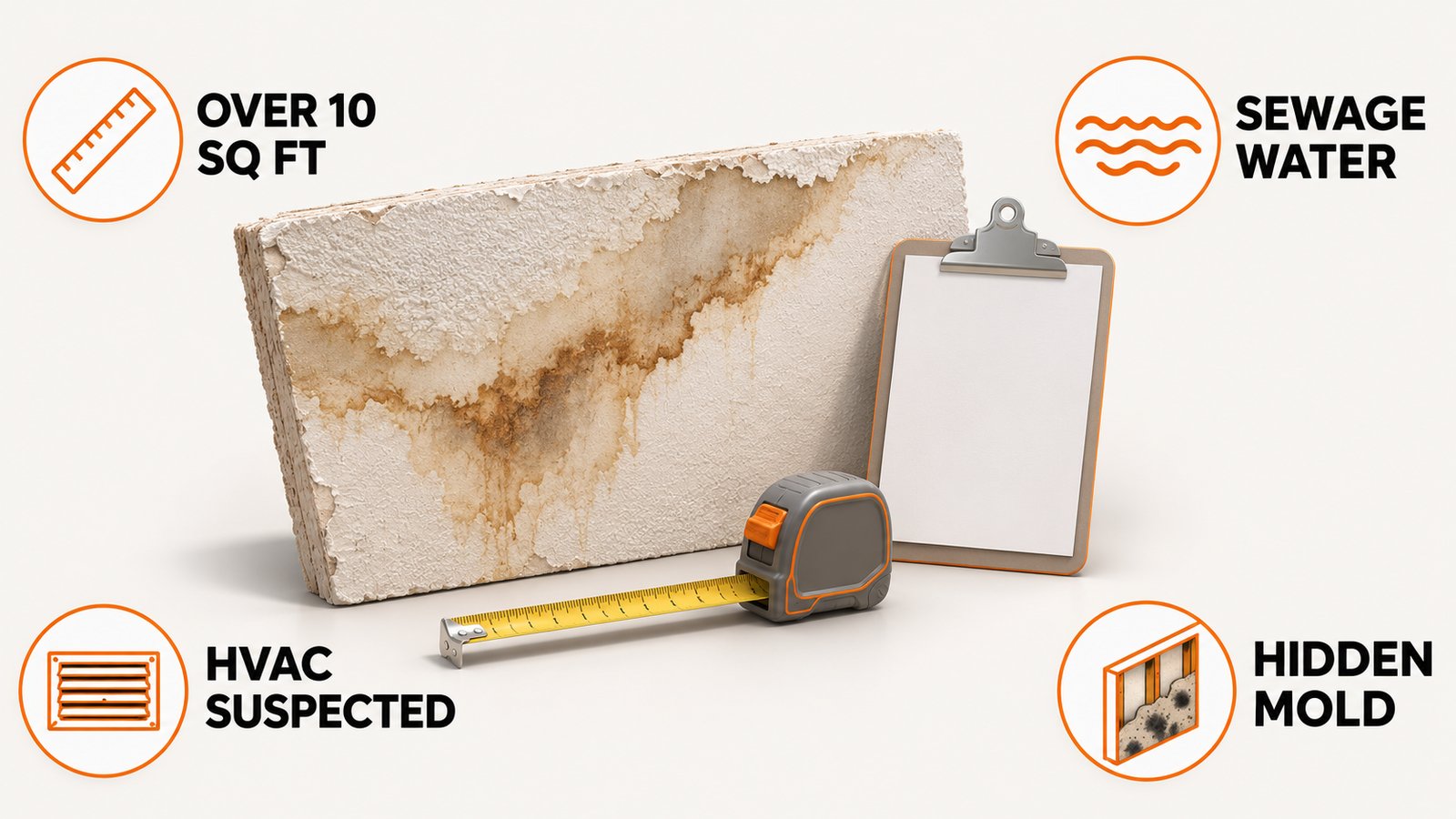
EPA points elsewhere in these cases:
- The patch covers more than about 10 square feet, or there has been a lot of water damage. EPA points to its guide for larger jobs. Past that size, we suggest a professional.
- The water came from sewage or other contaminated water. EPA says to call in a professional with experience in that kind of damage.
- You suspect mold in the heating and cooling system. EPA says not to run the system.
- You have health concerns. EPA says to consult a health professional before starting cleanup.
- You suspect hidden mold: the building smells moldy but you cannot see the source, or there has been water damage and residents are reporting health problems. EPA says to consider hiring an experienced professional.
Our mold remediation process page explains what a professional does, and the free 160-point checklist walks through visible areas room by room.
Frequently asked questions
Does salt kill mold?
We found no EPA or CDC page that recommends salt for mold in a home, and no agency test of salt on mold growing on building materials. The research that exists is about food and lab dishes. EPA's method is to fix the moisture, scrub hard surfaces with detergent and water, and dry completely.
Does salt water kill mold?
We can't say it does. A 2022 lab paper in the journal BIOS found that one indoor mold, grown in a nutrient medium, had several growth steps inhibited at 1 M sodium chloride, about 58 grams of salt per liter by our arithmetic. Inhibited is not killed, and the paper is not a cleaning instruction.
Does salt absorb moisture and prevent mold?
We found no agency or university test of a bowl of salt in a room. EPA's guidance is to keep indoor humidity below 60 percent, ideally 30 to 50 percent, by fixing leaks and using air conditioners or dehumidifiers when needed.
Does salt stop mold growing on food?
USDA's Food Safety and Inspection Service says molds tolerate salt and sugar better than most other food invaders, and that they can grow on cured, salty meats. This page is about homes and makes no claim about whether any salted or cured food is safe to eat.
Is white powder on my wall salt or mold?
It can be either. North Dakota State University Extension says moisture through a basement wall may deposit a salt that is sometimes thought to be mold, and that a salt deposit should dissolve when wet with water. Either way, find the moisture source.
Is salt the same as borax or baking soda for mold?
No. Table salt is sodium chloride. Borax and baking soda are different compounds with their own evidence, which our borax and baking soda pages cover. None of the three is on EPA's cleanup list, which names detergent and water for hard surfaces.
What should I use instead of salt on mold?
Follow EPA: fix the water problem, scrub mold off hard surfaces with detergent and water, and dry completely. Porous materials such as ceiling tiles and carpet may have to be thrown away. Past about 10 square feet, EPA points to its guide for larger jobs, and we suggest a professional.
Sources
Every claim on this page traces to one of these. Links open the primary document.