The Mold Growth Timeline
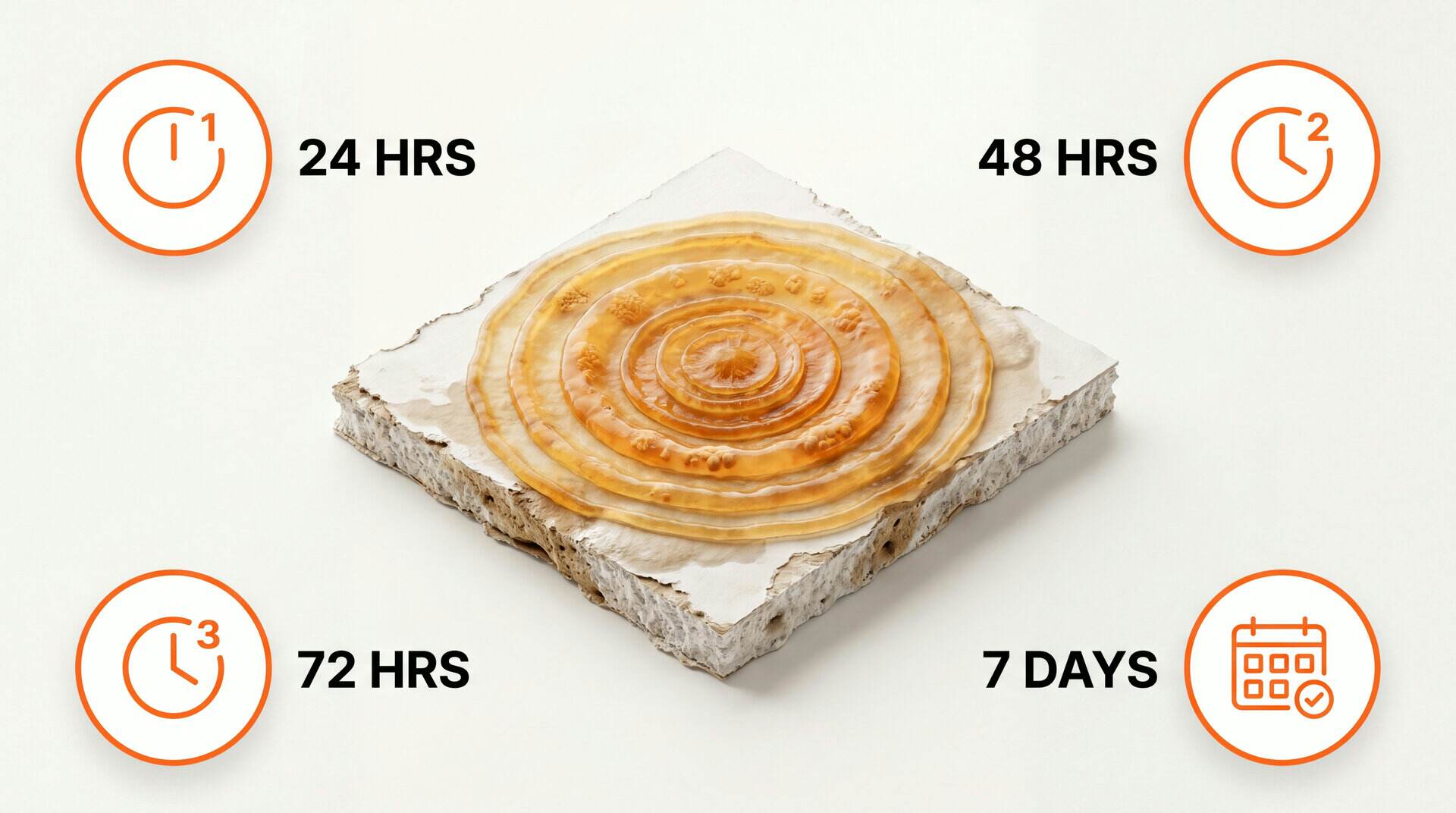
Understanding how fast mold grows helps you know when you have time and when you need to act immediately. Here is the timeline from initial water exposure to a full mold problem.
Hour 0 to 24: Spore germination. Mold spores are already present on nearly every surface in your home. They are microscopic, dormant, and waiting for moisture. When a surface gets wet and stays wet, spores within contact begin germinating. They send out hyphae (thin root-like threads) into the material. At this stage, there is nothing visible to the naked eye.
Hour 24 to 48: Colonization begins. Hyphae spread through the wet material, branching and forming a network called mycelium. The mold is feeding on the organic material (cellulose in drywall, wood, paper) and growing rapidly. Still not visible without magnification, but the colony is established.
Day 3 to 7: Visible growth. The mycelium network becomes dense enough to see. Small fuzzy or powdery spots appear on the surface. Color depends on the species: green, black, white, or gray. At this stage, the colony is also beginning to produce spores and, in some species, mycotoxins.
Day 7 to 14: Active spore production. The colony matures and begins releasing reproductive spores into the air. A single mold colony can release thousands of spores per hour. These spores become airborne, spread to other surfaces, and start new colonies wherever they find moisture. The mold problem is now self-perpetuating.
Week 2+: Expansion and structural damage. Mold continues to grow and spread as long as moisture is available. It digests the organic material it grows on, weakening drywall, wood, and insulation. A mold problem that goes untreated for weeks or months can cause significant structural damage that requires expensive repairs.
What Mold Needs to Grow
Mold needs exactly four things. Remove any one of them and mold cannot grow.
1. Moisture. This is the variable you can control. Mold needs relative humidity above 60% or a wet surface. The EPA recommends keeping indoor humidity between 30% and 50%. Fix leaks within 24 hours. Dry wet surfaces immediately. Run exhaust fans in bathrooms and kitchens.
2. An organic food source. Mold eats cellulose (wood, drywall paper, cardboard, cotton), dust, skin cells, and many other organic materials. Since you cannot remove all organic material from your home, moisture control is the key.
3. Oxygen. Mold is aerobic. It needs oxygen to grow. You cannot (and should not) remove oxygen from your home.
4. Temperature. Most household molds grow between 40 and 100 degrees Fahrenheit, with optimal growth at 77 to 86 degrees. Since your home is always in this range, temperature is not a practical control lever.
Bottom line: Moisture is the only variable you can realistically control. Every mold prevention strategy comes down to keeping things dry.
Growth Speed by Surface Type
Different surfaces support different growth speeds:
Fastest (24 to 48 hours to visible growth): Bread, fruit, damp paper, cardboard boxes sitting on wet concrete. These high-cellulose, high-nutrient surfaces get colonized extremely fast.
Fast (3 to 5 days): Paper-backed drywall, ceiling tiles, carpet padding, wallpaper paste, wood paneling. The paper layer on standard drywall is a perfect mold food source.
Medium (5 to 10 days): Bare wood, OSB sheathing, natural fiber insulation, cotton fabric. These materials feed mold but at a slower rate than paper-based products.
Slow (7 to 14 days): Concrete, tile grout, painted surfaces. These are not great food sources, but the dust, soap scum, and organic deposits that collect on them provide enough nutrients. Once mold establishes on these surfaces, it grows at normal speed.
Resistant (rarely colonized): Glass, metal, plastic, ceramic tile surfaces. These materials do not feed mold. Any mold you see on them is growing on surface deposits (dust, soap film) rather than the material itself. Easy to clean and keep clean.
How to Stop Mold at Each Stage
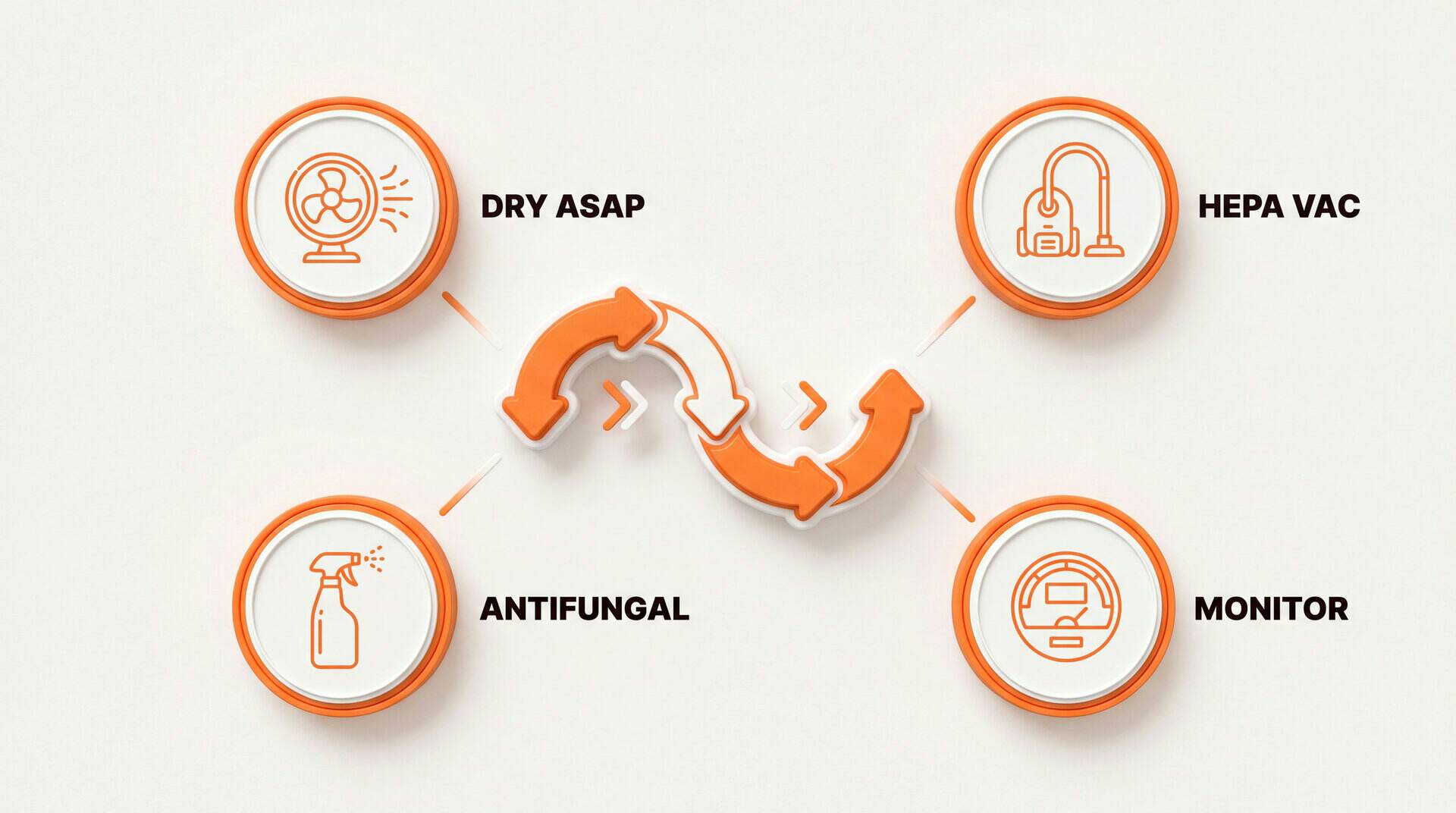
Within 24 hours (best case): Dry everything. Use fans, dehumidifiers, and open windows. Remove standing water with a wet vacuum. Pull up wet carpet padding. The goal is to get moisture levels below 16% in wood and below 1% in drywall within 24 hours. If you can dry the surface before germination completes, no mold colony will form.
24 to 48 hours: Still salvageable with aggressive drying. Add more fans and dehumidifiers. Remove any materials that cannot be dried quickly (wet insulation, soaked cardboard, saturated carpet padding). Clean hard surfaces with hydrogen peroxide as a precaution.
48 to 72 hours: Mold is likely established but not yet visible. Treat all affected surfaces with a no-bleach mold-control product. HEPA vacuum to capture spores. Monitor with a moisture meter over the next week.
Day 3 to 7 (visible mold): Now you are cleaning mold, not preventing it. Follow the standard removal process: fix the water source, protect yourself (N95 mask, gloves, goggles), clean with a mold-control product or hydrogen peroxide on hard surfaces, remove and replace porous materials (drywall, carpet) that have mold penetration.
Day 14+ (established colony): The mold is producing spores and may have spread to other areas. If the affected area is larger than 10 square feet, hire a professional. Post-remediation clearance testing is recommended to verify the cleanup was successful.
The 48 Hour Rule After Water Damage
The IICRC (Institute of Inspection, Cleaning and Restoration Certification) S500 standard establishes the 24 to 48 hour rule: wet materials must be dried within 24 to 48 hours to prevent mold growth. This rule is the foundation of the water damage restoration industry.
What to do immediately after water damage:
- Stop the water source (shut off valve, tarp the roof, plug the leak)
- Remove standing water with a wet/dry vacuum or pump
- Move wet furniture off carpet and away from walls
- Lift carpet and remove padding (padding holds water like a sponge)
- Run every fan you own plus a dehumidifier set to maximum
- Open interior doors (not exterior if it is humid outside)
- Call your insurance company and a water damage restoration company
- Document everything with photos and video for your insurance claim
Professional water restoration companies use industrial air movers, commercial dehumidifiers, and moisture mapping to dry structures within the 48 hour window. They also inject air behind walls and under floors where consumer fans cannot reach. The cost is typically $1,000 to $5,000 depending on the extent of damage, but this is far less than the $5,000 to $30,000 cost of mold remediation that becomes necessary if the window is missed.
Frequently asked questions
How fast does mold grow after water damage?
Mold spores begin germinating on wet surfaces within 24 to 48 hours. Visible colonies (fuzzy spots you can see) appear in 3 to 7 days. A fully established colony that is actively releasing spores can develop in 7 to 14 days. This is why water damage restoration professionals say you have a 24 to 48 hour window to dry wet materials before mold becomes a problem.
Can mold grow in 12 hours?
Mold spores can begin germinating (sending out hyphae) in as few as 12 hours in ideal conditions: warm temperatures (77 to 86 degrees Fahrenheit), high humidity (above 80%), and an organic food source. However, the growth at 12 hours is microscopic. You will not see visible mold until 3 to 7 days.
What temperature does mold grow fastest?
Most household molds grow fastest between 77 and 86 degrees Fahrenheit (25 to 30 Celsius). However, many species can grow between 40 and 100 degrees Fahrenheit. Some cold-adapted species like Cladosporium can grow at near-freezing temperatures, which is why you find mold in refrigerators. Temperature alone does not prevent mold. Moisture control is what matters.
Does mold stop growing when it dries out?
Mold goes dormant when it dries out but does not die. Dormant mold can survive for years without moisture. When water returns, the same colony reactivates and resumes growing within hours. This is why cleaning visible mold without fixing the moisture source leads to recurring mold. You must eliminate the water source and physically remove the mold.
How long after a leak does mold become dangerous?
Mold begins producing allergens and mycotoxins as soon as it starts growing, which can be within 24 to 48 hours of water damage. However, health symptoms from mold exposure typically develop after days to weeks of continuous exposure. A small patch of mold from a recent leak is unlikely to cause immediate illness, but leaving it untreated for weeks allows it to spread and increase your exposure.
Sources
Every claim on this page traces to one of these. Links open the primary document.