Mold on cheese: the safe versus toss rule by type
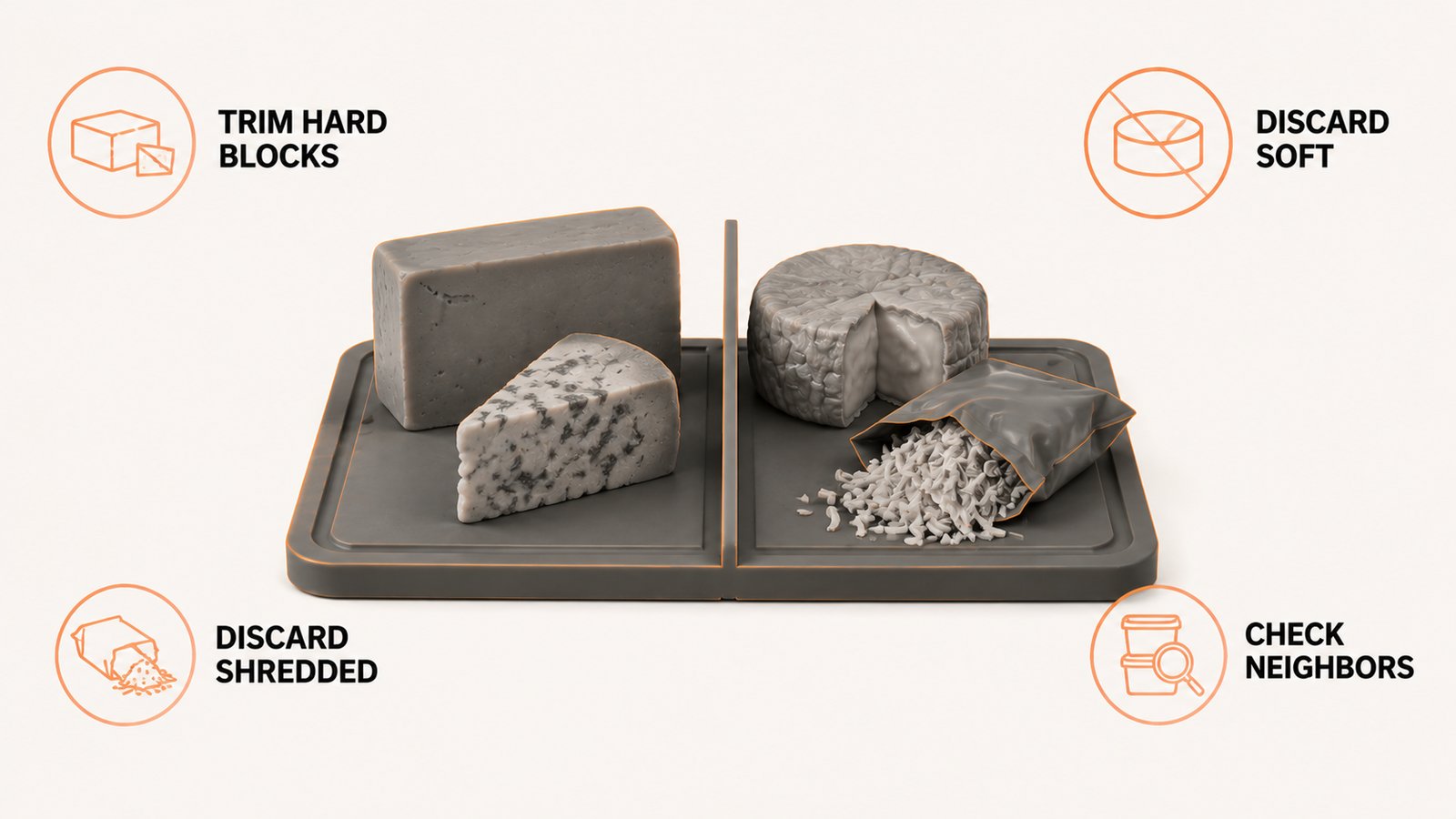
The USDA does not sort cheese by how expensive it was or how much of the block is left. It sorts by moisture and by whether a blade has already been through it. Hard blocks get trimmed. Everything soft, shredded, sliced or crumbled gets thrown out.
| Cheese | USDA handling | Reason |
|---|---|---|
| Hard cheese, block form: Cheddar, Parmesan, Swiss, Gouda | Use it. Cut off at least 1 inch around and below the mold spot, then re-cover in fresh wrap. | Mold generally cannot penetrate deep into the product. |
| Hard cheese made with mold: Gorgonzola, Stilton | Cut surface mold off at least 1 inch around and below the spot and handle it like hard cheese. | Molds that are not part of the manufacturing process can be dangerous. |
| Soft cheese made with mold: Brie, Camembert | Discard if it carries mold that is not part of the manufacturing process. | Molds that are not part of the manufacturing process can be dangerous. |
| Soft cheese: cottage, cream cheese, Neufchatel, chevre, Bel Paese | Discard. | High moisture content can be contaminated below the surface, and bacteria can grow along with the mold. |
| Crumbled, shredded and sliced cheese, all types | Discard. | The cutting instrument can carry contamination through the whole bag. |
| Yogurt and sour cream in the same drawer | Discard. | Same high-moisture rule. Check anything the moldy item touched. |
Every row above is the handling and the reason published by the USDA Food Safety and Inspection Service in Molds on Food: Are They Dangerous?
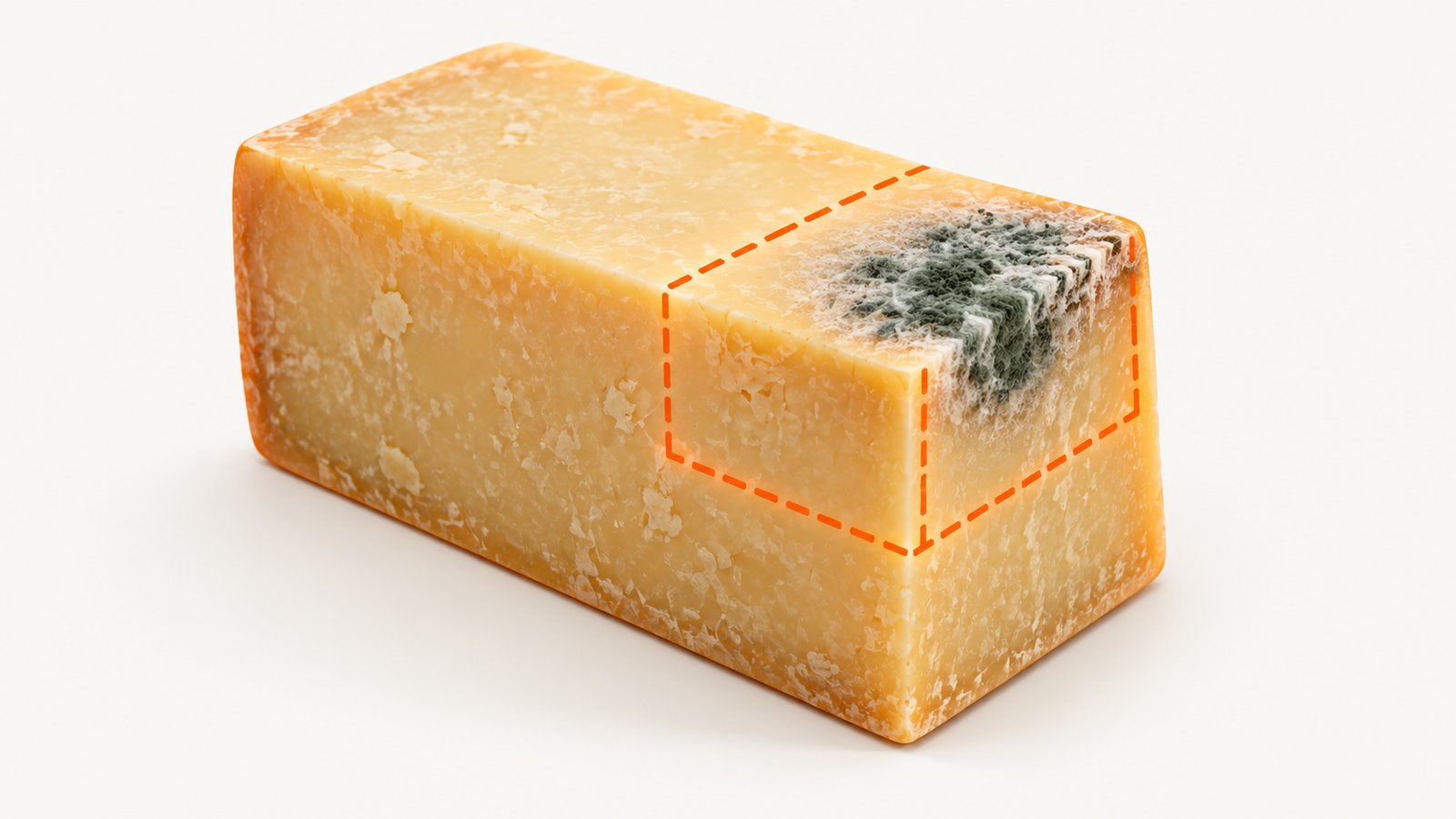
Two notes people miss. The 1 inch margin applies below the spot as well as around it, so you are cutting a cube out of the block rather than shaving the face. And the rule covers the neighbors: mold spreads quickly through produce, so check anything the moldy package was touching. The same moisture logic decides mold on bread and mold on strawberries.
Why hard cheese survives mold and soft cheese does not
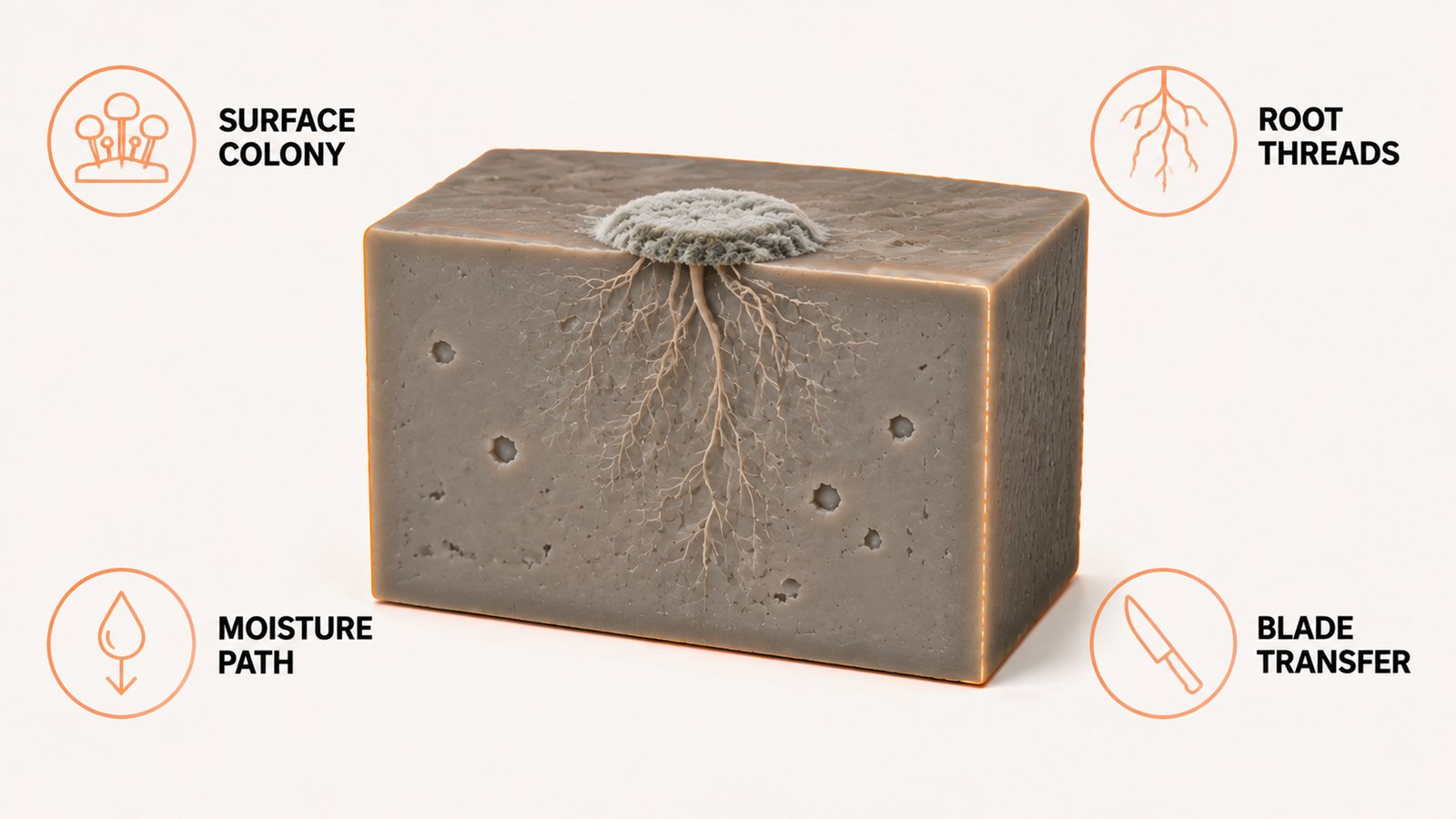
What you can see is the smallest part of the problem. The USDA describes a mold as root threads that invade the food, a stalk that rises above it, and spores that form at the ends of the stalks. The spores give the mold the color you notice. The threads are the part that matters, and the agency is direct that those roots may be very deep in the food and difficult to see while the mold is growing on it.
Density is what stops them. A block of Cheddar or Parmesan is low in moisture and tightly packed, so the mold generally cannot penetrate deep into the product. That is the whole reason a hard block earns a trim instead of a trash bag.
Soft cheese fails on the same physics. High moisture gives the threads an easy path, so contamination can sit well below the visible patch, and the USDA adds a second problem: moldy soft cheese can have bacteria growing along with the mold, which no amount of trimming addresses. Shredded and sliced cheese fails for a third reason that has nothing to do with the cheese itself. The blade that cut it can carry contamination through the entire bag, which is why the rule covers all shredded, sliced and crumbled types with no exception for hard varieties.
Bread does not get the same treatment. It is porous all the way through, so the USDA puts baked goods in the discard column with no trim option.
How to cut mold off hard cheese without spreading it
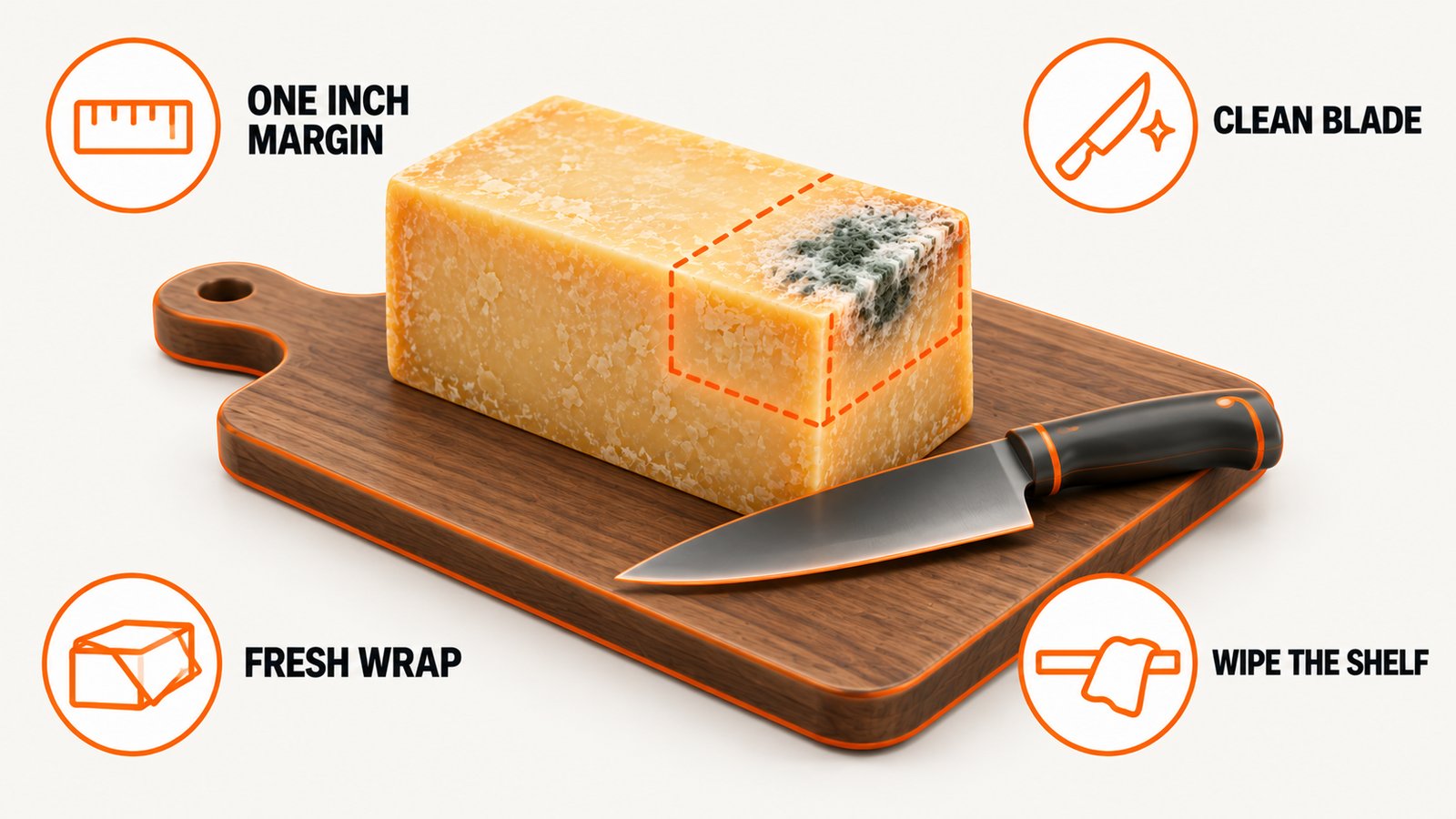
The trim is easy to do badly. Done properly it takes about a minute.
Step 1: do not smell it first. The USDA says plainly not to sniff a moldy item, because inhaling the spores can cause respiratory trouble.
Step 2: cut at least 1 inch around and below the spot. Measure it rather than eyeballing it. A shallow scrape leaves the threads behind.
Step 3: keep the knife out of the mold itself. This is the step that decides whether the rest of the block stays good. A blade that touches the colony and then the clean paste carries the problem into the part you were trying to save. Cut around the spot, then lift the wedge out.
Step 4: re-cover the cheese in fresh wrap. The old wrapper carries spores. Wrap the trimmed block in new material and put it back in a clean spot.
Step 5: bag the discard, then clean where it lived. The USDA advises wrapping moldy food in plastic or a small paper bag and putting it in a covered trash can that children and animals cannot get into, then cleaning the refrigerator or pantry at the exact spot the food was stored and checking any nearby items it might have touched.
None of this applies to a block that is soft, sliced or shredded. There is no version of the trim that makes those safe, and the USDA does not offer one.
Blue cheese, Brie and the molds that belong there
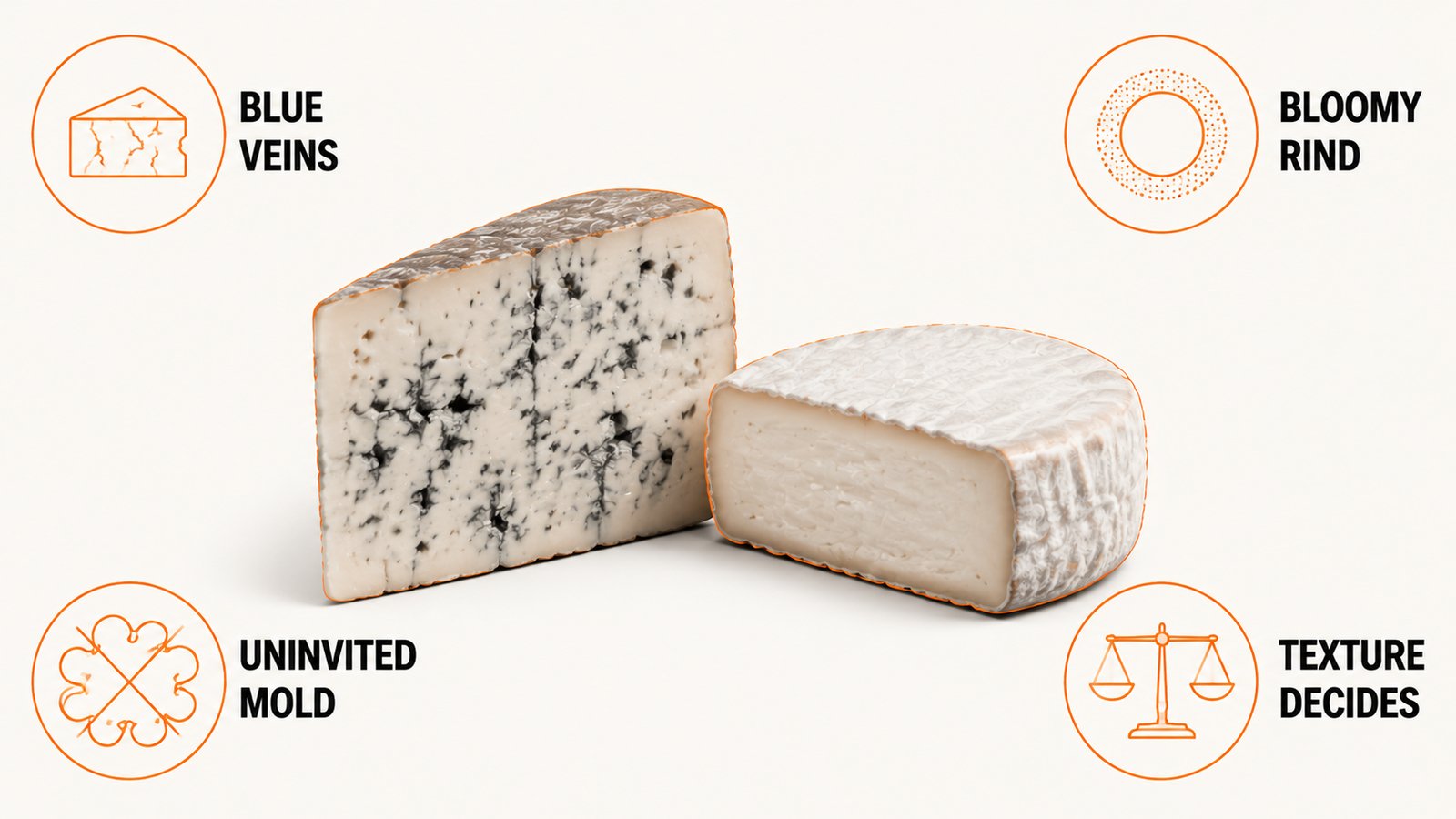
Some cheese is mold. The USDA states that blue veined cheeses such as Roquefort, blue, Gorgonzola and Stilton are created by introducing Penicillium roqueforti spores, that Brie and Camembert carry white surface molds, and that the molds used to manufacture these cheeses are safe to eat.
The question is what to do when a second, uninvited mold shows up on one of them. The USDA splits that answer by texture, exactly as it does everywhere else. Discard a soft mold-ripened cheese such as Brie or Camembert if it carries mold that is not part of the manufacturing process. On a hard mold-ripened cheese such as Gorgonzola or Stilton, cut the surface mold off at least 1 inch around and below the spot and handle the rest like any other hard cheese.
Worth knowing, because it comes up: the ripening molds do produce secondary metabolites. A 2023 review in the Journal of Fungi catalogs what P. roqueforti can synthesize, including roquefortine C, mycophenolic acid and PR toxin. A 2023 survey by USDA Agricultural Research Service scientists tested 254 cheese samples sold in the United States and detected cyclopiazonic acid in 45.6 percent of the soft-ripened samples and 24.4 percent of the blue-veined ones. The same authors state that the implication of those exposures is unknown, because no consensus acceptable intake has been established. Measurable, unresolved, and not a reason the USDA has moved off its position that the manufacturing molds are safe to eat.
What the mold on your cheese actually is
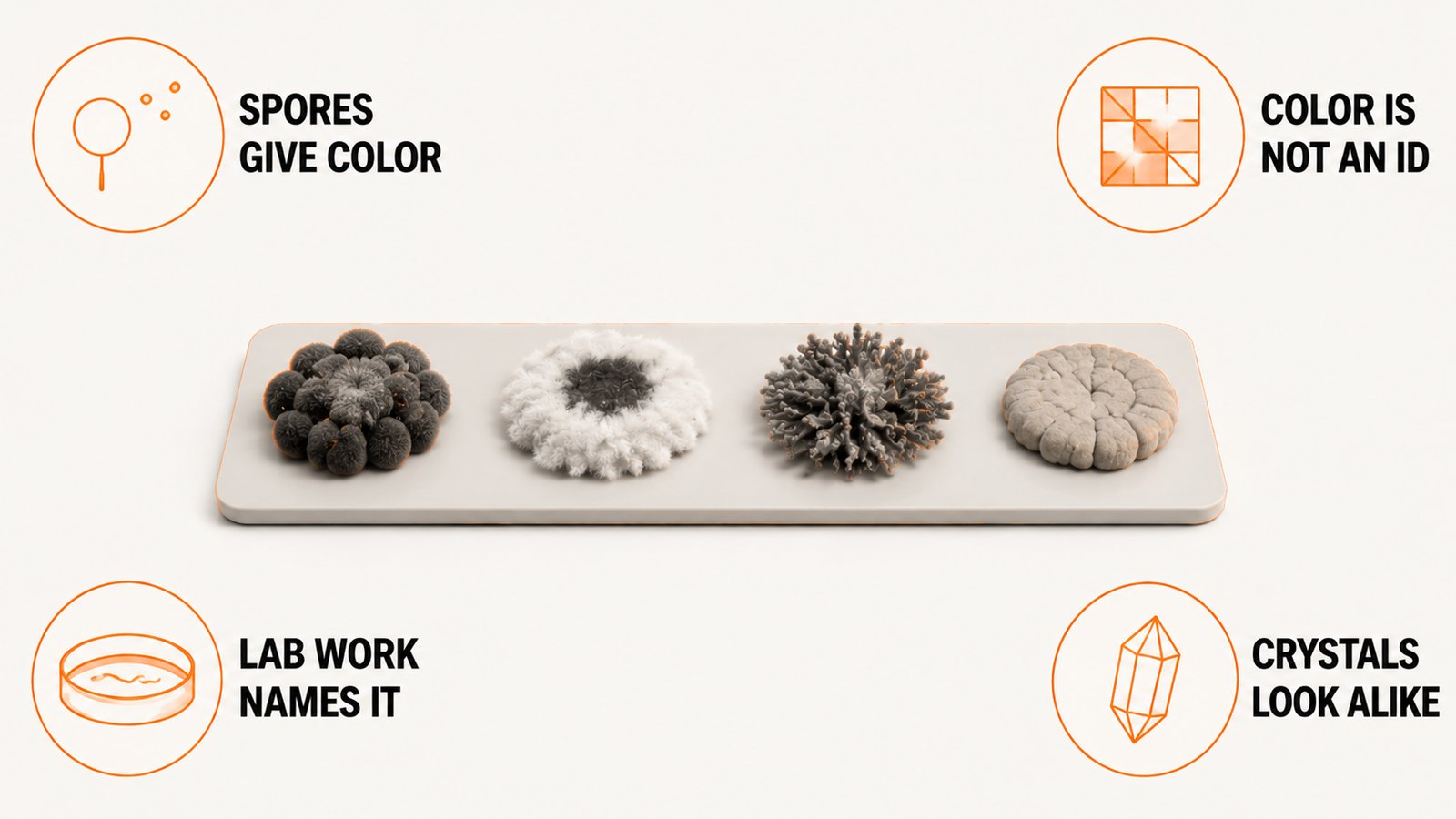
Usually a common food mold and occasionally something else. The USDA lists the genera found most often on food, including Alternaria, Aspergillus, Botrytis, Cladosporium, Fusarium, Mucor, Penicillium and Rhizopus. Those same organisms show up on walls and windowsills, which is why a fuzzy patch on a wedge of Cheddar and one on a bathroom ceiling can look so similar.
You cannot name it by eye. The color comes from the spores and it shifts with the surface, the age of the colony and the moisture around it, so a green mold patch and a white mold patch can be the same organism at different stages. The types of mold guide covers why that visual sorting fails. CDC takes the same position for indoor mold in buildings: you do not need to know the type of mold, and CDC does not recommend mold testing, because the response is the same either way.
One look-alike is worth calling out. White specks on aged Cheddar are often calcium lactate crystals, not growth. Dairy scientists have identified calcium lactate pentahydrate crystals in Cheddar by X-ray diffraction for decades, and they read as gritty flat flecks rather than a raised fuzzy patch. The USDA also describes white dust on Cheddar as one of the ways mold shows itself, so the safe read is simple: crystals are flat and crunchy, mold is raised and fuzzy, and anything raised gets the 1 inch trim.
Stop mold from coming back in your fridge
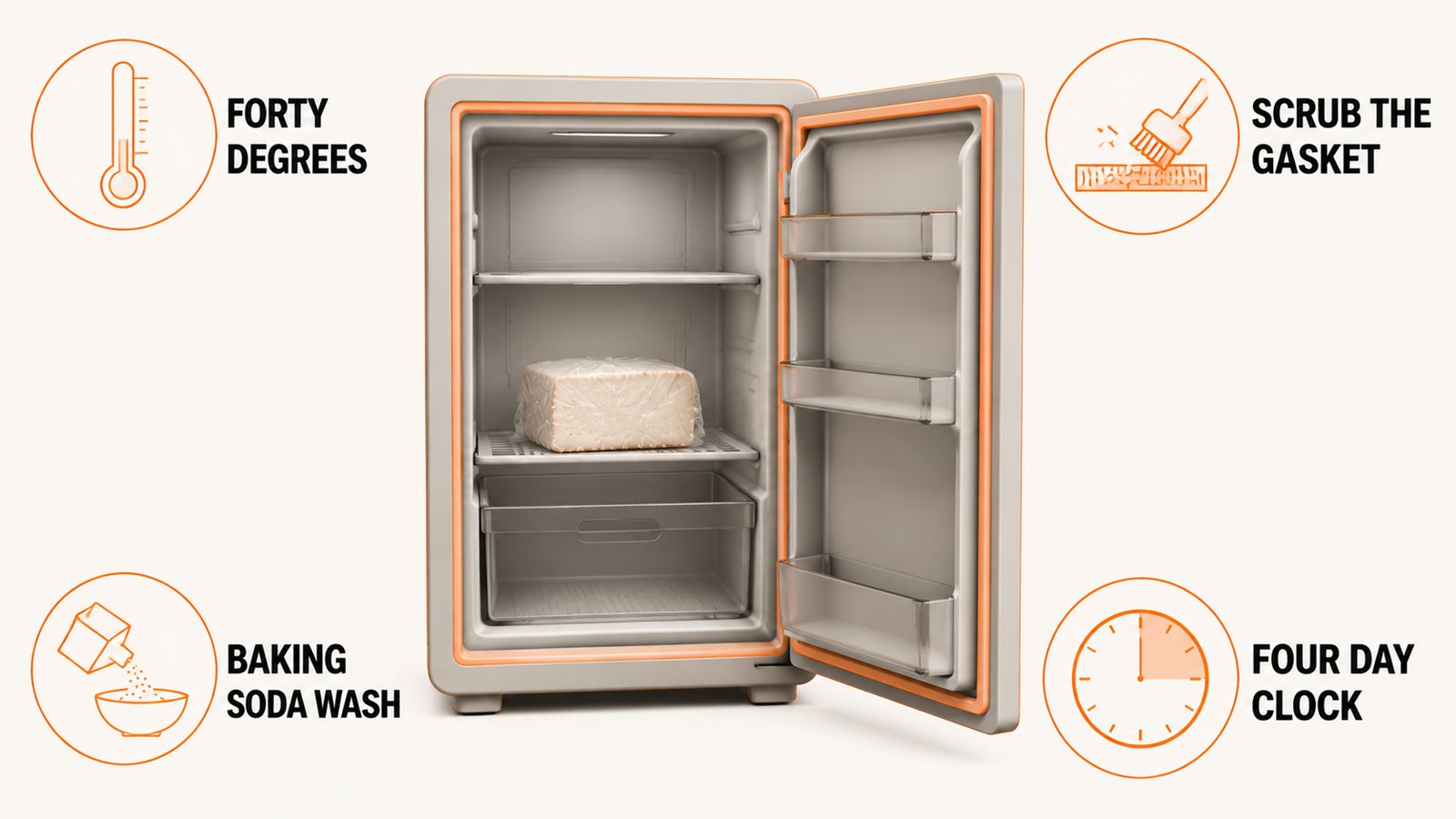
Mold spores from an affected food build up inside a refrigerator, so a second moldy block a week later is usually a cleaning problem rather than bad luck.
- Clean the inside every few months. The USDA recipe is 1 tablespoon of baking soda dissolved in a quart of water, then a rinse with clear water and a dry.
- Scrub the rubber casings. Visible mold on the door gasket gets 3 teaspoons of bleach in a quart of water. The gasket is the spot most people never touch and the one that stays damp.
- Hold the refrigerator at 40 degrees Fahrenheit or below. That is the FoodSafety.gov storage standard. Molds tolerate cold better than most food spoilers and grow at refrigerator temperatures, so cold slows them rather than stopping them.
- Keep cloths and sponges clean. A musty smell in a dishcloth means it is spreading mold around. Discard anything you cannot launder.
- Cover food and re-home opened cans. Empty opened cans of perishable food into clean containers, keep served food covered, and do not leave perishables out more than 2 hours.
- Use leftovers within 3 to 4 days so mold does not get a window, and buy cheese in amounts you will finish.
- Keep household humidity down. The USDA food guidance asks for a house below 40 percent relative humidity, and the EPA asks for indoor humidity below 60 percent and ideally between 30 and 50 percent.
If the growth keeps returning in one part of the kitchen rather than in the food, that is a moisture problem in the room. Our guides to mold in the fridge and mold in the kitchen cover the appliance and the room, and mold under the kitchen sink covers the cabinet where a slow supply-line drip usually starts.
When to call a pro
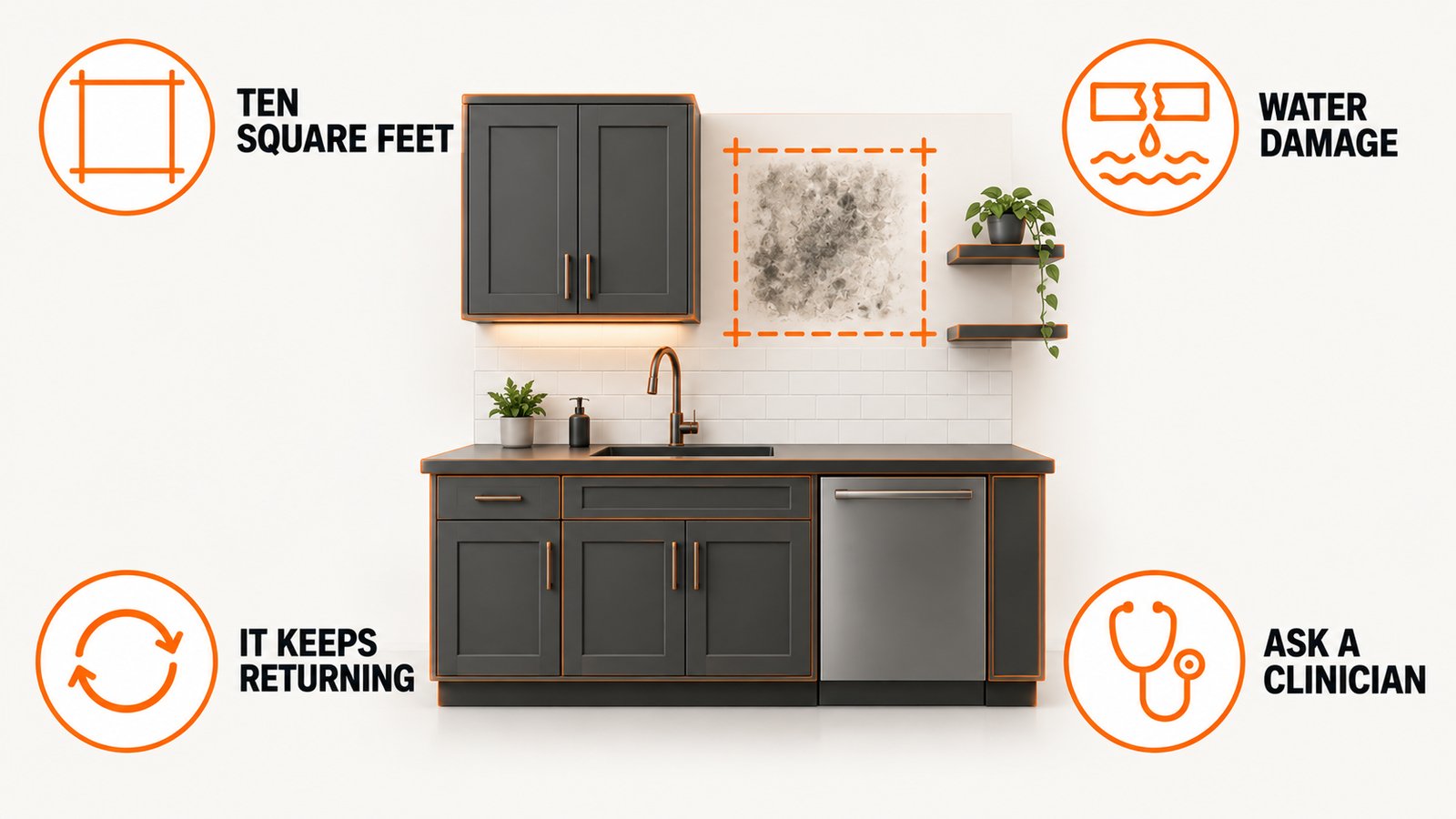
A wedge of cheese never needs a contractor. The kitchen around it sometimes does.
Call a qualified remediation professional when the growth is on the building, not the food. The EPA guidance is that an area smaller than about 10 square feet, roughly a 3 foot by 3 foot patch, is usually a job you can handle yourself, and that heavy water damage or a larger area calls for professional help. Scrub mold off hard surfaces with detergent and water and dry completely, and expect that absorbent materials such as ceiling tiles and carpet may have to be thrown away.
Call a plumber or appliance technician when the same spot keeps reseeding. Growth that returns on the same shelf, gasket or cabinet floor within days points at a drip, a failed door seal or a blocked defrost drain. Cleaning the patch without fixing the water is the loop people get stuck in, and our removal guide covers the order of operations.
Call a clinician for anything about a person. CDC states that exposure to damp and moldy environments may cause a variety of health effects or none at all, that people with asthma or a mold allergy may have severe reactions, and that immune-compromised people and people with chronic lung disease may get lung infections from mold. That is a matter for a licensed clinician who can examine the patient, not for a food-handling chart and not for an app.
Frequently asked questions
Can you cut mold off cheese and eat the rest?
On a hard block, yes. The USDA says to cut off at least 1 inch around and below the mold spot, keep the knife out of the mold so it does not carry spores into the clean paste, and re-cover the cheese in fresh wrap. On soft cheese, shredded cheese, sliced cheese or crumbles, no. Those go in the trash because the moisture and the cutting blade both spread contamination past the part you can see.
Is it safe to eat shredded cheese with mold in the bag?
No. The USDA puts crumbled, shredded and sliced cheese of all types in the discard column, including shredded hard cheese. The instrument that cut the cheese can carry contamination through the whole bag, so the rest of the bag is not proven clean just because it looks clean.
What should I do if I already ate moldy cheese?
This page cannot answer a medical question and will not try. The USDA notes that some molds cause allergic reactions and respiratory problems and that a few produce mycotoxins. If you feel unwell or you are worried about what you ate, contact a licensed clinician or your local poison control center rather than a web page.
Does cooking or freezing kill mold on cheese?
Neither one makes moldy cheese safe. Freezing pauses growth instead of removing it, and the USDA is clear that heavy mold growth means root threads have already invaded the food, with toxins in some cases spread through it. Cooking does not undo that. Follow the trim or discard rule by cheese type instead.
Why does cheese go moldy in the refrigerator?
Because cold slows mold rather than stopping it. The USDA notes that while most molds prefer warmer conditions they still grow at refrigerator temperatures, and that they tolerate salt and sugar better than most other food spoilers. Spores also build up inside the appliance, which is why the agency recommends cleaning the interior every few months and scrubbing visible growth off the rubber door casings.
Is the white stuff on my Cheddar mold or crystals?
It can be either. Calcium lactate pentahydrate crystals form in aged Cheddar and have been identified in dairy research by X-ray diffraction for decades. They read as flat gritty flecks. The USDA also describes white dust on Cheddar as one way mold appears, and mold sits raised and fuzzy on the surface. Treat anything raised or fuzzy as mold and give it the 1 inch trim.
Is blue cheese with extra mold on it still safe?
It depends on the texture, not the style. On a hard blue such as Gorgonzola or Stilton, cut the surface mold off at least 1 inch around and below the spot and handle the rest like hard cheese. On a soft mold-ripened cheese such as Brie or Camembert, the USDA says to discard it if it carries mold that is not part of the manufacturing process.
Sources
Every claim on this page traces to one of these. Links open the primary document.