Can insulation be cleaned, or does it come out?
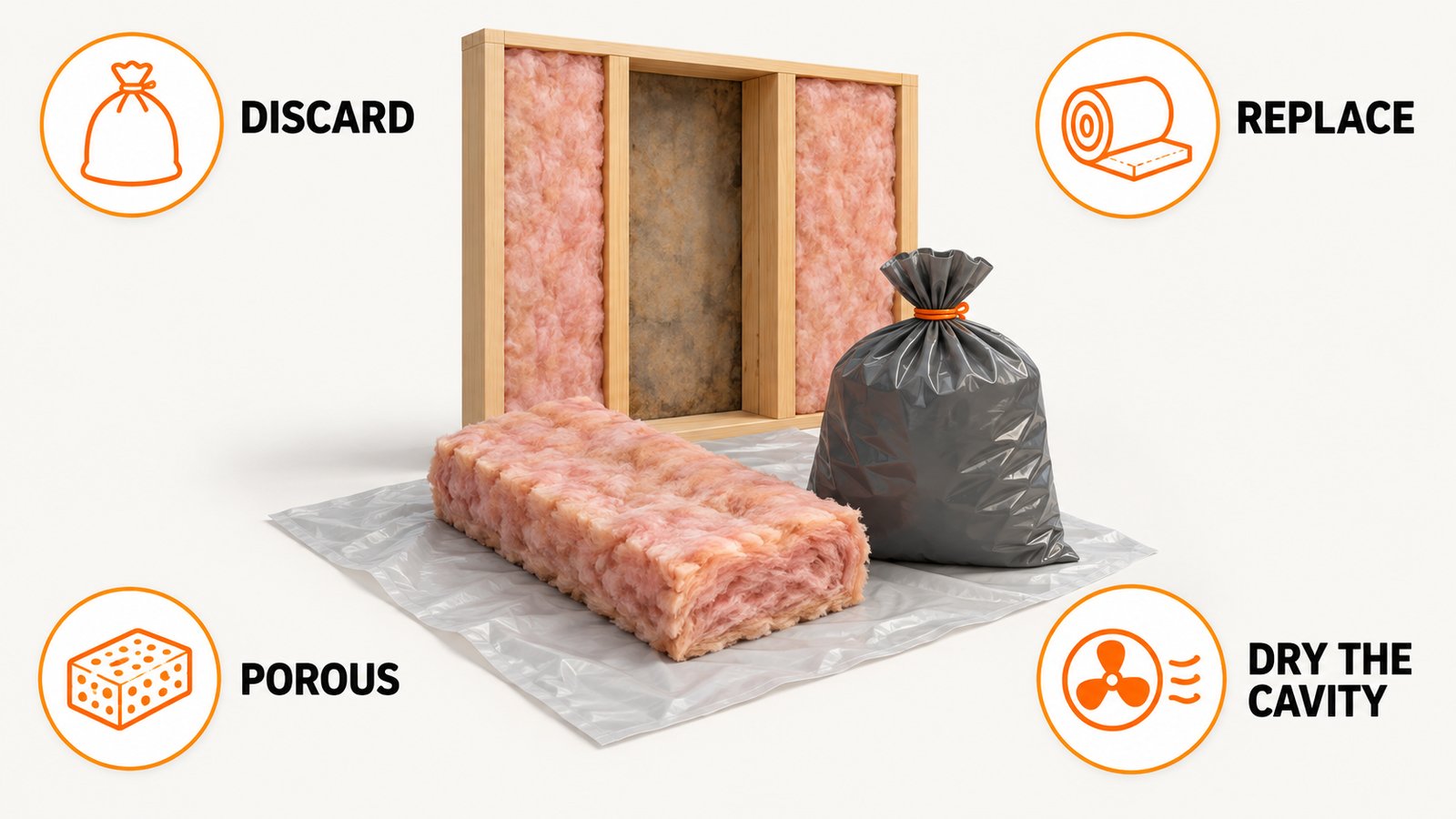
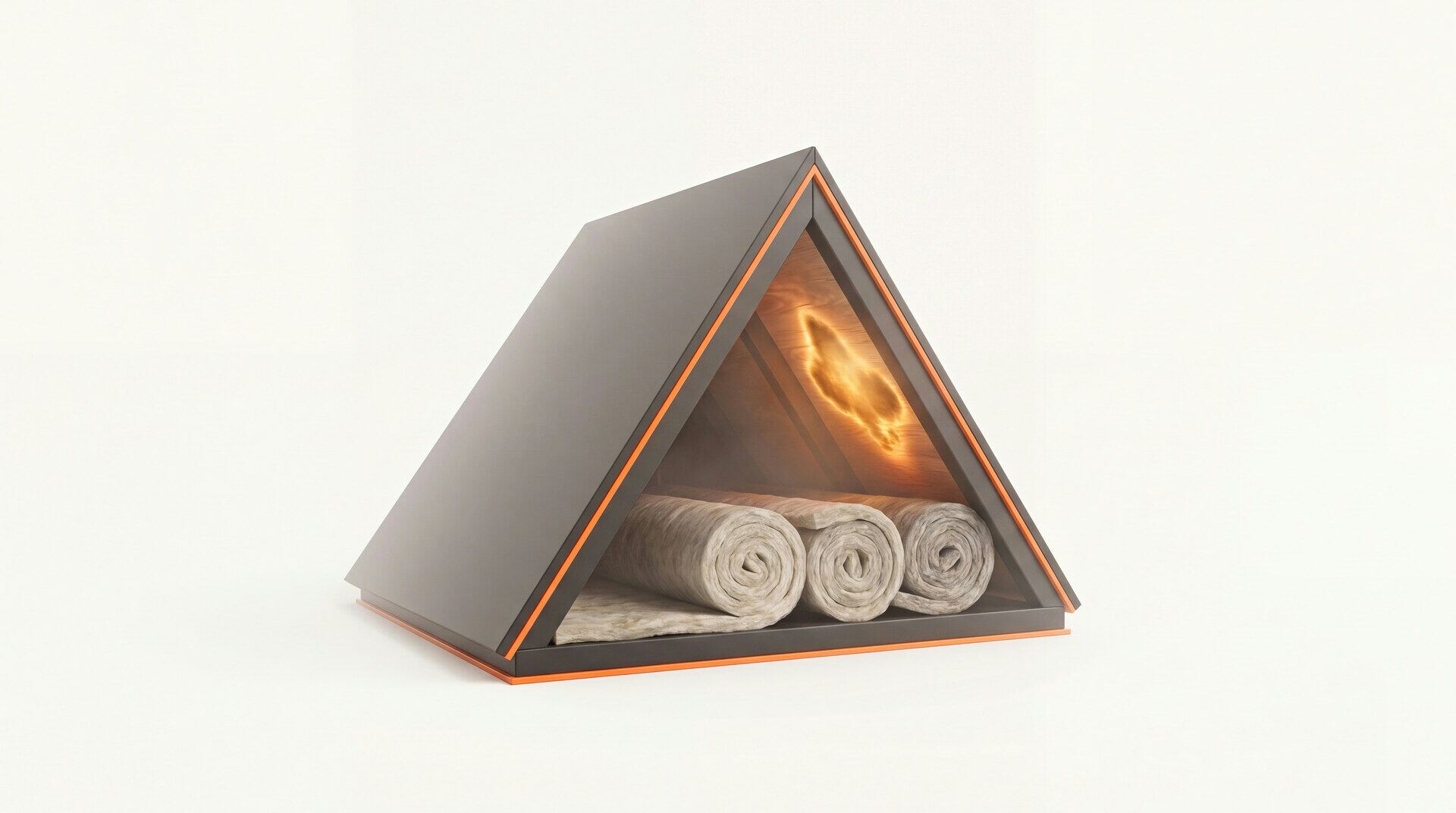
It comes out. EPA's water-damage response table is unambiguous on both of the common materials: the action for cellulose insulation is discard and replace, and the action for fiberglass insulation is also discard and replace. That is EPA's answer for water damage caught inside the first 24 to 48 hours, before growth is even visible. Once growth is visible the case for removal is stronger, not weaker.
Compare that to the neighboring rows in the same table. Concrete or cinder block gets a water extraction vacuum and drying. Non-porous hard surfaces get a damp wipe with mild detergent. Wallboard may be dried in place if there is no obvious swelling and the seams are intact. Insulation gets no clean-in-place option at all, because there is no way to reach through it, and no way to prove it dried through.
EPA's general position on materials backs this up: absorbent or porous materials such as ceiling tiles and carpet may have to be thrown away if they become moldy, because mold can grow on or fill in the empty spaces and crevices of porous materials, so it may be difficult or impossible to remove completely.
The common counterargument is that fiberglass is glass and glass is not food. Two facts cut against relying on that. CDC lists insulation among the materials mold grows in, alongside dust, paint, wallpaper, drywall, carpet, fabric and upholstery. And ASTM publishes C1338-19, the Standard Test Method for Determining Fungi Resistance of Insulation Materials and Facings, which would be a strange standard to need if insulation and its facings were inert.
Mold on insulation by material
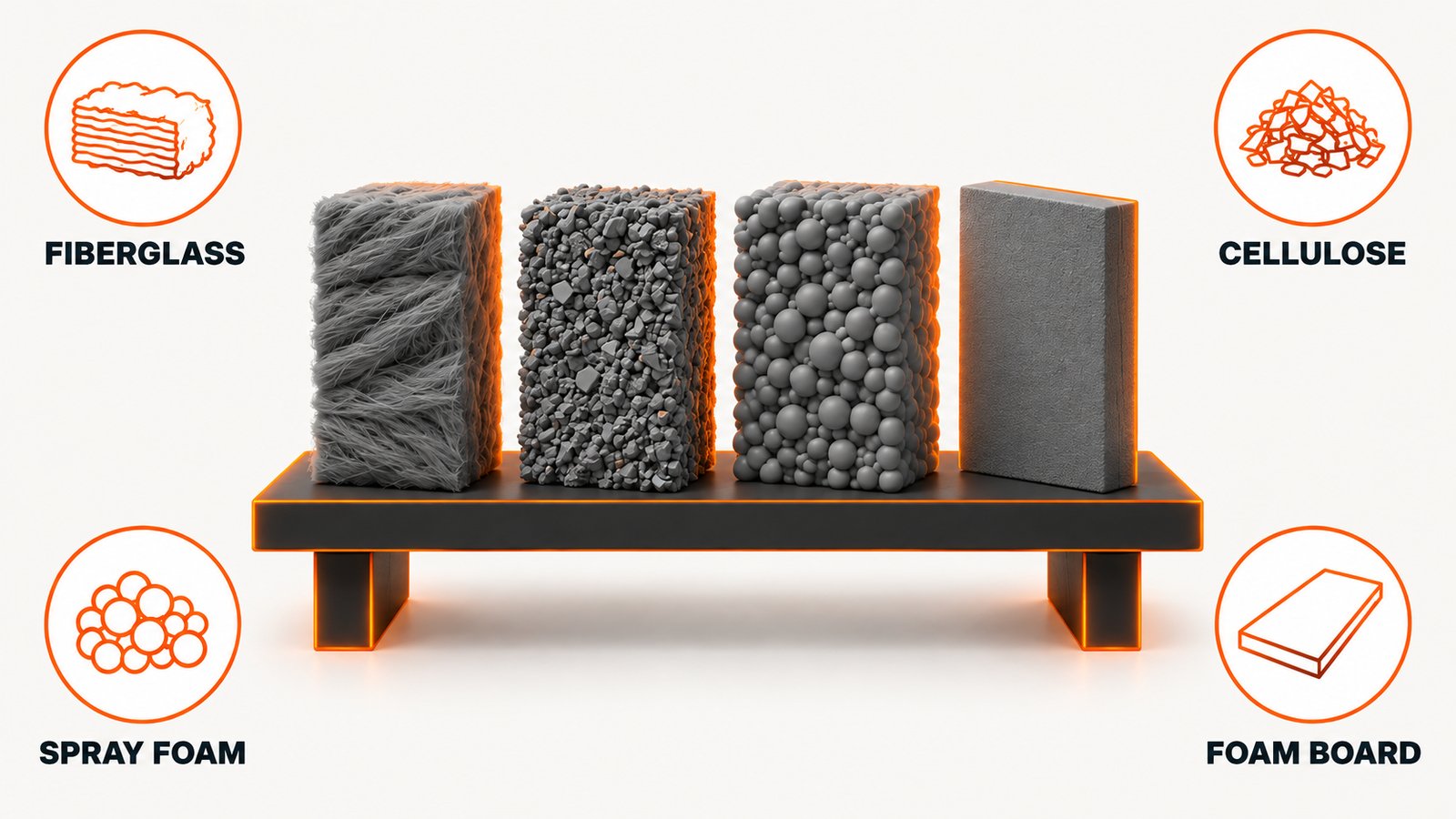
EPA's table names two materials. Everything else in a modern house is reasoning from the same principle rather than agency guidance, and the table below labels which is which.
| Material | Named in EPA Table 1? | What the guidance or the logic says |
|---|---|---|
| Fiberglass batt, unfaced | Yes | Discard and replace |
| Fiberglass batt, kraft paper faced | Fiberglass is named | Discard and replace. The paper facing is cellulose and is the part most likely to carry growth |
| Blown or dense-packed cellulose | Yes | Discard and replace |
| Mineral wool, rock or slag | No row | Not addressed. It holds water in the same way a batt does, so the porous-material reasoning applies |
| Open-cell spray foam | No row | Not addressed. It is an open matrix that can hold moisture, so treat it as porous |
| Closed-cell spray foam | No row | Not addressed. It resists bulk water, but growth can sit on its face and on whatever is behind it |
| Rigid foam board | No row | Not addressed. The board face is non-porous, the seams, tape and framing behind it are not |
| Vapor barriers and facings | No row | Not addressed. Facings are exactly what ASTM C1338 exists to test |
Only the first three rows are EPA statements. The rest are labeled as reasoning from EPA's porous-material principle, not as agency guidance, because EPA Table 2 has no insulation row at all.
The kraft paper facing deserves its own note. On a faced batt, the paper is the cellulose, the cellulose is the food, and it is usually the surface where growth is visible. People see the growth on the paper, peel it off, and keep the batt. That is the wrong call by EPA's own table, which does not distinguish faced from unfaced when it says discard and replace.
Cellulose insulation is usually borate-treated for fire and pest resistance, which is a real property and not a mold warranty. EPA's action for water-damaged cellulose insulation is the same as for fiberglass.
Where mold on insulation turns up
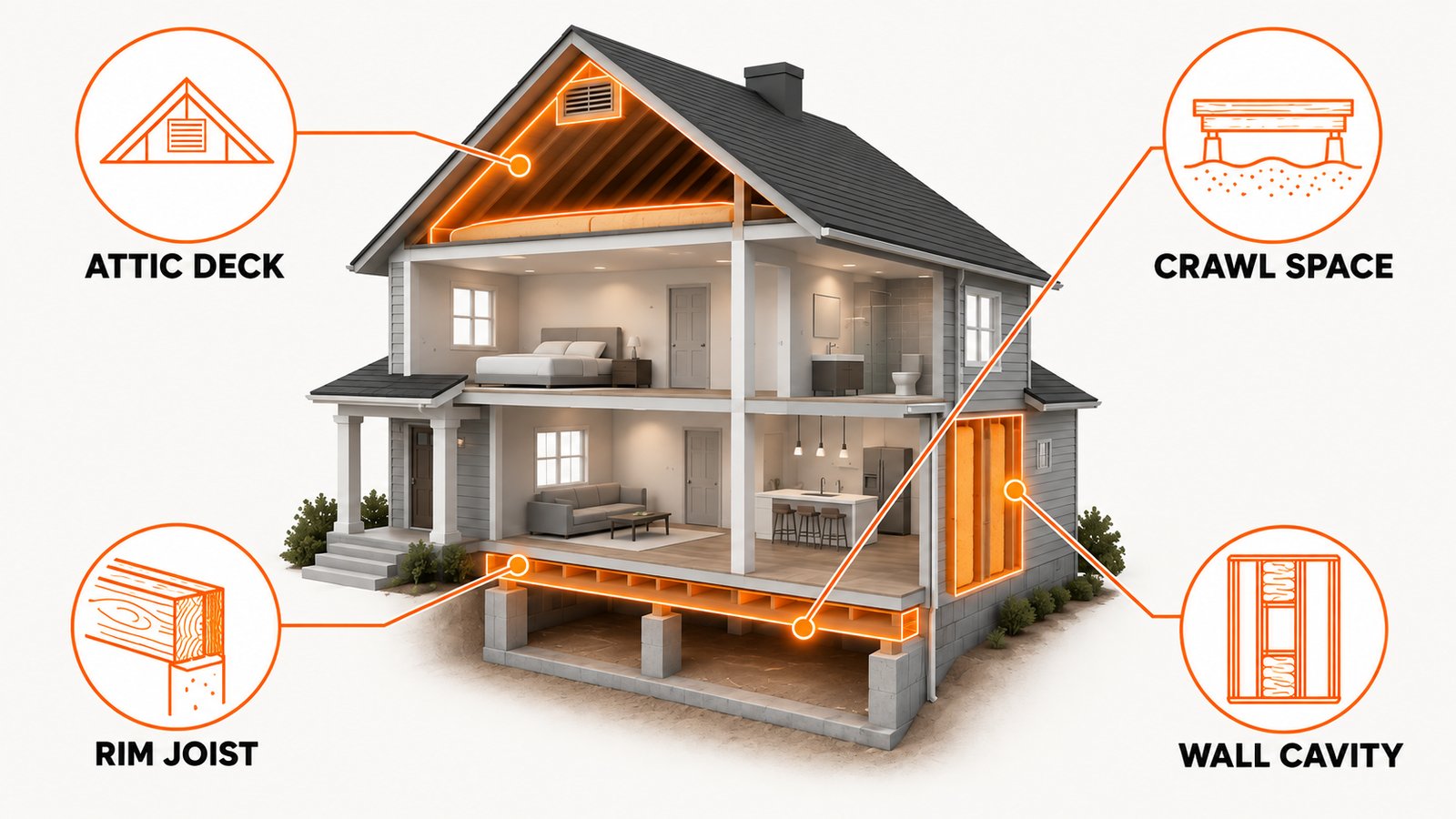
The attic. The usual cause is warm humid indoor air pushed into a cold attic, where it condenses on the roof deck and drips into the insulation below. Bath fans that terminate in the attic instead of outdoors are a classic version of this. Fixr notes that attic remediation runs wide partly because when the most affected area is within the insulation, it has to be removed, and that labor raises the cost. See mold in the attic for how to read the deck.
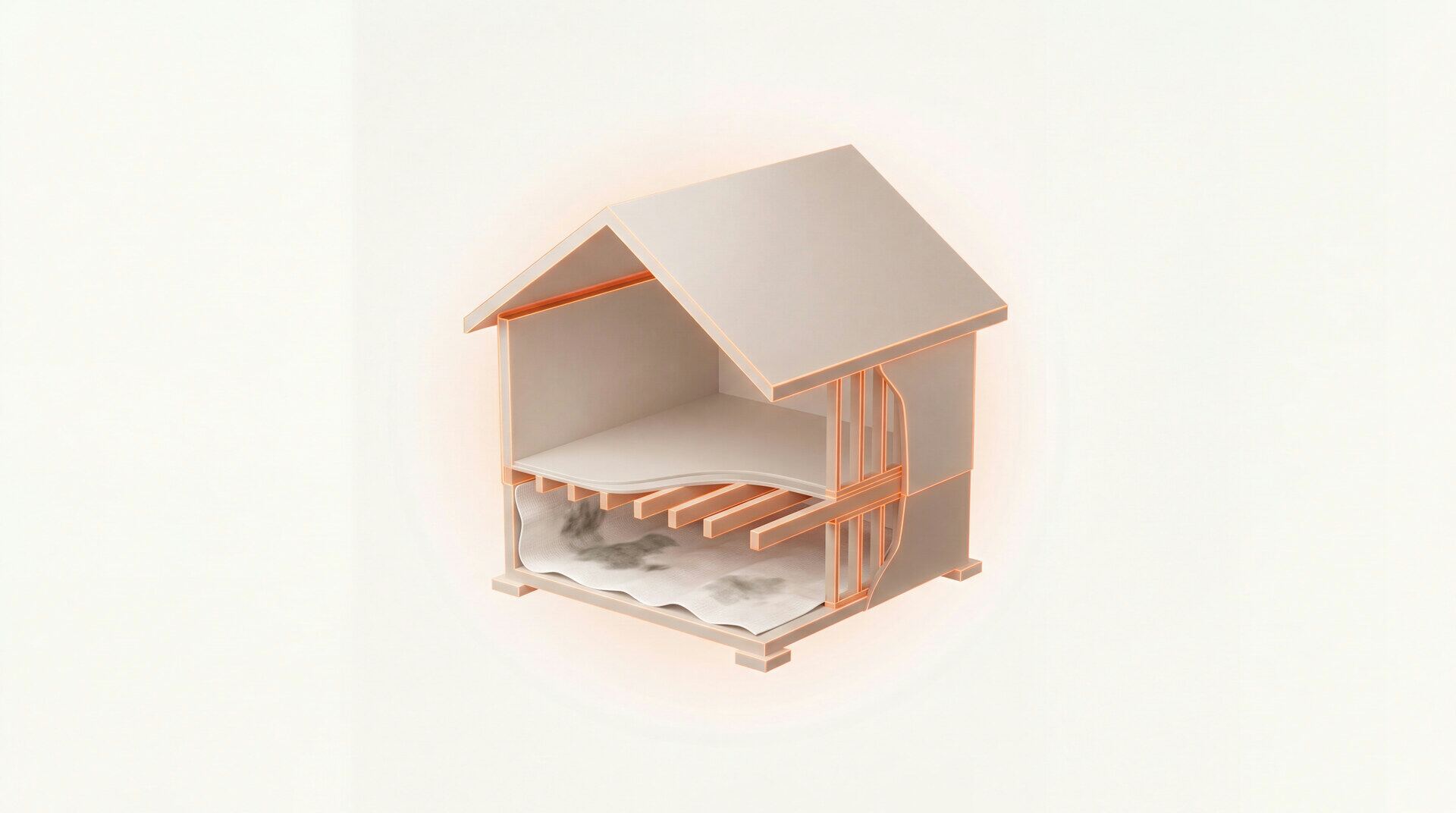
The crawl space. Ground moisture, a missing or torn vapor barrier, and a duct leak are the three common inputs. Batt insulation stapled between floor joists falls down as it gets heavy, which is often how people find out. See mold in a crawl space.
The rim joist band. The band at the top of a foundation wall is a cold surface with warm indoor air on one side, and it is often insulated with a batt stuffed in loose. Condensation collects behind the batt where nobody looks. See mold in the basement.
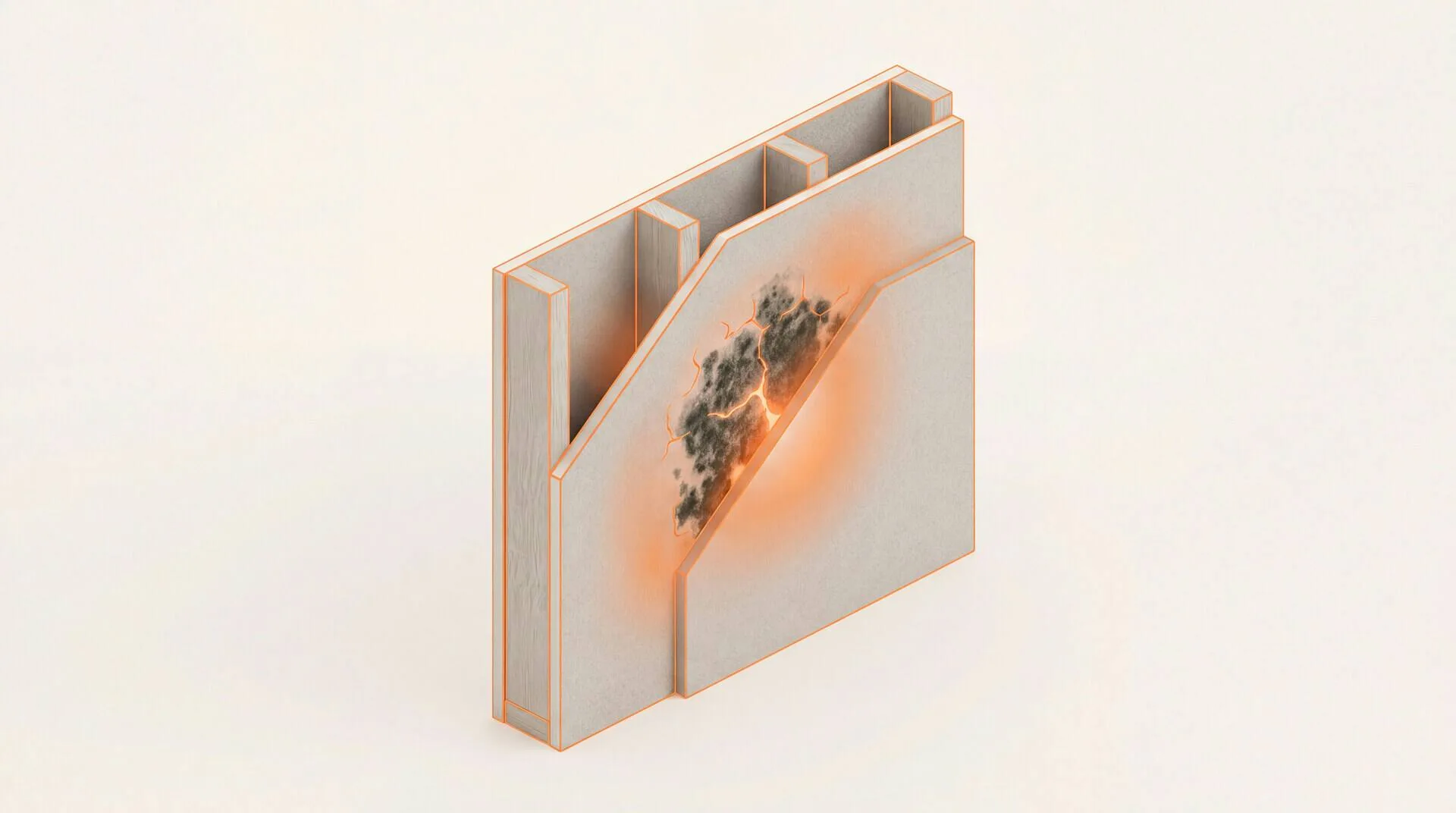
The wall cavity. A supply line, a window flashing failure, or a roof leak that runs down inside the wall. The insulation is the first thing that gets wet and the last thing anyone checks, because a wall has to be opened to see it. Our page on mold behind walls covers how it gets found, and mold on drywall covers the finish surface.
Around ductwork. Cold supply ducts sweating inside insulated chases wet everything around them. Do not open duct material to investigate. See mold in air ducts, and note EPA's instruction not to run an HVAC system you know or suspect is contaminated, because it can spread mold through the building.
What it costs to remove insulation with mold
Insulation removal is priced as part of the remediation for the space it sits in, not as a line of its own.
| Location | Professional cost | What drives it |
|---|---|---|
| Crawl space | $500 to $2,000 | Small area, tight access, labor hours rather than materials |
| Attic | $1,500 to $9,000 | Insulation removal labor, plus roof-deck work and the ventilation fix |
| Basement | $1,500 to $4,000 | Large footprint, and the moisture source is usually the foundation |
| Walls, cavity work | $1,000 to $12,000 | Demolition, drying, and rebuild of the finish surface |
Fixr 2026 mold remediation cost guide. Fixr specifically notes that when the most affected area is inside attic insulation you may have to remove it, and that the labor for insulation removal raises costs.
Two costs land on top of that. The replacement insulation and its installation, which is ordinary construction pricing rather than remediation pricing. And the repair that made it wet: a roof, a flashing detail, a duct, a vapor barrier, a bath fan re-routed to the outside. Skipping the second one means paying for the first one twice.
Full 2026 price tables by affected area, room and severity are on mold remediation cost. If the finish surface is coming off anyway, this is also the moment to consider mold resistant drywall on the rebuild, and to size a dehumidifier for a basement or crawl space that runs damp.
How to replace it without spreading the problem
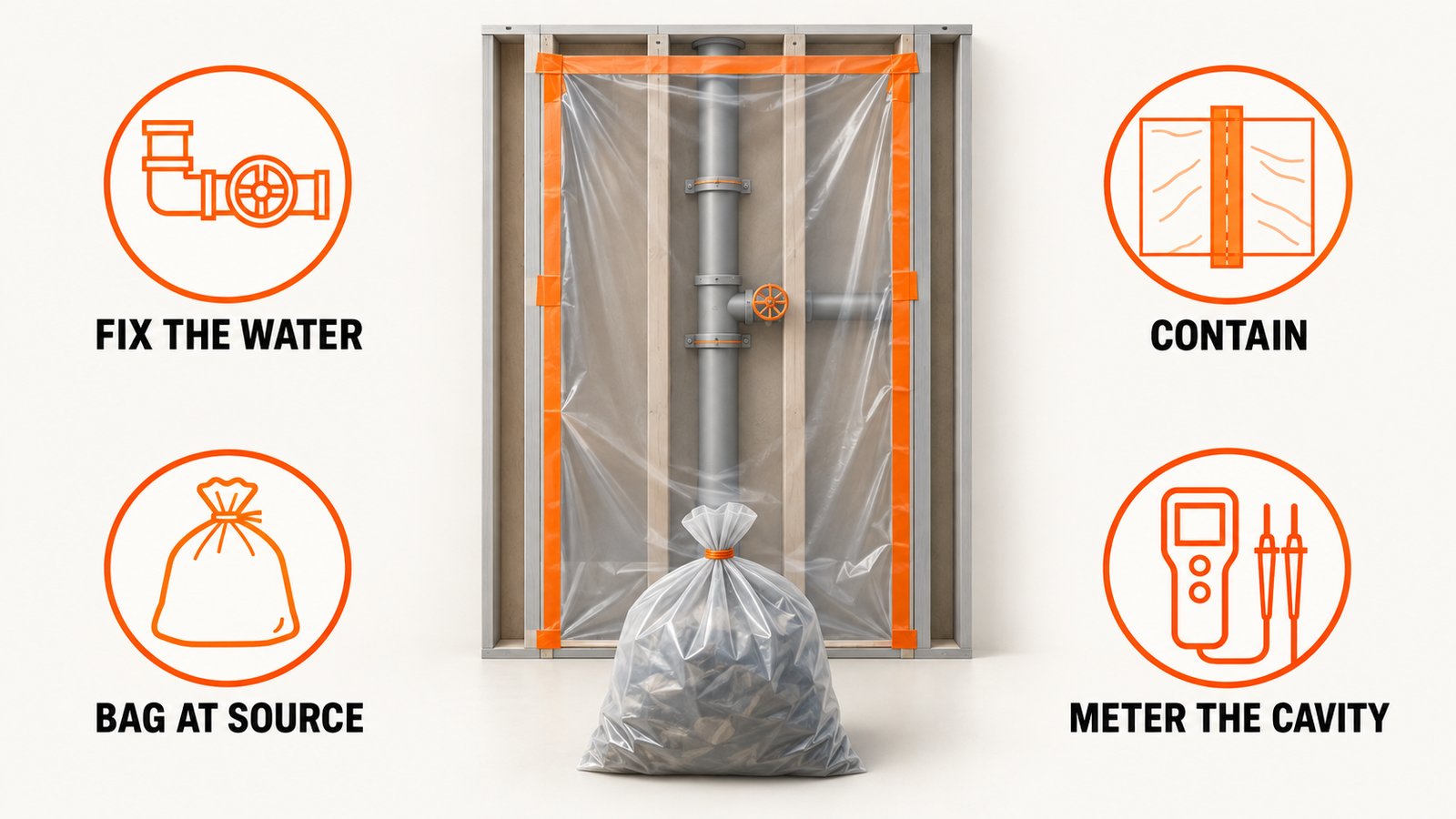
Insulation removal disturbs a lot of material at once, which is exactly the condition EPA's containment guidance exists for. The sequence matters more than the products.
1. Fix the water first. Roof, flashing, duct, supply line, vapor barrier, bath fan termination. Insulation installed into a wet cavity is a scheduled repeat.
2. Size the job honestly. EPA's consumer line is about 10 square feet of affected area. A stud bay is roughly 10 square feet on its own, so most insulation jobs are already above that line, and EPA points those to its professional remediation guide.
3. Protect yourself for the size of the job. EPA's minimum for a small job is an N95 respirator, gloves and goggles. For medium and large areas its table calls for limited or full protective equipment and containment, decided by professional judgment. It also flags a more cautious approach when a particularly toxic species is suspected, when extensive hidden mold is expected such as behind vinyl wallpaper or in the HVAC system, when the chance of mold becoming airborne is high, or when sensitive individuals such as those with severe allergies or asthma are present.
4. Bag it at the opening. Do not carry loose batt through the house. Bag it where it comes out, seal the bag, and take it straight outside.
5. Dry the cavity and prove it. A moisture meter reading, not a look and a guess. EPA's window for wet material is 24 to 48 hours, and a cavity that has been wet for months takes longer and needs air moving through it.
6. Clean what stays, then insulate. Framing is a wood surface, and EPA's cleanup methods for wood surfaces run from wet vacuum and damp wipe with detergent through HEPA vacuuming, with removal and disposal as the last option. Then keep the space in the 30 to 60 percent humidity band EPA recommends. Our page on how to prevent mold covers the ventilation and drainage side.
When to call a pro
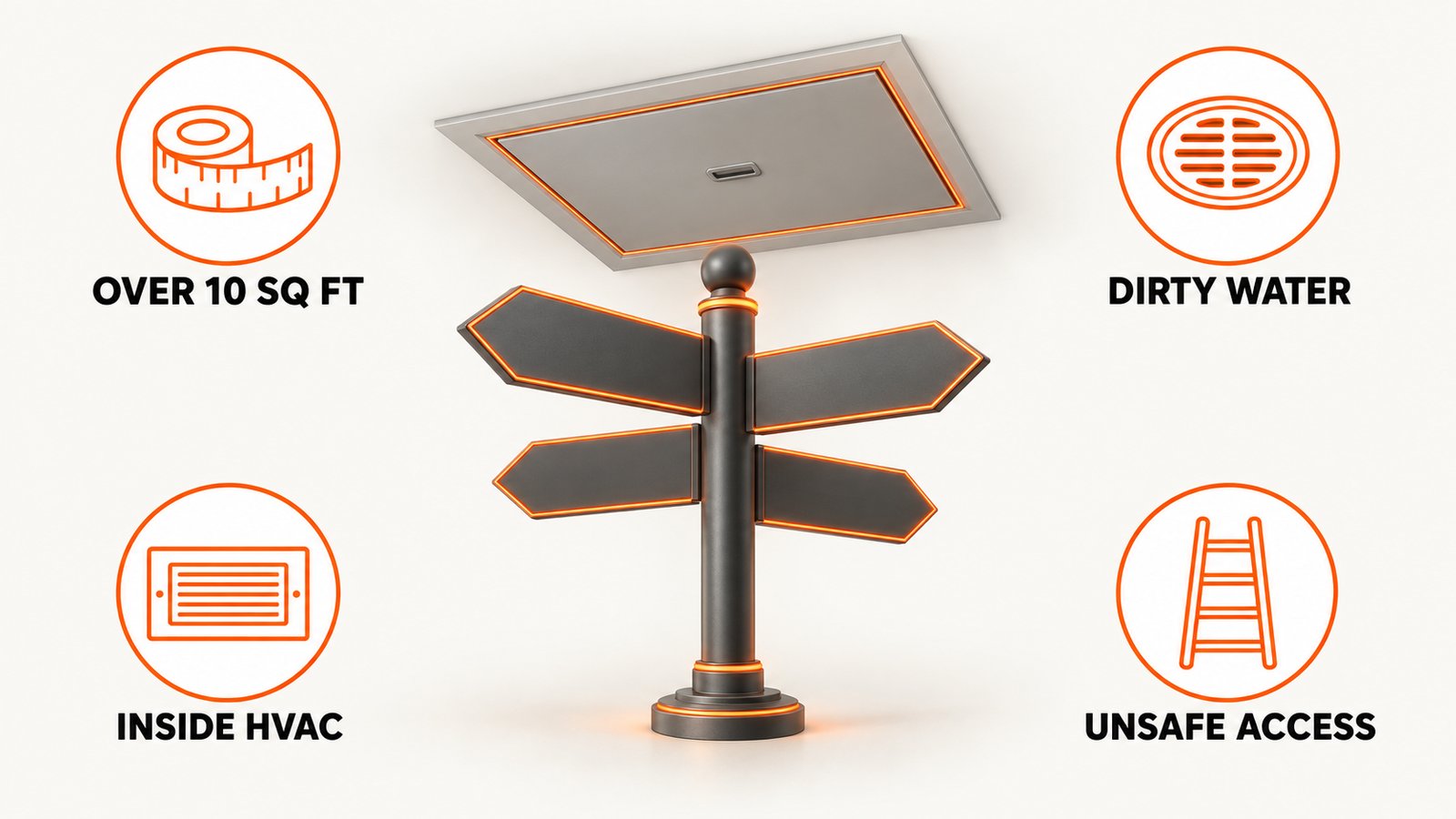
Most insulation jobs cross at least one of these lines, which is why this category ends up professional more often than a bathroom clean does.
The area is over about 10 square feet. One stud bay is close to that on its own, and an attic or crawl space is far past it. Above that line EPA sends readers to its professional remediation guide rather than to a do-it-yourself method.
The water was not clean. EPA says that if the water or mold damage was caused by sewage or other contaminated water, call a professional experienced with buildings damaged by contaminated water. Crawl spaces are where this comes up most.
The heating or cooling system is involved. EPA says not to run an HVAC system you know or suspect is contaminated because it can spread mold through the building, and points readers to its duct-cleaning guidance before taking further action.
You cannot reach it safely. Attic joists with no decking, a crawl space with limited headroom, or anywhere you would be working overhead in a respirator for hours. That is a real hazard independent of the mold.
Someone in the home reacts to it. CDC says exposure to damp and moldy environments may cause a variety of health effects or none at all, that people with asthma or a mold allergy may have severe reactions, and that immune-compromised people and people with chronic lung disease may get lung infections from mold. Health questions go to a licensed clinician.
When you hire, EPA suggests asking the contractor to follow its remediation guide or the guidelines of ACGIH or IICRC. Before any of that, if you are still deciding whether what you are looking at is even growth, start with what dark growth can and cannot tell you.
Frequently asked questions
Can you clean mold off insulation?
EPA does not offer a clean-in-place option for it. Its water-damage response table gives the action discard and replace for both cellulose insulation and fiberglass insulation, while giving drying and wiping options for concrete, non-porous surfaces and even wallboard. Once mold is visible the case for removal is stronger than it is for plain water damage.
Does mold grow on fiberglass insulation?
CDC lists insulation among the materials mold grows in, alongside dust, paint, wallpaper, drywall, carpet, fabric and upholstery. ASTM also publishes C1338-19, a standard test method for determining fungi resistance of insulation materials and facings, which exists because the question is real. EPA's action for water-damaged fiberglass insulation is discard and replace.
Can I just remove the moldy paper facing and keep the batt?
EPA's table does not distinguish faced from unfaced when it says discard and replace for fiberglass insulation. The kraft facing is the cellulose and is usually where visible growth sits, but the batt behind it held the same water. Removing the facing and keeping the batt is not what the guidance says.
How much does it cost to remove moldy insulation?
It is priced inside the remediation for the space. Fixr's 2026 ranges are $500 to $2,000 for a crawl space, $1,500 to $9,000 for an attic, $1,500 to $4,000 for a basement, and $1,000 to $12,000 for wall cavity work. Fixr specifically notes that when the affected area is inside attic insulation, removal is required and that labor raises the cost.
Is moldy attic insulation an emergency?
It is a repair with a clock on it rather than an emergency. What matters is finding and stopping the moisture source, because insulation that keeps getting wet keeps growing whatever you replace it with. If the heating or cooling system is involved, EPA says not to run it while you suspect contamination, since it can spread mold through the building.
What protective equipment do I need to pull moldy insulation?
EPA's minimum for a small job under 10 square feet is an N95 respirator, gloves and goggles. Most insulation work is above that line, where EPA's table calls for limited or full protective equipment and containment based on professional judgment. It also advises a more cautious approach when the chance of mold becoming airborne is high, which pulling batt out of a cavity certainly is.
Should I use mold resistant insulation when I replace it?
Choose for moisture management first. No insulation is mold proof, and the reason the old batt failed was water rather than the product. Fix the leak, add the ventilation, get a vapor barrier in the crawl space, and hold humidity in the 30 to 60 percent band EPA recommends. Then pick the insulation the assembly calls for.
Can mold in insulation spread to the rest of the house?
The material itself stays put, but disturbing it releases what is in it, which is why EPA's containment guidance scales with the area disturbed. The larger pathway is the air handling system. EPA advises not running an HVAC system you know or suspect is contaminated, because it can spread mold throughout the building.
Sources
Every claim on this page traces to one of these. Links open the primary document.