Is It Kahm Yeast or Mold?
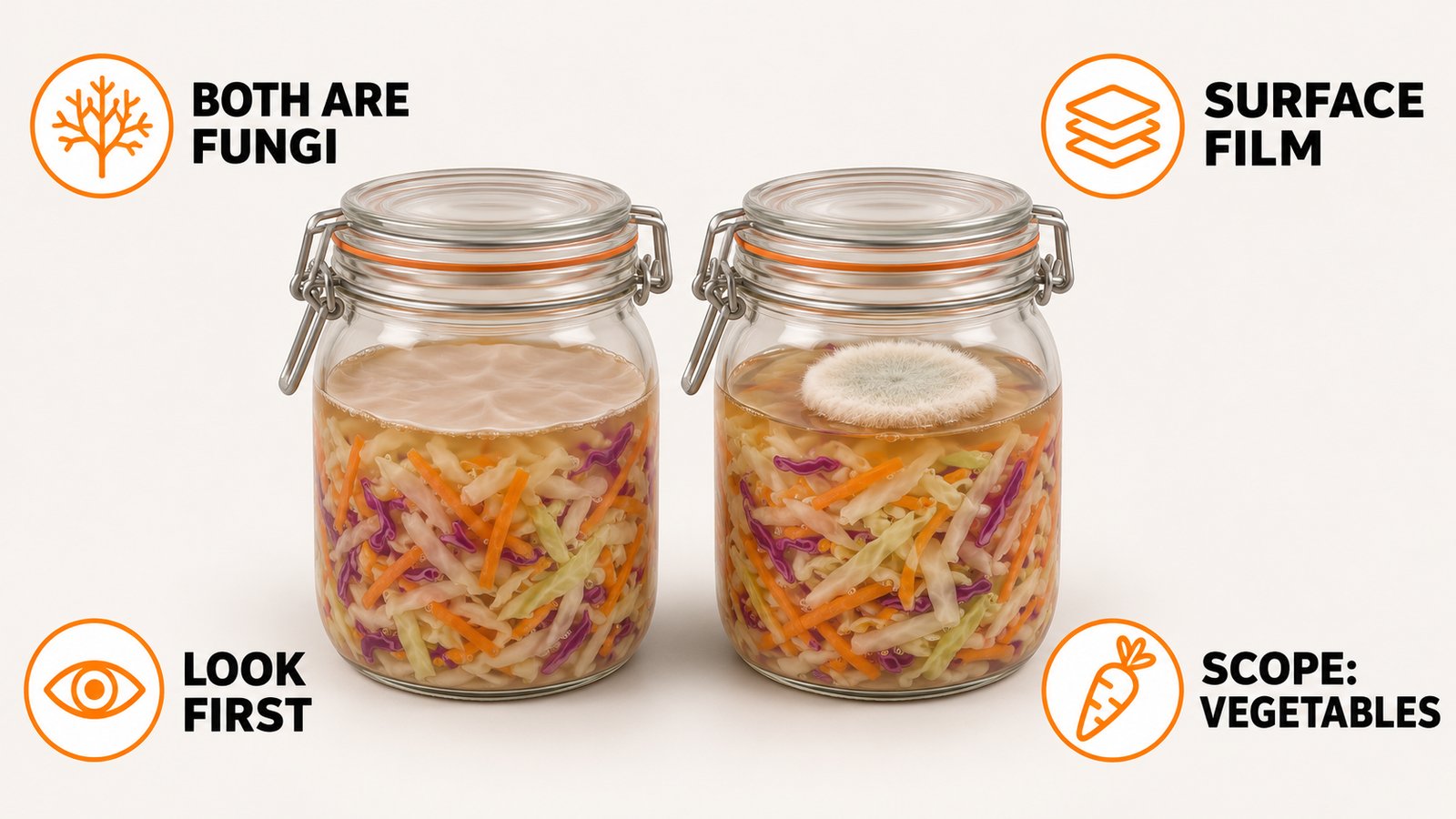
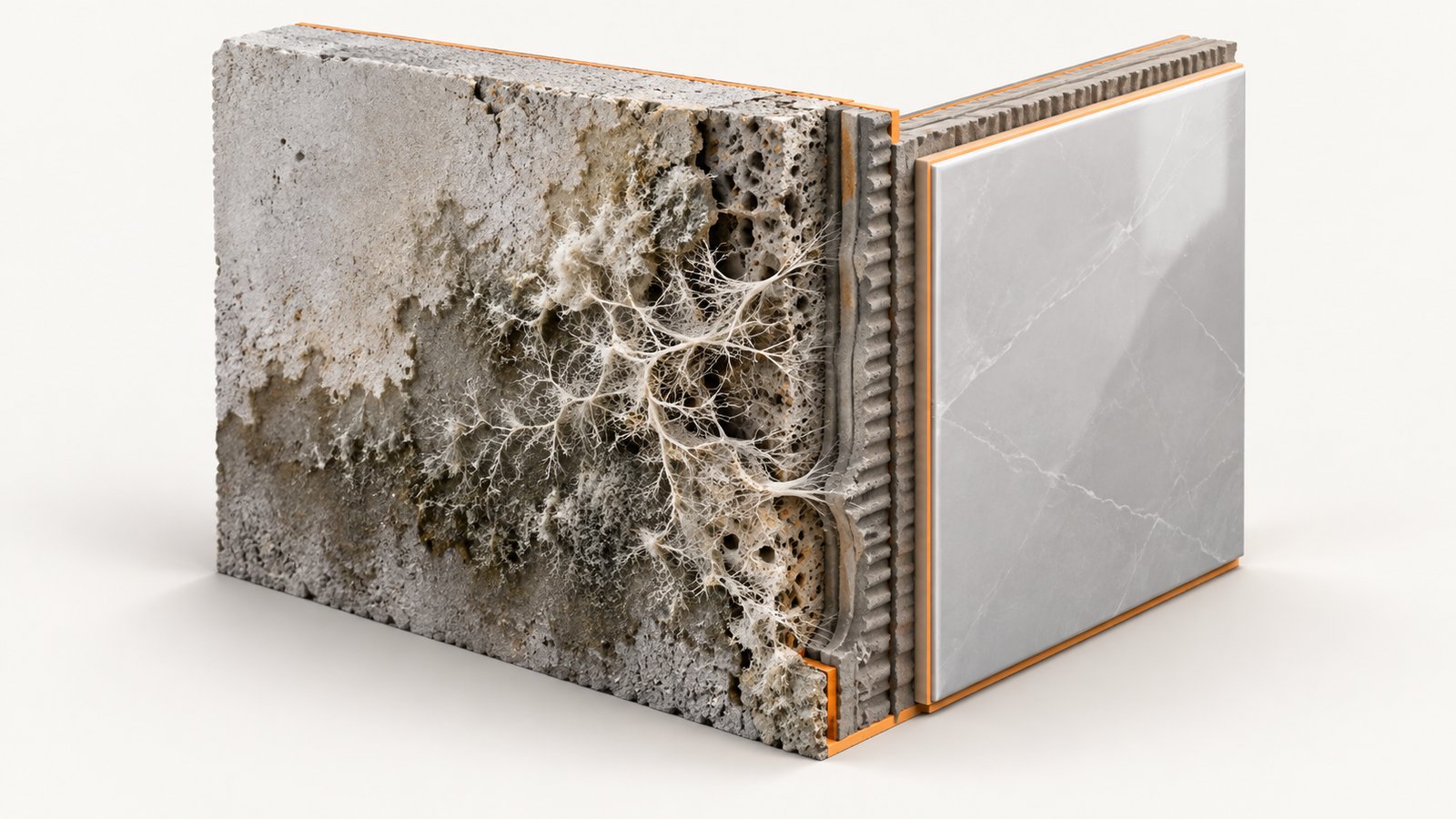
Both are fungi, so the real question is which growth sits on your ferment. Utah State University Extension says: "The fungi kingdom includes mushrooms, yeast, and molds." Our guide on whether mold is a fungus covers what mold is. This page covers how extension sources tell a yeast film from mold on a ferment, and what they say to do.
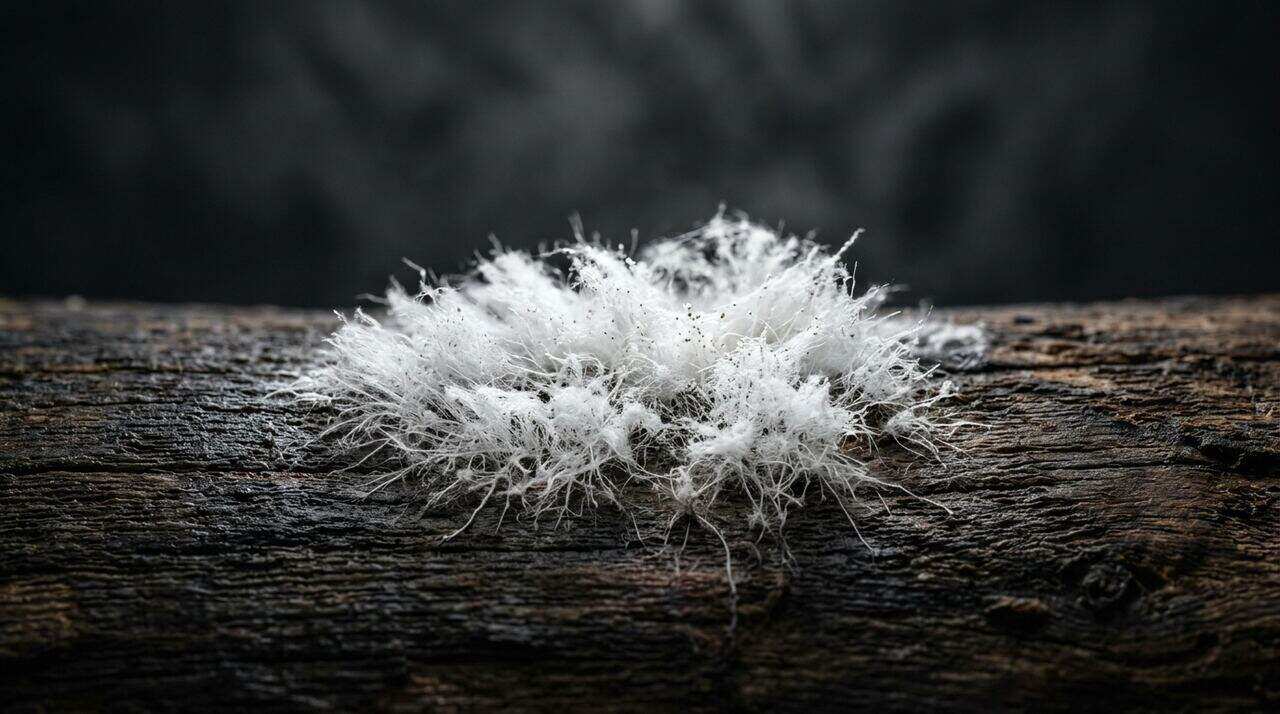
Kahm yeast is the name home fermenters use for a yeast film. UC Davis food scientists write: "White, gray, or pink films may form on the surface of fermenting fruits or vegetables. This film is typically yeast, often referred to by home fermenters as Kahm yeast."
A note on scope. The pages we read cover vegetable ferments such as sauerkraut, pickles, kimchi and olives. We read no university or federal page on kombucha or a sourdough starter, so we leave them out.
The sources do not always split the two. Ohio State's sauerkraut guide says "A thin film of yeast or mold (scum) may form on the surface of the fermentation brine." Treat the look as a first clue, not a lab result.
What Does Kahm Yeast Look Like?
Five extension pages describe it. Here is each one in its own words.
| Source | How it describes kahm yeast |
|---|---|
| UC Davis, March 2022 | White, gray or pink films, and the film is "typically yeast". |
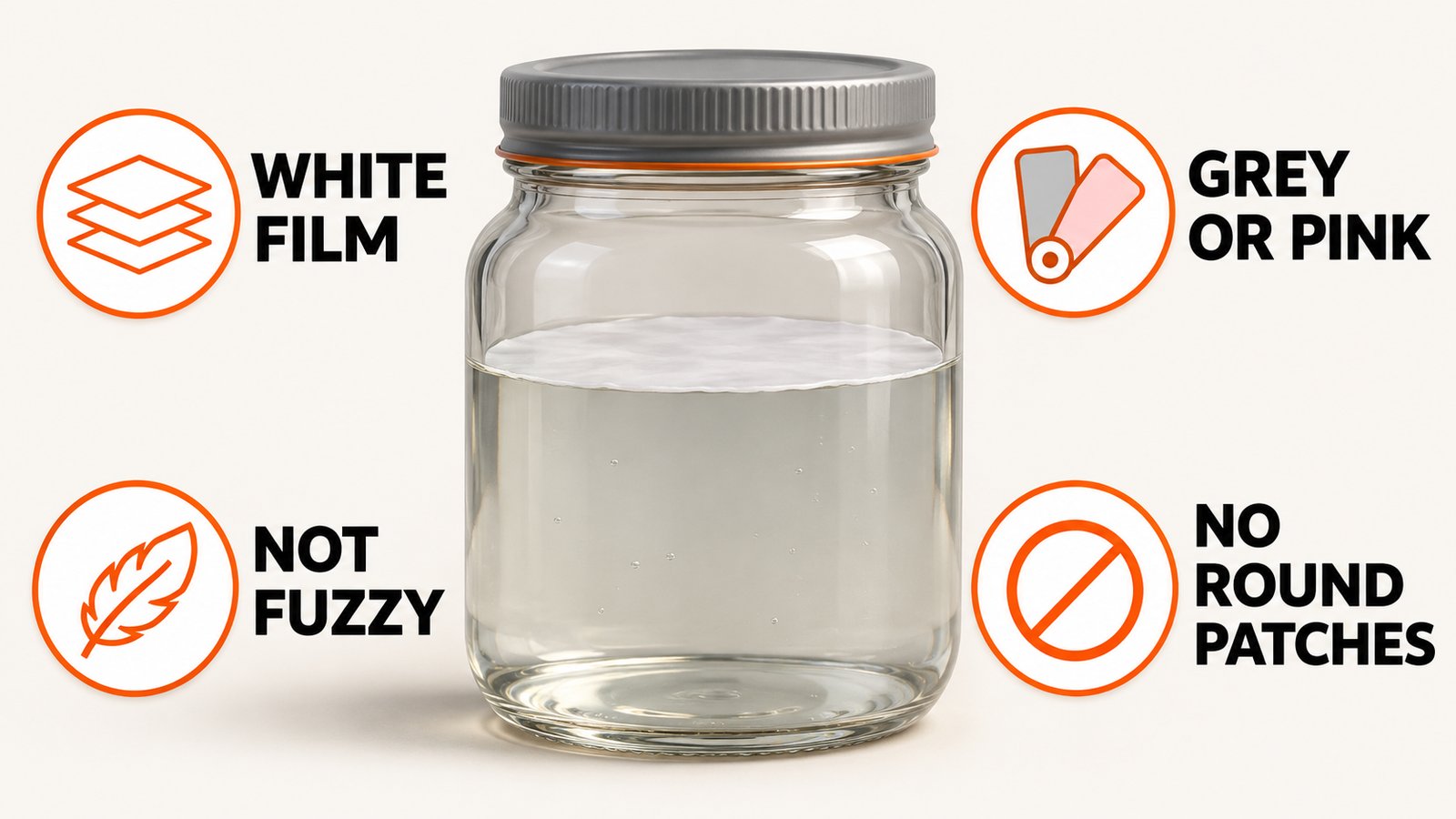
| Illinois Extension, Fermenting FAQ | "A white film that is not fuzzy or in round patches is kahm yeast." |
| UC Master Food Preservers, February 2023 | Kahm yeast "looks like a white milky film". |
| Ohio State Extension, HYG-5592, 2018 | "Scum or film of white yeast that sometimes forms at the top of the fermentation vessel." |
| Clackamas County Extension, November 2024 | If a brine has "a white bloomy residue growing on top", it may be kahm yeast. |
Every source says white. Four of the five use the word film or scum. Illinois adds two things it is not: fuzzy, or in round patches. UC Davis adds that the film can be gray or pink, and says "For other ferments, such as sauerkraut, yeast should be periodically removed during fermentation." It also says "Excessive yeast growth can lead to off flavors or textures and reduce acidity."
This last point is ours: a photo of a film is a photo of a pale layer. The cues the sources use, fuzzy or not and round patches or not, are texture cues, and texture is the first thing a photo loses.
What Does Mold Look Like on a Ferment?
| Source | How it describes mold |
|---|---|
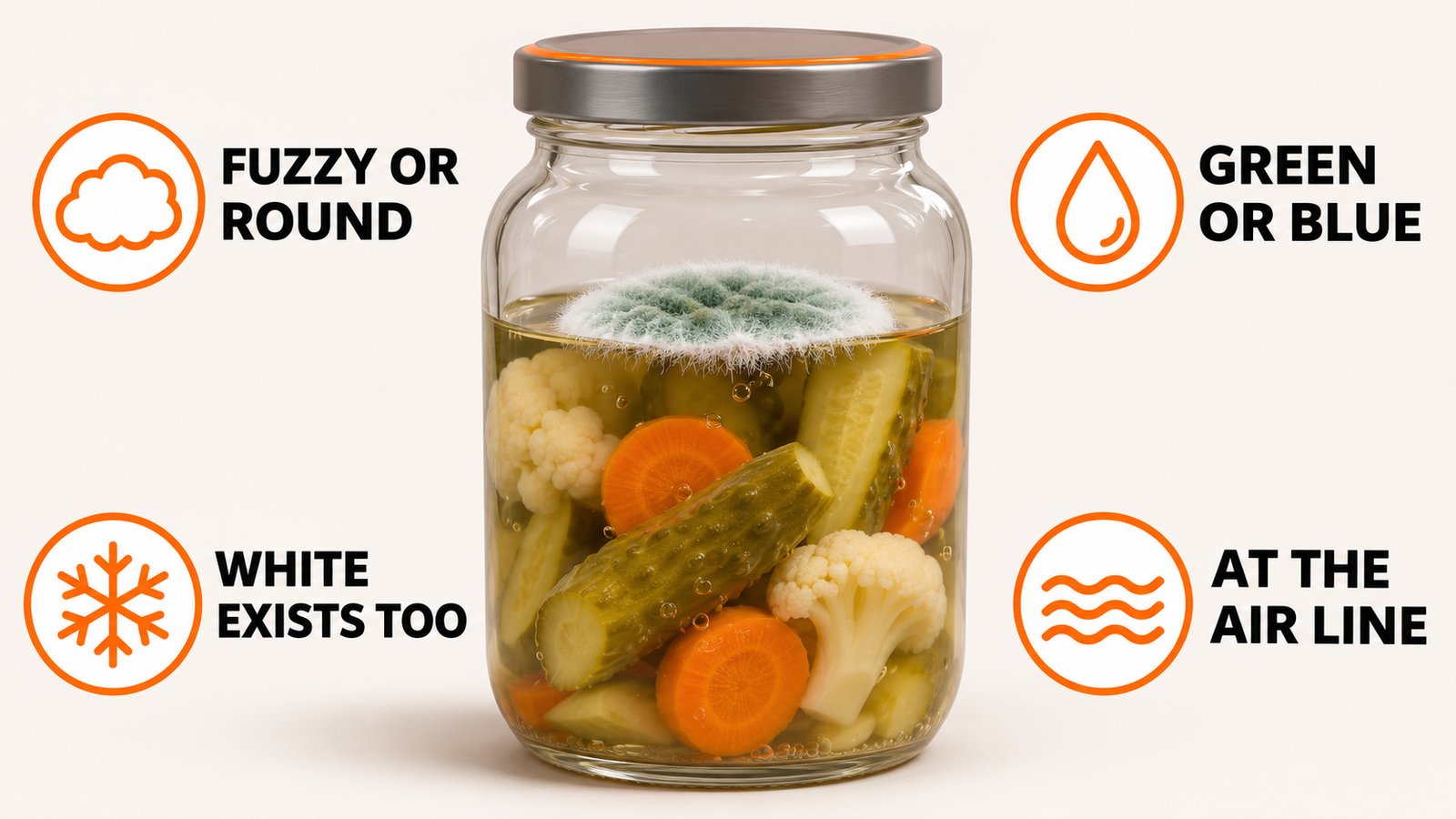
| UC Davis, March 2022 | "Mold is typically green, blue, brown, or black in color." "Molds can grow on the surface of the ferment at the air interface." |
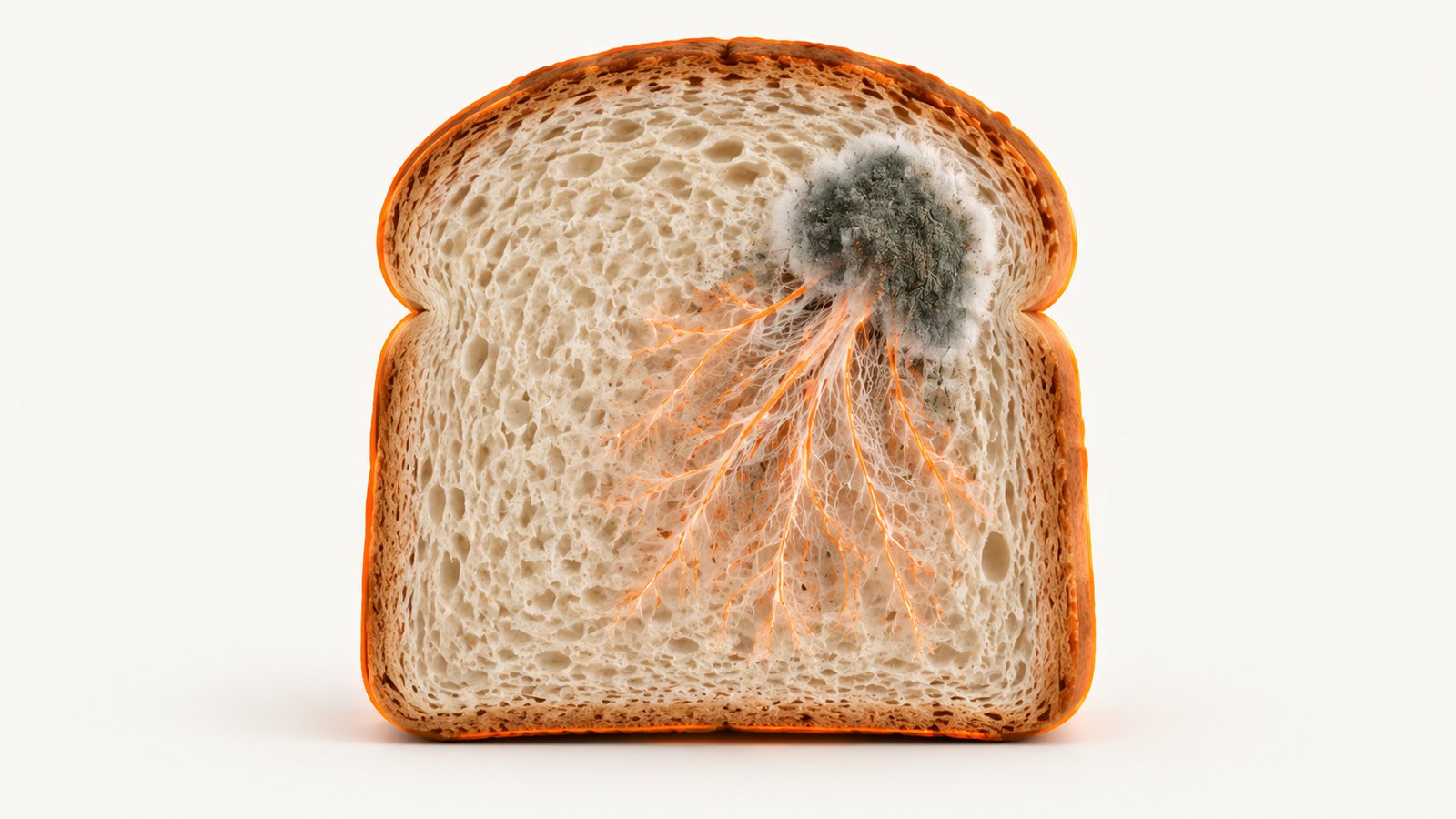
| UC Master Food Preservers, February 2023 | "It can be round and fuzzy, blue, black or pink." |
| USDA Food Safety and Inspection Service (molds on food in general, not ferments) | Mold looks like "gray fur on forgotten bologna, fuzzy green dots on bread, white dust on Cheddar, coin-size velvety circles on fruits, and furry growth on the surface of jellies". "The spores give mold the color you see." |
Two details keep color from settling the question. Pink is on both lists: UC Davis lists pink among yeast films, and the Master Food Preservers list pink among mold colors. White is on both lists too. UC Davis prints a photo caption that reads "White mold growth on sauerkraut stored outside brine", FSIS lists "white dust on Cheddar" among the looks of mold, and the EPA says "Molds come in many colors including white."
UC Davis says "If you confirm mold growth on any part of a ferment", and it does not say how to confirm it. The Illinois cue, a film "that is not fuzzy or in round patches", helps rule yeast in. It does not rule mold out.
That matches our position. Color and a flat or fuzzy look are clues and never an ID, and thin mildew can lie flat, so a flat spot is not proof of anything either way. Our white mold, mold or dirt and types of mold pages cover the same point for household surfaces.
What Do Sources Say to Do About Mold on a Ferment?
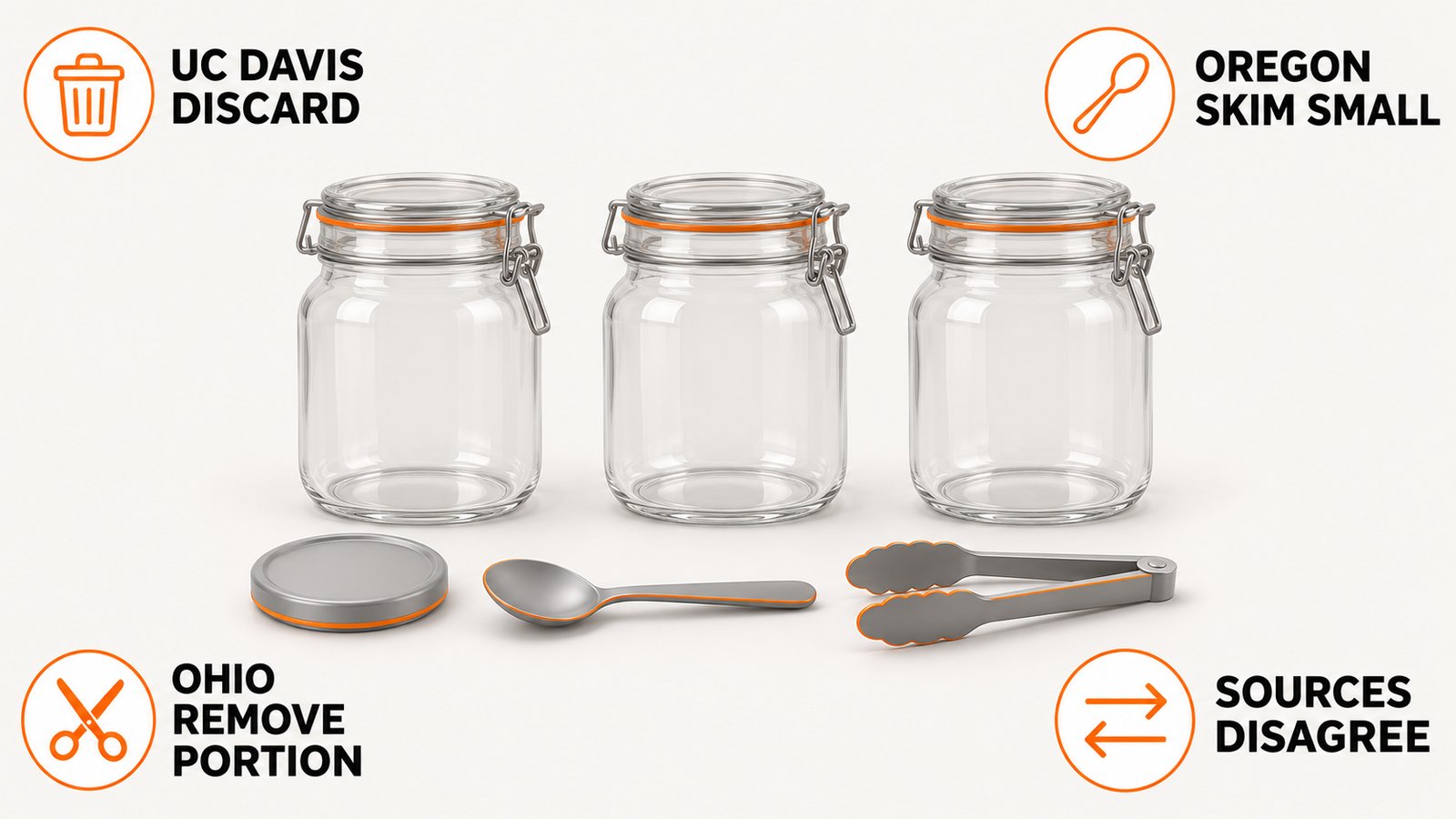
Here is each instruction, word for word. We are showing how they differ. We do not endorse any of them, and we are not telling you what to do with your batch.
| Source | Instruction, word for word |
|---|---|
| UC Davis, March 2022 | "If you confirm mold growth on any part of a ferment, it should be immediately discarded." |
| Clackamas County Extension, Ask Extension answer, November 2024 | "if your fermented or pickled products develop green, blue, or black mold, they must be discarded. The mold cannot be scooped out". |
| Oregon State University Extension, SP 50-745, January 2025 | "Moldy kraut (small mold patches may be skimmed off, but large amounts require discarding)" and "Discard the batch if large amounts of mold are visible." |
| UC Master Food Preservers, February 2023 | "If there is a thin layer of mold on top of the brine, either skim it off or throw the entire ferment away and start over." |
| Ohio State University Extension, HYG-5592, June 2018 | "Remove the molded portion and use the rest of the product." |
They do not agree. UC Davis and the Clackamas answer say discard. Oregon State and the Master Food Preservers allow skimming a small or thin amount, and Oregon State says to discard when large amounts are visible. Ohio State says to remove the molded portion, and warns that "the spoilage microbes may come back since you are unlikely to remove every cell". It is also the oldest dated source in the table, and the sheet says of itself that "recommendations have become more conservative over time".
The Clackamas answer gives a health reason for discarding. We leave it out, because we make no claim about what happens to a person who ate a food. The FSIS Molds on Food page has a food-by-food table for foods in general, and we do not apply it to ferments.
How Do You Keep Mold Off a Ferment?
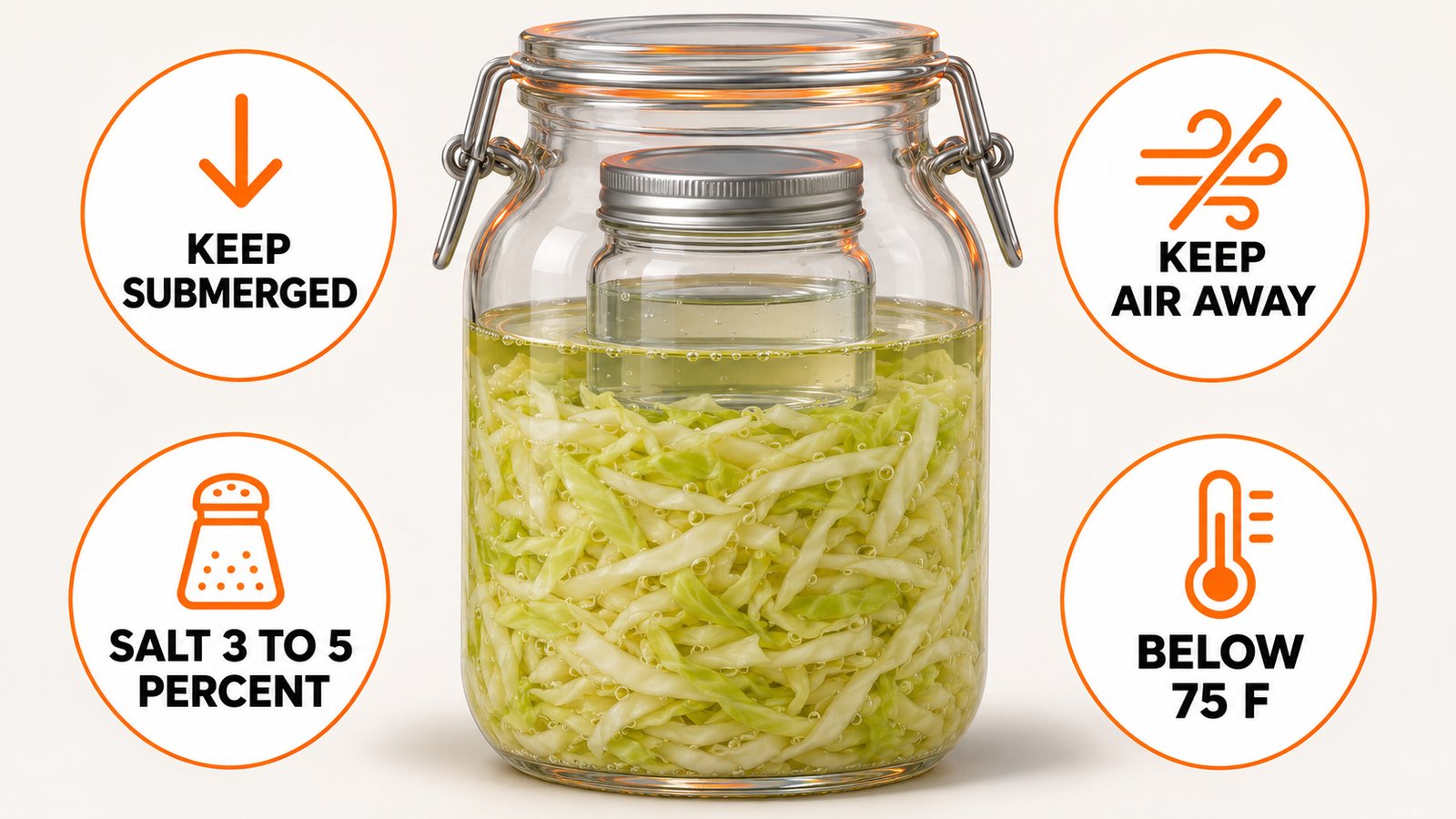
| Condition | What the source says |
|---|---|
| Keep vegetables under the brine | UC Davis: "All produce should be submerged in the brine liquid." Illinois Extension: "Your fermenting product should be kept 1-2 inches below the brine." |
| Keep air away from the surface | UC Davis: "It is important to keep the fermentation away from air." Illinois Extension: "Exposure to oxygen can encourage and allow for both mold and yeast to grow." |
| Salt level | Illinois Extension: "Generally 5% salt concentrations are used for large vegetables (cucumbers and carrots) and a 3% concentration is used for shredded vegetables (cabbage)." Oregon State: "Use 3T canning salt for 5 pounds of cabbage." |
| Temperature | Oregon State says to ferment at temperatures below 75 degrees F and to ensure proper coverage. The National Center for Home Food Preservation says the USDA recommendation is to store at 70 to 75 degrees F while fermenting. Illinois Extension lists 68 to 72 degrees F as the ideal room temperature. |
| Check the surface | The National Center for Home Food Preservation says that if you use jars as the weight, "you will have to check the kraut 2 to 3 times each week and remove scum if it forms". |
The temperature numbers differ by a few degrees, so read the number in your own tested recipe. UC Davis says "Mold growth can occur anytime during the fermentation process and is a sign of a failed fermentation", so none of this is a guarantee.
For buildings, the EPA's brief guide says "The key to mold control is moisture control." Keeping vegetables under the brine is the matching step in a ferment, and that pairing is ours, not theirs. See also how to prevent mold.
Can a Photo Tell Kahm Yeast From Mold?
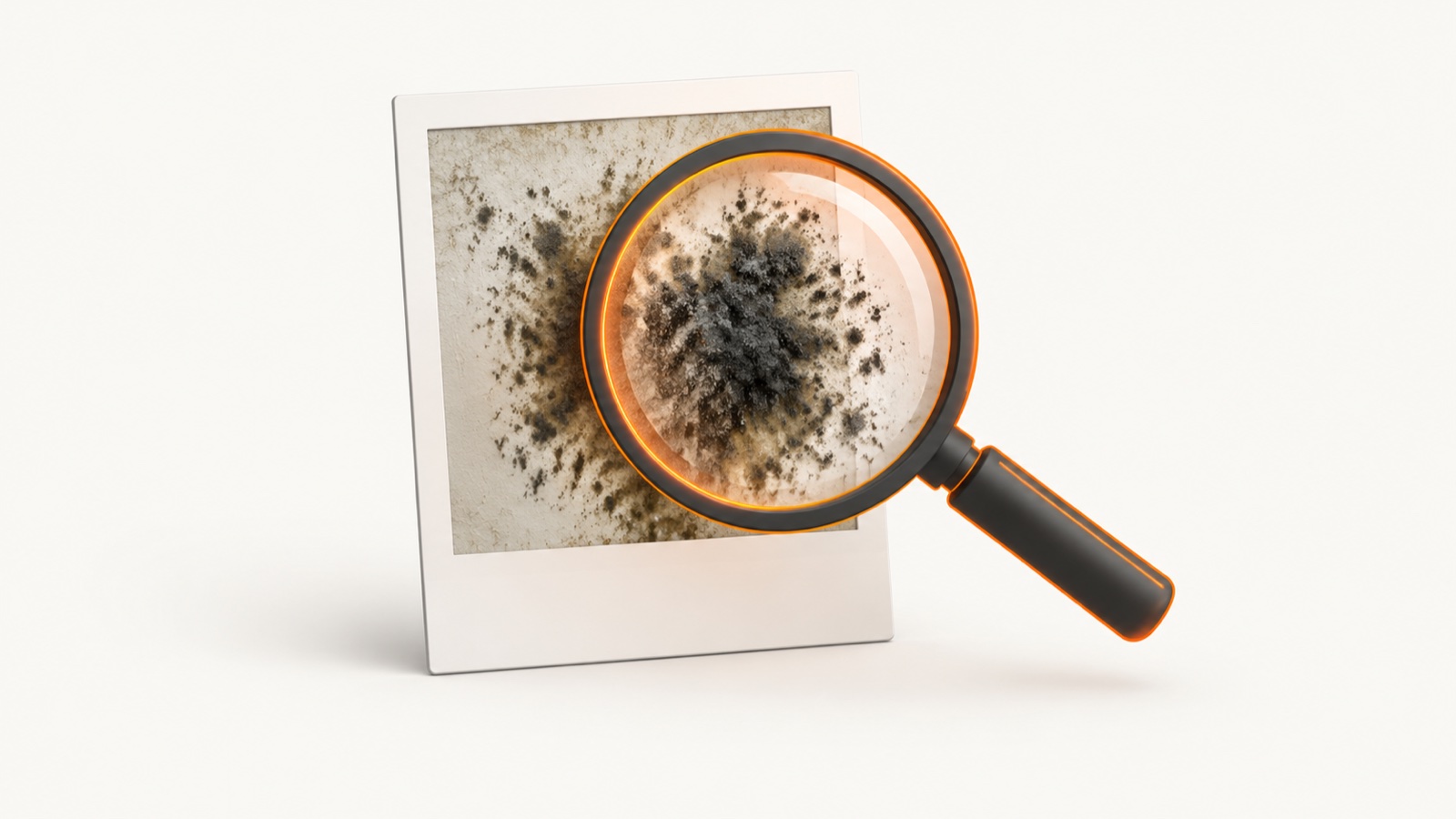
No, and we would rather say so than imply otherwise. The Mold Scanner AI photo scan is built for household surfaces such as walls, ceilings and grout. It helps tell whether a spot looks like mold and what to do next. It does not identify species and is not built for food.
The sources' cues are texture and color, and a photo shows texture poorly. If the same white fuzz is on a window sill, a wall or a shelf, that is our ground. Start with our guides to telling if a spot is mold and telling if it is mold from a photo. Our mold on bread page quotes a USDA page on food mold, and it does not cover fermented foods.
Who Should You Ask About a Ferment?

A food-safety question about your jar goes to the USDA or a local extension office. Illinois Extension's FAQ invites readers to "contact an Illinois Extension expert". A health question goes to a physician. We cannot say whether a particular ferment is safe or unsafe to eat. For lookalikes on household surfaces, see mold identification.
Frequently asked questions
Is kahm yeast the same as mold?
The sources we read treat them as different growths. UC Davis says a white, gray or pink surface film is typically yeast, and describes mold as typically green, blue, brown or black. Both are fungi, as Utah State Extension notes. Ohio State's sauerkraut guide groups them as a thin film of yeast or mold (scum).
What do sources say to do if mold appears on a ferment?
They disagree. UC Davis says a ferment with confirmed mold should be immediately discarded. Oregon State says small mold patches may be skimmed off but large amounts require discarding. Ohio State says to remove the molded portion. We do not pick one.
How do I keep mold off a ferment?
The sources name keeping all vegetables under the brine (Illinois Extension says 1 to 2 inches below), keeping air away from the surface, using the salt amount in a tested recipe, and fermenting in a cool room. UC Davis says mold growth can occur anytime during fermentation, so none of this is a guarantee.
Can a photo tell kahm yeast from mold?
No. The cues in the sources are texture and color, and a photo shows texture poorly. The Mold Scanner AI photo scan is built for household surfaces. It helps tell whether a spot looks like mold and what to do next, and it does not identify species or evaluate food.
Does Mold Scanner AI say whether a ferment is safe to eat?
No. We make no claim that any food or ferment is safe or unsafe to eat. A food-safety question goes to the USDA or a local extension office, and a health question goes to a physician.
Do these sources cover kombucha or a sourdough starter?
No. We read no university or federal page on kombucha or a sourdough starter, so this page leaves them out.
Sources
Every claim on this page traces to one of these. Links open the primary document.