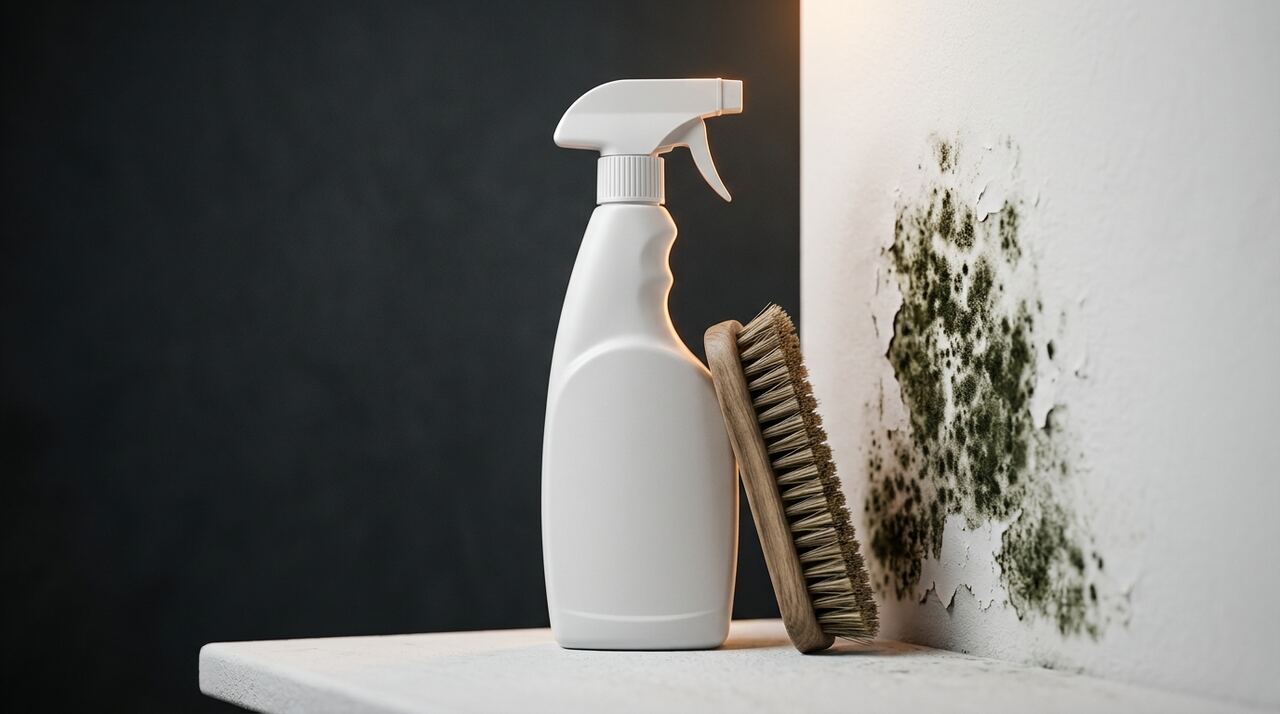
What do the Clorox labels say about mold?
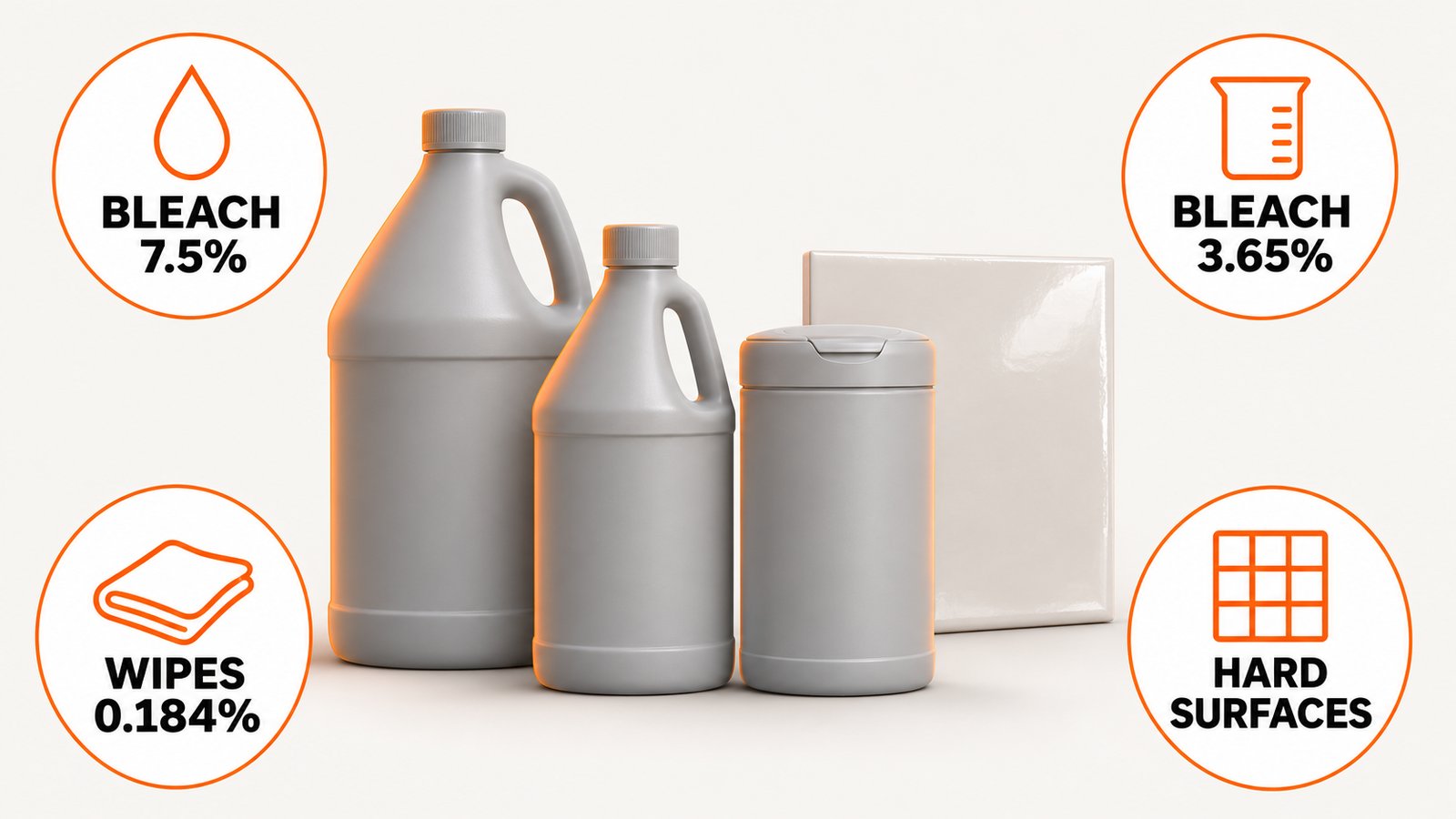
Clorox is a brand with many products, and each has its own EPA-stamped label. We read the current labels for three: the bleach sold as Clorox Disinfecting Bleach and Clorox Regular Bleach (EPA Reg. #5813-120), a second Clorox bleach registration (#5813-124), and Clorox Disinfecting Wipes (#5813-79). We did not read every Clorox label, so check the number on yours.
These are master labels, and each says bracketed text is optional, so the label printed on your bottle can carry only part of it. The bleach label also states, "It is a violation of federal law to use this product in a manner inconsistent with its labeling."
| Product and active ingredient | Mold or mildew wording | Surfaces and directions |
|---|---|---|
| Clorox Disinfecting Bleach and Regular Bleach (#5813-120). Sodium hypochlorite, 7.5% | Directions for mold and mildew removal; optional claim wording about household mold and mildew | Hard, nonporous surfaces. 1/3 cup of bleach in 1 gallon of water, visibly wet for ten minutes, rinse well, air dry. |
| Second Clorox bleach registration (#5813-124). Sodium hypochlorite, 3.65% | A direction for killing fungi, mold and mildew | Hard, nonporous surfaces, pre-washed. 1 cup of bleach in 1/2 gallon of water, visibly wet for five minutes, rinse well, air or wipe dry. |
| Clorox Disinfecting Wipes (#5813-79). Two ammonium chloride compounds, 0.184% each | No claim to kill mold. A direction to prevent, inhibit or control mildew growth for up to 7 days | Hard, nonporous surfaces. Preclean, wipe until visibly wet, air dry, repeat weekly or when growth reappears. |
The bleach labels carry mold directions, but the main directions name hard, nonporous surfaces, and the two registrations call for different mixes. The wipes label does not claim to kill mold. A shorter bathroom hint on the bleach labels says "surfaces" without naming a type, and no mold wording on the three labels names drywall, carpet or ceiling tile. For bleach on porous material, see our guide on whether bleach kills mold.
Does Clorox bleach kill mold and mildew?
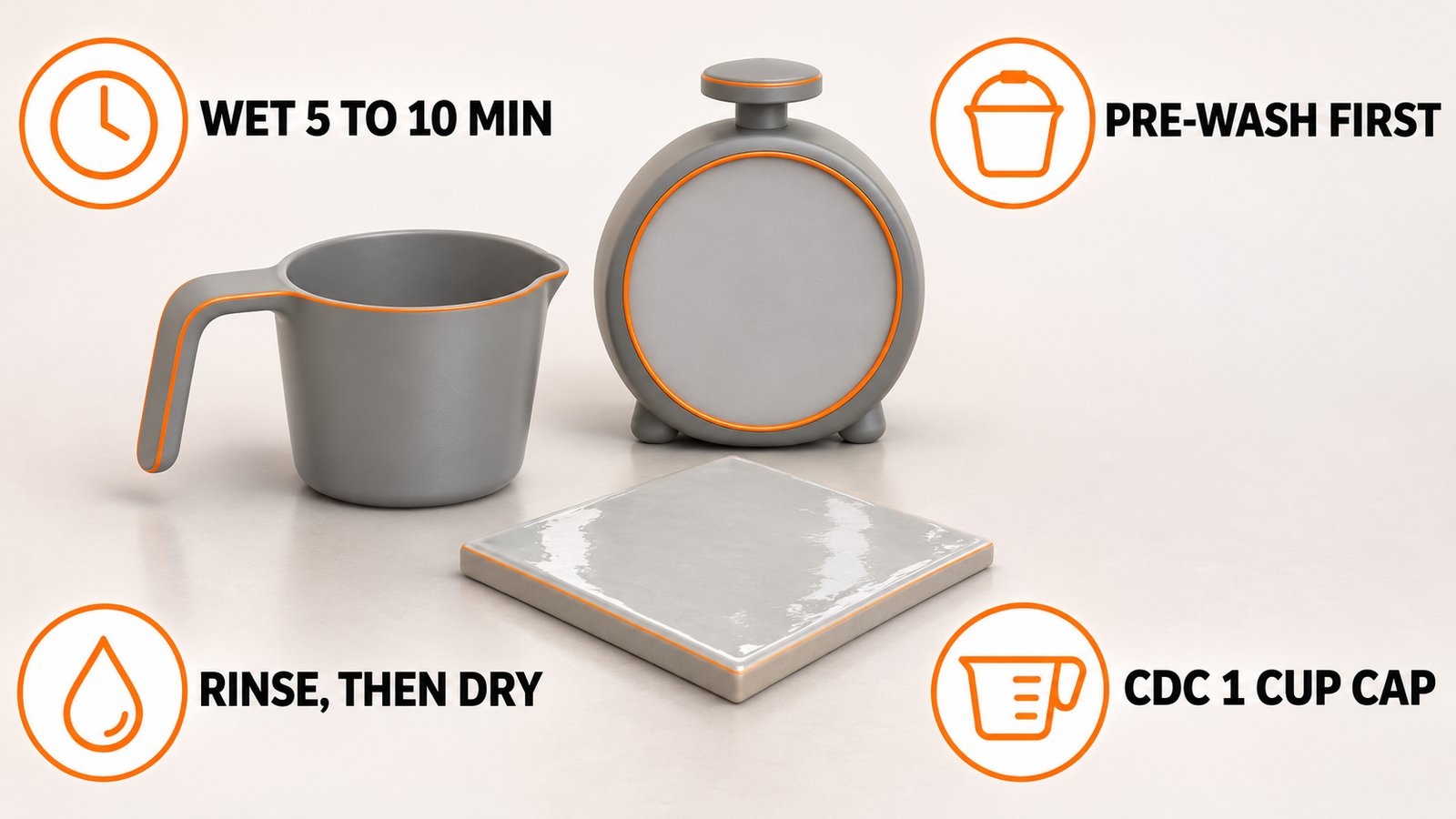
Both bleach labels list sodium hypochlorite. The strength differs: the #5813-120 label lists 7.5%, Clorox's safety data sheet for Clorox Disinfecting Bleach lists 4 to 9 percent, and the #5813-124 label lists 3.65%. The #5813-124 label also lists Clorox Regular Bleach among its alternate names, so one name can sit on bottles of different strength. The mold directions differ with it: 1/3 cup per gallon and ten minutes wet on #5813-120, 1 cup in half a gallon and five minutes on #5813-124. Both rinse and dry. The #5813-124 label requires a pre-wash, and on #5813-120 the pre-wash wording is optional label text.
What did the maker test? The #5813-124 footnote ties its fungi and mold claim to Trichophyton interdigitale and Aspergillus brasiliensis. The #5813-120 table lists those two plus Candida albicans at ten minutes each, and one optional claim line puts "mold" and "mildew" in parentheses beside Aspergillus brasiliensis. Our reading: the claim rests on named test species, and a patch in your house is not a named test species.
The CDC sets a ceiling. Its mold clean-up page says bleach or dish detergent can be used to clean mold in a home, with no more than 1 cup of bleach in 1 gallon of water. The #5813-124 mix, 1 cup in half a gallon, is stronger than that. We are not choosing between them: the CDC's disaster sheet is written for household laundry bleach, and the label is written for that product.
Both bleach labels also carry an outdoor hint for exterior surfaces such as siding and brick, which is not an indoor wall direction. The #5813-124 label also has an outdoor direction to control fungi and mildew on asphalt or wood roofs and siding. The Tilex review covers a separate bathroom spray. We did not read its label for this page.
Do Clorox wipes kill mold?
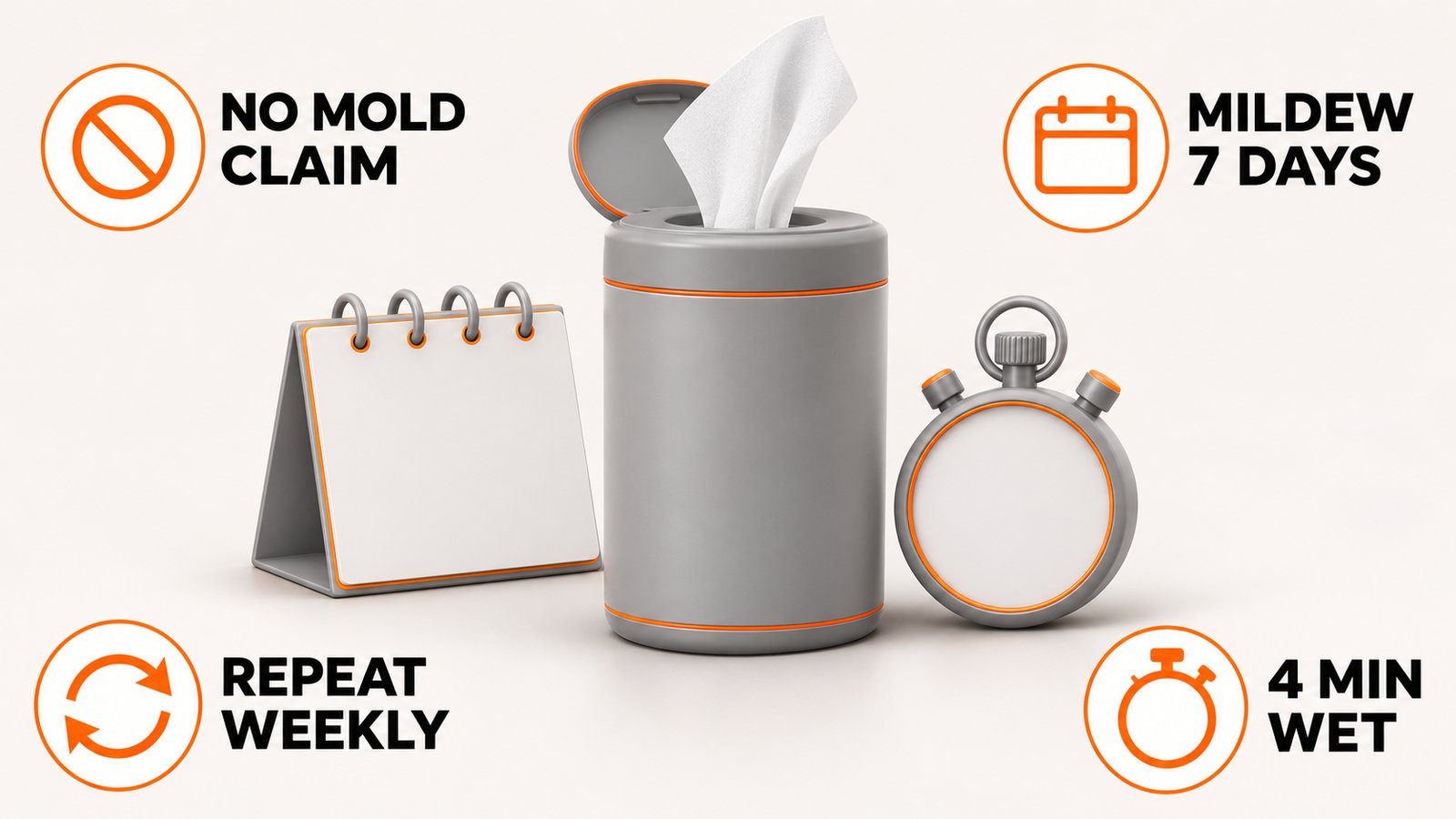
The wipes label we read (#5813-79, accepted September 29, 2026) lists two ammonium chloride compounds, 0.184% each. Its disinfecting directions cover hard, nonporous surfaces kept visibly wet for four minutes.
The only mold-adjacent direction is a line to prevent, inhibit or control the growth of mildew on hard, nonporous surfaces for up to 7 days: preclean, wipe until visibly wet, air dry, and repeat weekly or when growth reappears. That is about holding back growth on a cleaned surface, not removing a colony already there.
Candida albicans appears in the disinfection table at four minutes. Aspergillus niger appears only in the label's organism tables, under a heading that reads "Fungistat." Our reading is that the heading goes with the growth-control direction, not the kill times.
On wipes and mold spores: we found no spore claim and no claim to kill mold anywhere on the label, so it gives no basis for expecting a wipe to do either.
Why does the EPA not recommend bleach for routine mold cleanup?
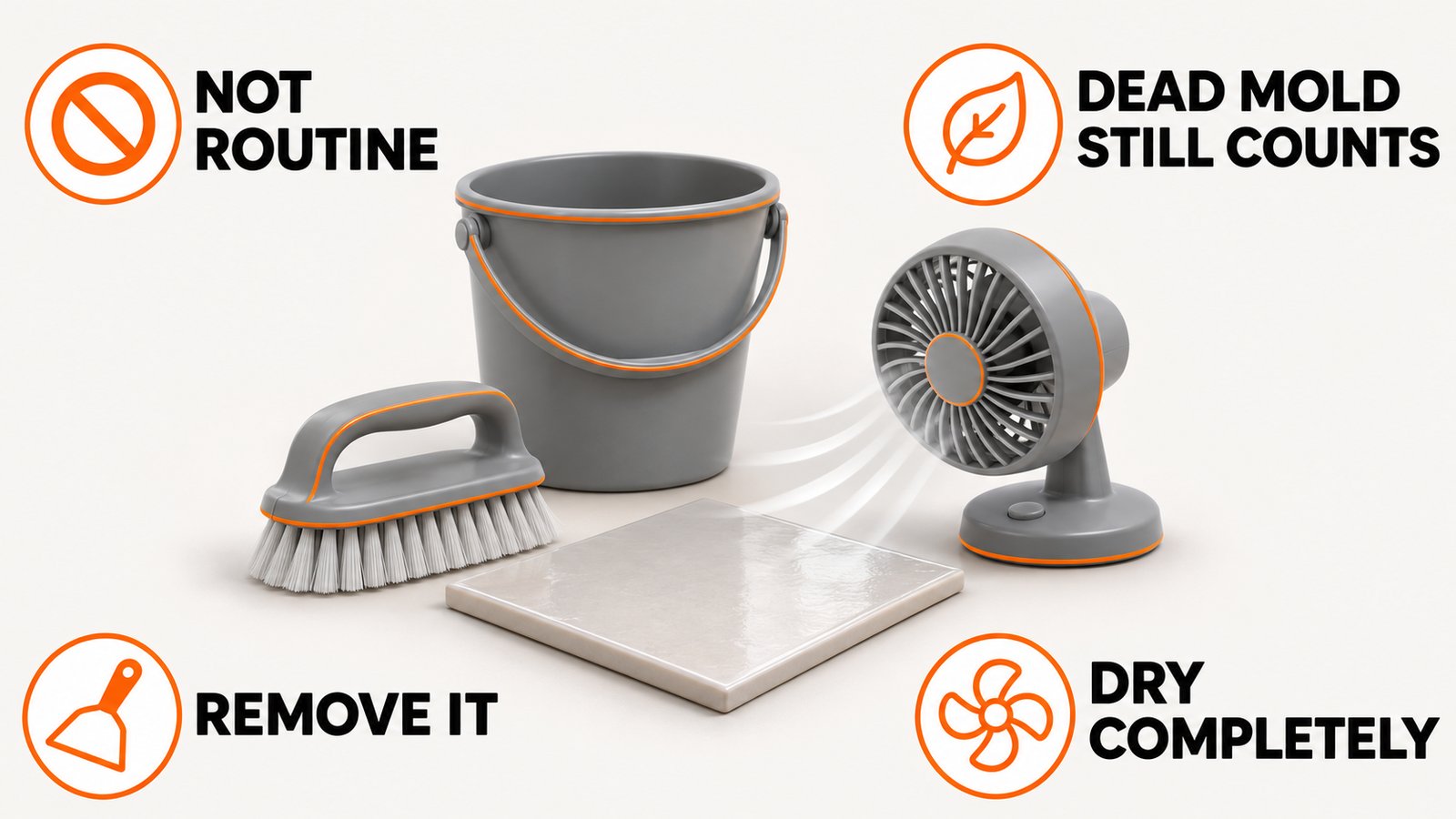
The EPA's guide to mold, moisture and your home defines biocides as "substances that can destroy living organisms." It then says: "The use of a chemical or biocide that kills organisms such as mold (chlorine bleach, for example) is not recommended as a routine practice during mold cleanup." It adds: "There may be instances, however, when professional judgment may indicate its use (for example, when immune-compromised individuals are present)."
It also says that in most cases it is not possible or desirable to sterilize an area, and that a background level of mold spores will remain and will not grow if the moisture problem has been resolved. And it states the point this site is built on: "Dead mold may still cause allergic reactions in some people, so it is not enough to simply kill the mold, it must also be removed."
For hard surfaces the EPA's cleanup page says to scrub mold off with detergent and water, and dry completely. Its mold course adds "Always follow the cleaning instructions on product labels." So the CDC says bleach can be used within a limit, the EPA says it is not recommended as a routine practice, and both say never to mix bleach with ammonia. The EPA's cleanup page and a CDC bleach fact sheet both call for drying. The EPA's brief guide also says the key to mold control is moisture control. Our guide to what kills mold covers the other products.
What to do about mold on drywall, wood and other porous material
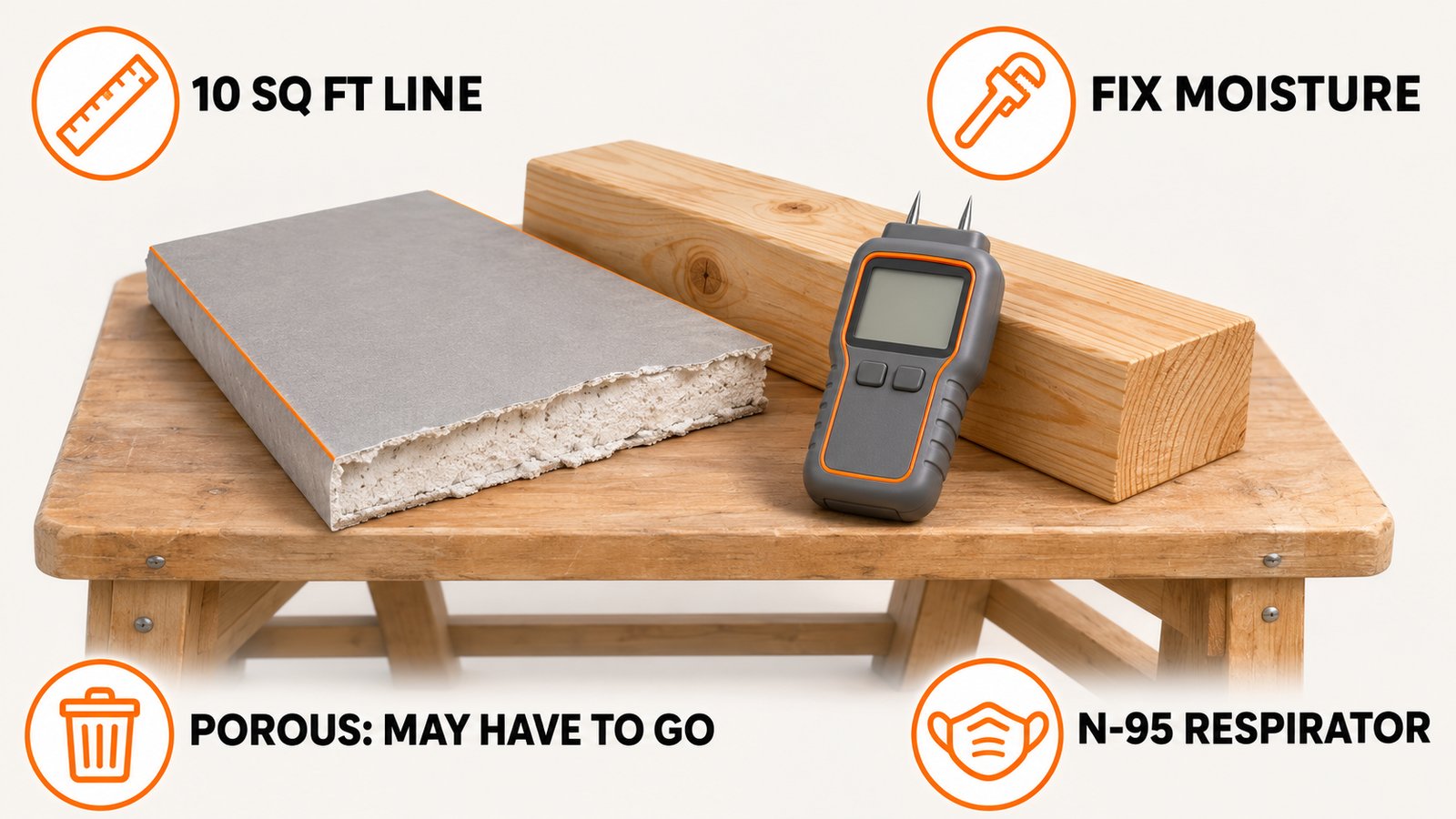
The three Clorox labels give no mold directions for drywall, carpet or ceiling tile. The EPA does speak to porous material: ceiling tiles and carpet "may have to be thrown away if they become moldy," because mold can grow on or fill in the empty spaces inside, so it may be difficult or impossible to remove completely. It also says not to paint or caulk moldy surfaces. Our guides on mold on drywall, how to get rid of mold and the mold remediation process cover the steps.
Size matters. The EPA says a moldy area under about 10 square feet, roughly a 3-foot by 3-foot patch, is in most cases a job you can handle yourself. Past that size, or after a lot of water damage, the EPA points to its guide for larger jobs, and we suggest a professional. The EPA's own call for a professional is for sewage or other contaminated water, and for suspected hidden mold it says to consider hiring an experienced one.
On protection, the EPA says you may want to wear an N-95 respirator, and that long gloves and goggles without ventilation holes are recommended. If the mold keeps returning, start with moisture: the EPA says to keep indoor humidity below 60 percent if possible, ideally 30 to 50 percent. Our humidity risk calculator and the guide to how to prevent mold help you find the cause.
Can you mix Clorox with other cleaners on mold?
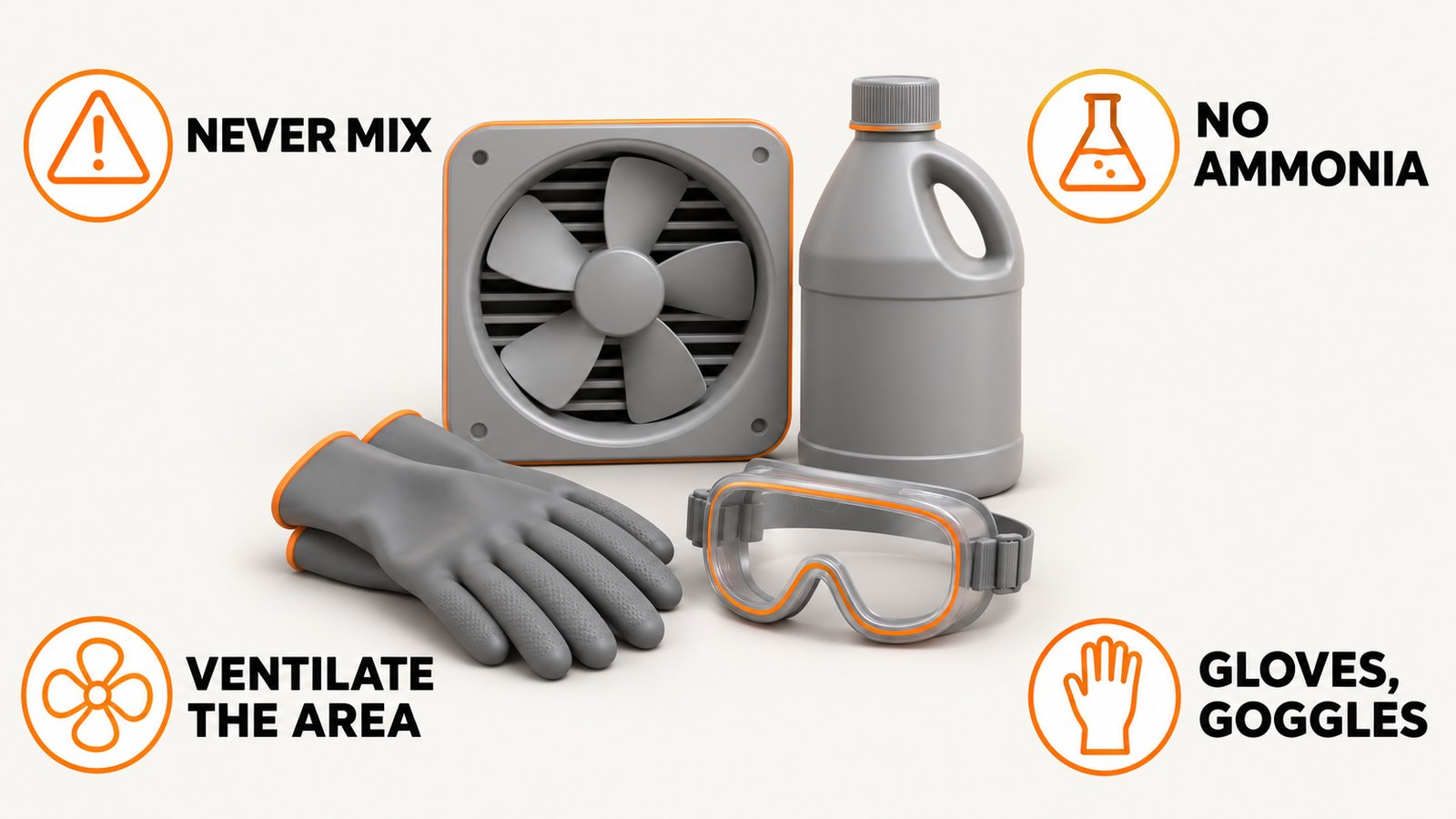
No. The EPA: "Never mix chlorine bleach solution with other cleaning solutions or detergents that contain ammonia because toxic fumes could be produced." The CDC: "You should never mix bleach with ammonia or any other cleanser." The #5813-124 label flags "STRONG OXIDIZING AGENT" with the line "Mix only with water according to label directions," and says mixing with chemicals such as ammonia or acids may release hazardous gases irritating to eyes, lungs and mucous membranes. Vinegar is an acid, so we read that line as covering it. See our ammonia guide and the bleach and vinegar comparison.
The hazard wording differs by bottle: the #5813-124 label's signal word is "warning", and Clorox's safety data sheet for Clorox Disinfecting Bleach (EPA Reg. #5813-120) says "danger." Read the signal word on yours.
The EPA says that if you use disinfectants or biocides, always ventilate the area and exhaust the air to the outdoors. The CDC says some people should not take part in mold cleanup at all: people with allergies, immune suppression or underlying lung disease, and people with chronic respiratory disease such as asthma or COPD.
Frequently asked questions
Does Clorox kill mold?
It depends on the product. The Clorox bleach labels we read have directions that name mold, for hard, nonporous surfaces that are pre-washed and kept wet for five or ten minutes. The Clorox Disinfecting Wipes label makes no claim to kill mold. The EPA says bleach is not recommended as a routine practice in mold cleanup.
Do Clorox wipes kill mold?
The Clorox Disinfecting Wipes label we read does not claim to kill mold. It claims to prevent, inhibit or control the growth of mildew on hard, nonporous surfaces for up to 7 days after the surface is precleaned, repeated weekly.
Do Clorox wipes kill mold spores?
We found no claim about mold spores anywhere on the wipes label. The EPA's method for mold on a hard surface is to scrub with detergent and water and dry completely.
Will Clorox kill mold on drywall?
The Clorox labels we read give indoor mold directions for hard, nonporous surfaces, and none of the mold wording names drywall. The EPA says porous materials such as ceiling tiles and carpet may have to be thrown away if they become moldy.
How long should Clorox bleach sit on mold?
It depends on the bottle. The 7.5% bleach label we read says ten minutes visibly wet, and the 3.65% label says five. Both say to pre-wash and rinse well. Follow your own bottle.
Can I mix Clorox with vinegar or ammonia?
No. The EPA says never to mix chlorine bleach solution with cleaning solutions or detergents that contain ammonia, and the CDC says never to mix bleach with ammonia or any other cleanser. One Clorox bleach label also names acids, and vinegar is an acid.
If the mold is dead, is the problem finished?
No. The EPA states that dead mold may still cause allergic reactions in some people, so it is not enough to simply kill the mold, it must also be removed. The moisture that fed the growth has to be fixed too.
Sources
Every claim on this page traces to one of these. Links open the primary document.