What the One Real Study Found
The published evidence base here is one study, and it is worth reading closely because almost nobody who sells this service quotes it accurately.
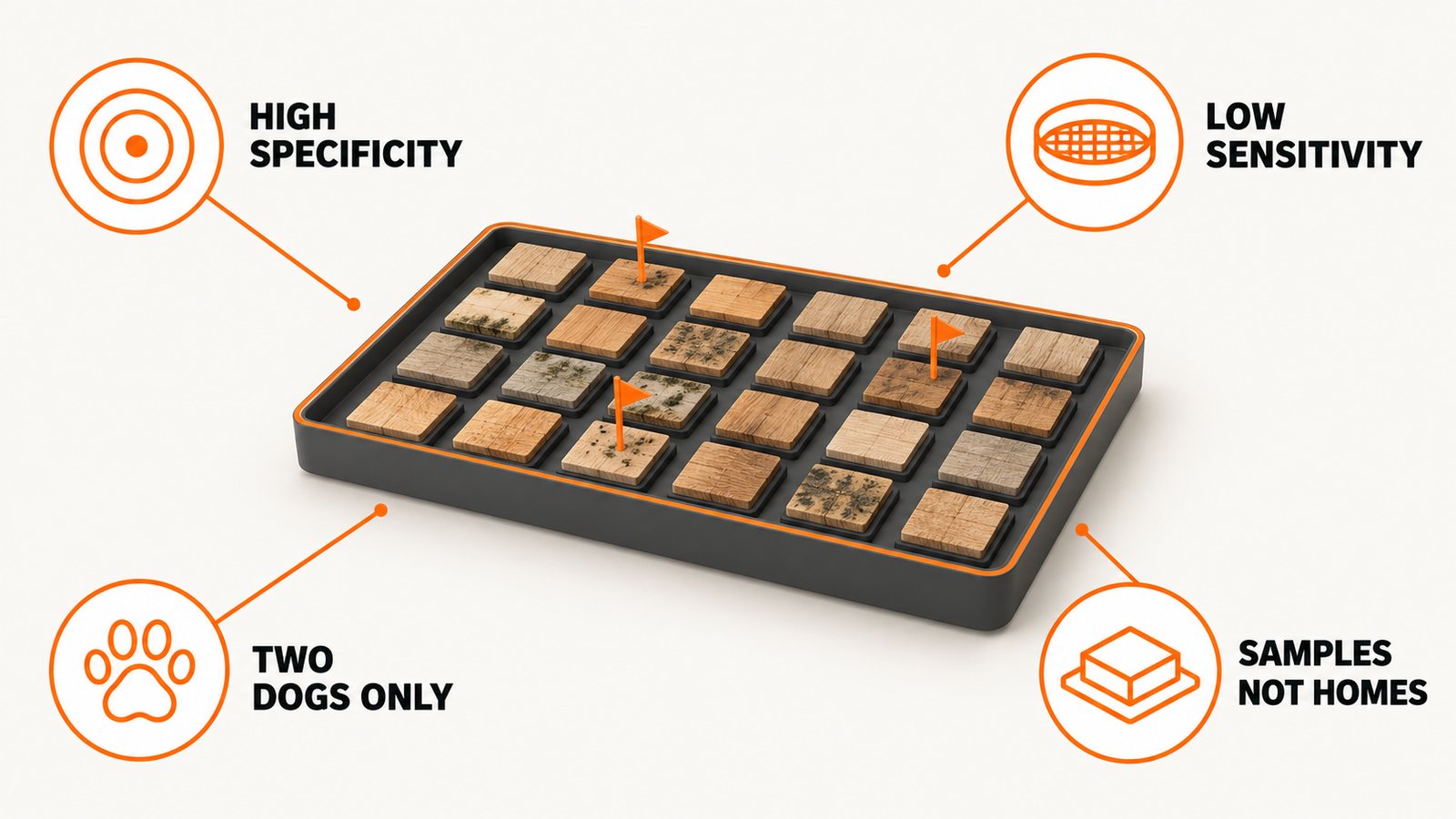
Kauhanen and colleagues published Validity of detection of microbial growth in buildings by trained dogs in Environment International in 2002. Two trained dogs were tested against sample sets: 100 decay samples, 75 controls of healthy birch, pine and treated wood, and 25 bacteria samples. The dogs had been trained on rot fungi, specifically Serpula lacrymans, Coniophora puteana and Antrodia sinuosa.
In that first round, the dogs detected 75 percent of the decay samples and 60 percent of the bacteria samples, and flagged somewhere between 0 and 24 percent of the healthy control samples as positive. Since the dogs picked out bacteria they had never been trained on, the researchers ran a second test using mold strains including Cladosporium, Botrytis, Trichoderma, Penicillium and Aspergillus. In that round the dogs found all the decay, mold and bacteria samples, and gave a false positive on only one piece of healthy wood.
The authors' own summary is the sentence that should drive every buying decision on this page. The use of dogs to detect mold or decay damage appears to have high specificity and high positive predictive value, but low sensitivity.
In plain terms: when a trained dog alerts, there is usually something there. When a trained dog does not alert, that proves very little. It is a finding tool, not a clearance tool, and the difference is the whole subject.
The second honest note is about the size of that evidence base. This is a small study on two dogs, published more than twenty years ago, on wood samples rather than on occupied houses. There is no large modern trial of building mold dogs to point at. Anyone quoting a precise accuracy percentage for a commercial mold dog is quoting a marketing number, not a measured one.
What a Dog Alert Actually Means
Understanding what the alert is will save you from the two ways people misread it.
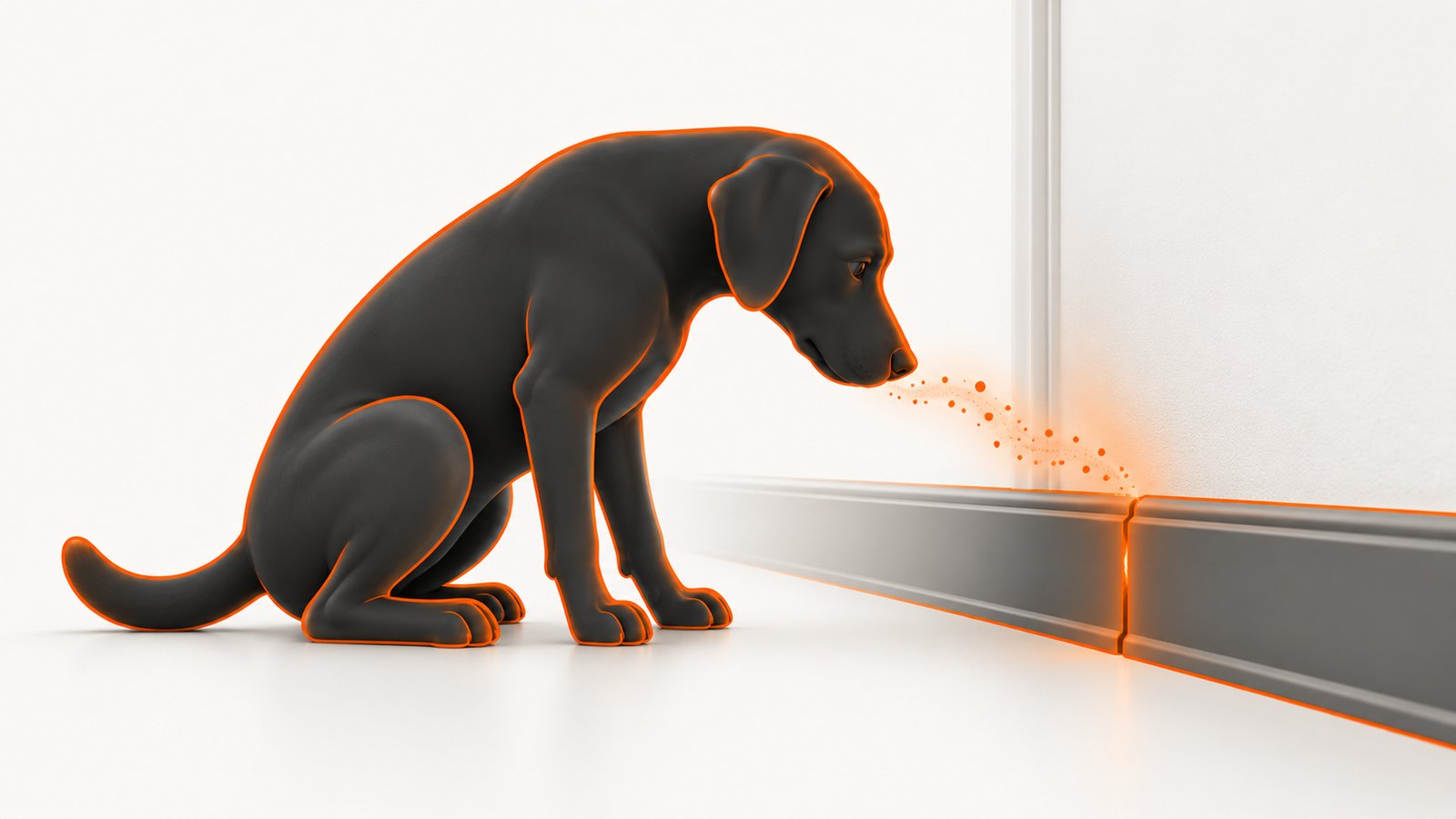
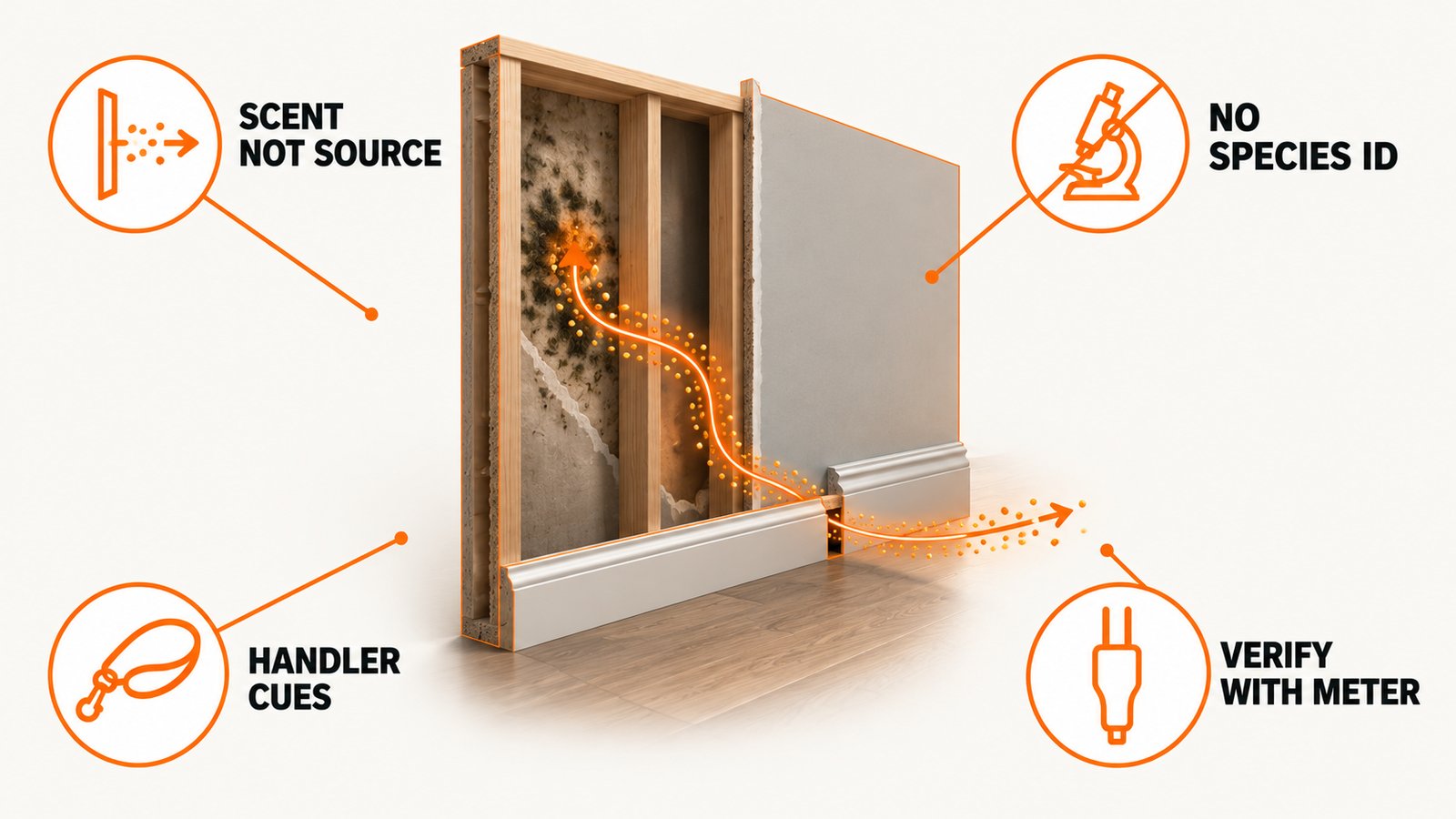
A dog is detecting volatile compounds, not mold. Growing fungi and bacteria release microbial volatile organic compounds, the same chemistry behind the musty smell a person can sometimes notice. The dog is trained to sit, paw, or freeze when it catches that scent pattern. It has no concept of species, colony size, or whether growth is active.
An alert marks a scent, not a location. Air moves through a building along pressure paths, so a smell released inside a wall cavity can exit at a baseboard gap, an outlet, or a ceiling seam several feet from the actual growth. The dog sits where the odor reaches its nose. Where the colony sits is a second question, and answering it takes a moisture meter, a borescope, or a hole.
A non-alert is not a clean bill of health. This is the low sensitivity finding, and it matters most in exactly the scenario people hire a dog for: a real estate purchase where someone wants to hear that the house is fine. Nothing about that study supports using a dog to certify absence.
Handlers cue dogs, sometimes without meaning to. This is a well-documented problem across every scent detection discipline. A handler who believes there is mold behind a particular wall changes their body language, and the dog reads the handler as readily as the room. It is why a blind alert, given without the handler knowing where the suspected problem is, is worth far more than one given after a walkthrough with the homeowner.
None of this makes the animal useless. It makes the alert a starting point. Verify it with a moisture reading, which is the instrument the EPA names for finding wet areas where mold may be growing. Our moisture meter guide covers that step.
Cost, Certification, and What to Ask
There is no federal accreditation for mold detection dogs. No agency licenses them, and no standard governs how an alert is scored, which means the quality range in this market is enormous. Private organizations certify handler and dog teams, and those certifications vary in rigor and are not equivalent to a government credential.
Pricing tracks the local inspection market rather than any national rate, and is usually quoted per visit, in the same neighborhood as a conventional mold inspection. Our mold inspection cost page covers what that market looks like.
Questions worth asking before you book:
- Who trained the dog, and on what? Ask what target odors it was trained against and how often it is re-proofed. A dog trained on rot fungi and a dog trained on indoor mold strains are not the same animal.
- Will the dog work blind? Ask whether the handler will run the house without being told where you suspect a problem. If the answer is no, you are buying confirmation of your own guess.
- How are alerts recorded and verified? A good report marks every alert location and pairs it with a moisture reading or a visual confirmation. An alert with nothing behind it is a lead, not a finding.
- Do you also sell the remediation? This is the single most important question in the whole category. A company that finds the problem and then quotes the cleanup has a direct incentive to find more of it. Keep those in separate hands.
- What happens if the dog finds nothing? The honest answer is that nothing was found today, not that the house is clear. If the pitch says otherwise, that contradicts the only study on the subject.
- What is included besides the dog? Most credible teams also carry moisture meters and cameras, which is a good sign. A dog alone is half an inspection.
Keep the EPA's framing in view while you evaluate any of this. It states that in most cases, if visible mold growth is present, sampling is unnecessary, and that since no EPA or other federal limits have been set for mold or mold spores, sampling cannot be used to check a building's compliance with federal standards. There is no threshold a dog can put you above or below.

Dog Against the Other Detection Methods
Every tool in this category answers a different question, and a dog answers a narrow one very well.
| Method | Question it answers | Main limitation |
|---|---|---|
| Detection dog | Where should we look first in a large space? | Low sensitivity, so a non-alert clears nothing |
| Moisture meter | Is this material wet right now? | Reads only where you touch it |
| Photo screening | Is this visible patch growth or a stain? | Visible surfaces only, never inside a cavity |
| Borescope | What is on the other side of this wall? | Needs a drilled hole, one small view at a time |
| Lab sampling | What species is present, and in what quantity? | No federal limits exist to compare a result against |
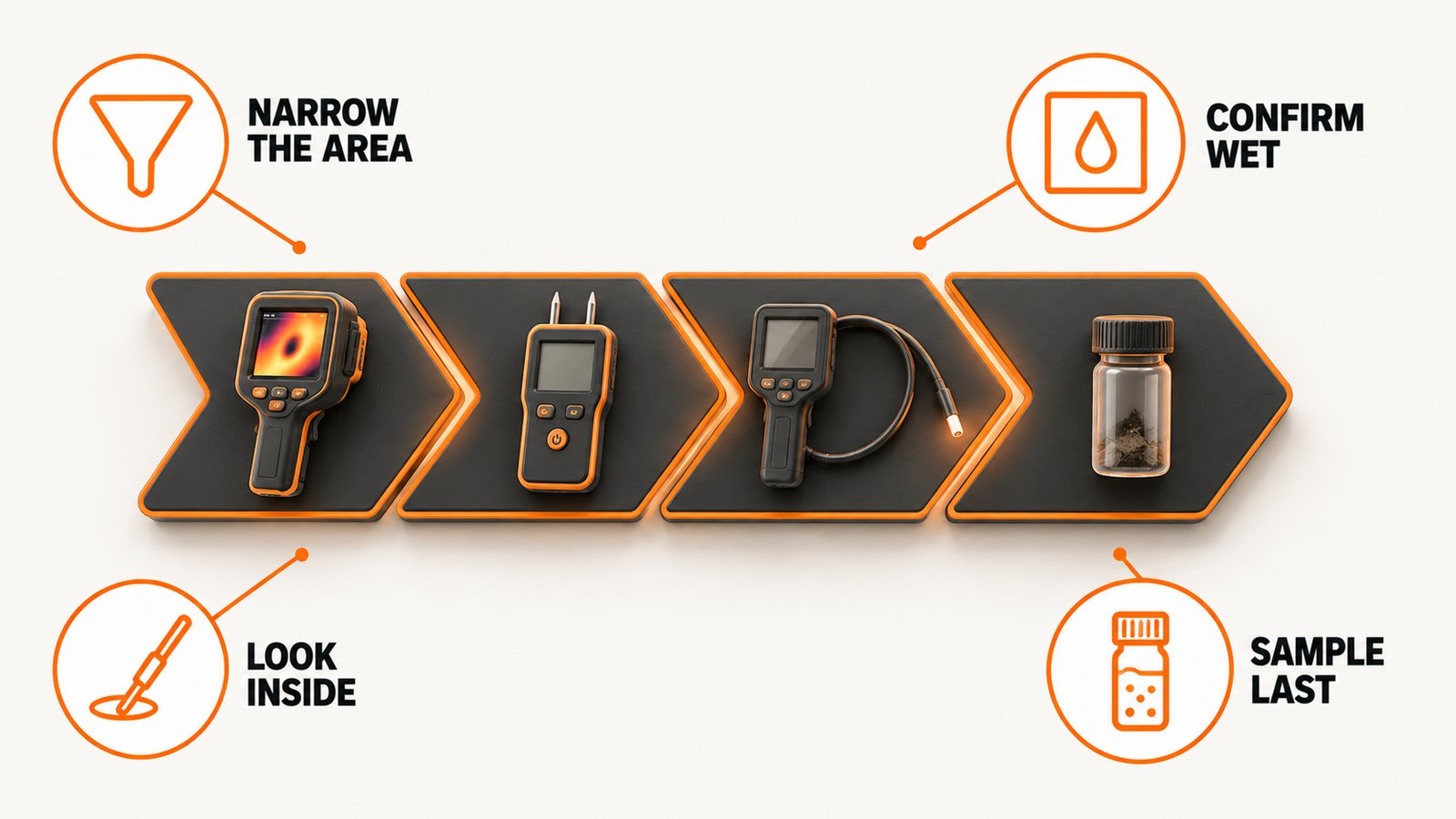
Read that table as a sequence rather than a menu. A dog narrows a large building down to a handful of spots. A meter confirms which of those spots is actually wet. A borescope or a small opening confirms what is behind the wet spot. Sampling only earns its cost once you already know where to sample and why.
The EPA's own investigation equipment list runs the same way: eyes and nose first, with a good flashlight, then borescopes, humidity gauges, and moisture meters. A dog is essentially a much better nose applied to a much larger area, which is exactly why it belongs at the front of that list rather than in place of it. Best mold detector covers the consumer end, and UV light for mold covers a tool that does not make this list at all.
When a Dog Is Worth It and When It Is Not
A short version of when the money makes sense.
Worth considering:
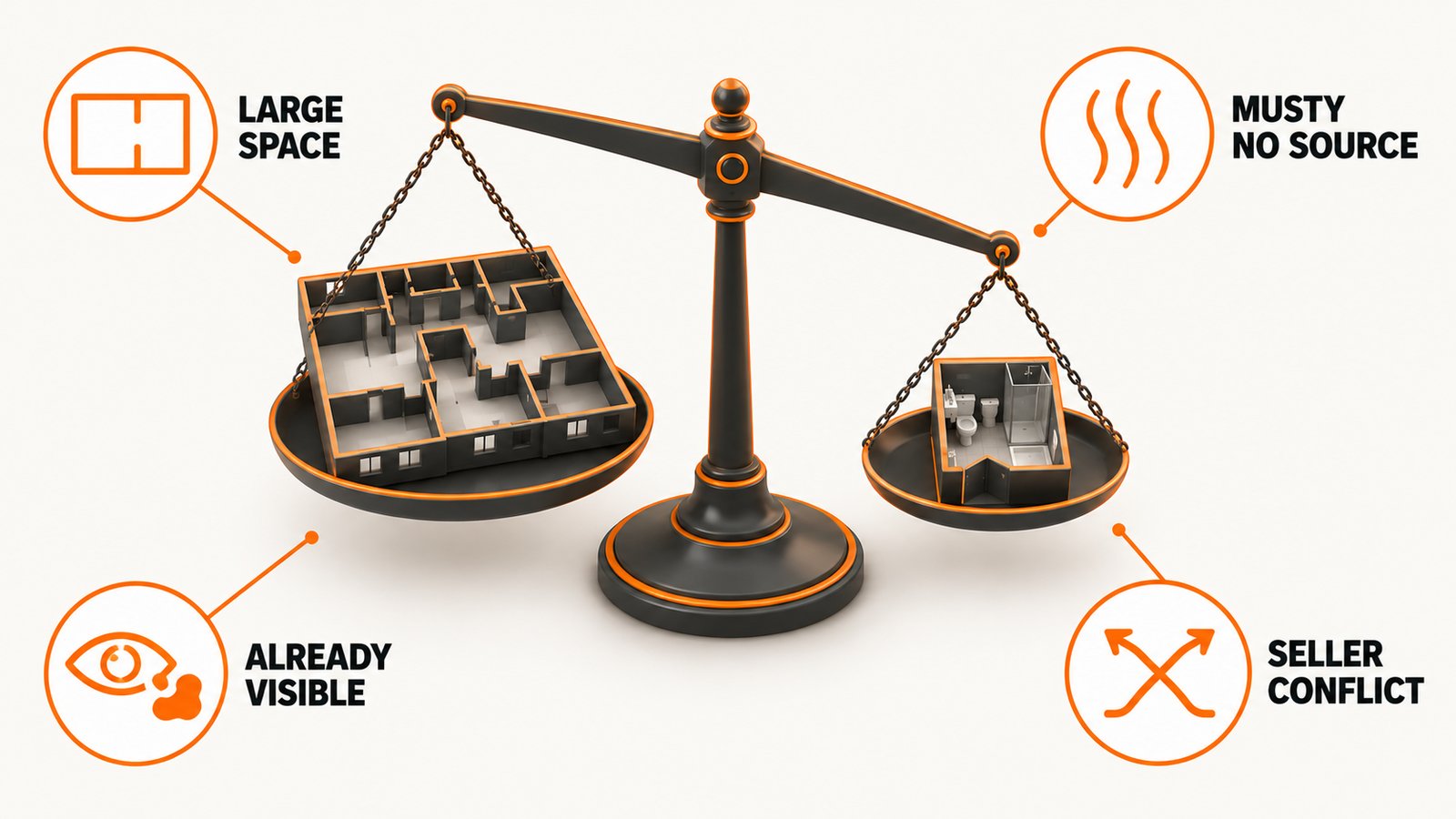
- A large building with a persistent musty smell and no visible source. This is the scenario the tool is built for. The EPA notes you may suspect hidden mold if a building smells moldy but you cannot see the source.
- A finished basement or a commercial space where opening walls to search would be expensive and you need to narrow the search first.
- After a known water event where the drying may have missed a cavity, and you want a fast sweep before committing to demolition.
- As one input among several, with a handler who also carries meters and a camera, and who is not selling you the cleanup.
Not worth it:
- You already see the growth. The EPA states that in most cases, if visible mold growth is present, sampling is unnecessary. That logic covers a dog too. Confirm the surface, meter around it, and clean it.
- You want to prove a house is clean. The one study on this says low sensitivity. A non-alert is not a clearance.
- A small, contained problem in one bathroom. A moisture meter and twenty minutes beats a scheduled visit.
- The company also quotes the remediation. Different reason, same answer.
Whatever you find, the cleanup rules do not change. Scrub mold off hard surfaces with detergent and water and dry completely, expect to replace absorbent or porous materials, and hand it over once the affected area passes about 10 square feet, roughly a 3 foot by 3 foot patch, which is the EPA's own line. Use gloves, goggles without ventilation holes, and an N95 respirator around disturbed growth. If anyone in the home is immune-compromised or has chronic lung disease, the CDC notes people in those groups may get infections in their lungs from mold, which makes it a physician's question and a professional's job. This page covers inspection methods, cleaning, and protective equipment only, and gives no medical advice. Mold inspection and mold remediation cover what comes next.
Frequently asked questions
Do mold sniffing dogs actually work?
Within limits, yes. The one published study on building mold dogs, Kauhanen and colleagues in Environment International in 2002, concluded that using dogs to detect mold or decay damage appears to have high specificity and high positive predictive value, but low sensitivity. That means an alert is usually meaningful, and a non-alert proves very little.
How accurate is a mold detection dog?
The published numbers come from two dogs on sample sets, not from occupied houses. In the first round they detected 75 percent of decay samples and 60 percent of bacteria samples, with between 0 and 24 percent of healthy controls flagged as positive. In a follow-up test with mold strains they found every decay, mold and bacteria sample and gave one false positive on healthy wood. Any precise accuracy figure quoted by a service is a marketing number.
Can a dog tell me where the mold is?
It can tell you where the odor reaches its nose, which is not always where the growth is. Air moves through a building along pressure paths, so a scent released inside a wall cavity can exit at a baseboard, an outlet, or a ceiling seam some distance away. Confirm every alert with a moisture reading before you open anything.
Can a mold dog prove my house does not have mold?
No, and this is the most important limitation. The published finding is low sensitivity, which means misses are expected. A dog that alerts on nothing has told you that nothing was found on that visit, not that the building is clear. Treat any service that markets a non-alert as a clean bill of health with considerable suspicion.
Are mold detection dogs certified?
Not by any federal agency. There is no government license for mold detection dogs and no standard governing how alerts are scored. Private organizations certify handler and dog teams, and those certifications vary widely in rigor. Ask what odors the dog was trained on, how often it is re-proofed, and whether the handler will work the building blind.
Is a dog better than air sampling?
They answer different questions. A dog narrows a large space to a few spots to investigate. Lab sampling identifies species and quantity, but the EPA notes that since no federal limits have been set for mold or mold spores, sampling cannot be used to check a building against a federal standard, and that in most cases sampling is unnecessary when visible growth is present.
What should I do after a dog alerts on a spot?
Verify before you demolish. Take moisture readings at and around the alert, compare against a dry baseline elsewhere in the house, and look for a plausible water source. If the readings are high, a borescope through a small hole or a professional inspection is the next step. The EPA cautions that disturbing moldy areas may spread mold through the building.
Sources
Every claim on this page traces to one of these. Links open the primary document.