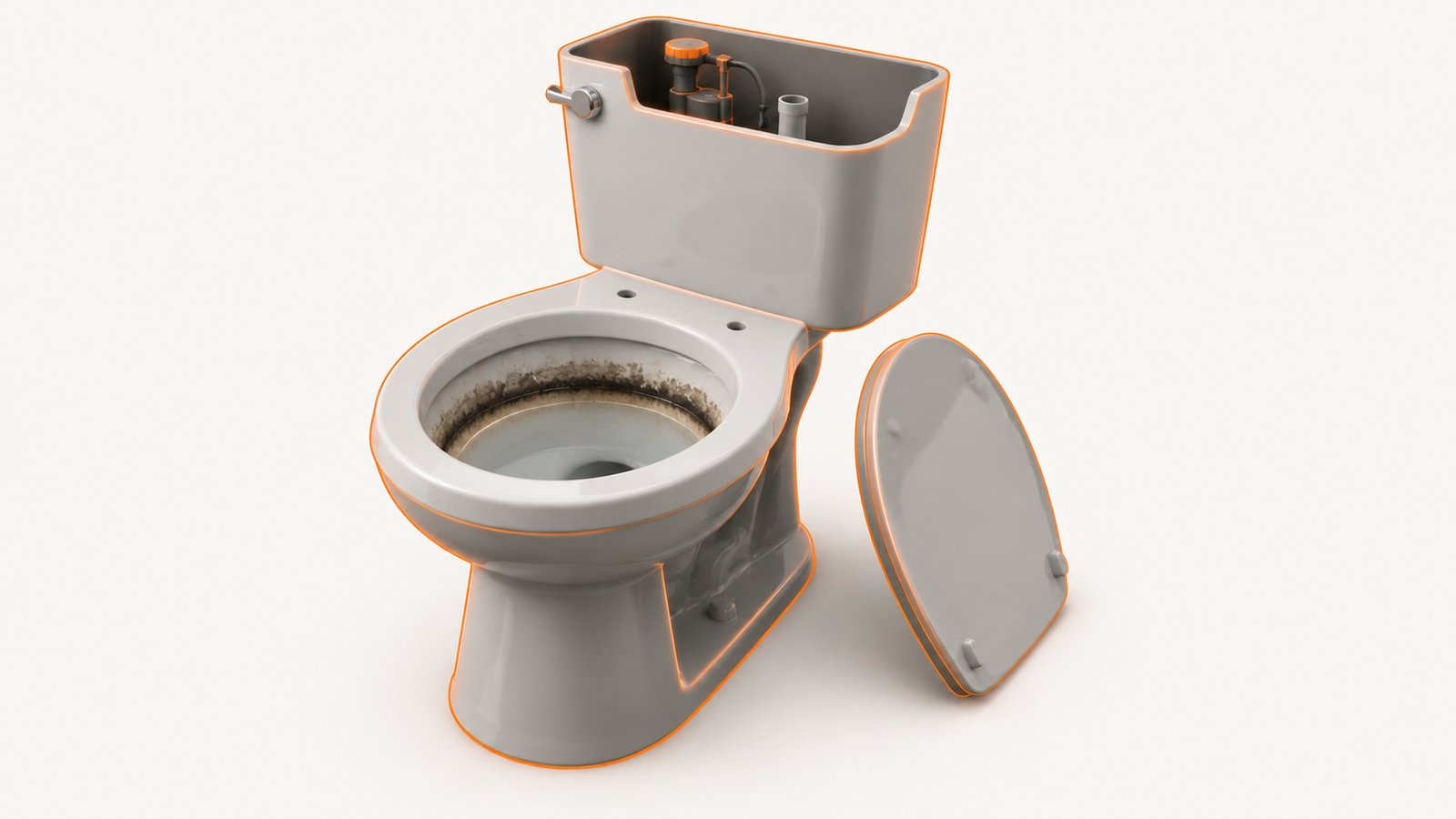
Is the black ring in your toilet actually mold?
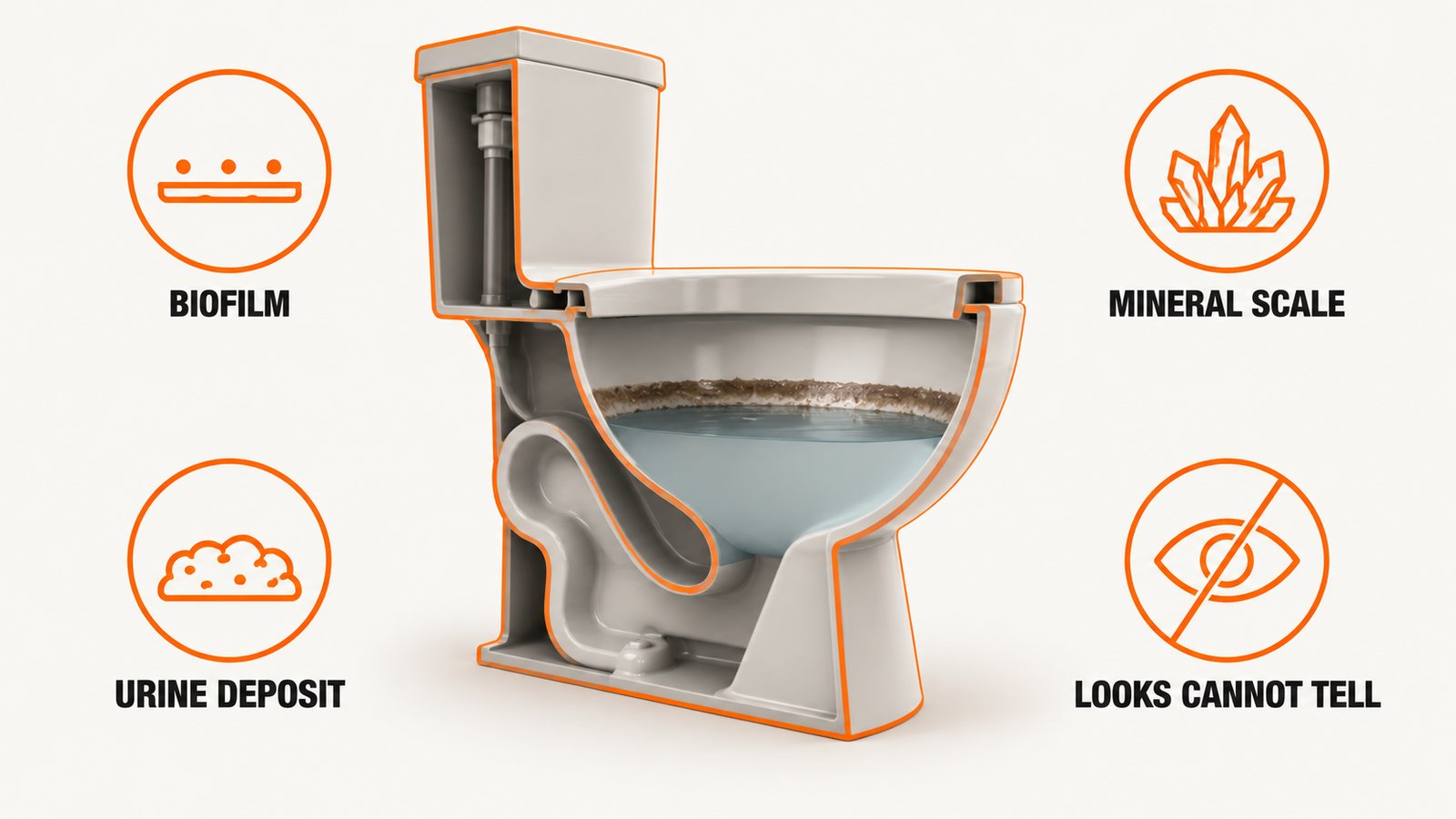
Partly, often, and it does not change what you do. A dark ring at the water line is normally a mixed film of microorganisms with mineral deposits from hard water folded into it. Some of that community is fungal and much of it is bacterial, and no amount of staring at the porcelain will tell you the ratio.
CDC takes the same position for indoor growth generally: you do not need to know the type of mold, and CDC does not recommend mold testing, because the cleanup is the same regardless of species. That is the practical read for a toilet. If it is growing on a wet surface in your bathroom, it comes off the same way.
Two look-alikes are worth separating, because they change the cleaner you reach for. A pink or orange film is usually a bacterium that spreads through the air and settles on wet surfaces, the same organism behind pink film in a shower. Yellow crusty deposits are urine scale, and laboratory work on toilet deposits has tied the ammonia smell to bacteria that break urea down in place using an enzyme called urease. Scale needs an acidic descaler. Growth needs a brush.
Dark growth elsewhere in the room follows the same logic, which is covered in our guide to black mold and why appearance alone identifies nothing.
Where it shows up and what each spot means
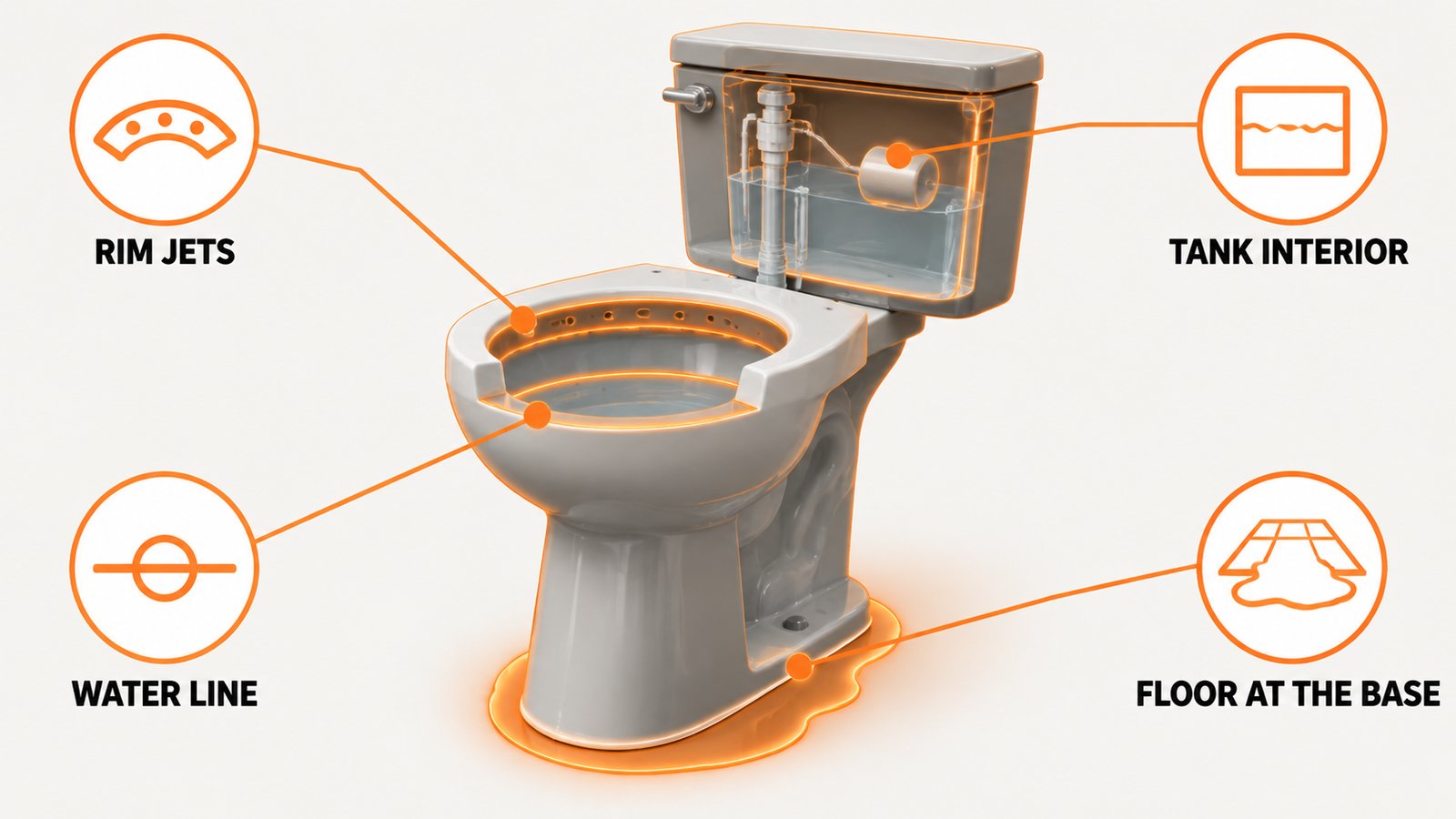
Location tells you more than color does. Work through the table before you buy anything.
| Where you see it | Most likely explanation | What to do first |
|---|---|---|
| Dark ring at the water line | Biofilm at the air and water boundary, often mixed with mineral scale from hard water. | Scrub it mechanically. A cleaner alone will not lift a film that is anchored to the glaze. |
| Streaks under the rim | Growth in the rim jets, which stay wet and dark between flushes. | Scrub up into the rim with an angled brush, then clear the jet holes. |
| Dark patches inside the tank | Standing water that never moves, no light, and no cleaning in years. | Shut the supply, flush to empty, scrub the walls and parts, refill. |
| Pink or orange film | Usually an airborne bacterium rather than a mold, the same one behind pink film in a shower. | Clean it the same way, and see pink mold for what it is. |
| Yellow crusty deposits | Urine scale. Research on toilet deposits ties the ammonia odor to bacteria that break down urea in place. | Descale with an acidic bowl cleaner used alone, never mixed with bleach. |
| Growth on the floor or the base | A leak at the supply line, the tank bolts or the wax ring, or condensation running off the tank. | Find the water before you clean anything. This one is a plumbing job. |
The last row is the one people get wrong. Growth on the floor around the base is not a bowl-cleaning problem. It means water is getting out, from the supply line, the tank bolts, the wax ring under the toilet or condensation dripping off a cold tank, and cleaning the stain without finding the source guarantees a repeat.
Why a toilet grows it in the first place
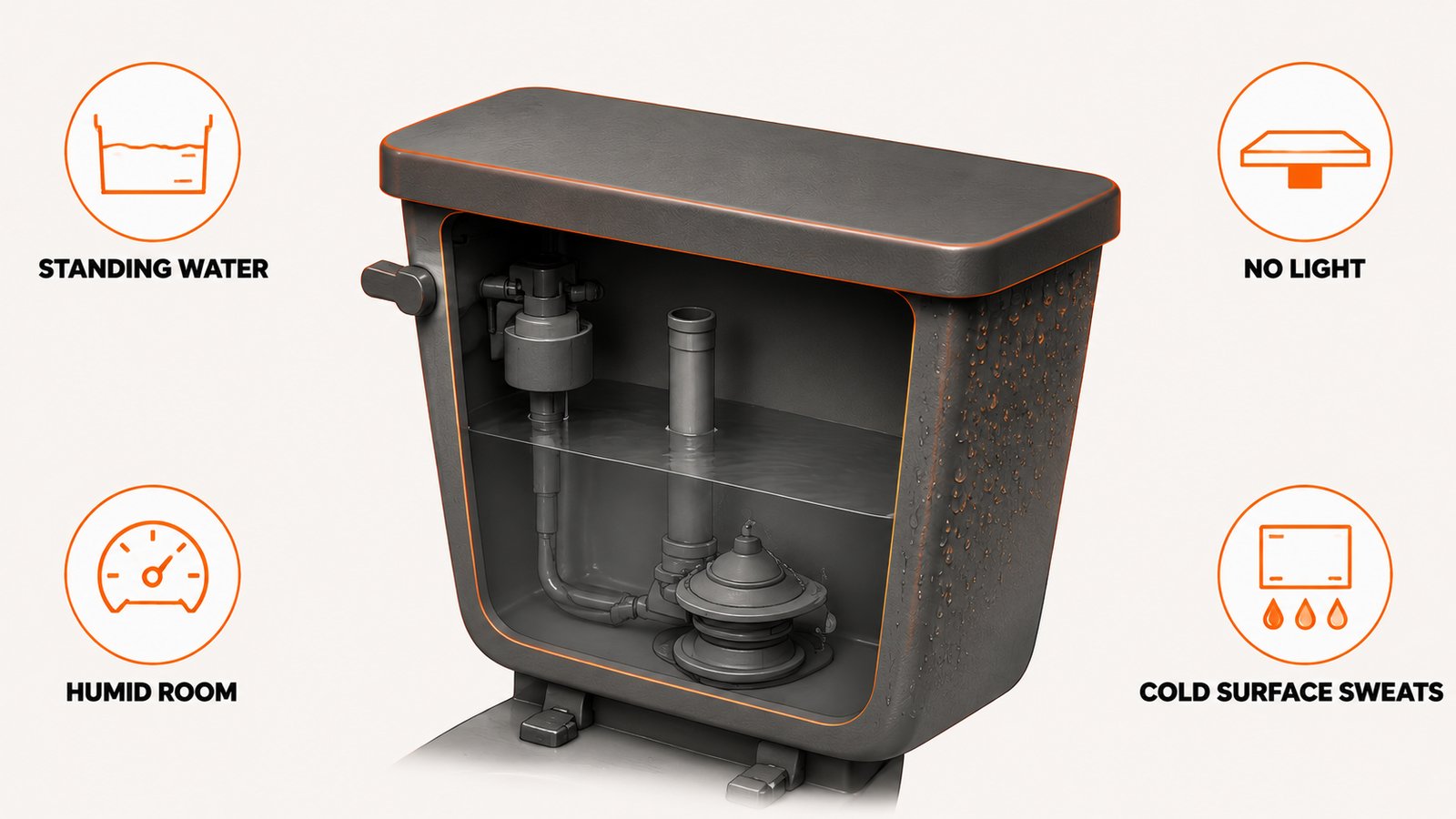
A toilet is close to a purpose-built incubator. It holds standing water permanently, the tank is dark and undisturbed, the bowl receives organic material several times a day, and the whole fixture sits in the most humid room in the house.
The evidence on how quickly that community establishes is specific. A study from the Center for Biofilm Engineering at Montana State University built a laboratory reactor to reproduce toilet bowl conditions and found that biofilm accumulated to high cell densities within roughly a week, and that accumulation still happened when free chlorine was continuously present in the water at several milligrams per liter. That is the scientific version of what everybody notices at home: the ring comes back, and adding chlorine does not stop it.
Three household variables decide how fast it happens:
- How often the toilet is flushed. A guest bathroom or a vacation-home toilet that sits for weeks grows the heaviest rings, because nothing disturbs the surface and the water slowly evaporates.
- How humid the room is. EPA asks for indoor humidity below 60 percent and ideally between 30 and 50 percent. A bathroom without a working exhaust fan lives above that after every shower.
- How cold the tank runs. As air cools it holds less moisture, which is why EPA describes condensation forming on cold surfaces. A tank full of cold supply water in a warm humid bathroom sweats, and that water runs down onto the floor and the base.
The rest of the room usually shows the same pattern at the same time. If the grout and the caulk are going too, start with mold in the bathroom rather than treating the toilet as an isolated problem.
How to clean the bowl without making it worse
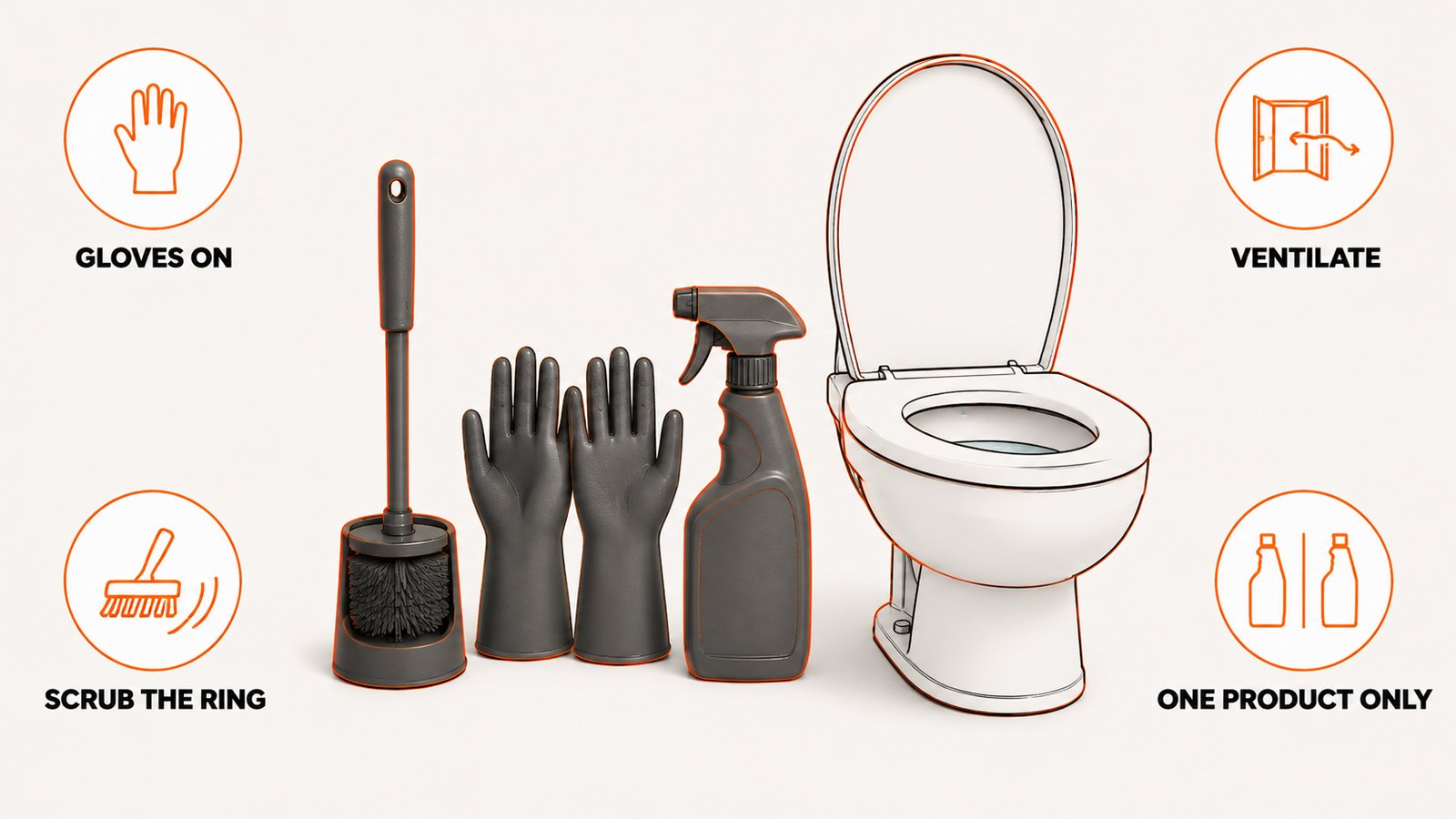
Step 1: put on gloves and open a window. EPA's cleanup guidance is gloves, goggles without ventilation holes and an N-95 respirator for mold work, and it says to avoid touching moldy items with bare hands. For a toilet ring, gloves and ventilation are the minimum.
Step 2: never mix products. This is the one that sends people to the emergency room. EPA warns specifically against mixing chlorine bleach with cleaners containing ammonia because toxic fumes can be produced, and the same warning applies to mixing bleach with an acidic descaler. Use one product, rinse thoroughly, then use the other if you still need it.
Step 3: lower the water level so you can reach the ring. Shut the supply valve and flush once, or push the water down the trap with a brush. The ring sits at the water line, so you have to expose it to scrub it.
Step 4: scrub, do not soak. Biofilm is anchored. The laboratory work above found accumulation continuing in constantly chlorinated water, which is why mechanical removal with a stiff brush or a pumice stone rated for porcelain does the actual work. Get up into the rim jets with an angled brush.
Step 5: rinse, then dry the outside. Restore the supply, flush twice, then wipe the outside of the bowl, the base and the floor dry. EPA's rule for hard surfaces is detergent and water followed by complete drying, and the drying is not optional.
On the bleach question generally, EPA does not recommend a biocide such as chlorine bleach as routine practice during mold cleanup, and notes that dead growth can still cause allergic reactions in some people, so it has to be physically removed rather than only killed. Our page on whether bleach kills mold covers the full argument.
How to clean the toilet tank
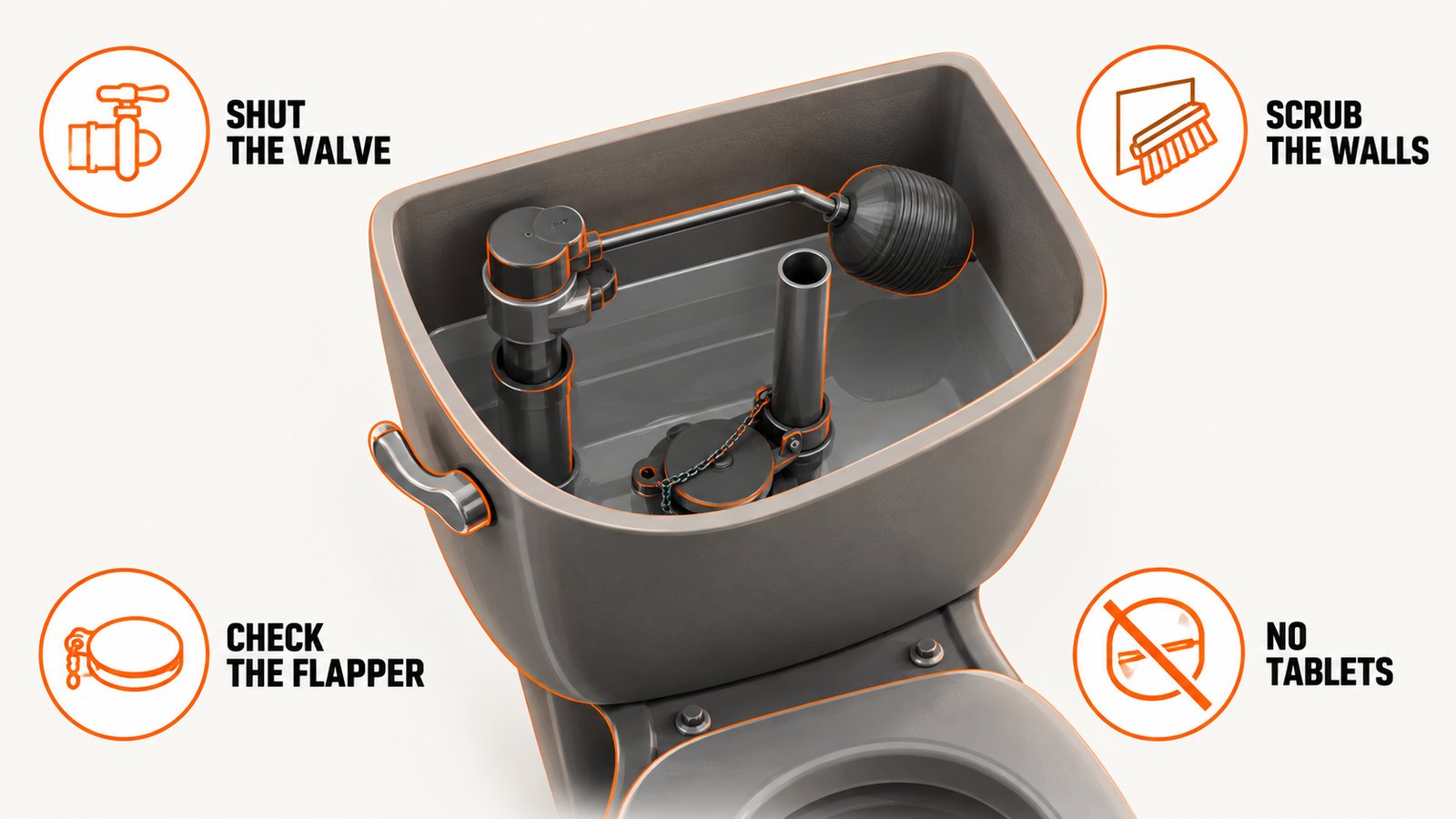
Most people have never opened the tank. It holds several gallons of still water permanently in the dark, which makes it the part of the fixture most likely to have visible growth, and cleaning the bowl while ignoring it means every flush reintroduces what you just removed.
- Shut the supply valve at the wall, then flush and hold the handle to empty the tank.
- Lift the lid off carefully and set it flat on a towel. Porcelain lids crack easily and are awkward to replace.
- Scrub the walls and the parts with detergent and water and a brush that is not your bowl brush. Get the flapper, the overflow tube and the float, which all hold film.
- Rinse by refilling and flushing two or three times until the water runs clear.
- Inspect the rubber parts while it is empty. A flapper that has gone soft or warped lets water trickle through, which keeps the bowl wet and refilling all day.
Skip the in-tank bleach tablets. They sit against the rubber flapper and gaskets and shorten their life, and a failed flapper produces exactly the slow constant leak that feeds growth in the bowl. Clean the tank twice a year by hand instead.
Stop it from coming back
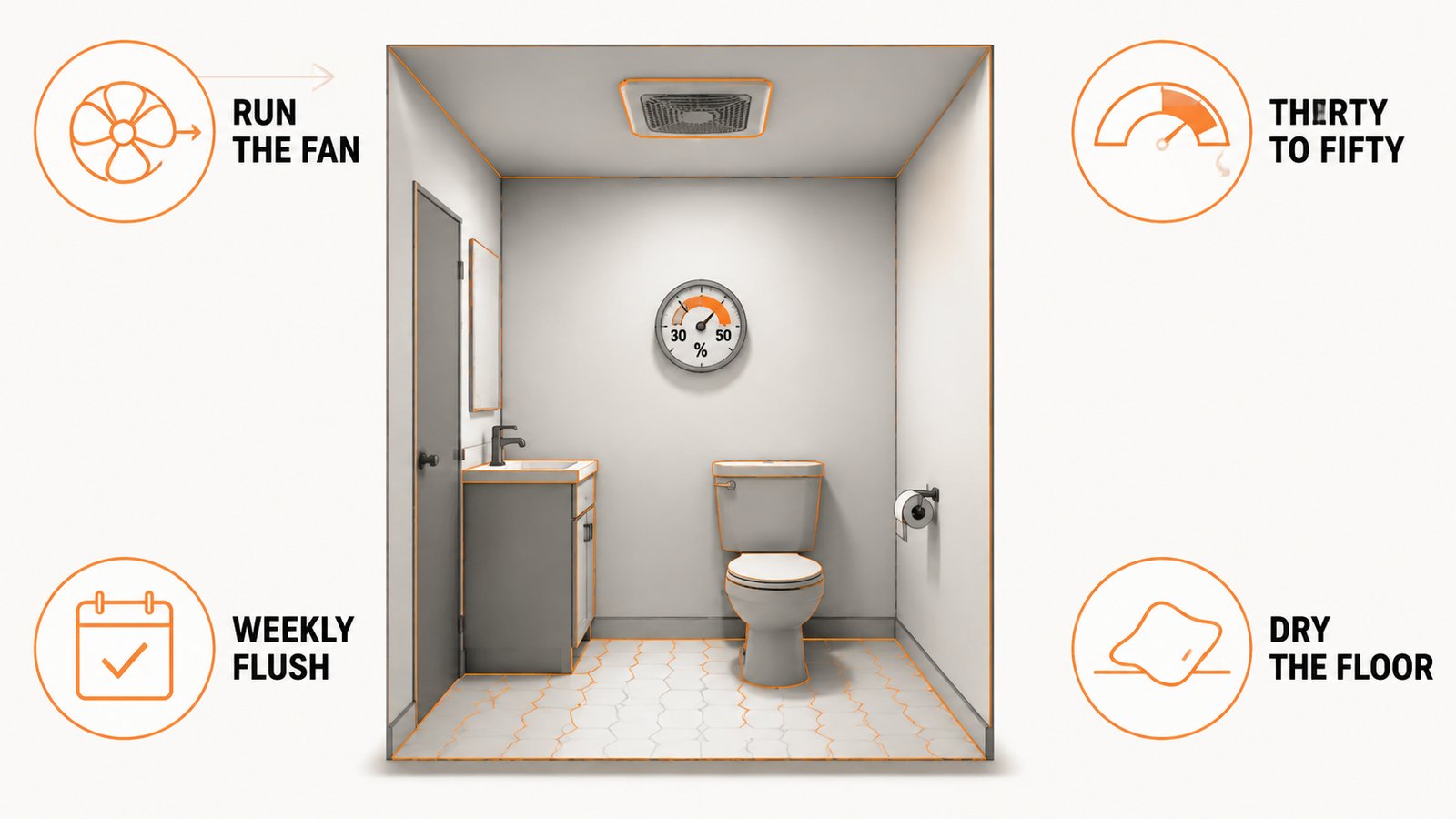
Cleaning is the easy half. Keeping it clean is a moisture problem, and EPA's own list of moisture controls covers most of it.
- Run the exhaust fan. EPA's guidance is to use exhaust fans in bathrooms and kitchens to move moisture outside, not into the attic. Twenty minutes after a shower, every time.
- Hold humidity in range. Below 60 percent, ideally 30 to 50 percent. A cheap hygrometer settles the argument about whether your bathroom is in range.
- Flush unused toilets weekly. It disturbs the surface film and refreshes the trap, which also keeps sewer gas out of a rarely used bathroom.
- Deal with a sweating tank. EPA's fix for condensation is to raise the temperature of the cold surface or reduce the humidity around it. An insulated tank liner or a mixing valve stops the drip that keeps the floor wet.
- Fix a running toilet. A leaking flapper keeps the bowl in constant slow motion and wastes water in the process.
- Keep the ring from establishing. A quick brush once a week costs a minute and beats a chemical assault once a season, because the biofilm work shows how fast the film rebuilds when it is left alone.
If growth is also appearing on the grout, the caulk line or the ceiling, the room is running too wet overall. Our guides to mold on grout and mold in the shower handle those surfaces, and how to get rid of mold covers the order of operations.
When to call a pro
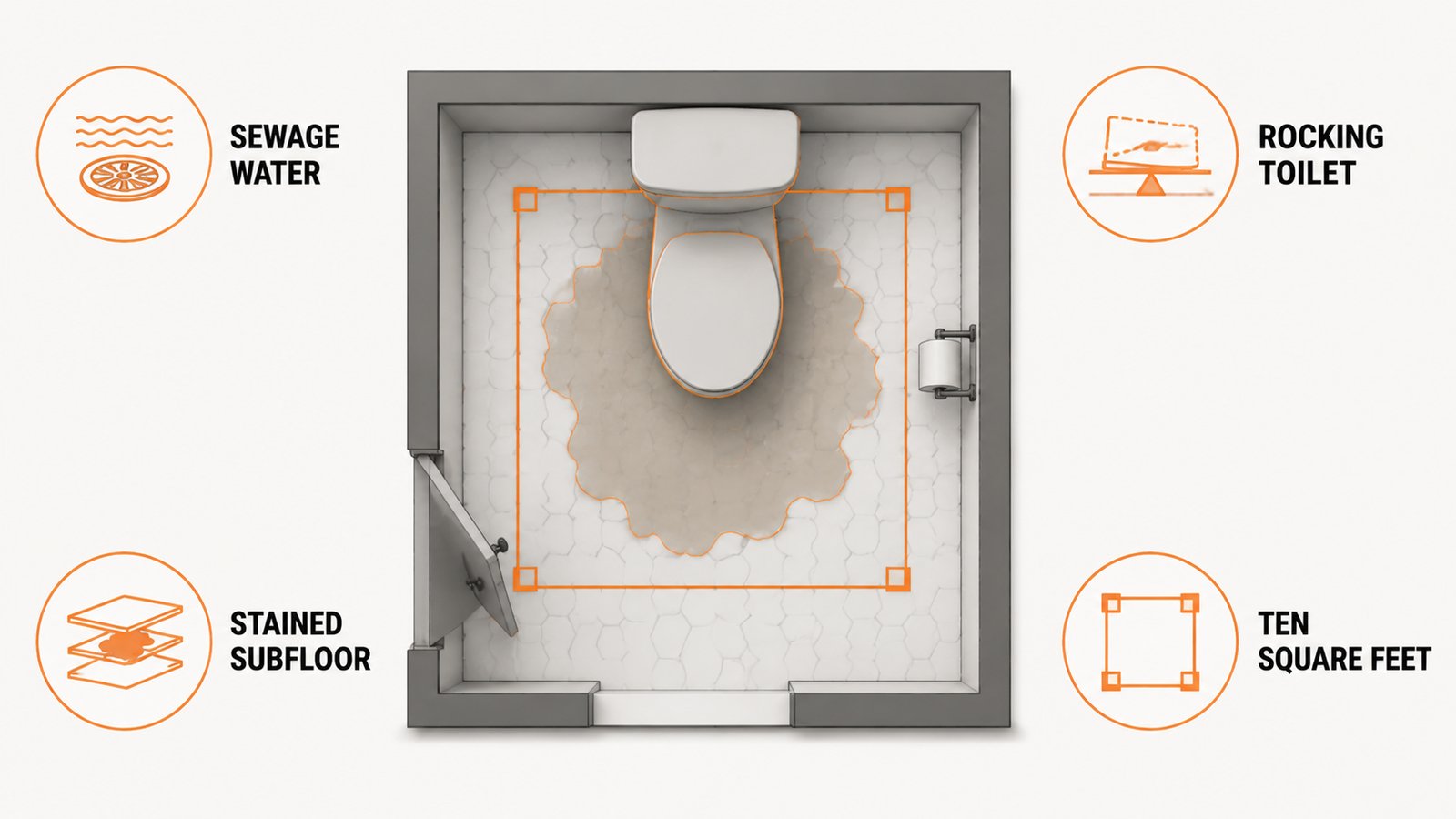
Three situations are not brush work.
Any sewage backup or overflow. EPA is direct that if water or mold damage was caused by sewage or other contaminated water, you should call in a professional with experience cleaning and repairing buildings damaged by contaminated water. Contaminated water is a different category from a dirty bowl, and porous materials it soaked usually do not come back.
A toilet that rocks, leaks at the base, or sits on a stained floor. That points at the wax ring or the flange, and every flush pushes a little more water under the fixture and into the subfloor. A plumber pulls the toilet, replaces the seal and shows you the damage underneath, which is the only way to see it. Growth under vinyl or laminate is covered in mold under flooring.
Growth larger than about 10 square feet, or heavy water damage. EPA puts the do-it-yourself line at less than roughly a 3 foot by 3 foot patch and recommends a contractor with mold experience past that, working to EPA's remediation guide, the ACGIH guidelines or the IICRC standard.
Anything about a person goes to a clinician. CDC states that exposure to damp and moldy environments may cause a variety of health effects or none at all, that people with asthma or a mold allergy may have severe reactions, and that immune-compromised people and people with chronic lung disease may get lung infections. EPA also advises consulting a health professional before starting cleanup if you have health concerns. That is the line this page does not cross.
Frequently asked questions
What is the black ring in my toilet?
A film of microorganisms growing at the boundary between the water and the air, usually mixed with mineral deposits from hard water. Part of that community can be fungal and much of it is bacterial. You cannot separate them by eye, and CDC's position on indoor growth is that you do not need to know the type, because the cleanup is the same either way.
Will bleach get rid of mold in a toilet?
Not on its own, and it is not the recommended first move. Laboratory work that reproduced toilet bowl conditions found biofilm still accumulating while free chlorine was continuously present in the water. EPA also does not recommend chlorine bleach as a routine practice during mold cleanup and notes that dead growth still has to be physically removed. Scrubbing is what takes the ring off.
Why does the ring keep coming back after I clean it?
Because the conditions did not change and the film rebuilds fast. The same laboratory work measured heavy biofilm accumulation in about a week. A weekly brush, a working exhaust fan, humidity between 30 and 50 percent and a flush on any unused toilet keep it from establishing again.
Can mold grow inside a toilet tank?
Yes, and the tank is often worse than the bowl. It holds still water in the dark permanently and most people never open it. Shut the supply valve, flush to empty, scrub the walls, flapper, float and overflow tube with detergent and water, then refill and flush a few times. Twice a year is a reasonable schedule.
Are in-tank bleach tablets a good idea?
No. They sit against the rubber flapper and gaskets and shorten their working life, and a warped flapper produces a slow constant leak that keeps the bowl wet and the water bill high. Cleaning the tank by hand twice a year does more and costs the parts nothing.
Why does my rarely used toilet grow the worst ring?
Because nothing disturbs the water. An undisturbed surface lets a film establish and thicken, and slow evaporation concentrates minerals at the water line. Flush a guest or vacation-home toilet weekly, which also refills the trap and keeps sewer gas out of the room.
Is the pink slime in my toilet mold?
Usually not. Pink or orange film on wet bathroom surfaces is normally a bacterium that travels through the air and settles where water sits, which is why it turns up in the toilet, the shower and around a drain at the same time. It cleans off the same way. Our pink mold guide covers what it is and why it favors a bathroom.
Sources
Every claim on this page traces to one of these. Links open the primary document.