Where mold starts in an RV
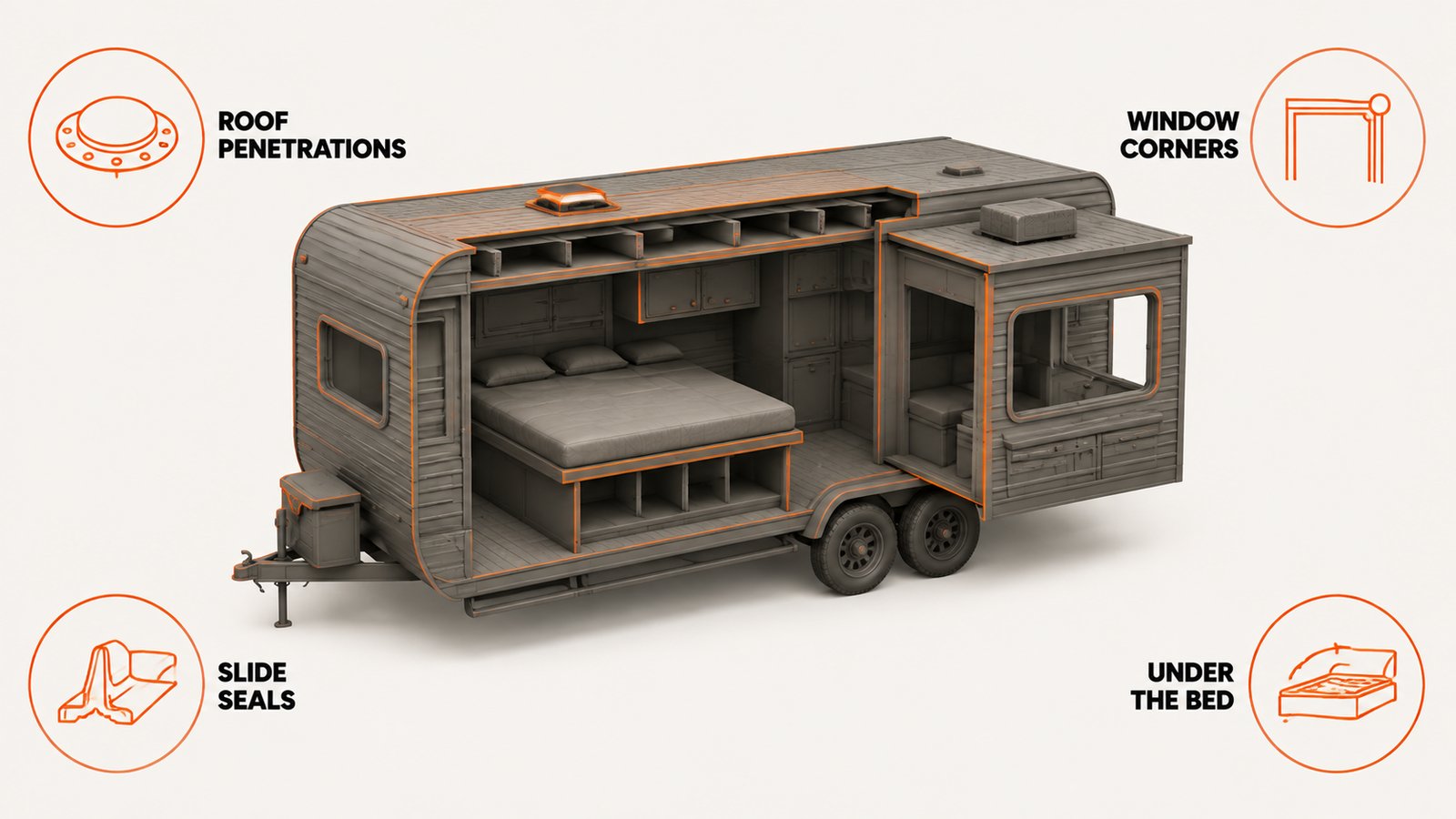
A recreational vehicle is a small box with dozens of holes cut in its roof and walls, every one of them sealed with a material that ages. Add porous interior panels and thin insulation, and you have a structure that punishes any water intrusion faster than a house does.
| Where it appears | Usual cause | What to check first |
|---|---|---|
| Ceiling around a vent or skylight | Failed sealant on the roof penetration above it. | Get on the roof and inspect every seam, vent flange and screw head for cracked or lifted sealant. |
| Wall below a window | Window frame seal, or condensation running off single-pane glass and an aluminum frame. | Look for staining under the frame corners and press for soft spots. |
| Under mattresses and cushions | Body moisture with no airflow underneath, against a cold exterior wall. | Lift the mattress and look at the platform and the underside of the foam. |
| Slide-out floor and seals | Worn wiper seals and water sitting on the slide roof. | Run the slide out, inspect the seals for splits, and check the floor where the slide lands. |
| Cabinet interiors and closets | Still, humid air against an uninsulated outside wall. | Open every door, look at the back wall and the corners, and smell for musty air. |
| Under the shower or sink | A loose fitting or a slow drain leak that road vibration has worked open. | Feel every fitting dry, then run water and feel again. |
| Around the roof air conditioner | A compressed gasket, or a drain path that has stopped draining. | Check the gasket compression and the condensate path before you clean anything indoors. |
The pattern to look for is water traveling. A leak at a roof vent can appear as a stain in a cabinet three feet away, because water runs along framing and drops where it finds a seam. That is why the stain almost never marks the entry point, and why cleaning the stain solves nothing. Vehicles in general behave this way, which is why mold in a car follows the same script on a smaller scale.
Condensation, the problem unique to a small box
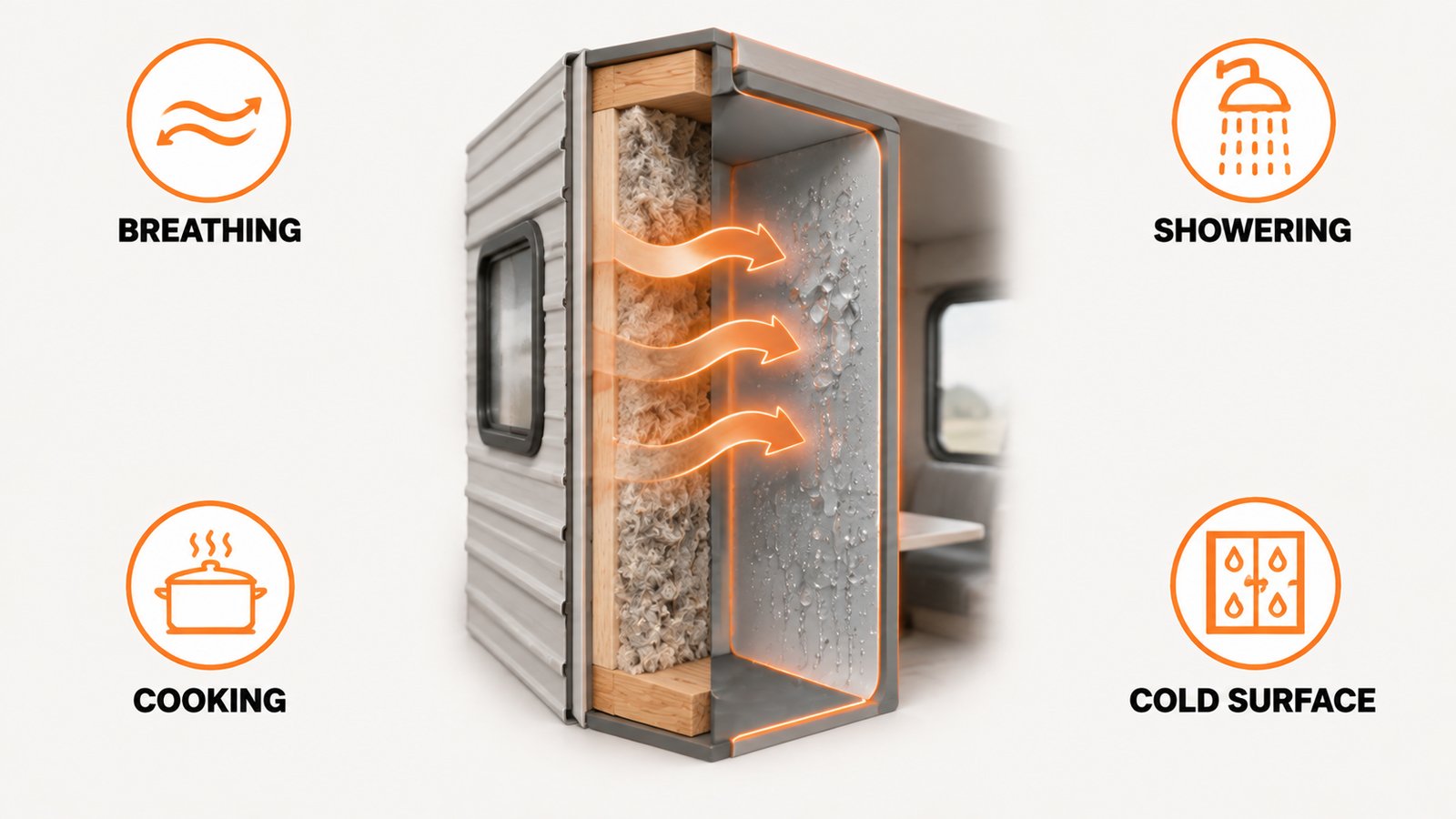
Even a perfectly sealed rig grows mold if the air inside stays wet. EPA explains the mechanism plainly: the amount of moisture air can hold depends on its temperature, and as the temperature goes down the air holds less, which is why in cold weather moisture condenses on cold surfaces such as the inside of a windowpane. That moisture then encourages biological growth.
An RV maximizes every part of that. The interior volume is tiny, so two people breathing overnight measurably raises humidity. Cooking and showering add more. Single-pane windows, aluminum frames and thin walls give that moisture cold surfaces to land on within inches of where it was created.
EPA's moisture controls translate directly:
- Use exhaust fans to move moisture outside rather than into another space. Run the roof fan during and after every shower and while cooking.
- Raise the temperature of cold surfaces, which EPA lists alongside insulation and storm windows as a condensation fix. In a camper that means window insulating film, thermal curtains or reflective panels.
- Increase air circulation by opening interior doors, especially closet doors, and moving furniture away from wall corners so heat reaches them. In a camper, that is the reason mattresses and cushions sit against cold walls with no airflow underneath.
- Turn off appliances that add moisture when you see condensation on windows and other surfaces. Unvented catalytic and portable heaters produce water vapor as they burn.
- Use a dehumidifier where power allows, keeping the range EPA recommends: below 60 percent relative humidity, ideally between 30 and 50 percent. Choosing one is covered in dehumidifiers for mold.
The same still-air rule explains why cabinets and closets go first. Our page on mold in a closet covers that specific case in a house, and a camper closet is the same problem with less insulation.
Finding the water before you clean anything
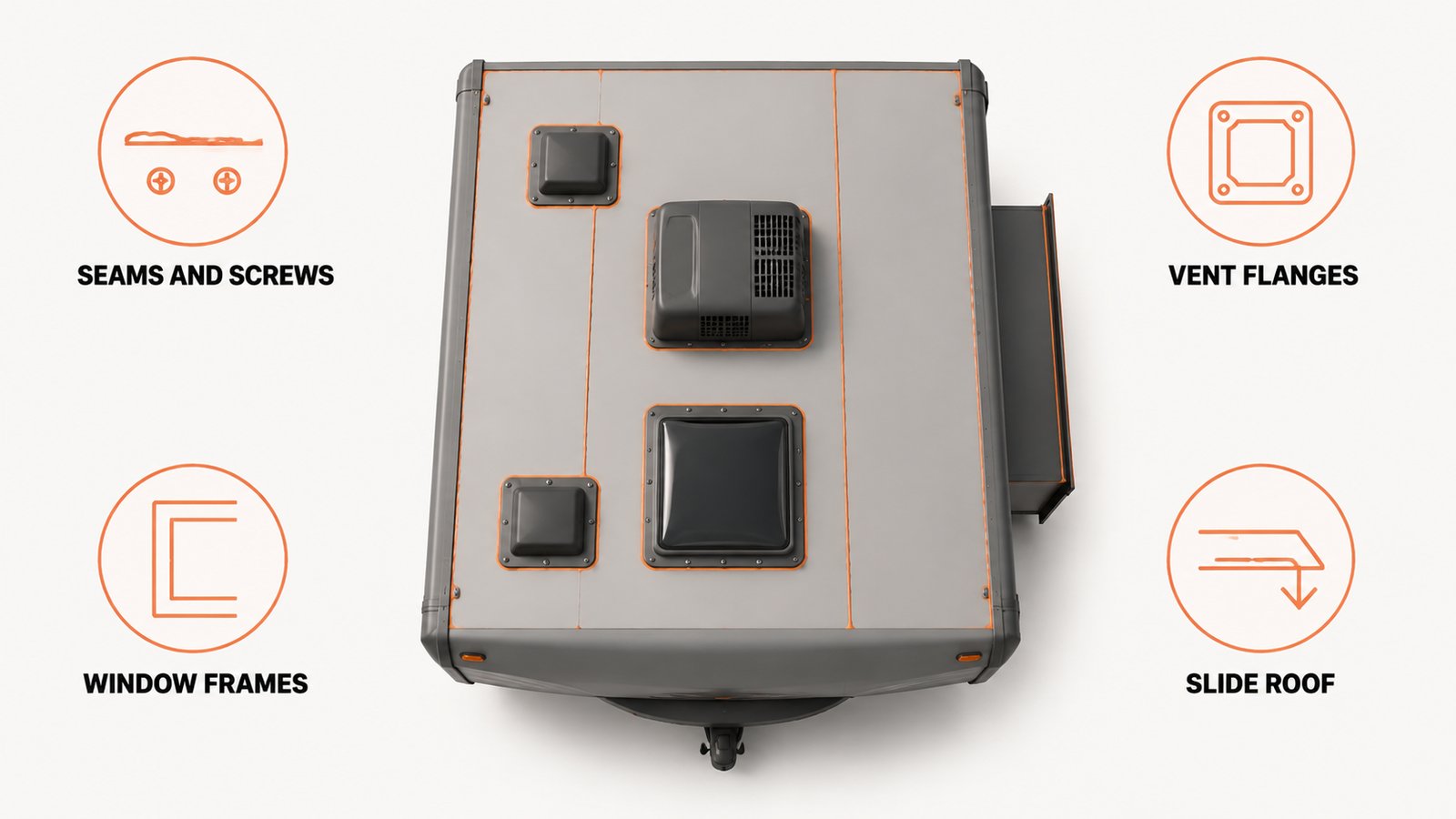
EPA's completion standard for any mold work starts with the water problem being completely fixed. In a camper, that means an inspection outside before a brush ever comes out inside.
Walk the roof, carefully. Inspect every seam, every vent flange, the skylight, the antenna base, the marker lights and each screw head. You are looking for sealant that has cracked, lifted, chalked or pulled away. Roof sealant is a maintenance item with a service life, not a permanent part.
Check the window and door frames. Corners fail first. Staining below a frame corner and a soft feel to the wall panel underneath both point at the frame seal.
Run the slides out and inspect the seals. Wiper seals split with age and let water into the floor at the exact point where the slide lands.
Look for soft spots and delamination. Press the walls and the floor. Any soft or spongy area means water has been in the structure long enough to break down the substrate, and a bubble or ripple in an exterior fiberglass wall means the layers have separated. That is structural damage, not a cleaning job.
Follow the water uphill. Find the highest wet point rather than the widest stain. Water enters high and travels down and sideways along framing.
EPA also notes you may suspect hidden growth when a space smells moldy but you cannot see a source. In a camper that smell usually means water inside a wall or under the floor, and opening the assembly is the only way to see it.
How to clean what can be saved
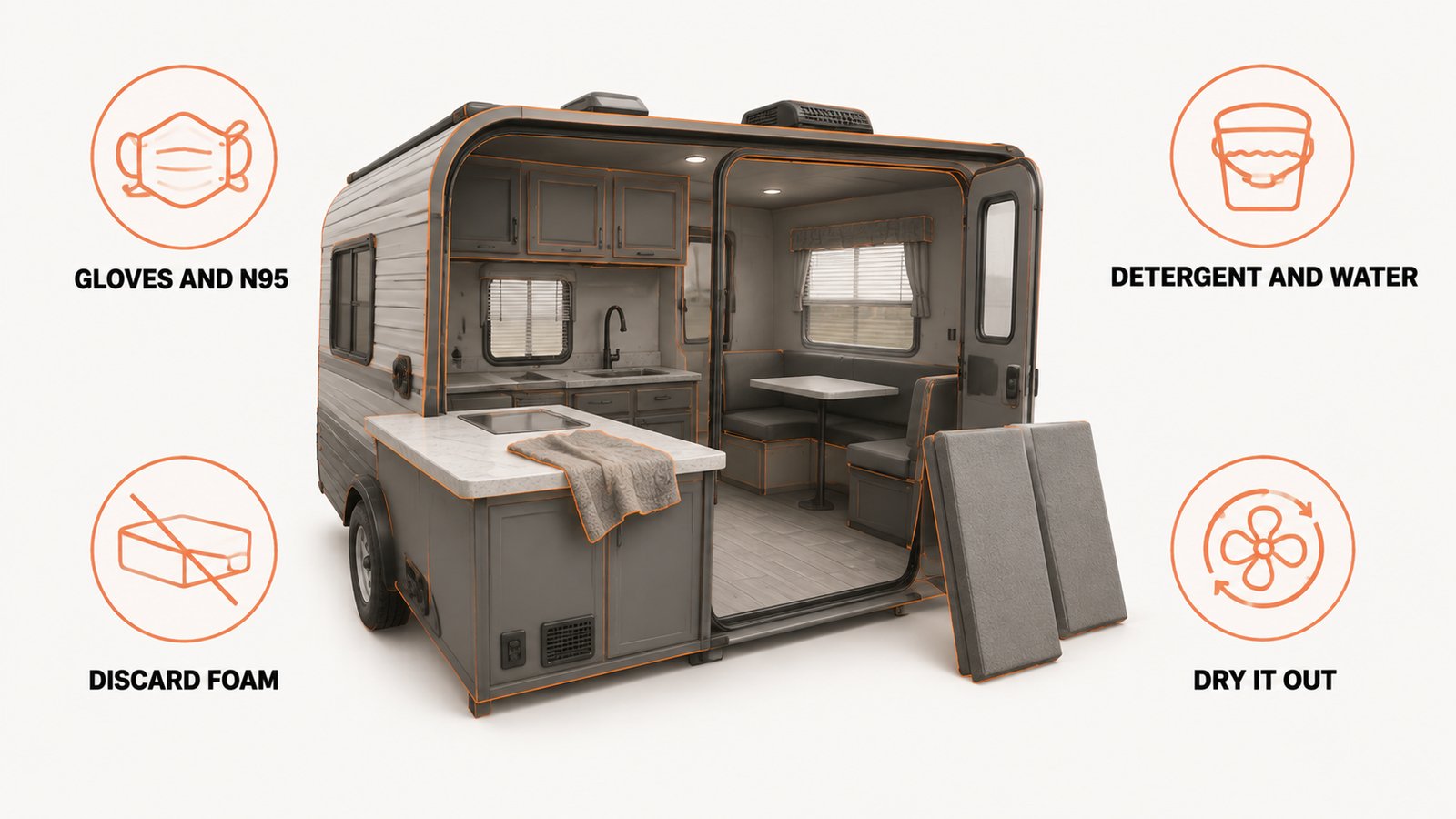
Wear protection and ventilate. EPA's guidance is gloves, goggles without ventilation holes and an N-95 respirator, and it advises against touching mold or moldy items with bare hands. In a space this small, open every window and run the fan while you work.
Hard surfaces get detergent and water. Scrub, wipe and dry completely. That covers laminate counters, plastic trim, painted metal, sealed cabinet fronts and the shower surround. EPA does not recommend a biocide such as chlorine bleach as routine practice, and dead growth still has to be physically removed, so wiping matters more than what is in the bottle. The full comparison is at bleach versus vinegar for mold.
Porous items usually go. EPA states that absorbent or porous materials such as ceiling tiles and carpet may have to be thrown away when they become moldy, because growth fills the spaces and crevices and can be impossible to remove completely. In a camper that list is cushion foam, mattresses, carpet and padding, and any water-damaged luan panel. Mattress specifics are covered in mold on a mattress.
Fabric that survives gets laundered hot and dried fully. Curtains, bedding and covers come out and go through a real wash, which is covered in getting mold smell out of fabric.
Then dry the whole rig. Fans, open vents, a dehumidifier if you have power. EPA's prevention rule is that materials dried within 24 to 48 hours will in most cases not grow mold, so speed is the whole game once the water is stopped.
Storing a camper without growing mold

Most discoveries happen in spring, on a rig that was closed up wet in the fall. Storage is where the damage is done.
- Dry it completely before closing it. Drain the plumbing, dry the shower and sinks, empty and clean the refrigerator, and leave it running with fans for a day if you can.
- Leave air moving. Vent covers that stay open in rain let a rig breathe. A sealed box with damp air inside is the worst option.
- Open every interior door. Cabinets, closets, the refrigerator, the shower door. EPA's own advice for houses is to open doors between rooms, especially closet doors, to increase circulation, and it matters more in a small space.
- Take out everything absorbent you do not need. Bedding, towels, clothing, paper, and all food. The USDA's food guidance is to keep humidity down and to clean where food was stored, and a camper pantry left over winter is a reliable starting point for growth.
- Use desiccant or a dehumidifier. Absorber tubs in each compartment if there is no power, a small dehumidifier if there is.
- Inspect and reseal before it sits, not after. A cracked seam gets a whole winter of rain and snow to work with.
- Choose the cover carefully. A breathable RV cover sheds water while letting vapor out. A plastic tarp traps moisture against the roof and walls and creates the problem it was meant to prevent.
General prevention across any structure is in how to prevent mold, and the same physics applies to a rig sitting in a driveway.
The roof air conditioner and the vents
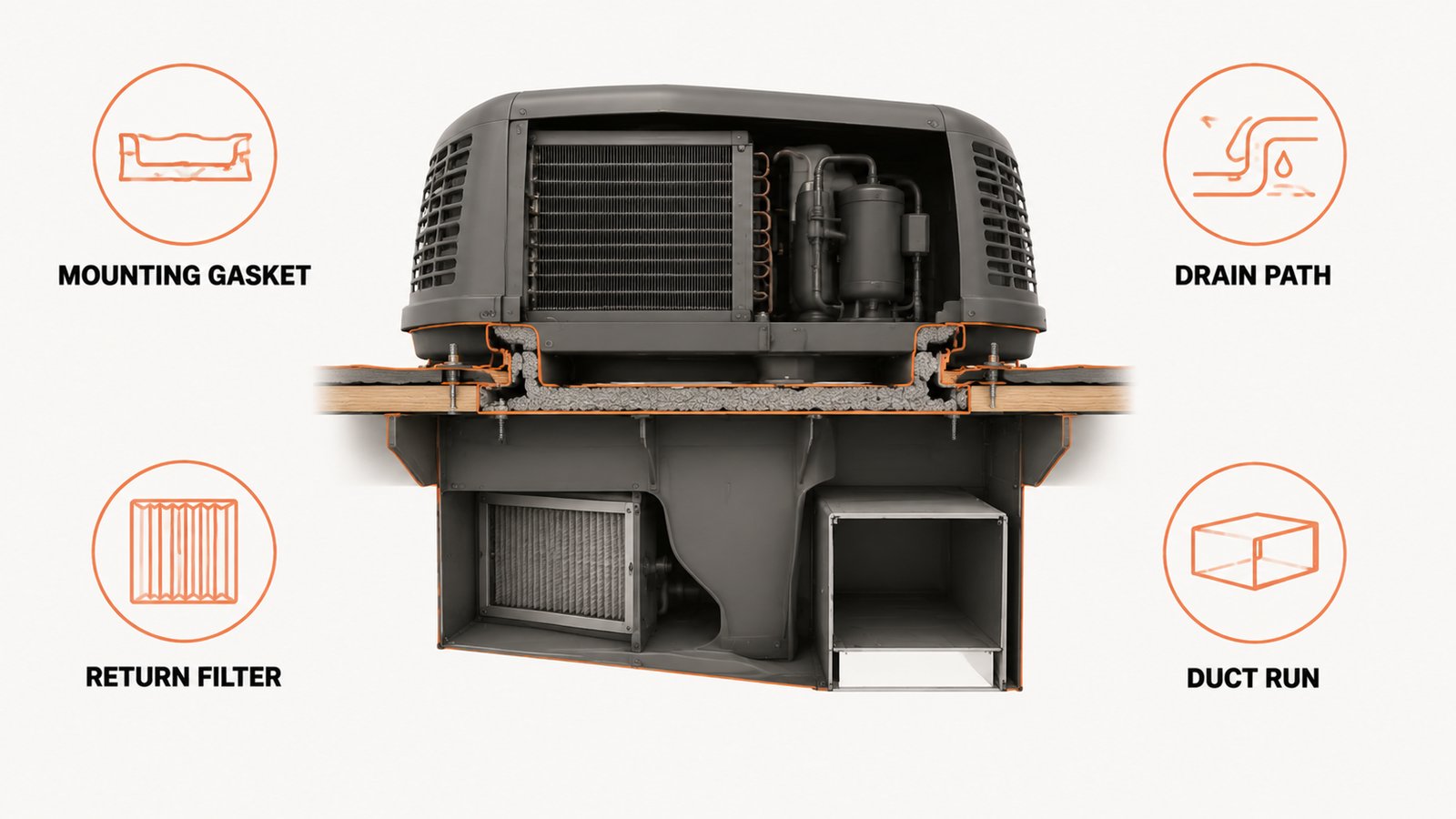
A rooftop air conditioner is a large hole in the roof with a rubber gasket holding the weather out, and it makes water by design.
The gasket is a maintenance item. It compresses over time and it leaks when it does. Ceiling staining around the interior shroud is the classic sign, and the fix is a technician resealing or replacing the gasket, not a wipe with a cloth.
Condensate has to be able to leave. A unit that cannot drain sends water where it should not go. The same principle appears in EPA's house guidance: keep air conditioning drip pans clean and drain lines unobstructed and flowing properly.
Do not run a system you suspect. EPA is explicit that you should not run an HVAC system if you know or suspect it is contaminated, because it could spread growth throughout the building, and it says to read the duct-cleaning guidance before acting.
Wet insulation inside a ducted system does not get cleaned. EPA's position is that if insulated air ducts get wet or moldy, the insulation cannot be effectively cleaned and should be removed and replaced. It also warns that if the conditions causing growth are not corrected, growth will recur.
Filters and returns are yours to clean. Pull the interior return filter, wash or replace it, and wipe the plastic shroud. Anything past that is technician work. The house version of this problem is covered in mold in an air conditioner.
When to call a pro
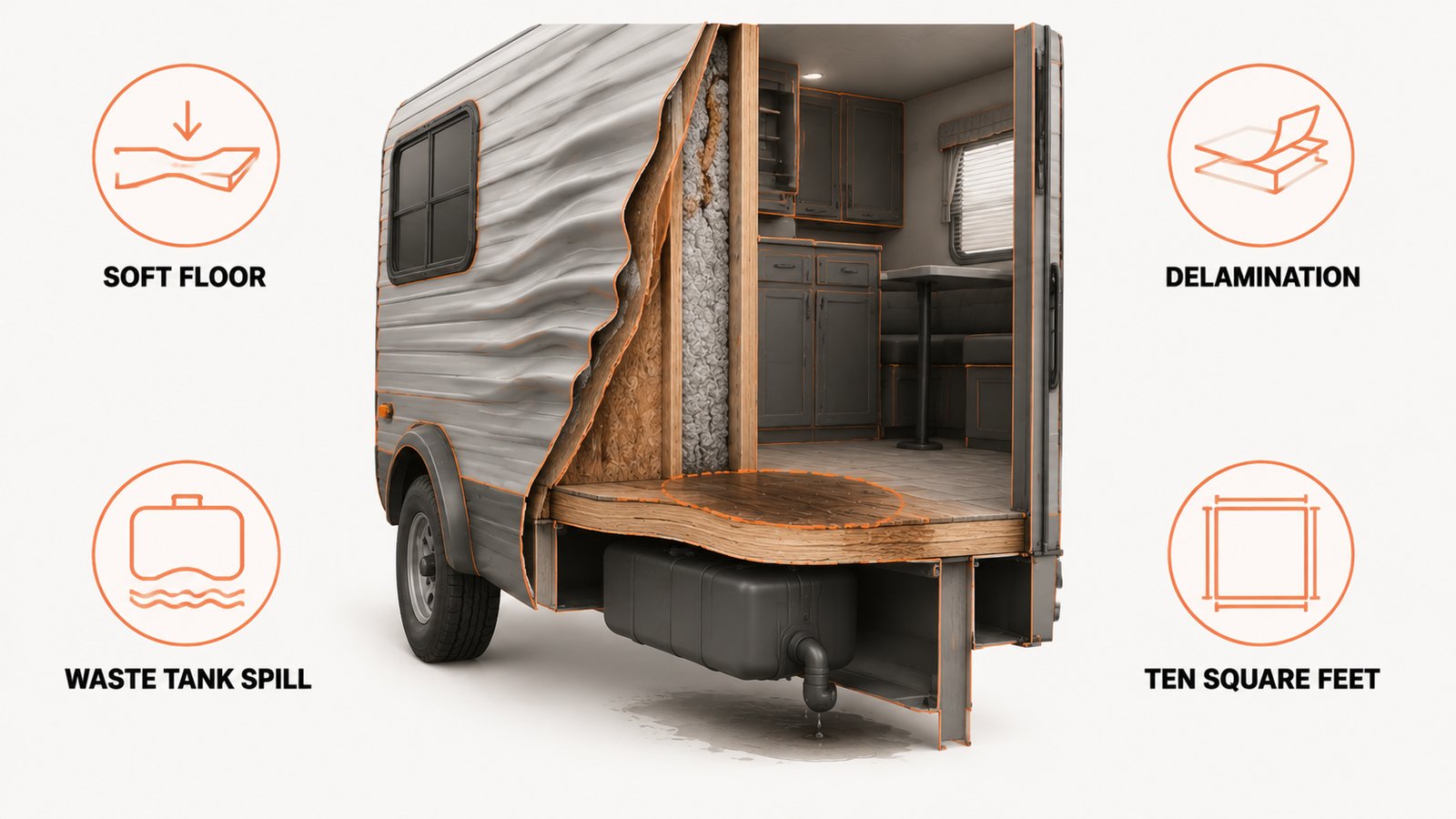
A soft floor or a delaminated wall is structural. Water has already broken down the substrate, and the repair means opening the assembly and replacing material. An RV service center or a mobile technician does this. Cleaning the surface of a rotted panel accomplishes nothing.
Anything involving the waste tank is a contaminated-water job. EPA says damage caused by sewage or other contaminated water calls for a professional experienced in that work. A black tank leak inside a camper is that category exactly.
Growth past about 10 square feet. EPA's line for do-it-yourself work is less than roughly a 3 foot by 3 foot patch. In an interior this small, that threshold arrives fast, and past it the guidance is a contractor with mold experience working to EPA's remediation guide, the ACGIH guidelines or the IICRC standard. Which professional does what is covered in mold specialist.
Anything you cannot reach. Growth inside a wall cavity, under the floor or inside a ducted air system needs the assembly opened by someone who knows how the rig is built.
Health questions go to a clinician. CDC states that exposure to damp and moldy environments may cause a variety of health effects or none at all, that people with asthma or a mold allergy may have severe reactions, and that immune-compromised people and people with chronic lung disease may get lung infections. EPA advises consulting a health professional before starting cleanup if you have health concerns.
Frequently asked questions
What causes mold in an RV?
Water intrusion or condensation, and usually both. Roof sealant, window frames, slide-out seals and plumbing fittings all fail over time and let water into porous interior panels. Condensation adds to it, because EPA notes that air holds less moisture as its temperature drops, so moisture condenses on the cold single-pane windows and thin walls that a camper is built from.
How do I find the leak that caused it?
Work outside first and follow the water uphill. Inspect every roof seam, vent flange, skylight, antenna base, marker light and screw head for cracked or lifted sealant, then the window and door frame corners, then the slide-out wiper seals. The stain inside rarely marks the entry point, because water travels along framing and drops where it finds a seam.
Can I clean RV mold myself?
Small areas on hard surfaces, yes. EPA's method is detergent and water, scrub, then dry completely, wearing gloves, goggles without ventilation holes and an N-95 respirator. It puts the do-it-yourself line at growth under about 10 square feet, less than roughly a 3 foot by 3 foot patch, and says heavy water damage or larger growth calls for a contractor with mold experience.
Do I have to throw out cushions and the mattress?
Often yes. EPA states that absorbent or porous materials may have to be thrown away when they become moldy, because growth fills the spaces and crevices in porous material and can be difficult or impossible to remove completely. Foam cushions, mattresses, carpet and padding fall in that category once they have been wet and colonized.
How do I stop condensation inside a camper?
Move the moisture out and warm the cold surfaces. Run vent fans while cooking and showering, use window film or thermal curtains, open interior and cabinet doors so air circulates, turn off unvented appliances that add water vapor when you see condensation, and hold humidity in EPA's range of below 60 percent and ideally 30 to 50 percent.
How should I store an RV so it does not grow mold?
Dry it out before you close it, drain the plumbing, empty all food and fabric, leave every interior door and cabinet open, keep vents open under rain-proof covers so it can breathe, place desiccant absorbers or run a small dehumidifier if power is available, and inspect and reseal the roof before it sits rather than after. Use a breathable cover rather than a plastic tarp, which traps moisture against the rig.
Is a musty smell with no visible growth still a problem?
Treat it as one. EPA says you may suspect hidden mold when a space smells moldy but you cannot see the source. In a camper that usually means water inside a wall cavity or under the floor, which is found by opening the assembly rather than by cleaning surfaces or spraying an odor product.
Sources
Every claim on this page traces to one of these. Links open the primary document.