What the kit is, and what is in the box
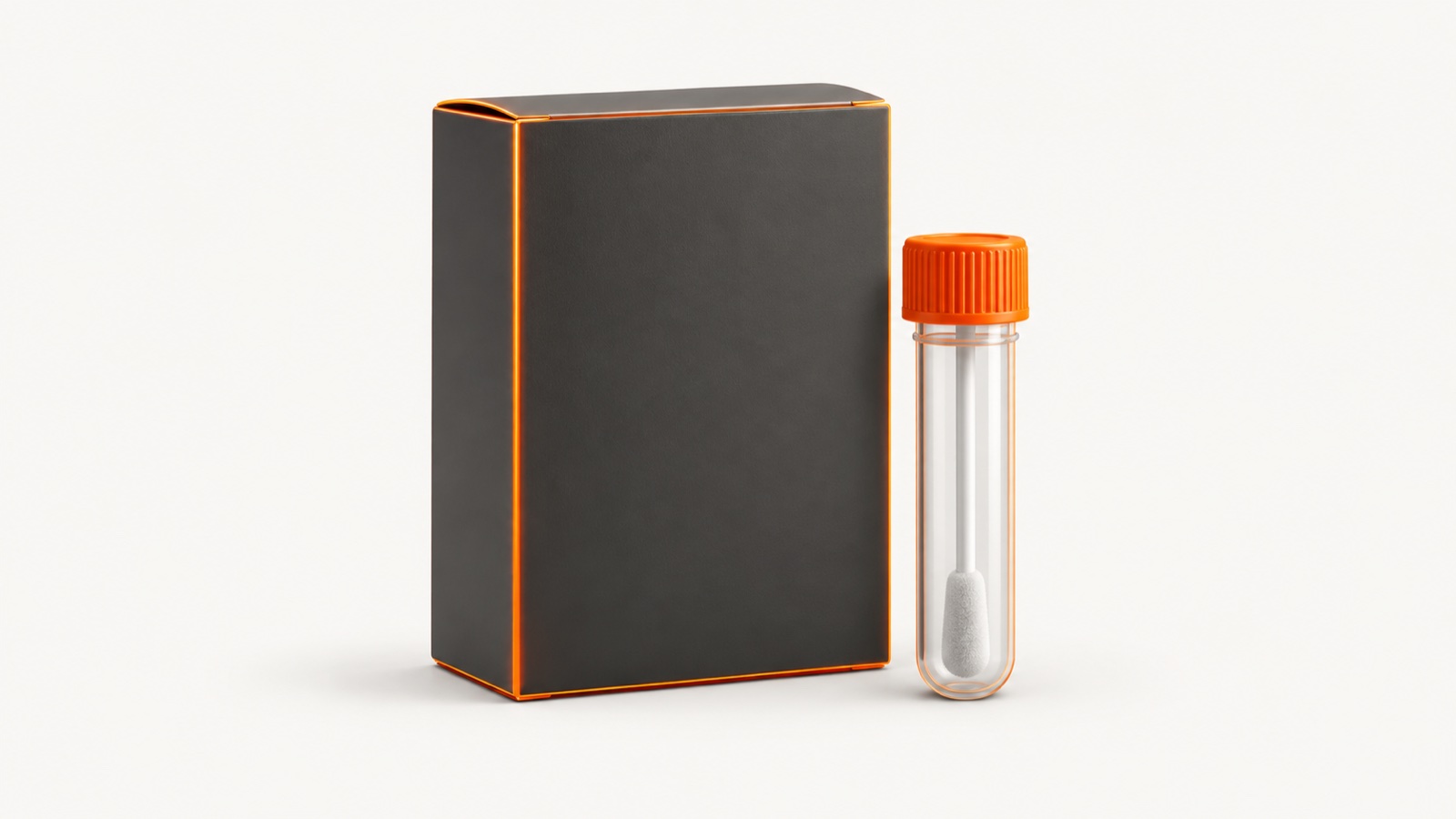
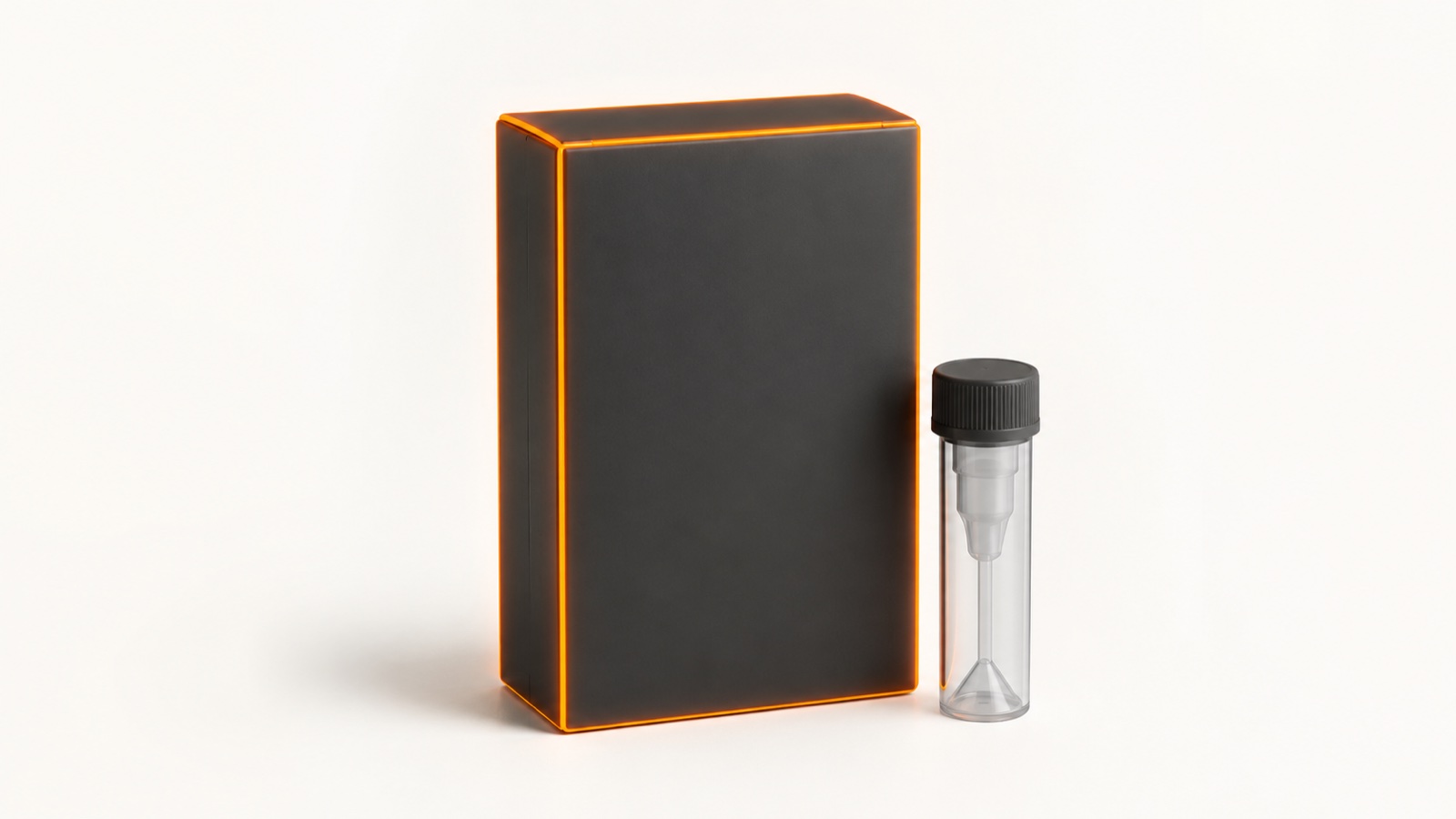
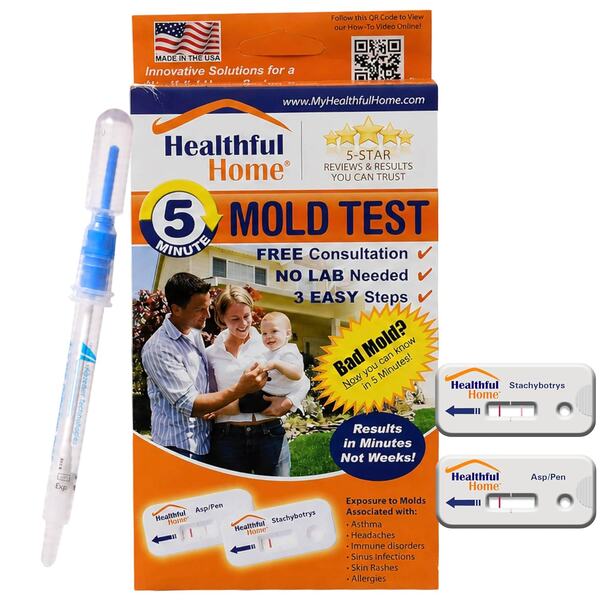
This is a do-it-yourself rapid screening test, not a laboratory kit. The package holds a collection swab in a tube with a reagent bulb on top, plus two test cassettes. Look at the cassettes and the scope of the product is printed right on them: one reads Asp/Pen and one reads Stachybotrys. The front of the box adds the three selling points, free consultation, no lab needed, and three easy steps, and the panel notes it is made in the USA.
The workflow is genuinely simple. You swab the surface or dust you want checked, mix the swab with the solution in the tube, then apply drops of that liquid to each cassette and wait. The manufacturer markets it as a five minute read, which is where the product gets its name.
The important thing to hold onto is what a positive means here. It means the sampled material triggered one of two targets. It is not a species identification, not a spore count, and not a measurement of the air you are breathing. Our guide to home mold test kits lays out how the rapid, air, dust, and lab formats differ, because buying the wrong format is the most expensive mistake in this category.
The one sample limit is the whole story
Every other pro and con on this page is secondary to this one. A kit collects one sample. That sample runs across both cassettes, so you learn about the Aspergillus and Penicillium group and Stachybotrys at a single location, and nothing else.
Buyers arrive at this the hard way. A four star reviewer wrote that they were about 90 percent certain there was mold in the house, swabbed dust from a heat duct, got a negative, and concluded the kit should include supplies for two to four samples at this price. That is not a complaint about accuracy. It is a complaint about coverage, and it is correct.
So plan the sample before you open the package. Pick the one spot where a yes or no would actually change your next move: the stain on the windowsill, the patch behind the toilet, the dark line along the basement sill plate. If your real question is "is there mold somewhere in my house," a single swab cannot answer it, and neither can three. That question belongs to an inspection or to a dust or air format that integrates material from a room.
How to run it so the result means something
Step 1. Put on protection first. Wear an N95, gloves, and eye protection before you disturb anything. Swabbing growth lifts spores into the air you are standing in. Ventilate the room and keep the door closed to the rest of the house.
Step 2. Choose one spot deliberately. Visible growth, a musty smelling surface, or settled dust on a surface near suspected moisture. Write down where you sampled. A result with no recorded location is a result you cannot act on later.
Step 3. Swab the way the insert says. Technique drives the outcome on any surface test. A light touch on a large area collects less material than a firm pass over a small one.
Step 4. Use all of the reagent. One of the recurring one star complaints is the bulb running short of liquid before both cassettes are properly wet. Read the insert before you squeeze, and do not part fill a cassette. A partially run test is not a negative.
Step 5. Read it against the control line, and photograph it. If the control line never develops, the run failed and the result is void. Buyers have reported the window fading over a couple of days, so take a clear photo the moment you read it.
Step 6. Fix the water either way. A positive tells you to clean and to find the moisture. A negative at one spot does not tell you the moisture is gone. Keep the room under 50 percent relative humidity with a dehumidifier, and work through the order of operations in our mold removal guide.
What the ratings actually show
The listing sits at 3.9 out of 5 across 3,043 Amazon ratings, and the distribution is more useful than the average. 53 percent are five star, 17 percent four star, 14 percent three star, 5 percent two star, and 11 percent one star. So roughly one rating in six is critical, which is high for a product this simple and worth understanding before you buy.
The critical reviews cluster into three themes rather than scattering. Coverage: one sample per kit, covered above. Reagent volume: a one star buyer described the bulb holding nowhere near enough liquid, partially completing the tests, and never knowing whether the results were valid. Readability and dead runs: a three star buyer reported a result that appeared about an hour later and was not clearly positive, and paid for lab analysis to settle the question, which did find mold. A separate one star buyer reported a kit where even the control strip failed.
The positive reviews are consistent too, and they describe the same narrow use case: a specific spot, a fast answer, a decision made the same day. That gap between what the box promises and what a third of buyers wanted it to do is exactly where this product earns and loses its stars.
The lab option, and what it costs
The rapid read needs no lab, and that is the product's reason to exist. The kit also includes extra swabs that can be mailed in for paid laboratory analysis when you want detail the cassettes cannot give you. Buyers have reported a fee in the region of $30 per swab, and one three star reviewer took that route after an ambiguous rapid result and got a clear answer back.
Treat that figure as a buyer report rather than a current price. Fees and lab terms change, and the manufacturer site was unreachable while we wrote this, so confirm the cost directly before you plan around it. The general point holds regardless: if you already know you want species level information, buying a rapid screen and then paying for lab work is a slower and more expensive path than buying a lab kit in the first place.
Pros and cons
Pros: the result reads in minutes with no shipping and no lab wait, which no mail-in kit can match. Two cassettes run from a single sample, covering the Aspergillus and Penicillium group and Stachybotrys together. The three step process is genuinely simple and needs no equipment, so a renter, a parent, or a homebuyer can run it on the spot. Extra swabs give you an optional paid lab path if the rapid answer is not enough. The listing includes access to consultation support for help reading the result.
Cons: one kit collects one sample, so a real walkthrough of a house means buying several. It screens two groups rather than identifying anything, so plenty of household molds are outside its scope and a negative is narrower than it feels. Faint lines, slow reads, and short reagent volume show up repeatedly in the critical reviews, and 11 percent of all ratings are one star. The result window has been reported to fade within days. It is self collected with no chain of custody, which rules it out as documentation. And like every test, it says nothing about the moisture that caused the problem.
Our rating: 3.5 / 5. Accurate to its own promise, and that promise is narrower than most buyers assume when they add it to the cart.
Bottom line: buy it when you have one specific spot and want an answer today. Buy something else when you need coverage, identification, or evidence. It sits alongside the other formats in our best mold products lineup.
Skip this product if
- You want to survey a whole house. One kit is one sample. Coverage is the thing this format cannot buy you at any speed.
- You need to know which mold it is. The cassettes return a positive or negative on two targets. They do not name a species or count anything.
- You need proof for a landlord, an insurer, or a court. Self collected, no chain of custody, no accredited report, and buyers report the window fading within days.
- You are worried about air quality rather than a surface. This is a swab. An air sampling format answers a different question. Compare them in our mold test kit guide.
- You already know you want lab results. Going rapid first and paying per swab afterwards costs more and takes longer than buying a lab kit outright.
- The mold is visible and widespread. If you can see it across a large area, testing confirms what your eyes already told you. Spend the money on cleanup and on fixing the water.
- A result would not change what you do next. That is the honest test for any kit in this category, and it is the one most people skip.
Our fastest-result pick · reads in minutes · no lab step. Affiliate link.
Frequently asked questions
Does the Healthful Home 5-Minute Mold Test actually work?
It works as a rapid screen of one sampled spot. You swab a surface, mix the swab with the supplied solution, and drop that liquid onto two test cassettes that read in minutes. It returns a positive or negative indication for the mold groups on the label. It does not identify species, count spores, or measure the air in the room. Read it as a fast yes or no about the spot you swabbed, nothing wider.
What molds does the Healthful Home test detect?
The kit ships with two cassettes. One is labeled Asp/Pen, for the Aspergillus and Penicillium group, and one is labeled Stachybotrys. Those are the only targets. Plenty of other household molds exist, and this test is not designed to flag them, so a negative result does not mean the sampled spot is free of all mold.
How many spots can one kit test?
One. A single kit collects a single sample and runs it across the two cassettes. This is the most common complaint in the reviews, and it is a real limit rather than a defect. A four star buyer put it plainly, that the kit only tests one sample of dust and the price should cover two to four. If you want to check a bathroom, a basement, and a duct, you are buying three kits.
Do you have to send anything to a lab?
Not for the rapid read. That is the point of the product, and the box says no lab needed. The kit also includes extra swabs you can mail in for paid laboratory analysis if you want species level detail, and buyers have reported a per swab fee of roughly $30. Fees and terms change, so confirm the current cost with the manufacturer before you count on it.
Why was my result faint or slower than 5 minutes?
Faint lines and slow reads show up repeatedly in the critical reviews. One buyer reported a line that only appeared about an hour later and was not clearly positive, and paid for lab analysis to settle it. Another reported the reagent bulb held too little liquid to finish both cassettes properly. If a line is ambiguous or the control line never appears, treat the run as failed rather than as a negative.
Does a negative result mean my home is clean?
No. A negative means the spot you swabbed did not trigger the two targets on the cassettes, at the sensitivity of this test, using your collection technique. Mold growing three feet away, inside a wall cavity, or belonging to a group this test does not target will all read negative. Sampling one location cannot describe a whole house.
Is it good enough as proof for a landlord or an insurer?
Treat it as a personal screen, not as documentation. It is a self collected sample with no chain of custody, no accredited laboratory report, and no species identification. Buyers have also reported the result window fading over a couple of days, which makes it a poor exhibit. If the result has to hold up with a landlord, an insurer, or a court, hire a qualified professional who can defend the scope and the method.
How does it compare to a lab dust or air test?
Different jobs. This kit answers one question in minutes about one surface, for the price of a single kit and no lab wait. A dust or air kit sends a sample to a laboratory and comes back with identification or quantity, which costs more and takes days. Speed is the only category the Healthful Home test wins. Depth belongs to the lab formats.
Is the Healthful Home 5-Minute Mold Test worth it?
It earns 3.5 out of 5 here. It is worth buying when you have one suspicious spot, you want an answer today, and a yes or no would actually change what you do next. It is not worth buying as a whole home survey, as evidence, or as a way to identify what is growing, and the one sample per kit limit makes it expensive if you need to check several rooms.
Sources
Every claim on this page traces to one of these. Links open the primary document.