The verdict
Benefect Decon 30 is the product a lot of professional remediators reach for when they want something plant-based that still performs. It is an EPA-registered botanical disinfectant, and the thing that sets it apart is gentle chemistry doing a serious job. No chlorine, no quats, no synthetic perfume. You spray it, it kills the mold it touches, and the room smells faintly of thyme instead of a swimming pool.
The honest catch is the same one that applies to every disinfectant. Benefect kills mold. It does not erase the dark stain mold leaves in a surface, and it does nothing about the water that grew the colony. Killing is one step in a sequence, not the whole fix.
Our rating: 4.5 / 5. One of the best kill-step products for homeowners who want low odor and pro-grade performance, with a price that reflects it.
Pros: Botanical thymol formula, no harsh fumes, no rinse. EPA-registered against mold, bacteria, and viruses. Label covers porous and semi-porous surfaces like wood studs, subfloor, and concrete, where bleach is documented to fail. The standard reach-for product on professional remediation trucks.
Cons: Costs more than bleach or budget sprays. Does not remove staining, so a surface can stay discolored after the mold is dead. No magic against the moisture problem. Not a substitute for removing material mold has rooted deep into.
Bottom line: buy it as the kill step, not as a one-bottle cure. The fix is a sequence: stop the water, treat the growth, then deal with appearance. Benefect lives in the treatment step and does it cleanly. For the appearance step, pair it with a stain remover. Our step by step mold removal guide walks the whole sequence, and our Concrobium Mold Control review covers the other no-bleach treatment people cross-shop against it.
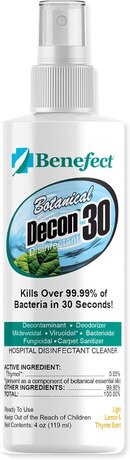
Benefect Botanical Decon 30
EPA-registered thyme-oil disinfectant. Kills mold, bacteria, and viruses on porous and non-porous surfaces, with no harsh fumes and no rinse.
Mold Scanner AI may earn a commission from purchases made through links on this page. It never changes what we recommend or the price you pay.
What Benefect Decon 30 actually is
Benefect sells Decon 30 as a botanical disinfectant cleaner. The active ingredient is thymol, a compound that comes from thyme oil, and the formula uses whole essential plant oil rather than a synthesized copy. That is the whole pitch: kill power from a plant, not from chlorine or a quaternary ammonium compound.
It is registered with the EPA as a disinfectant, which is a real bar to clear. To carry those claims a product has to prove in testing that it kills the organisms on the label. Decon 30's label covers mold and mildew along with bacteria and viruses, including common indoor molds in the Aspergillus and Candida families. An EPA registration number on a mold product means the kill claims were tested, not just printed.
The detail that matters most for mold work is surface coverage. Most disinfectants are cleared only for hard, non-porous surfaces. Decon 30's label reaches further, onto porous and semi-porous materials like wood studding, subfloor, trim, concrete, and paneling. Those are exactly the materials a leak ruins, and exactly where bleach is documented to fail because the chlorine reacts at the surface and never reaches the roots. A product labeled for porous wood is built for the job homeowners actually face.
What it does well
It performs without the fumes. This is the headline. You can spray a crawl space or a closed bathroom and not get chased out by chlorine. No harsh smell, no eyes watering, no respirator just to be in the room. For anyone who has tried to work in a small space with bleach, that difference is the entire reason to buy it.
It works on the surfaces that matter. The porous-material label is the practical edge. Framing lumber, subfloor, and bare concrete are where household mold actually grows, and they are where a non-porous-only disinfectant is the wrong tool. Decon 30 is cleared for them.
It is a real disinfectant, not just a mold spray. The same bottle is registered against bacteria and viruses, which is why it shows up on restoration jobs after water and sewage damage, not only mold jobs. One product, several decontamination uses.
No rinse, simple to apply. The manufacturer's directions do not require a rinse step on most surfaces, so the workflow is spray, let it dwell, and let it dry. That keeps it friendly for a homeowner doing a careful job.
This is why pros carry it. On a professional remediation, the heavy work is containment, removing damaged material, HEPA vacuuming, and drying. Benefect is the treatment that disinfects what remains, without filling the house with fumes. Our mold cleaning products roundup ranks it as the botanical pick alongside the other treatments.
What it does not do
It does not remove staining. Benefect kills mold. It does not bleach pigment out of a surface. After it works, a board can still look dark even though the growth is dead. That is true of every disinfectant, and it surprises people who expect the stain to vanish. If the leftover discoloration bothers you and the surface can take it, follow up with a dedicated stain remover after the mold is treated and dry. We break that step down in our RMR-86 review.
It does not replace removal. The EPA's guidance notes that dead mold can still cause allergic reactions in some people, so mold has to be removed, not only killed. Killing the colony in heavily rooted porous material does not undo the damage. For drywall colonized through the paper face, no spray rescues it: cut out the section plus a margin beyond visible growth and replace it. Our guide to mold on drywall shows where the cut lines go.
It does not fix moisture. The EPA is blunt here: clean up the mold without fixing the water problem and the mold comes back. Find the leak, the condensation, or the humidity source first, and keep indoor humidity below 50 percent. No disinfectant substitutes for that.
Size limits still apply. For mold covering more than 10 square feet, the EPA says skip the DIY and hire a qualified mold remediation professional. Look for firms that follow the IICRC S520 standard; ACAC or RIA credentials and state licenses count too.
It costs more. Botanical chemistry is not cheap. Decon 30 runs well above a bottle of bleach or a budget mildew spray. You are paying for the low odor, the porous-surface label, and the disinfectant testing. For a one-time small job it can feel like a lot. For repeated work in living space, the gentler chemistry usually earns it.
How to use it
Benefect is one of the easier mold products to use well, but the order of operations still decides whether the job holds.
Fix the water first. Before you spray anything, stop the leak or drop the humidity. Treating mold on a still-damp surface is treating a symptom.
Clean, then disinfect. Wipe heavy surface growth off with a damp cloth or a HEPA vacuum so the disinfectant reaches the material instead of sitting on a mat of spores. Bag and discard what you wipe.
Spray and let it dwell. Apply Decon 30 to the surface and let it stay wet for the dwell time on the label. The kill happens during that wet contact time, so do not wipe it off early.
Wear basic protection anyway. The spray is gentle, but the mold you are disturbing is the real hazard. Wear an N95 and gloves, open a window, and run a fan. The EPA suggests people with asthma or mold sensitivity stay out of the room during cleanup.
Let it dry, then handle stains. Once the surface is dry and the mold is dead, decide whether the leftover staining needs a cosmetic pass. That is a separate product and a separate step.
Know when to stop. If the growth is bigger than a few square feet, behind walls, or in the HVAC system, this is a job for a remediation pro. A spray does not reach mold you cannot see.
Where to use Decon 30 for mold
Decon 30 for mold works as the treatment step: you spray it on the growth, keep the surface wet for the dwell time printed on the label, and let it dry. It comes after you stop the water and wipe off the heavy growth, never before.
Benefect's label covers hard non-porous surfaces and also porous and semi-porous ones. That second part is why it gets picked as a decon 30 mold killer for framing work, since many disinfectants are cleared only for hard surfaces. Whether you type Decon 30 or decon30, it is the same Benefect Botanical Decon 30 Disinfectant this page reviews.
Where it fits
- Wood studs and subfloor are porous or semi-porous, and the label covers them.
- Concrete, trim, and paneling get the same porous-surface coverage.
- Hard non-porous surfaces are the easy case.
Where it does not fit
- Drywall with growth through the paper face. No spray fixes it. Cut out the section and replace it, as in our mold on drywall guide.
- Mold covering more than 10 square feet. The EPA says to hire a qualified remediation professional instead of doing it yourself.
- Growth in the HVAC system or behind walls. A spray does not reach mold you cannot see.
You will also see it searched as a decon mold spray. The bottle is a disinfectant cleaner, and you use it like one: clean first, spray, let it dwell, let it dry. The full order of steps is in the how to use it section above, and our page on why bleach fails on porous surfaces explains why the porous label matters.
Does Decon 30 kill mold?
Yes. Decon 30 is an EPA-registered disinfectant with mold and mildew on its label, so it kills the mold it stays wet on for the full dwell time. It does not remove the dead growth or the stain it leaves behind.
The question also comes up as does Benefect kill mold. Same answer, with one condition: the product has to actually reach the mold. Spray wiped off early, or sitting on top of a mat of spores, does not do the job. That is why the steps say to wipe heavy growth off first and let the surface stay wet for the label's dwell time.
Does Decon 30 kill mold on wood?
Yes, on the label's terms. Wood studding, subfloor, trim, and paneling are listed as porous or semi-porous surfaces it covers. The limit is depth. Killing a colony that has rooted deep into wood does not undo the damage, and badly damaged material may still need to come out.
Does Decon 30 kill black mold?
It treats dark growth the same way it treats any other mold: by wet contact. We quote its label as covering mold and mildew, and a dark colony is still mold. "Black mold" is a color people use for many kinds of growth, not one species, and a photo cannot tell you which one you have. What Decon 30 will not do is lift the dark stain, so the spot can still look black after the growth is dead.
If you are not sure what the spot is, scan a photo first. Mold Scanner checks a photo for signs of mold growth, which helps you decide whether to treat it, remove it, or call a pro.
Benefect mold killer vs mold remover
A Benefect mold killer like Decon 30 kills mold, but it does not remove it: the dead growth, the stain, and any damaged material are still there after you spray. Killing is one step, and removal is a separate job.
This is the point that trips people up when they shop for a benefect mold spray or read about using Benefect for mold. The EPA notes that dead mold can still cause allergic reactions in some people, so a job that stops at spraying is unfinished. Here is how the pieces fit together.
- Stop the water. Fix the leak or the humidity first. The EPA says mold comes back if the moisture problem stays.
- Remove the growth. Wipe heavy growth off with a damp cloth or a HEPA vacuum, and bag what you take off.
- Kill what is left. Spray Decon 30, keep the surface wet for the label's dwell time, and let it dry. This is the only step Benefect does.
- Deal with the stain. Use a separate stain remover if the leftover color bothers you. Our RMR-86 review covers that step.
- Replace what is too far gone. Drywall colonized through the paper face gets cut out, not sprayed.
So Benefect is a killer, not a remover and not a stain fix. Buy it for step 3 and plan the rest around it.
Frequently asked questions
Is Decon 30 sold at Home Depot?
We can't confirm what Home Depot has on the shelf, and stock changes by store and by week. This page links to the Amazon listing. If your search was decon 30 home depot, look up the exact name, Benefect Botanical Decon 30 Disinfectant, on the store's site and check that the label matches before you buy.
What are the Decon 30 ingredients?
The active ingredient is thymol, a compound from thyme oil, and the formula uses whole essential plant oil. It has no chlorine, no quats, and no synthetic fragrance. For the complete ingredient list, read the label on the Benefect product page linked in our sources.
Does Benefect Decon 30 actually kill mold?
Yes. Benefect Decon 30 is an EPA-registered disinfectant whose active ingredient is thymol, a compound from thyme oil. On contact it kills the mold, bacteria, and viruses it reaches, and unlike most disinfectants its label covers porous and semi-porous materials like wood studs, subfloor, and concrete. What it does not do is remove the dark staining mold leaves behind, or fix the moisture that grew it.
Is Benefect Decon 30 safe to breathe?
Is Decon 30 safe to breathe? It is built to be gentler than bleach. The formula uses thyme-oil chemistry instead of chlorine or quats, with no synthetic fragrance, and the manufacturer says it needs no rinse and no warning label when used as directed. The real hazard during cleanup is the mold itself, not the spray. Still open a window, run a fan, and wear an N95 and gloves while you disturb growth. The EPA suggests people with asthma or mold sensitivity stay out of the room during cleanup.
Does Benefect Decon 30 remove black mold stains?
No. Benefect kills mold, it does not bleach out the pigment. After it works, the surface can still look stained even though the growth is dead. That is normal for any disinfectant. If the leftover discoloration bothers you and the surface can take it, follow up with a dedicated stain remover after the mold is treated and the area is dry.
Is Benefect Decon 30 the same as bleach?
No. Bleach is sodium hypochlorite, an oxidizer that adds water and struggles on porous material. Benefect is a botanical disinfectant built on thymol from thyme oil. It carries no chlorine fumes, needs no rinse, and its label covers porous surfaces where bleach is documented to fail. It costs more per bottle, which is the trade for the gentler chemistry.
Where can you use Benefect Decon 30?
On hard non-porous surfaces and on porous and semi-porous materials including wood studding, subfloor, trim, concrete, and paneling. That porous coverage is why remediation crews keep it on the truck. It is not a substitute for removing material that mold has rooted deep into. For drywall colonized through the paper face, cut out the section and replace it rather than spraying it.
Sources
Every claim on this page traces to one of these. Links open the primary document.