What Zinsser BIN Advanced actually is
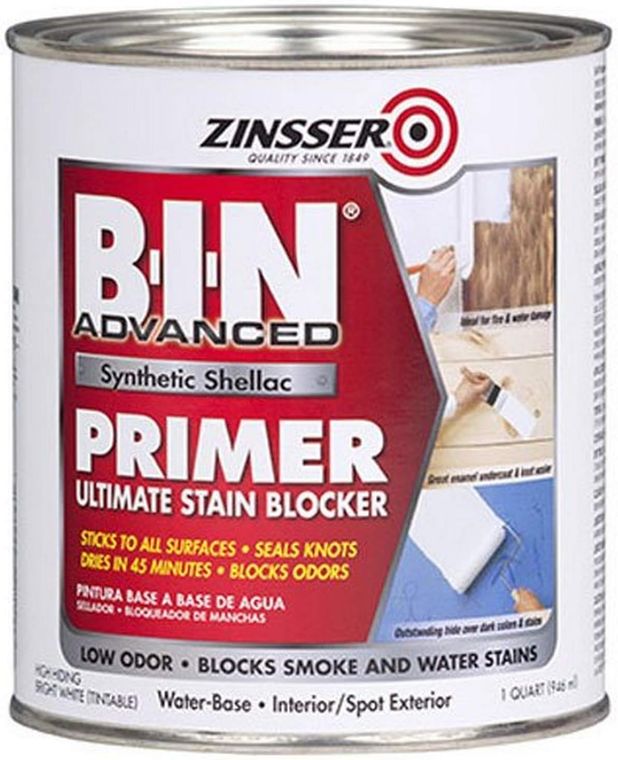
Zinsser B-I-N Advanced Synthetic Shellac Primer is a primer sealer built for one job: covering things that refuse to stay covered. Zinsser describes it as a synthetic shellac-based primer sealer that provides excellent stain blocking for whole-surface interior priming and exterior spot priming, combining fast dry time, low odor, excellent hide and stain blocking for new construction, remodeling, and fire and water restoration.
The word "shellac" is doing some marketing work there. The original Zinsser B-I-N is real shellac, and its data sheet tells you to clean up spills with acetone or denatured alcohol. B-I-N Advanced is not that product. Its physical properties list an acrylic resin with glycol ethers and water as the solvents, and cleanup is warm soap and water. "Synthetic shellac" means it aims for shellac-like stain blocking without the solvent smell.
What it blocks is specific and stated plainly: stains from water, nicotine, grease, oil, soot, rust, mildew, tannin, crayon and lipstick. It also seals odors from fire damage, smoke, cigarettes, pet urine and fireplaces. It grips dense, glossy surfaces such as enamel paints and varnishes, paneling, laminates, glass and ceramic tile without sanding or de-glossing, which is the feature that earns it a place in most painters' vans.
Note that mildew appears on that list as a stain. That single word is why this product turns up in mold searches, and it is also the source of the confusion this review exists to clear up.
The mold question, answered from the label
If you arrived here because you have mold, this is the section that matters. There are three separate things a coating can do about mold, and B-I-N Advanced does exactly one of them.
1. Kill what is there
It does not. Nothing in the B-I-N Advanced technical data sheet claims to kill mold, mildew or any fungal organism, and the sheet carries no EPA registration number. Compare that with Zinsser's own Mold Killing Primer, whose data sheet is headed with EPA Reg. No. 87469-1-69587 and states plainly that the product contains an EPA registered antimicrobial. A coating that can legally say "kills" is registered as a pesticide. B-I-N Advanced is not registered, and does not say it.
2. Stop it coming back
It does not claim this either. The Mold Killing Primer data sheet says its antimicrobial works "to prevent the growth of mold, mildew and other fungal organisms on the paint film." Zinsser Perma-White, the finish paint, contains a mildewcide for the same purpose on the film. The B-I-N Advanced sheet contains no equivalent statement anywhere. There is no mildewcide listed, and no protection claim for the dried film.
3. Hide the stain mold left behind
This it does, and does well. Mildew is on the stain list, and stain blocking is the entire point of the product. Once you have fixed the leak, cleaned the surface, and let it dry, a coat of B-I-N Advanced will stop that brown or gray shadow from ghosting through your fresh paint.
Then there is the limitation that decides most purchases. Zinsser's limitations section states that B-I-N Advanced is not recommended for full service use on exterior applications, for excessively humid interior areas, or for surfaces subject to immersion or prolonged contact with water. Read that middle clause again in the context of a mold problem. The rooms where household mold grows are, almost by definition, the humid ones. The manufacturer is telling you this is not the coating for a room with an ongoing damp problem.
None of this makes B-I-N Advanced a bad product. It makes it a finishing product. It belongs at the end of a mold job, after the moisture is fixed and the surface is clean, not at the start of one and never as a substitute for either.
Specifications at a glance
| Specification | Value |
|---|---|
| Product | Zinsser B-I-N Advanced Synthetic Shellac Primer |
| Sizes and SKUs | 271009 (1 quart), 270,976 (1 gallon), 270,978 (5 gallon pail) |
| Resin type | Acrylic |
| Solvents | Glycol ethers and water (water-based) |
| VOC | Under 100 g/L (0.83 lbs per gallon) |
| Dry to touch | 25 minutes |
| Recoat | 45 minutes |
| Stain sealing | Allow 2 hours |
| Full hardness | 7 days |
| Practical coverage | 300 to 400 sq ft per gallon |
| Application conditions | 50 to 90°F, relative humidity under 85% |
| Cleanup | Warm soap and water |
| Shelf life | 5 years |
| Antimicrobial in the dried film | None listed on the technical data sheet |
| EPA registration | None on this product |
All figures above are from the Zinsser B-I-N Advanced technical data sheet (form GDH-16). Dry times assume 70 to 80°F and 50 percent relative humidity.
Pros
- Genuinely excellent stain blocking. Water, nicotine, grease, oil, soot, rust, mildew, tannin, crayon and lipstick are all on the manufacturer's list, and one coat is usually enough.
- Water-based with soap and water cleanup. The original shellac B-I-N needs acetone or denatured alcohol. This is the version you can use without ventilating the house for a day.
- Low odor and under 100 g/L VOC. That matters for interior work, and especially for anyone priming a bedroom or a nursery ceiling.
- Very fast. Touch dry in 25 minutes, recoat in 45. You can prime and topcoat a ceiling stain in an afternoon.
- Sticks to slick surfaces with no prep sanding. Enamel, varnish, paneling, laminate, glass and ceramic tile all take it directly, which saves the messiest step of a repaint.
- Seals smoke and fire odors. Zinsser positions it for fire and water restoration work, and the odor barrier is a real, stated capability, not an implication.
- Tintable. Up to 2 ounces of universal colorant per gallon toward the topcoat color, which helps you cover in one finish coat.
- Strong buyer record. 4.6 out of 5 across 1,464 Amazon ratings, with 81 percent leaving five stars.
- Long shelf life. Five years, so a leftover quart kept for the next ceiling stain is not wasted money.
Cons and limitations
- It does not kill mold. No EPA registration, no antimicrobial claim, no mildewcide listed for the dried film. If you came here for a mold treatment, this is not one.
- It does not prevent regrowth. Unlike Zinsser's Mold Killing Primer and Perma-White, there is no protective claim for the film. Spores landing on a B-I-N Advanced surface meet ordinary primer.
- Ruled out for excessively humid interior areas. This is the manufacturer's own limitation, and it excludes a large share of the rooms people want to use it in.
- Not for full exterior service. Exterior use is spot priming only, and Zinsser says to spot prime under high hiding paints or prime the whole surface with a different product afterwards.
- Not for immersion or prolonged water contact. Shower surrounds, splash zones and anything that stays wet are outside its range.
- Mildew has to come off first. Zinsser's surface preparation list includes mildew among the contamination you must remove before priming, so this adds a step to your job rather than removing one.
- The 45 minute recoat number misleads on stains. Stain sealing needs 2 hours. People who recoat at 45 minutes over a heavy water stain and then complain about bleed-through skipped a documented instruction.
- Stain can appear in the drying film. Zinsser documents that some stain may show in the primer as it dries, and that it is locked and will not reach the topcoat. Accurate, but alarming if nobody warned you.
- Fussy application window. 50 to 90°F and under 85 percent relative humidity. A room you have just dried out after a leak can easily sit above that humidity ceiling.
- Do not intermix. Zinsser says not to box or intermix it with other oil-base or water-base products, which limits stretching a part-tin.
Who it is for
Buy it if
- You have a brown water stain on a ceiling or wall, the leak above it is fixed, and you want it gone for good under fresh paint.
- You have already cleaned a patch of surface mildew off a dry, sound surface and want the gray shadow it left to stop showing through.
- You are painting over glossy trim, varnish, tile or laminate and want adhesion without sanding the whole thing back.
- You need to seal smoke or fire odors after a restoration job.
- You want the stain blocking reputation of B-I-N without the alcohol smell and the acetone cleanup.
Skip this product if
- You want to kill the mold you can see. This primer has no EPA registration and no antimicrobial. Clean the surface first using the approach in our how to get rid of mold guide, wearing an N95 and gloves.
- You want to stop mold coming back on that wall. Wrong product. Zinsser's own Mold Killing Primer carries the antimicrobial claim, and Perma-White carries a mildewcide for the finish film. Buying B-I-N Advanced for protection buys you no protection.
- The room is still damp. Zinsser rules out excessively humid interior areas. If the bathroom fogs for an hour after a shower or the basement smells musty, fix that before you buy any coating. A dehumidifier holding the room under 50 percent humidity does more than any primer will.
- You have not found the water source. Priming over a stain fed by an active leak just gives you a fresh white surface to watch the stain return through. Find the water first.
- The surface is soft, crumbling or visibly rotted. Primer needs a sound substrate. Drywall that has gone soft or wood that crumbles needs replacing, not coating.
- It is a shower surround, a splash zone, or anything that gets wet and stays wet. The data sheet excludes immersion and prolonged water contact.
- You need a whole-house exterior primer. Exterior use here is spot priming only.
- You suspect the mold is inside the wall, under the floor, or in the ductwork. Zinsser's own guidance on the original B-I-N is to contact a professional who specializes in mold and mildew remediation for unseen areas. No primer reaches those places.
How it compares to the alternatives
B-I-N Advanced vs Zinsser Mold Killing Primer
The clearest comparison on this page, because they look similar on the shelf and do different jobs. Mold Killing Primer is registered with the EPA as a pesticide product and its data sheet states it contains an EPA registered antimicrobial to prevent growth of mold, mildew and other fungal organisms on the paint film. B-I-N Advanced has neither the registration nor the claim. If your question is "what do I paint on a wall that keeps growing mold," the answer is not this product. Our Zinsser Mold Killing Primer review covers that one in full.
B-I-N Advanced vs the original shellac B-I-N
The original is genuine shellac, cleaned up with acetone or denatured alcohol, and it carries a dedicated mold and mildew section in its technical data sheet that the Advanced version does not have. Advanced is water-based acrylic, cleans up with soap and water, and is far more pleasant to use indoors. If you want the lowest odor and easiest cleanup, take Advanced. If you are sealing the most stubborn stain you have ever met and do not care about the smell, the original still has its reputation for a reason.
B-I-N Advanced vs Zinsser Perma-White
Different layers of the same job. Perma-White is a finish paint containing a mildewcide to prevent mold and mildew growth on the paint film, which makes it the topcoat of choice for a bathroom or kitchen that runs humid. B-I-N Advanced is the primer underneath, and it is the stain blocker. They are complements, not competitors, though Perma-White is the one carrying the protective claim.
B-I-N Advanced vs cleaning the surface properly
The comparison people skip. A primer is not a cleaner. If mildew is on the surface, Zinsser's preparation instructions require you to remove it before priming, so the cleaning step happens either way. For the cleaning side, see our roundup of the best mold cleaning products, where this primer sits as the sealing step, and the master Best Mold Products hub for every category we cover.
How to use it after a mold cleanup
The instructions on the can are authoritative. This is the order that keeps the primer from taking the blame for someone else's problem:
- Step 1: Fix the water. The leak, the condensation, the humidity. Nothing below this line matters if water is still arriving. This is the whole job, and the primer is the last five percent of it.
- Step 2: Clean the surface. Remove the growth and the contamination. Zinsser requires the surface to be clean, dry, sound, and free of mildew, grime, grease, oil, wax and anything else that interferes with adhesion. Wear an N95 and gloves whenever you disturb growth, because disturbing it puts it in the air.
- Step 3: Let it dry completely. Fully dry, not surface dry. Priming a damp substrate is how adhesion failures start.
- Step 4: Remove anything unsound. Peeling or loose coating comes off, and remaining paint edges get sanded smooth. Soft drywall or crumbling wood gets replaced rather than painted.
- Step 5: Check your conditions. Between 50 and 90°F, relative humidity under 85 percent. After a water event, measure rather than assume.
- Step 6: Stir, do not thin unless you must. Mix thoroughly to redisperse settled pigment. If thinning is genuinely needed, no more than 10 ounces of water per gallon.
- Step 7: One coat, applied properly. A quality brush, a 3/8 inch nap roller, or an airless sprayer with a 0.015 to 0.017 inch tip at 1,700 to 2,200 psi. Very porous substrates may need a second coat.
- Step 8: Give stains the full 2 hours. Not 45 minutes. If some stain shows in the film as it dries, that is documented and expected, and it will not bleed into your topcoat.
- Step 9: Topcoat, and keep the room dry. The primer has no residual protection, so the thing that stops the mold returning is the moisture control you did in step 1, maintained.
Ventilate while you work. If your concern is mold inside a wall cavity, under flooring, or in a ventilation system, Zinsser's own advice on the original B-I-N is to contact a professional who specializes in mold and mildew remediation, and that is the right call here too. Look for someone who follows the ANSI/IICRC S520 standard. ACAC or RIA credentials and a state license count as well.
What buyers say
On Amazon the 1 quart 271009 holds 4.6 out of 5 across 1,464 ratings, checked July 27, 2026. The distribution is unusually top-heavy:
| Rating | Share of ratings |
|---|---|
| 5 star | 81% |
| 4 star | 9% |
| 3 star | 5% |
| 2 star | 1% |
| 1 star | 4% |
Ninety percent of buyers rate it four stars or better, which is a strong signal for a product with this many ratings. Only 5 percent land at one or two stars. That shape is what you would expect from a product that does a narrow job well: the people who bought it for stain blocking got stain blocking.
We are not quoting individual reviews here, because Amazon does not serve review text in the page source we can verify, and we would rather show you the distribution we can confirm than paraphrase reviews we cannot. The known failure modes worth watching for come from the manufacturer's own documentation rather than anecdote: recoating a heavy stain before the 2 hour stain sealing window, priming outside the temperature and humidity range, and expecting mold protection the label never promised.
Our verdict and rating
3.5 out of 5.
Judged purely as a primer, B-I-N Advanced would score higher. It is fast, low odor, water-based, grips surfaces that normally demand sanding, and blocks a stain list most primers cannot match. Buyers agree, at 4.6 stars across 1,464 ratings. There is nothing wrong with this product.
The rating reflects the job this site's readers are actually trying to do. People find this primer while searching for something to solve a mold problem, and for that purpose it is close to the wrong shelf. It has no EPA registration, no antimicrobial, and no protective claim for the dried film, and Zinsser rules it out for the excessively humid interior areas where household mold usually lives. Every one of those is the manufacturer's own position, not our interpretation. A product that gets bought for a job it never claimed to do will disappoint people, and the honest response is to say so before the money is spent rather than after.
Bottom line: buy it as the last step of a mold job, not the first. Fix the moisture, clean the surface, let it dry, then use B-I-N Advanced to make sure the stain never ghosts through your new paint. If what you actually need is a coating that kills what is there or resists what comes next, Zinsser makes different products for both, and buying one of those instead will serve you better. See how it compares in our best mold-resistant paints roundup.
Best for sealing the stain after cleanup. Affiliate link.
Find the moisture before you prime
Here is the part that decides whether this primer works for you, and it happens before the tin is opened: do you know where the water came from?
A stain is a receipt. Something was wet long enough to leave a mark, and the mark is usually smaller than the wet area that made it. Prime the mark without finding the source and you get a clean white patch that turns brown again in a season. That is the single most common way people end up believing a good primer failed them.
Mold Scanner AI provides AI-assisted visual screening for visible surfaces. It offers 266 guided photo prompts across 19 rooms, with 38 in Quick and 129 in Standard. Processing time varies, and the app does not replace physical sampling or a licensed inspection.
Find the water, fix it, clean the surface, then prime. In that order, this is an excellent product. In any other order, it is white paint over a problem.
Frequently asked questions
Does Zinsser B-I-N Advanced kill mold?
No, and it does not claim to. The B-I-N Advanced technical data sheet lists mildew among the stains it blocks, but it lists no antimicrobial or mildewcide for the dried film. Zinsser makes that claim on a different product: the Mold Killing Primer technical data sheet carries an EPA registration number and states that it contains an EPA registered antimicrobial to prevent the growth of mold, mildew and other fungal organisms on the paint film. B-I-N Advanced hides the stain mold left behind. It is not a mold treatment.
Can I paint B-I-N Advanced over mold?
You should not. Zinsser's own surface preparation instructions say the surface must be clean, dry, sound and free of dust, dirt, chalky material, grime, grease, oil, wax, mildew, wallpaper, adhesive or any contamination that may interfere with adhesion. Mildew is on that list of things to remove before you prime, not something to paint over. Sealing living growth under a coating hides it without addressing it, and the coating tends to fail because the surface underneath is not sound.
Can I use B-I-N Advanced in a bathroom or basement?
Zinsser advises against it in exactly those conditions. The limitations section of the technical data sheet says B-I-N Advanced is not recommended for full service use on exterior applications, for excessively humid interior areas, or for surfaces subject to immersion or prolonged contact with water. A bathroom that stays damp or a basement with a humidity problem is the excessively humid interior area being described. Fix the moisture first, and for a room that stays damp look at coatings built for that job.
What is the difference between B-I-N Advanced and Zinsser Mold Killing Primer?
They solve different problems. B-I-N Advanced is a stain and odor blocking primer. Mold Killing Primer is registered with the EPA as a pesticide product, EPA Reg. No. 87469-1-69587, and its technical data sheet states it contains an EPA registered antimicrobial to prevent the growth of mold, mildew and other fungal organisms on the paint film. If your problem is a brown water stain on a ceiling, B-I-N Advanced is the better tool. If you are priming a surface that keeps growing mold, the Mold Killing Primer is the product designed for it.
What is the difference between B-I-N Advanced and the original B-I-N?
The chemistry. The original B-I-N is a genuine shellac-base primer, and its technical data sheet tells you to clean spills with acetone or denatured alcohol. B-I-N Advanced is water-based, listing acrylic resin and glycol ethers with water as solvents, and it cleans up with warm soap and water. Advanced trades the solvent smell and cleanup for convenience and lower odor. The original also carries a dedicated mold and mildew section in its data sheet that B-I-N Advanced does not have.
How long does B-I-N Advanced take to dry?
It dries to the touch in 25 minutes and can be recoated in 45 minutes at 70 degrees Fahrenheit and 50 percent relative humidity. Two other numbers matter more. For knots and stain blocking, Zinsser says to allow 2 hours to dry, so the 45 minute figure is not the stain sealing figure. Full hardness takes 7 days. Cooler temperatures and higher humidity extend all of these.
Why is the stain still showing through my primer?
That can be normal, and Zinsser documents it. The technical data sheet states that when sealing water stains, some stain may appear in the primer film as it dries, and that the stain is locked and will not bleed into the topcoat. In other words, seeing color in the drying primer is not proof the primer failed. Give it the full 2 hour stain sealing window before you judge it, and if it still bothers you, a second coat is the usual answer.
How much B-I-N Advanced do I need?
Zinsser lists practical coverage at 300 to 400 square feet per gallon at the recommended dry film thickness, depending on application method and surface porosity. A quart therefore covers roughly 75 to 100 square feet, which is plenty for spot priming ceiling stains and a few patches. For a whole room, buy the gallon. Very porous substrates may absorb enough to need a second coat.
Can B-I-N Advanced be used outside?
Only for spot priming. Zinsser states it is excellent for spot priming exterior surfaces and effectively seals knots and sap streaks, but the limitations section says it is not recommended for full service use on exterior applications. Zinsser also advises that you spot prime only under high hiding paints, or prime the entire surface with a different product after spot priming. Treat it as an interior primer that can handle exterior touch-ups.
What temperature does B-I-N Advanced need?
Apply only when air, material and surface temperatures are between 50 and 90 degrees Fahrenheit and relative humidity is under 85 percent. That humidity ceiling is worth noting if you are priming after a water event, because a room that has just been dried out can easily still be above it. Zinsser also says not to box or intermix B-I-N Advanced with other oil-base or water-base products.
Sources
Every claim on this page traces to one of these. Links open the primary document.