How Zinsser Mold Killing Primer works
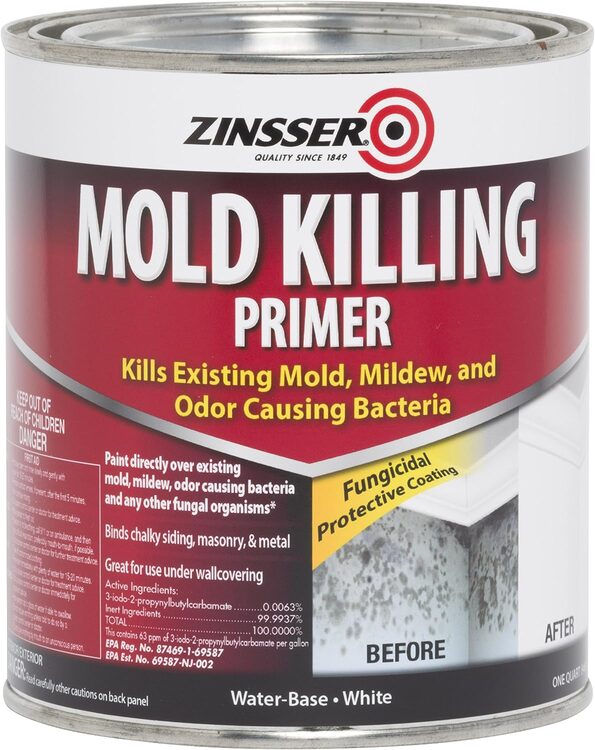
Zinsser Mold Killing Primer is not a spray-and-wipe cleaner. It is a water-based primer with a fungicide built into the film. The active ingredient is 3-iodo-2-propynylbutylcarbamate at 0.0063 percent, and the product carries an EPA registration (EPA Reg. No. 87469-1-69587). You paint it directly over existing mold, mildew, moss, fungi, and odor causing bacteria on the surface.
Two things happen at once. First, the coating goes over the surface growth as you paint. Second, the dried paint film holds an EPA-registered antimicrobial that resists new mold and mildew taking hold on the paint itself. The manufacturer also says it aides in covering residual microbiological and fungal stains, which is why people reach for it before repainting a basement wall or a bathroom ceiling.
The important limit is right on the technical data sheet: this is designed for non-porous surfaces. On porous material like soft drywall paper or bare wood, mold roots deeper than a surface coating can reach. If the growth looks like fuzzy, hairy black mold soaked into porous material, identify it first, because deeply penetrated material needs replacing, not painting.
Where to use it (and where NOT to)
Use it on: Non-porous interior and exterior surfaces in residential, commercial, and industrial settings. The manufacturer names basements, window frames, bathrooms, wall cavities, baseboards, sub-floors, and table tops. It binds chalky siding, masonry, and metal, and it is great for use under wallcovering. It works with any topcoat and is designed to pair with Zinsser Perma-White.
Do NOT use it on: Porous surfaces where mold has rooted deep, such as soft drywall paper or bare wood. Rust-Oleum does not warrant the product on porous wood. Do not use it on decks or any surface subject to immersion or prolonged water. It is also not recommended for new or unpainted aluminum, metal, or vinyl siding.
It does not replace fixing the water. The first rule of mold work is fixing the moisture source. If a pipe leaks or the basement stays damp, primer slows regrowth but it will not stop it. Fix the leak, dry the area, then prime. Keep humidity under 50 percent with a dehumidifier so it does not come back.
Not sure how serious the problem is yet? Use our free water-damage documentation helper to record accessible water-event conditions.
Step by step application
Step 1: Protect yourself. Wear an N95 mask, gloves, and goggles. Painting over mold still disturbs it, and disturbed mold releases spores. Turn off HVAC in the room so you do not spread spores through the ducts.
Step 2: Prep the surface. Make sure the surface is clean and dry. The data sheet says if mold or mildew needs to be removed before application, remove it first with an EPA-registered mildew remover and let it dry. Do not paint over a wet or greasy surface.
Step 3: Apply generously. Brush, roll, or spray a generous, uniform coat so the surface is completely covered. Coverage runs about 400 to 450 square feet per gallon depending on method and how porous or smooth the surface is. It is a thin primer, so do not stretch it.
Step 4: Let it dry and recoat. It dries to the touch in 30 minutes and can be recoated in 1 hour at 70 degrees Fahrenheit. Do not apply when the surface temperature is below 50 degrees Fahrenheit.
Step 5: Topcoat. For best protection, apply your topcoat within 72 hours. Pair it with Zinsser Perma-White or any quality paint. For heavy water stained areas, prime first, let it dry, then follow with a dedicated stain remover or stain-blocking topcoat. Full adhesion and hardness develops over 7 days.
Zinsser primer vs bleach vs Perma-White vs Concrobium
Zinsser Mold Killing Primer vs bleach: Different jobs. Bleach is a surface cleaner that adds moisture and leaves nothing behind. This primer paints over surface growth and leaves an antimicrobial film plus a paintable base. For mold work, bleach is a poor choice on porous material, and the primer is the better step when your real goal is to seal and repaint a non-porous surface.
Zinsser Mold Killing Primer vs Zinsser Perma-White: These are teammates, not rivals. Mold Killing Primer is the fungicidal base coat. Perma-White is the mold and mildew resistant finish paint that goes on top. Prime with one, topcoat with the other. Using both is the manufacturer's own recommendation.
Zinsser Mold Killing Primer vs Concrobium: Pick by goal. Concrobium Mold Control is a clear spray that crushes mold at the root as it dries and leaves no paint film, so it is best when you want to clean a surface and leave it as is. Mold Killing Primer is white and is best when the plan is to paint the surface afterward. Many people clean with Concrobium first, then prime and paint.
Zinsser Mold Killing Primer vs Zinsser B-I-N: B-I-N is a shellac-based stain and spore sealer that blocks the toughest stains and odors. Mold Killing Primer is water-based and carries the fungicidal claim. For heavy stain and odor lockdown on masonry, B-I-N wins. For a low-odor water-based fungicidal primer on non-porous surfaces, Mold Killing Primer is the easier product to live with.
For how it stacks up against every other option, see our full guide to the best mold cleaning products.
Pros and cons
Pros: EPA-registered fungicidal primer you can paint directly over existing surface mold and mildew. Water-based and low odor. Dries to the touch in 30 minutes and recoats in 1 hour. Leaves an antimicrobial film that resists new mold on the paint. Works with any topcoat and pairs with Perma-White. Covers 400 to 450 square feet per gallon. Binds chalky siding, masonry, and metal, and works under wallcovering.
Cons: It is a thin primer, not a finish, so you need a topcoat and often a second primer coat for even coverage. For non-porous surfaces only, so it will not reach mold rooted deep in porous drywall paper or bare wood, and the manufacturer does not warrant it on porous wood. Heavy water stains can bleed through and need a dedicated stain-blocking topcoat. Not for decks, immersion, or new unpainted aluminum, metal, or vinyl siding. It does not fix the moisture source.
Our rating: 4.3 / 5. Excellent for its lane, which is priming and sealing surface mold on non-porous surfaces before you repaint. Two honest caveats: it needs a topcoat, and it is not for deep porous growth.
Bottom line: If your plan is to paint the wall anyway, this is the right base coat. Clean and dry the surface, prime with Mold Killing Primer, then topcoat with Perma-White. For growth that has soaked into porous drywall or wood, cut the material out instead. For areas larger than 10 square feet or toxic species like Stachybotrys, hire a qualified mold remediation professional who follows the IICRC S520 standard. See how it compares in our best mold-resistant paints roundup.
EPA-registered · water-based · best for painting over surface mold. Affiliate link.
Skip this product if
- The mold has soaked into porous drywall paper or bare wood. A surface primer will not reach roots inside porous material. Cut it out and replace it.
- You want a one-step cleaner with no painting. This is a primer, not a spray-and-wipe. Reach for a clear mold control spray instead.
- You will not apply a topcoat. It is thin by design and needs a finish coat for durability and full stain coverage.
- The surface is a deck, gets immersed, or stays wet for long stretches. The manufacturer says do not use it there.
- It is new or unpainted aluminum, metal, or vinyl siding. Not recommended by the manufacturer.
- You have not fixed the water yet. Any coating fails if the moisture source keeps feeding the mold.
Does Zinsser kill mold?
Yes, on the surface. Zinsser Mold Killing Primer is an EPA-registered fungicidal primer you paint over existing surface mold, and the dried film resists new growth on the paint.
The active ingredient is 3-iodo-2-propynylbutylcarbamate at 0.0063 percent, and the label carries EPA Reg. No. 87469-1-69587. The label says it goes over mold, mildew, moss, fungi, and odor causing bacteria. So when people ask does zinsser kill mold, the honest answer has two parts: it works as a coating over growth on the surface, and it does not work as a deep treatment.
Where it stops working
- It is designed for non-porous surfaces. Mold rooted in soft drywall paper or bare wood is out of its reach.
- It does not fix the water. If the moisture source keeps feeding the growth, the mold comes back.
- It is a primer, so it needs a topcoat for a finished look.
What about black mold?
The label does not name a species. It says mold and mildew, not black mold or any other color. Color alone does not tell you what species you have, and a photo cannot identify one. Mold Scanner checks a photo for signs of mold growth, and that is as far as it goes.
If dark growth covers more than 10 square feet, or you suspect a toxic species like Stachybotrys, do not paint over it. Hire a qualified mold remediation professional who follows the IICRC S520 standard.
Can you use Zinsser Mold Killing Primer on drywall?
Not where the mold has soaked into the drywall. The primer is made for non-porous surfaces, so it will not reach mold rooted inside soft drywall paper.
Drywall paper is porous. Surface growth on a wall you plan to repaint is one thing. Fuzzy growth that has soaked into the paper is another, and painting over it hides the problem without removing it.
How to decide
- Fix the water first. Any coating fails if the leak or the damp is still there.
- Look at the damage. If the paper is soft, crumbling, or stained through, cut that section out and replace it.
- If the growth is only on the surface, clean and dry the wall. The data sheet says to remove mold or mildew first with an EPA-registered mildew remover and let it dry. Do not paint over a wet or greasy surface.
- Apply a generous, uniform coat, then topcoat within 72 hours.
Wear an N95 mask, gloves, and goggles, and turn off HVAC in the room. Painting over mold still disturbs it. For anything larger than 10 square feet, hire a qualified professional instead of doing it yourself.
Can you use Zinsser Mold Killing Primer on wood?
Not on bare wood. Rust-Oleum does not warrant the primer on porous wood, and it will not reach mold rooted inside it.
The manufacturer does list window frames, baseboards, and sub-floors among its uses, so wood trim is not a blanket no. The line is porosity and how deep the growth goes. Raw, unsealed wood that mold has soaked into is the case the label warns about.
What to do instead
- Fix the moisture source and let the wood dry. Keep humidity under 50 percent with a dehumidifier.
- If the growth is only on the surface, clean it with an EPA-registered mildew remover and let it dry before you prime.
- If the wood is soft, dark all the way through, or crumbling, replace it. Primer will not repair it.
- Skip decks and any wood that stays wet or gets immersed. The manufacturer says not to use it there.
Not sure what you are looking at? Upload one photo and Mold Scanner will check it for signs of mold growth before you buy a gallon.
Frequently asked questions
Can I use Zinsser Mold Killing Primer on wood?
Not on bare wood. Rust-Oleum does not warrant the primer on porous wood, and it will not reach mold rooted inside it. The manufacturer does list window frames, baseboards, and sub-floors among its uses. Do not use it on decks or wood that stays wet or gets immersed.
Can I use Zinsser Mold Killing Primer on drywall?
Not where mold has soaked into soft drywall paper. The primer is made for non-porous surfaces and will not reach mold rooted in porous drywall paper. If the growth is only on the surface, clean and dry the wall, then prime. If the paper is soft or stained through, cut that section out and replace it.
Is Zinsser Mold Killing Primer a mold killer or a mold remover?
It is a mold killing primer, not a remover. You paint it over surface mold and mildew, and the dried film resists new growth. If mold or mildew needs to be removed first, the data sheet says to use an EPA-registered mildew remover and let the surface dry before you prime. It does not clean, and it does not fix the moisture source.
Does Zinsser kill black mold?
Yes, on the surface. It is an EPA-registered fungicidal primer, and the label says it goes over mold, mildew, moss, fungi, and odor causing bacteria. Does Zinsser kill black mold? The label does not name a species, and color alone does not tell you which mold you have. Do not paint over large or suspected toxic growth. Over 10 square feet, or if you suspect Stachybotrys, hire a qualified professional who follows the IICRC S520 standard.
Does Zinsser Mold Killing Primer actually kill mold?
Yes, on the surface. The label is EPA registered (EPA Reg. No. 87469-1-69587) and the active ingredient is 3-iodo-2-propynylbutylcarbamate at 0.0063 percent. You paint it directly over existing surface mold, mildew, and odor causing bacteria, and it leaves an antimicrobial film that resists new growth on the paint. It is designed for non-porous surfaces. It will not reach mold rooted deep inside porous drywall paper or bare wood.
Where should you NOT use Zinsser Mold Killing Primer?
Do not use it on porous surfaces where mold has rooted deep, such as soft drywall paper or bare wood. Rust-Oleum does not warrant the product on porous wood. Do not use it on decks or surfaces subject to immersion or prolonged water. It is also not recommended for new or unpainted aluminum, metal, or vinyl siding. And it does not replace fixing the moisture source.
How long does Zinsser Mold Killing Primer take to dry?
It dries to the touch in 30 minutes and can be recoated in 1 hour at 70 degrees Fahrenheit. For best protection, apply your topcoat within 72 hours. Full adhesion and hardness develops over 7 days.
How much does Zinsser Mold Killing Primer cover?
Practical coverage is about 400 to 450 square feet per gallon, depending on application method and how porous or smooth the surface is. Apply it generously and uniformly so the surface is fully coated.
Is Zinsser Mold Killing Primer a paint or a primer?
It is a primer, not a finish coat. It is thin by design. For durability and full stain coverage you apply a topcoat over it. It works with any topcoat and is designed to pair with Zinsser Perma-White. If you skip the topcoat you will likely need two coats of primer for even coverage.
Does Zinsser Mold Killing Primer cover mold stains?
It helps cover residual microbiological and fungal stains, but heavy water staining often bleeds through a single coat. For heavy stains the manufacturer says to prime with Mold Killing Primer, let it dry, then follow with a dedicated stain-blocking topcoat such as Perma-White.
Sources
Every claim on this page traces to one of these. Links open the primary document.