
What is RealTime Laboratories
RealTime Laboratories is a clinical laboratory based in Texas that sells urine and environmental panels. The company states that its urine panel measures selected mycotoxins and that its laboratory is CLIA certified and CAP accredited. Those credentials address laboratory operations; they do not establish clinical validity for a mold-related diagnosis.
RealTime states that the urine panel is sold directly to consumers and can be collected at home. Direct availability does not make the result diagnostic. The panel reports compounds in urine, not conditions in a building, and cannot identify a source, prove illness or causation, or establish whether a space is safe.
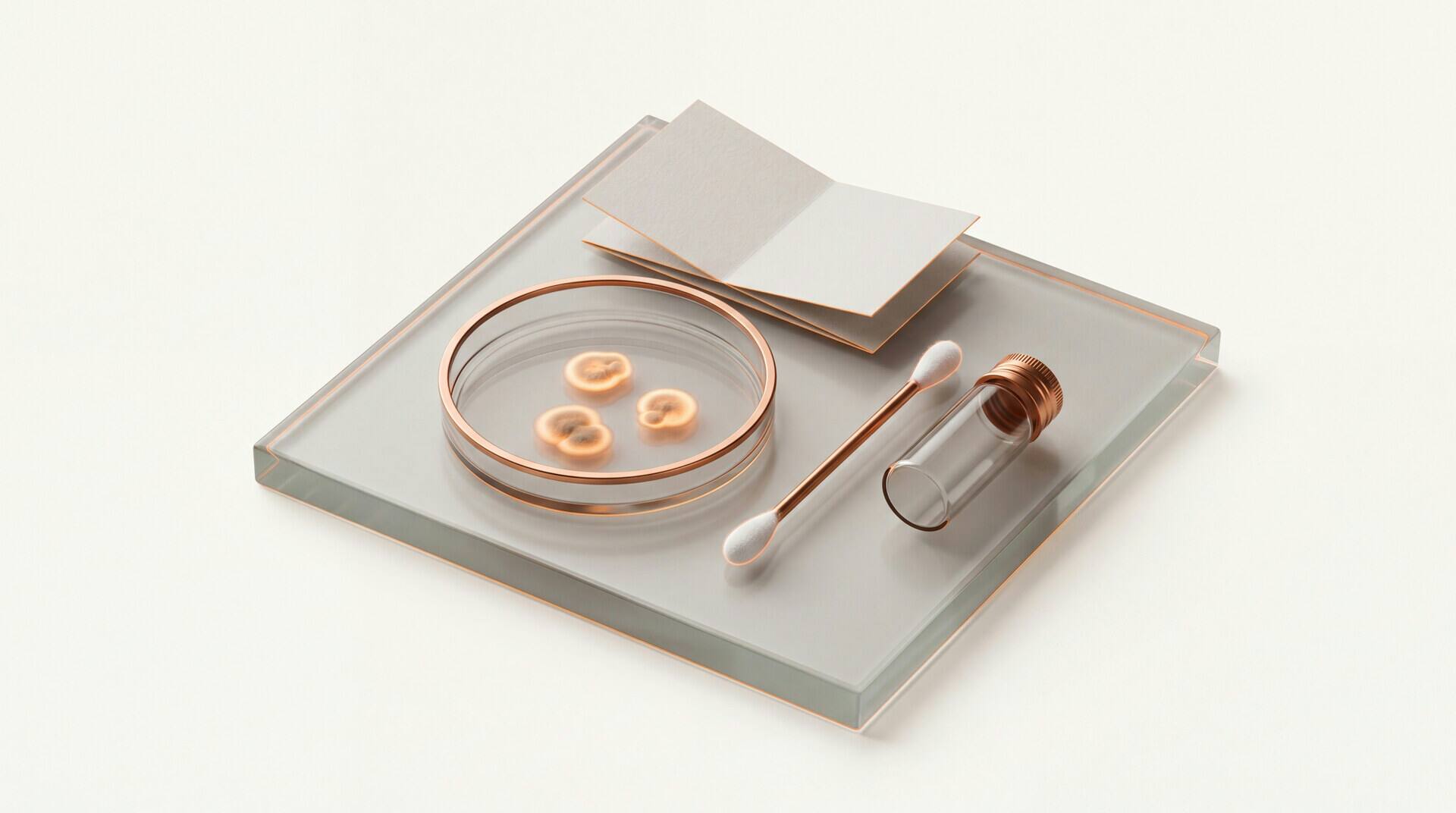
Company-described collection process

The company describes the following product process. These are collection and reporting facts, not medical guidance.
- Kit delivery. RealTime states that it ships collection materials, instructions, and a prepaid return label within the continental United States.
- Collect a urine sample at home. Use only the included kit directions. We do not recommend supplements, binders, sweating, or other attempts to alter a sample. CDC states urine mycotoxin tests are not FDA-approved for clinical use, so altered collection does not make a result diagnostic.
- Return shipping. The company directs customers to seal and return the sample with the provided materials.
- The lab runs a competitive ELISA. ELISA stands for enzyme-linked immunosorbent assay. It uses antibodies made to bind specific mycotoxins. RealTime reports this method as analytically validated for accuracy, precision, sensitivity, specificity, and reportable range under CLIA and CAP standards.
- You get a report. Results come back in roughly 7 to 10 business days. Each of the 16 mycotoxins is reported with a measured value in parts per billion (also written as nanograms per milliliter), so you see a number for each toxin rather than a simple pass or fail.
The parts-per-billion report is a laboratory measurement, not a clinical conclusion. CDC notes that mycotoxins can appear in urine from dietary exposure and that levels predicting disease have not been established. Do not use a result to infer a source, illness, or a need for a detox protocol.
What it tests for and what you get
The headline number is 16 mycotoxins, and the panel is unusually broad because it includes nine macrocyclic trichothecenes, the group linked to Stachybotrys, the mold many people call black mold. Here is the full list RealTime reports on its Mycotoxin Panel.
| Ochratoxins | Ochratoxin A |
| Aflatoxins | Aflatoxin B1, Aflatoxin B2, Aflatoxin G1, Aflatoxin G2 |
| Trichothecenes (9) | Roridin A, Roridin E, Roridin H, Roridin L-2, Verrucarin A, Verrucarin J, Satratoxin G, Satratoxin H, Isosatratoxin F |
| Gliotoxin group | Gliotoxin |
| Zearalenone | Zearalenone |
| Sample type | Urine, collected at home |
| Method | Competitive ELISA |
| Result format | A measured parts-per-billion value for each of the 16 toxins |
| Turnaround | About 7 to 10 business days |
RealTime says the product includes a collection kit, prepaid return materials, and a report listing each analyte and measured level. The company also lists broader urine and environmental products at separate prices. An environmental dust product measures a different sample, and EPA does not recommend ERMI for routine consumer use. Neither product type establishes illness, causation, source location, clearance, or safe occupancy.
Pricing and what is included
RealTime lists the core Mycotoxin Panel at about $399, while some practitioner portals list prices closer to $299. The company also lists broader and environmental panels at higher prices. Prices and terms can change.
- RealTime states that the panel is HSA and FSA eligible.
- The company says insurance or Medicare coverage may require a physician order and varies by plan.
- RealTime does not list a separate draw fee for the at-home urine kit.
- The company says prepaid return shipping is included within the continental United States.
Price and payment treatment do not establish clinical validity. A urine panel and a building investigation are not substitutes.
Laboratory operations and clinical validity

What the company reports
RealTime states that its laboratory is CLIA certified and CAP accredited and that the assay is analytically validated for defined laboratory characteristics. Those claims describe how a target compound is measured under the laboratory method. They do not establish that the result predicts disease, identifies a source, or supports a treatment or occupancy decision.
The clinical meaning is contested
CDC states that urine mycotoxin tests are not FDA-approved for clinical use and that disease-predictive levels have not been established. Mycotoxins can appear in urine after dietary exposure, including in healthy people. A result is not diagnostic. It does not establish that a building caused symptoms, identify a source, or determine what medical or environmental action is appropriate.
Collection changes do not solve the validity problem
We do not recommend altering collection conditions. A manufacturer's collection instructions describe its product process, but CDC states urine mycotoxin tests are not FDA-approved for clinical use and do not have established disease-predictive ranges.
Company-reported product facts
- RealTime states that its laboratory is CLIA certified and CAP accredited.
- The company lists 16 analytes and describes a competitive ELISA method.
- The company describes at-home urine collection and a turnaround of about 7 to 10 business days after receipt.
- RealTime states that the direct-to-consumer panel is HSA and FSA eligible; insurance and Medicare coverage may require a physician order and varies by plan.
None of these product facts establishes clinical validity. The result is not diagnostic and does not establish causation, locate mold, or establish clearance or safe occupancy.
Evidence and decision limits
- It measures your body, not your building. This is the big one. A urine panel cannot tell you whether mold is growing in your home or where. It is the wrong tool if your goal is to find a source.
- Not recognized for diagnosis. The CDC and FDA do not endorse urine mycotoxin testing as a validated diagnostic, and it is not FDA cleared for that use.
- No established disease-predictive levels. A measured number cannot be converted into a diagnosis or personal health threshold.
- Diet drives positives. A large share of healthy people test positive from food alone, so a positive does not prove a building problem.
- Hard to interpret without expertise. With no standard reference ranges, a parts-per-billion number is difficult for a layperson to act on, and two labs can produce different-looking results for the same person.
- The method is debated. RealTime uses competitive ELISA, while some competitors use mass spectrometry (LC-MS/MS) that critics consider more specific for these trace levels. No independent standard settles which is better.
- Cost adds up. At roughly $399, and often paired with practitioner visits or a separate environmental test, the total spend can climb quickly.
- No treatment or occupancy conclusion. The result does not establish a treatment need, remediation scope, clearance, or safe occupancy.
What the result cannot decide
This panel is not a suitable basis for a diagnosis, causal conclusion, treatment decision, remediation scope, clearance, or occupancy decision. It does not answer whether mold is present in a building or where a moisture source is located. Building questions require a qualified building investigation, and health concerns require evaluation under established medical guidance.
How it compares to alternatives

Versus other urine mycotoxin labs
RealTime describes competitive ELISA, while several competing laboratories describe mass-spectrometry methods. Panels, methods, and laboratory ranges differ, and no result from this testing category is recognized by CDC or FDA as a validated diagnosis of mold-related illness.
Versus DIY mold test kits
A hardware-store mold plate or a DIY mold testing kit samples a limited location or material from a building, while RealTime samples urine. Settling plates and other limited DIY samples cannot establish a complete source, remediation scope, clearance, or safe occupancy.
Versus environmental dust testing (ERMI)
An ERMI test applies a research index to mold-DNA measurements from settled dust. EPA does not recommend ERMI for routine consumer use. A urine panel and a dust index measure different samples, and neither establishes illness, causation, source location, clearance, or safe occupancy.
Versus a professional inspection
A qualified building professional can investigate building history, moisture, accessible materials, and any defined sampling question. A urine result cannot perform that work. See the limits described in our guide on how to test for mold.
Collection facts and limits
RealTime publishes collection, packaging, and return instructions with its kit. Follow only the current manufacturer directions for handling a purchased product. This review does not recommend buying the panel or modifying collection conditions. Do not treat a result as a diagnosis or use it to establish causation, a building source, treatment, clearance, or occupancy.
Evidence-based conclusion
RealTime publishes laboratory credentials, a defined analyte list, a collection process, and a reporting timeframe. Those product facts do not establish clinical validity. CDC states that urine mycotoxin tests are not FDA-approved for clinical use and that levels predicting disease have not been established. Do not use this panel as a diagnosis. It does not establish causation, a building source, treatment, clearance, or safe occupancy.
Screen visible surfaces with Mold Scanner AI
A urine panel and a building investigation answer different questions. Mold Scanner AI guides visible-surface photo capture and provides AI-assisted visual screening with variable processing time. It cannot locate hidden growth, trace a source, choose sampling sites, or determine whether a health test is warranted. Use a qualified inspector, laboratory, and clinician as appropriate. See how Mold Scanner AI works.
Real time lab comparison for urine mycotoxin testing
A real time lab comparison comes down to method, panel size, price, and turnaround: RealTime Laboratories uses competitive ELISA on a 16-analyte urine panel, listed around $399, with results in about 7 to 10 business days.
The table shows what this page can verify about RealTime and what you would need to check on each other lab's own site. Prices and terms change, so treat the numbers as a snapshot.
| Method | RealTime: competitive ELISA. Several competing laboratories describe mass spectrometry (LC-MS/MS). |
| Panel size | RealTime: 16 mycotoxins. Other labs vary by panel. |
| Price | RealTime: about $399 listed, and some practitioner portals list about $299. Check each lab's current listing. |
| Turnaround | RealTime: about 7 to 10 business days. Check each lab. |
| Credentials | RealTime states it is CLIA certified and CAP accredited. Ask any other lab for its own credentials. |
| Recognized for diagnosis | CDC and FDA do not recognize any urine mycotoxin panel as a validated diagnosis. |
The method is the most debated line. Critics consider mass spectrometry more specific for trace levels, and no independent standard settles which method is better. That is why a longer analyte list or a lower price does not make one lab's result more useful than another's.
Whichever lab you compare, the same limit applies. CDC states that urine mycotoxin tests are not FDA-approved for clinical use and that levels predicting disease have not been established. For the wider picture across urine, blood, and dust tests, see our mycotoxin testing guide, and for the dust option see the ERMI test guide.
Real-time lab oversight and what CLIA and CAP cover
Real-time lab oversight for RealTime Laboratories comes from two credentials the company states it holds, CLIA certification and CAP accreditation, and both address laboratory operations, not whether a result can diagnose illness.
These are the company's own statements, so confirm them on the official RealTime site before you rely on them. Here is how far each claim reaches.
What the credentials speak to:
- RealTime states its laboratory is CLIA certified and CAP accredited.
- RealTime states the assay is analytically validated for accuracy, precision, sensitivity, specificity, and reportable range under CLIA and CAP standards.
- RealTime states it is HIPAA compliant.
What they do not speak to:
- Whether a urine result predicts disease. CDC states that levels predicting disease have not been established.
- Whether the panel is cleared for clinical use. CDC states that urine mycotoxin tests are not FDA-approved for clinical use.
- Whether mold is growing in a building, where it is, or whether a space is safe.
In short, real-time lab oversight tells you the lab follows defined procedures when it measures a compound. It does not tell you what a measured number means for your health or your home.
Real-time mold detection and what a urine test can tell you
A urine test is not real-time mold detection: RealTime Laboratories lists results in about 7 to 10 business days, and the panel measures compounds in urine, not mold in a building.
The delay is built into the process. The company ships a kit, you collect a sample at home, you mail it back, and the lab runs the assay before a report is issued. Even a faster turnaround would not change what the panel measures, because it cannot locate mold, trace a moisture source, or show whether a space is safe.
If your question is about a room, the useful first step is looking at the room:
- Look at the visible surface where you suspect growth, and note any water damage or musty smell nearby.
- Upload a clear photo to Mold Scanner, which checks a photo for signs of mold growth on visible surfaces. Processing time varies, and it cannot locate hidden growth or trace a source.
- For sampling questions, use a qualified building professional. Our guide on how to test for mold explains which test answers which question, and the mold testing kit guide covers what home kits can and cannot show.
A urine panel and a building check answer different questions. Pick the one that matches the question you actually have.
Frequently asked questions
Is real time lab the same as RealTime Laboratories?
This page covers RealTime Laboratories, the Texas clinical laboratory that sells the urine mycotoxin panel, which is also searched as real time lab or RealTime Labs. The name belongs to the company. It is not a claim about speed, since the company lists results in about 7 to 10 business days.
Does a urine test offer real-time mold detection?
No. A urine panel is not real-time mold detection. RealTime lists results in about 7 to 10 business days, and the panel measures compounds in urine, not mold in a building. It cannot locate mold, identify a source, or show that a space is safe.
What should I compare in a real time lab comparison?
In a real time lab comparison, check the method (competitive ELISA or mass spectrometry), the number of mycotoxins on the panel, the current price, the turnaround time, and the credentials each lab states. None of those make a urine result a diagnosis, because CDC states that levels predicting disease have not been established.
What is the RealTime Laboratories mycotoxin test?
It is an at-home urine test from RealTime Laboratories, a CLIA certified and CAP accredited clinical lab in Texas. You collect a urine sample at home and mail it back. The lab screens it for 16 mold toxins using a competitive ELISA method and reports each one in parts per billion. It measures compounds in your body, not mold in your house.
How much does the RealTime Labs mycotoxin test cost?
The core Mycotoxin Panel is listed around $399 on the RealTime Labs site, and some practitioner portals offer it closer to $299. RealTime also sells broader and environmental panels at higher prices. Pricing changes, so check the current number on the official site. The test is HSA and FSA eligible.
How many mycotoxins does it test for?
Sixteen. The panel covers Ochratoxin A, four aflatoxins (B1, B2, G1, G2), nine macrocyclic trichothecenes (Roridin A, E, H and L-2, Verrucarin A and J, Satratoxin G and H, and Isosatratoxin F), Gliotoxin, and Zearalenone. The nine trichothecenes are the group associated with Stachybotrys, the mold many people call black mold.
Do you need a doctor to order the test?
RealTime states that its at-home panel is sold directly to consumers. A physician order may still be required for an insurance or Medicare claim, and coverage varies by plan. Direct availability does not establish clinical validity or make the result diagnostic.
How does collection work and how long do results take?
RealTime instructs customers to collect a urine sample at home, follow the included kit directions, and return it with the provided shipping materials. The company lists results in about 7 to 10 business days. Those product-process facts do not make the result a diagnosis.
Is urine mycotoxin testing accurate or FDA approved?
RealTime states that its assay is analytically validated and operates in a CLIA certified and CAP accredited lab. Those facts address laboratory operations, not clinical validity. CDC states that urine mycotoxin tests are not FDA-approved for clinical use, and levels that predict disease have not been established. Do not use the result as a diagnosis. It does not establish causation, a building source, or safe occupancy.
Does the test tell me if there is mold in my house?
No. A urine panel measures compounds in urine, not conditions in a building. It cannot identify a source, diagnose illness, or establish whether a space is safe. Use a qualified building investigation for building questions; EPA does not recommend ERMI for consumer home testing.
What collection guidance applies?
Use only RealTime's written kit directions. This review does not endorse altering a sample. CDC states urine mycotoxin tests are not FDA-approved for clinical use, so collection changes do not make a result diagnostic.
Is RealTime Labs CLIA certified, and is the test HSA or FSA eligible?
RealTime states that its laboratory is CLIA certified and CAP accredited, that it is HIPAA compliant, and that the panel is HSA and FSA eligible. Those administrative and laboratory-operation facts do not validate the panel as a diagnosis or establish causation, source, or safe occupancy.
RealTime Labs versus an ERMI or environmental test, which do I need?
They measure different things. A urine panel reports compounds in urine; a dust product reports material in collected dust. Neither establishes illness, a source location, clearance, or safe occupancy. EPA says ERMI is a research tool and does not recommend it for consumer home testing.
Sources
Every claim on this page traces to one of these. Links open the primary document.